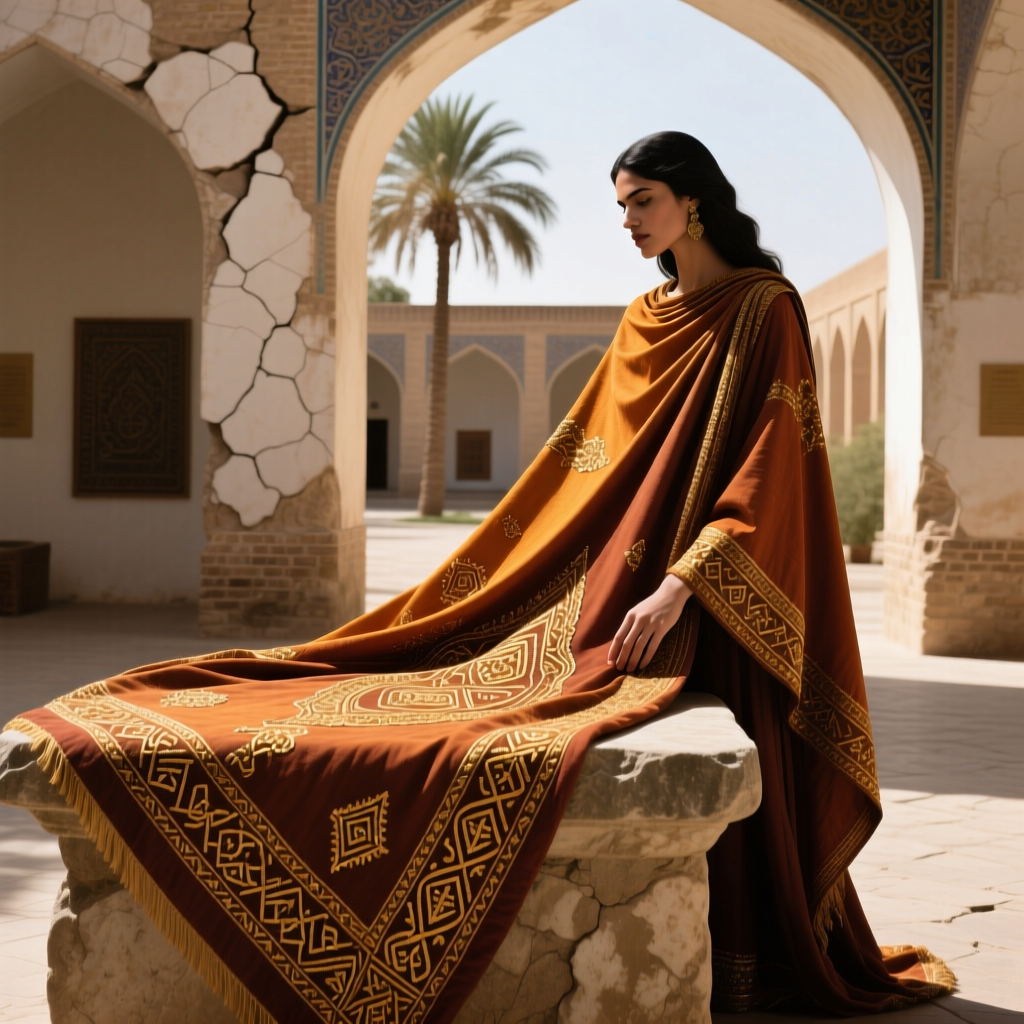
Moroccan Fez Embroidery: Fassi Textile Art

The Living Thread of Fez: Unraveling Morocco's Most Revered Embroidery Tradition
In the labyrinthine medina of Fez, where narrow alleyways twist between ancient tanneries & bustling souks, a textile tradition has flourished for centuries in quiet defiance of time. Moroccan Fez embroidery — known locally as Tarz Fassi — represents one of North Africa's most sophisticated & enduring needlework traditions, a craft whose geometric precision & symbolic depth have captivated artisans, collectors, & cultural historians alike. Unlike many textile arts that faded with industrialization, Fassi embroidery has maintained its relevance, threading together past & present through every meticulously placed stitch.
The story of Fez embroidery is inseparable from the city itself. Founded in the ninth century, Fez became the spiritual & intellectual capital of Morocco, attracting scholars, merchants, & master craftspeople from across the Islamic world & beyond. Within this crucible of cultural exchange, a distinctive embroidery style emerged — one that blended Andalusian refinement with Berber symbolism & Islamic geometric principles. The result was a textile art form of extraordinary complexity, characterized by its reversible stitchwork, its restrained yet elegant color palettes, & its deeply embedded cultural meanings.
Today, as global interest in artisanal craftsmanship & cultural heritage textiles continues to grow, Moroccan Fez embroidery stands at a fascinating crossroads. It is simultaneously a living tradition practiced by thousands of women across Morocco, a luxury craft celebrated by international fashion houses, & a cultural treasure that preservationists are working tirelessly to protect. To understand Fassi embroidery is to understand something essential about Moroccan identity — its reverence for beauty, its commitment to mastery, & its belief that the objects we surround ourselves with should carry meaning as well as function.
The Historical Roots of Fassi Embroidery: A Craft Forged in Cultural Confluence
The origins of Fez embroidery stretch back to the medieval period, when the city served as a vital crossroads of trade, scholarship, & artistic innovation. The earliest surviving examples of Fassi needlework date to the Merinid dynasty, though oral traditions & historical accounts suggest that embroidery workshops were well established in Fez centuries earlier. The craft developed within a unique cultural milieu: the city's population included descendants of Andalusian refugees who fled the Iberian Peninsula, Berber communities with their own rich textile traditions, Jewish artisans who brought distinct aesthetic sensibilities, & Arab scholars who carried the geometric & calligraphic traditions of the broader Islamic world.
This confluence of influences gave Fassi embroidery its distinctive character. From Andalusian traditions came a love of floral arabesques & refined color harmony. From Berber culture came symbolic motifs — diamonds, triangles, & stylized natural forms — that carried protective & auspicious meanings. From Islamic artistic principles came the emphasis on geometry, repetition, & the infinite patterns that suggest the boundless nature of creation. The synthesis of these elements produced an embroidery style unlike anything found elsewhere in the Mediterranean or North African region.
During the Saadian & Alaouite periods, Fez embroidery reached new heights of refinement. Royal courts commissioned elaborate embroidered textiles for ceremonial garments, palace furnishings, & diplomatic gifts. The city's embroidery guilds — organized with the same rigor as other artisanal corporations in the medina — established strict standards of quality & technique. Young embroiderers underwent years of apprenticeship, learning not merely stitch techniques but the symbolic vocabulary of patterns, the mathematics of geometric design, & the discipline required to produce work of the highest order.
The domestic sphere played an equally important role in the tradition's development. Across Fez & surrounding regions, women embroidered household textiles — cushion covers, tablecloths, bed linens, & curtains — that transformed everyday objects into works of art. These domestic embroideries were often created as part of a young woman's trousseau, with mothers & grandmothers passing down patterns, techniques, & the stories embedded within them. This domestic transmission ensured the craft's survival even when commercial workshops faced economic disruption, making Fassi embroidery a fundamentally intergenerational art form. For those interested in how domestic textile traditions shape broader fashion culture, our style guides explore the connections between heritage craft & contemporary wardrobes.
The Craftsmanship of Tarz Fassi: Techniques, Materials & the Art of the Reversible Stitch
What distinguishes Fassi embroidery from other Moroccan needlework traditions — & indeed from most embroidery worldwide — is its defining technical feature: the reversible stitch. Known as Tarz Fassi or sometimes Tarz Ghirb (counted-thread work), this technique produces identical patterns on both sides of the fabric. There are no visible knots, no tangled threads, no "wrong" side. The finished textile is equally beautiful & finished whether viewed from front or back, a quality that speaks to both practical ingenuity & a philosophical commitment to integrity in craftsmanship.
The reversible stitch is achieved through a counted-thread technique in which the embroiderer works the design by counting warp & weft threads in the base fabric. Each stitch is placed with mathematical precision, following the grid of the cloth rather than a drawn or traced pattern. This demands extraordinary spatial reasoning: the artisan must hold the entire design in her mind, calculating how each stitch relates to the larger pattern & ensuring that the thread path produces clean, identical results on both faces of the textile. Master embroiderers describe this mental process as a form of meditation, a state of focused concentration in which the pattern unfolds stitch by stitch like a slowly revealed truth.
Traditional Fassi embroidery employs a limited but carefully chosen range of materials. The base fabric is typically a fine, even-weave cotton or linen, chosen for the regularity of its thread count, which is essential for accurate counted-thread work. The embroidery thread is traditionally silk — lustrous, strong, & capable of holding vibrant color — though cotton thread has become increasingly common for everyday pieces. The silk is dyed using techniques that have themselves been refined over centuries, with the tanneries & dye workshops of Fez producing threads in a characteristic palette of deep blue, emerald green, crimson red, gold, & black.
The color choices in Fassi embroidery are never arbitrary. Deep blue — derived historically from indigo — evokes the infinite sky & spiritual depth. Green, sacred in Islamic tradition, represents paradise & renewal. Red symbolizes vitality & protection, while gold suggests divine light & prosperity. A single embroidered textile might combine these colors in specific proportions & arrangements that communicate the maker's intentions, the piece's intended use, or the social status of its owner. Understanding this chromatic language adds a rich layer of meaning to what might otherwise appear to be purely decorative work. Our guide to traditional textile dyeing explores how natural dye processes continue to shape artisanal textiles worldwide.
The motifs of Fassi embroidery form a vast & structured visual vocabulary. Geometric patterns predominate: eight-pointed stars, interlocking diamonds, zigzagging borders, & complex tessellations that recall the zellij tilework found in Moroccan architecture. Floral & vegetal motifs appear as well, though they are typically stylized into geometric forms rather than rendered naturalistically. Certain motifs carry specific meanings — the hand of Fatima for protection, the tree of life for fertility & continuity, the diamond for femininity & strength — while others serve primarily aesthetic functions, creating rhythm, balance, & visual harmony across the textile's surface.
The tools of Fassi embroidery are remarkably simple: a needle, thread, fabric, & small scissors. There is no embroidery hoop in the traditional practice, no transfer paper, no printed pattern. The entire design exists in the artisan's memory & imagination, emerging through the disciplined application of a few fundamental stitches. This simplicity of means, combined with the extraordinary complexity of the results, is one of the tradition's most remarkable features. It speaks to a cultural philosophy in which mastery is measured not by the sophistication of one's tools but by the depth of one's skill & understanding.
Cultural Significance: Embroidery as Identity, Ceremony & Social Expression
In Moroccan society, Fassi embroidery has never been merely decorative. It functions as a language of identity, a marker of social occasions, & a medium through which cultural values are expressed, transmitted, & renewed. To commission or create an embroidered textile is to participate in a system of meaning that connects the individual to family, community, & centuries of accumulated tradition.
Perhaps nowhere is this cultural significance more visible than in the context of marriage. The preparation of a bride's trousseau remains one of the primary contexts for Fassi embroidery, with families investing months or even years in creating embroidered textiles for the new household. Cushion covers, bed canopies, table linens, & ceremonial garments are all embroidered with patterns chosen for their auspicious meanings — fertility motifs, protective symbols, & designs that invoke prosperity & harmony. The trousseau serves as both a practical collection of household goods & a symbolic statement of the family's cultural knowledge, aesthetic refinement, & social standing. The quality & quantity of embroidery in a trousseau communicates volumes about the bride's upbringing & the family's values.
Ceremonial garments represent another crucial domain of Fassi embroidery. The caftan — Morocco's iconic full-length garment — is frequently adorned with Fassi embroidery, particularly for weddings, religious celebrations, & formal gatherings. An embroidered caftan is among the most treasured items in a Moroccan woman's wardrobe, often passed down through generations & worn on occasions that demand the fullest expression of cultural elegance. The embroidery on these garments is typically concentrated along the front opening, the neckline, & the cuffs, creating borders of intricate beauty that frame the wearer & draw the eye to the garment's most visible surfaces. For more on how traditional garments like the caftan fit into broader sartorial heritage, explore our Moroccan caftan heritage guide.
Religious & spiritual dimensions permeate Fassi embroidery as well. The geometric patterns that dominate the tradition are deeply connected to Islamic artistic philosophy, in which the representation of infinite, repeating patterns serves as a reminder of the infinite nature of creation. Embroidered textiles are used to adorn domestic prayer spaces, to wrap religious texts, & to furnish mosques & zaouias during important celebrations. The act of embroidery itself is often described by practitioners in spiritual terms — as a form of devotion, a discipline that cultivates patience, & a practice that connects the maker to something larger than herself.
Socially, Fassi embroidery has historically functioned as a marker of regional & class identity. Different cities & regions developed recognizable styles, & knowledgeable observers could often identify the origin of a piece based on its color palette, motif selection, & stitch density. Within Fez itself, the most refined & complex embroideries were associated with the city's aristocratic families, while simpler, bolder designs were produced in working-class neighborhoods & surrounding rural areas. These distinctions have softened considerably in the modern era, but they remain part of the tradition's rich social history & continue to inform how collectors & scholars understand surviving historical pieces.
The communal nature of embroidery practice has also made it an important vehicle for women's social bonds. Traditionally, women gathered to embroider together — in family courtyards, in neighborhood circles, & in the workshops of master embroiderers. These gatherings were spaces of conversation, storytelling, mutual support, & the informal transmission of knowledge. Older women taught younger ones not only stitching techniques but the histories & meanings of patterns, the appropriate designs for different occasions, & the ethical values embedded in careful, honest craftsmanship. In this way, Fassi embroidery has served as a thread connecting generations of women, creating continuities of knowledge & relationship that have sustained Moroccan communities through periods of profound social change.
Regional Variations: From Fez to Tetouan, Rabat & Beyond
While Fez gives its name to Morocco's most celebrated embroidery tradition, the practice of counted-thread embroidery extends across the country in a rich tapestry of regional variations. Each city & region has developed its own distinctive approach to color, motif, & composition, reflecting local histories, available materials, & the cultural influences that have shaped each community. Understanding these variations is essential to appreciating the full scope of Moroccan embroidery as a living, evolving art form.
Fez (Fassi) Embroidery remains the reference point against which all other Moroccan embroidery is measured. Fassi work is characterized by its monochromatic or limited-color palette — often a single color of silk thread on white or cream fabric — its emphasis on complex geometric patterns, & its rigorous reversible stitch technique. The designs tend toward density & intricacy, with large surfaces filled with interlocking geometric forms that create a sense of ordered abundance. Fassi embroidery favors deep blue, black, or green thread on light backgrounds, producing a striking visual contrast that emphasizes the precision of the stitchwork.
Tetouan embroidery, born in the northern city shaped by deep Andalusian roots, presents a markedly different aesthetic. Tetouan work is typically more colorful than Fassi embroidery, often employing multiple colors within a single piece & favoring warm reds, oranges, & golds alongside the more traditional blues & greens. The motifs in Tetouan embroidery show stronger Andalusian influence, with more floral & curvilinear elements woven into the geometric framework. The overall effect is softer & more lyrical than the austere precision of Fez work, reflecting Tetouan's historical identity as a city of refugees & cultural intermediaries between Morocco & the Mediterranean world.
Rabat embroidery — sometimes called Tarz Rabati — occupies a middle ground between Fassi & Tetouan styles. Rabat work is known for its elegant balance, combining the geometric rigor of Fez with a somewhat freer approach to composition & color. The city's status as Morocco's political capital has exposed its embroidery traditions to diverse influences, resulting in a style that is both refined & adaptable. Rabat embroideries often feature distinctive border treatments & a characteristic use of negative space that allows the base fabric to breathe between embroidered elements, creating a sense of lightness & openness.
Chefchaouen, the famous blue city of the Rif Mountains, produces embroidery that reflects its unique visual culture. Chefchaouen embroidery often incorporates the blue tones that dominate the city's architecture, & its motifs tend toward simpler, bolder geometric forms that read clearly at a distance. The mountain setting & relative isolation of Chefchaouen have allowed distinctive local patterns to persist, making the city's embroidery immediately recognizable to knowledgeable observers.
Meknes embroidery shares many technical features with Fassi work but tends toward slightly larger-scale motifs & a greater willingness to combine geometric & floral elements within a single composition. The imperial history of Meknes — it served as the capital under Sultan Moulay Ismail — gave its embroidery traditions a courtly inflection, with certain patterns & color combinations historically associated with the royal workshops.
Beyond these urban centers, rural embroidery traditions across Morocco incorporate Fassi techniques while adapting them to local aesthetics & needs. Berber communities in the Atlas Mountains, for example, may employ counted-thread techniques learned from Fassi tradition but apply them to heavier fabrics, use bolder colors, & combine them with distinctly Berber motifs & symbolic systems. These rural-urban exchanges have enriched Moroccan embroidery as a whole, ensuring that the tradition remains dynamic rather than frozen in a single historical moment. Our guide to Berber textile traditions explores these rural craft practices in greater depth.
Modern Preservation & the Future of Fassi Embroidery
Like many traditional crafts worldwide, Moroccan Fassi embroidery faces a complex set of challenges in the contemporary era. Changing lifestyles, the availability of inexpensive machine-made textiles, the migration of young women away from rural areas & traditional communities, & the economic pressures that make hand-embroidery difficult to sustain as a livelihood have all placed strain on the tradition's continuity. Yet the story of Fassi embroidery today is not one of simple decline — it is a story of adaptation, innovation, & determined cultural stewardship.
At the institutional level, several organizations have taken up the cause of preserving & promoting Fassi embroidery. Morocco's Ministry of Culture has recognized the tradition as an important element of national heritage, supporting documentation efforts & sponsoring exhibitions that celebrate master embroiderers. The artisanal sector, a significant component of Morocco's economy, includes numerous cooperatives & workshops dedicated to producing high-quality Fassi embroidery for both domestic & international markets. These cooperatives often provide training programs for young women, ensuring that technical knowledge passes to a new generation while creating sustainable economic opportunities.
International organizations have also recognized the importance of Moroccan embroidery traditions. UNESCO's intangible cultural heritage frameworks have drawn attention to the need to safeguard textile crafts like Fassi embroidery, not merely as museum artifacts but as living practices embedded in community life. Documentation projects — including video recordings of master artisans, pattern archives, & scholarly research — are creating records that will help future generations understand & potentially revive techniques that might otherwise be lost.
The fashion industry has emerged as an unexpected but powerful ally in Fassi embroidery's contemporary revival. Moroccan designers have increasingly incorporated traditional embroidery into modern garment designs, creating pieces that honor the craft's heritage while appealing to contemporary tastes & lifestyles. International fashion houses, too, have drawn inspiration from Fassi embroidery, collaborating with Moroccan artisans & bringing the tradition to global audiences. These collaborations must be navigated carefully — the risk of cultural appropriation & exploitation is real — but when conducted with respect & fair compensation, they can provide vital economic support for artisan communities while raising the craft's international profile. Our guide to caring for embroidered garments offers practical advice for those who collect or wear these artisanal pieces.
Perhaps most importantly, Fassi embroidery continues to thrive because it remains meaningful to the people who practice & value it. Moroccan women continue to embroider for their homes & families, to commission embroidered garments for celebrations, & to teach their daughters the patterns they learned from their own mothers. The tradition persists not because of external preservation efforts alone but because it fulfills enduring human needs — the need for beauty in daily life, the need for connection to one's ancestors & culture, & the need to create something lasting with one's own hands.
For collectors, travelers, & textile enthusiasts seeking to engage with Fassi embroidery responsibly, several principles are worth keeping in mind. Purchase directly from artisans or reputable cooperatives whenever possible, ensuring that the makers receive fair compensation for their extraordinary skill & labor. Learn to recognize the hallmarks of quality — the regularity of stitchwork, the clarity of reversible patterns, the quality of materials — so that you can distinguish genuine handwork from machine-made imitations. Take time to understand the cultural context of the pieces you acquire, the meanings embedded in their patterns, & the communities from which they originate. In doing so, you become not merely a consumer but a participant in the tradition's ongoing story.
The future of Fassi embroidery will be shaped by the interplay of preservation & innovation, tradition & adaptation. The challenge is to ensure that the craft's essential qualities — its technical excellence, its cultural depth, its spiritual resonance — endure even as the forms it takes evolve to meet new contexts & needs. If the past centuries are any guide, this is a tradition with remarkable resilience, one that has weathered empires, colonialism, modernization, & globalization while continuing to produce objects of extraordinary beauty & meaning. The thread, it seems, remains unbroken.
Frequently Asked Questions About Moroccan Fez Embroidery
What makes Fassi embroidery different from other types of Moroccan needlework?
Fassi embroidery is distinguished primarily by its reversible counted-thread technique, which produces identical patterns on both sides of the fabric with no visible knots or loose threads. This sets it apart from other Moroccan embroidery styles such as Rabat gold-thread embroidery (Tarz Errkham), which uses metallic threads & couching techniques, or the more free-form embroidery traditions of rural Berber communities. Fassi work is also characterized by its geometric precision, its reliance on the grid of the base fabric for pattern placement, & its traditionally limited color palette. The combination of technical rigor, aesthetic refinement, & deep cultural symbolism makes Fassi embroidery the most celebrated of Morocco's needlework traditions.
How long does it take to create a hand-embroidered Fassi textile?
The time required varies enormously depending on the size of the piece, the complexity of the pattern, the density of the stitchwork, & the skill level of the embroiderer. A small cushion cover with a moderately complex geometric pattern might require forty to eighty hours of work. A large tablecloth or bed canopy with dense, intricate embroidery could represent hundreds of hours of labor spread across several months. Master embroiderers working on ceremonial garments or commission pieces may spend six months to a year or more on a single textile. This investment of time & attention is precisely what gives Fassi embroidery its value — each piece represents not merely material costs but an irreplaceable expenditure of human skill, patience, & creative vision.
How can I tell if a piece of Fassi embroidery is authentic handwork?
Several indicators can help distinguish genuine hand-embroidered Fassi work from machine-made imitations. First, examine both sides of the fabric: authentic Fassi embroidery should look identical on front & back, with clean, knot-free stitchwork on both faces. Machine embroidery typically shows a different pattern or visible bobbin threads on the reverse side. Second, look closely at the regularity of the stitches: hand-embroidered pieces show slight, natural variations that indicate human work, while machine pieces are perfectly uniform. Third, check the base fabric — traditional Fassi work uses even-weave natural fibers like cotton or linen, while imitations often use synthetic blends. Finally, consider the source: purchasing from established artisan cooperatives, reputable dealers, or directly from known embroidery workshops provides the greatest assurance of authenticity.
What are the most common traditional motifs in Fassi embroidery & what do they symbolize?
Fassi embroidery employs a rich vocabulary of geometric & stylized motifs, each carrying layers of meaning. The eight-pointed star (rub el hizb) represents cosmic order & divine harmony. Interlocking diamonds symbolize femininity, fertility, & protection. Zigzag borders evoke flowing water & the life-giving power of nature. The tree of life motif represents continuity, growth, & the connection between earthly & spiritual realms. Stylized hand motifs (the khamsa or Hand of Fatima) offer protection against the evil eye. Chevron patterns suggest arrows or directional movement, symbolizing progress & purpose. Many patterns also function on a purely aesthetic level, creating visual rhythm, balance, & harmony without specific symbolic intent. A single textile typically combines multiple motifs in carefully balanced compositions that reward extended contemplation.
Where can I learn Fassi embroidery or find authentic pieces to purchase?
For those interested in learning Fassi embroidery, several avenues exist. In Morocco, artisan cooperatives in Fez, Rabat, & Tetouan sometimes offer workshops or apprenticeships for serious students. Cultural organizations & craft schools in major Moroccan cities periodically host embroidery courses. Internationally, textile arts organizations & embroidery guilds occasionally feature instructors specializing in Moroccan counted-thread techniques, & online resources — including video tutorials & pattern guides — have made the basics more accessible than ever. For purchasing authentic pieces, the best options include established artisan cooperatives (many of which now sell online), reputable textile dealers specializing in Moroccan crafts, fair-trade organizations working with Moroccan artisans, & direct purchases during visits to Morocco's medinas. Always ask about the maker, the materials, & the time invested in the piece — a genuine artisan or cooperative will be proud to share this information. Our artisan textile shopping guide provides additional tips for ethical & informed purchasing.