The Complete Guide to Traditional Japanese Clothing for Men
When exploring the vast and intricate world of global fashion, few sartorial traditions are as deeply steeped in philosophy, craftsmanship, and cultural heritage as traditional Japanese clothing. Known collectively as wafuku (literally 'Japanese clothing'), these garments stand in stark contrast to Western tailoring. Where Western menswear relies on cutting and sewing fabric to contour the male physique, traditional Japanese menswear is defined by the art of wrapping, folding, and draping straight panels of cloth. This creates a silhouette that is simultaneously structured and fluid, emphasizing the wearer's posture, grace, and the exquisite quality of the textiles themselves.
For men, wafuku encompasses a wide spectrum of garments, ranging from the ultra-formal montsuki hakama worn at weddings to the breezy, cotton jinbei enjoyed during humid summer festivals. Understanding traditional Japanese clothing for men requires looking beyond the fabric to appreciate the historical evolution, the strict rules of occasion, and the subtle aesthetics that define masculine elegance in Japan. In this comprehensive guide, we will explore the origins, key characteristics, regional variations, and enduring cultural significance of men's traditional Japanese garments.
The Origins and Evolution of Men's Wafuku
The roots of traditional Japanese clothing trace back centuries, heavily influenced by early cultural and trade exchanges with the Asian mainland. During the early historical eras, Japanese garments closely mirrored the robes and trousers of Chinese courtiers. However, as Japan began to isolate itself and develop its own distinct cultural identity, particularly during the Heian period, a uniquely Japanese aesthetic began to emerge. The straight-line construction method was perfected, allowing garments to be easily folded, stored, and layered—a practical necessity in a country with distinct, shifting seasons.
The true golden age of men's wafuku arrived during the Edo period. This era was characterized by a rigid social hierarchy and strict sumptuary laws that dictated what different classes could wear. The merchant class, though wealthy, was forbidden from wearing ostentatious silks or bright colors. This restriction birthed the sophisticated aesthetic concept of iki—an understated, subtle elegance. Men began to wear subdued, dark colors on the outside of their garments, reserving lavish, hand-painted silk linings and intricate woven patterns for the inside, a practice known as ura-masari (hidden luxury). This philosophy of restrained exterior and opulent interior remains a hallmark of high-end men's kimono to this day.
With the opening of Japan to the West during the Meiji era, the government actively encouraged the adoption of yofuku (Western clothing) to modernize the military and civil service. Consequently, wafuku transitioned from daily wear to ceremonial, leisure, and traditional arts attire. Today, while Western suits dominate the Japanese business world, traditional garments retain a revered place in cultural rites, martial arts, and seasonal celebrations.
Key Garments: Characteristics of Traditional Menswear
To truly understand what traditional Japanese clothing for men entails, one must become familiar with the foundational pieces that make up the wardrobe. For a deeper dive into the anatomy of these garments, our guide on understanding the kimono offers a detailed breakdown of the construction techniques.
The Kimono
The kimono is the cornerstone of Japanese traditional dress. Men's kimono differ significantly from women's in both cut and aesthetic. The sleeves, or sode, are shorter and attached to the body of the garment all the way down, unlike the deep, open pouches found on women's kimono. The color palette for men is traditionally grounded in nature: deep navy, charcoal, olive green, rich browns, and muted greys. Patterns are usually subtle, featuring micro-geometrics, woven textures, or faint stripes, though bolder motifs are sometimes used for casual wear or by performers in traditional theater.
The Hakama
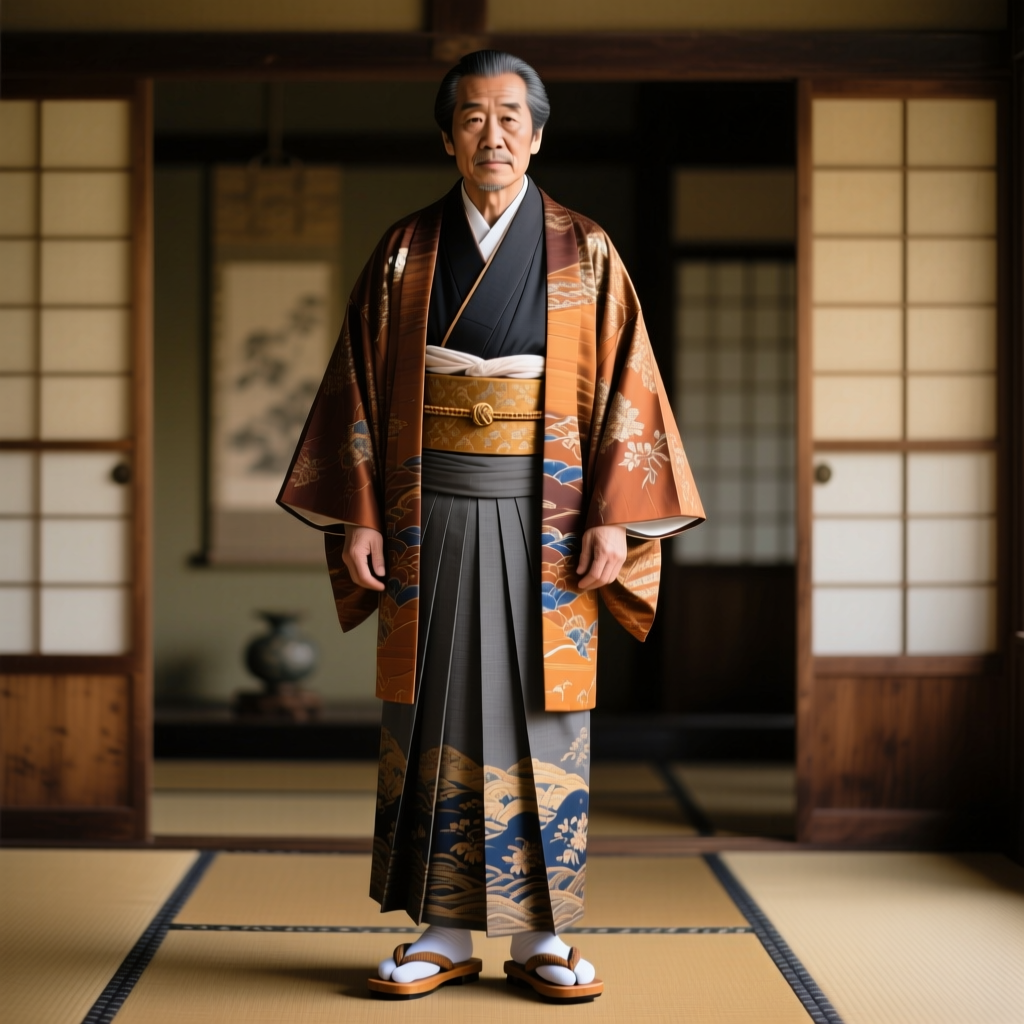
The hakama is a pleated, skirt-like trouser worn over the kimono. It features seven deep pleats (five in the front, two in the back), which are said to represent the seven virtues of the samurai. There are two main types: umanori (divided legs, resembling wide trousers) and andon (undivided, resembling a long skirt). The hakama is held in place by four long ties that are wrapped around the waist and tied in a specific knot at the back. It is an essential garment for formal ceremonies, martial arts like kendo and aikido, and university graduation ceremonies.
The Haori
The haori is a hip- or thigh-length jacket worn open over the kimono. It shares the same basic T-shape construction as the kimono but is designed to be left unfastened at the front. Instead, it is secured using haori himo—decorative, braided silk cords that tie together at the center of the chest. The haori adds a layer of formality and warmth, and its inner lining is often where men express their personal style through vibrant, artistic paintings or intricate dye work.
The Obi
No kimono is complete without the obi, the sash that secures the garment. Men's obi are notably narrower than women's, typically measuring around 10 centimeters in width. They are tied low on the hips, resting just below the navel, which provides a grounded, masculine posture. The most common and traditional knot for men is the kai-no-kuchi (clam shell knot), a flat, compact knot that sits neatly at the small of the back and does not interfere with sitting or leaning.
Yukata and Jinbei
For casual and summer wear, men turn to the yukata and jinbei. The yukata is an unlined cotton kimono, originally used as a bathrobe but now the standard attire for summer festivals and fireworks displays. To learn more about the distinctions between these summer garments, explore our comparison of yukata vs kimono. The jinbei is a two-piece set consisting of a short-sleeved wrap top and matching shorts, often featuring breathable side slits. It is the ultimate loungewear for hot, humid Japanese summers.
Dressing for the Occasion: Formal vs. Casual Wear
In the world of wafuku, context is everything. The rules governing what a man should wear are dictated by the formality of the event, the season, and the time of day. Misunderstanding these nuances can be seen as a breach of etiquette, making it crucial to understand the hierarchy of menswear.
Ultra-Formal: Montsuki Hakama
The highest level of formality for men is the montsuki hakama ensemble. This consists of a plain black silk kimono adorned with five kamon (family crests) dyed in white. The crests are placed strategically: one on the back of the neck, two on the outer sleeves, and two on the chest. This is paired with a black silk haori (also bearing five crests) and a grey or white striped silk hakama. This ensemble is strictly reserved for the most significant life events, such as a traditional Shinto wedding, severe mourning, or receiving a high imperial or state honor.
Semi-Formal: Iromuji and Tsukesage
For events like tea ceremonies, theater performances, or formal dinners, a semi-formal approach is appropriate. Men often wear an iromuji (a solid-colored kimono without woven patterns) or a subtle edo komon (a kimono featuring incredibly fine, micro-stencil dyed patterns that look solid from a distance). These garments may feature one to three kamon and are paired with a matching haori and a high-quality woven hakama or a formal obi.
Casual and Everyday Wear
When attending casual gatherings, visiting hot springs, or enjoying a weekend stroll, men opt for kimono made from wool, cotton, linen, or tsumugi (a slubbed, textured silk). These garments rarely feature family crests and allow for much more freedom in color and pattern coordination. A casual kimono is typically worn without a haori or hakama, secured simply by a woven or dyed cotton obi.
Regional Variations and Textile Traditions
Japan's diverse geography and climate have given rise to a stunning array of regional textile traditions. The fabric of a man's kimono often tells a story of its geographic origin, showcasing local resources and ancestral techniques. Our archives on Japanese textile heritage delve deeply into these regional crafts.
Kyoto: The Heart of Silk Weaving
Kyoto remains the undisputed capital of Japanese silk production. The Nishijin district is famous for Nishijin-ori, a luxurious, heavily brocaded weave. While often used for women's obi, master weavers also create breathtaking, subtle geometric patterns for men's high-end kimono and haori. Kyoto is also the home of Kyo-yuzen, a resist-dyeing technique that allows for painterly, highly detailed designs, often used for the hidden inner linings of men's jackets.
Amami Oshima: The Mastery of Mud and Silk
From the southern islands of Kagoshima comes Oshima Tsumugi, one of the most prized and expensive textiles in Japan. This fabric is created using a painstaking process involving the dyeing of silk threads with the tannin-rich bark of the teichigi tree, followed by mud-dyeing in iron-rich paddy fields. The result is a deep, rich black or brown fabric with intricate kasuri (splash) patterns. An Oshima Tsumugi kimono is lightweight, wrinkle-resistant, and considered the pinnacle of sophisticated, casual menswear.
Okinawa: Tropical Elegance
In the subtropical climate of Okinawa, traditional clothing takes on a lighter, more vibrant form. The indigenous Ryukyuan garment, known as Ryusou, features wider sleeves and lighter fabrics to accommodate the heat. Okinawa is also famous for Bingata, a vibrant stencil resist-dyeing technique featuring motifs of tropical flora, fauna, and ocean waves. Additionally, Bashofu, a rare and highly breathable textile woven from the fibers of the Japanese banana plant, is a treasured material for summer kimono.
Tohoku and Rural Traditions: Sashiko and Boro
In the harsh, snowy winters of northern Japan, textiles were too precious to discard. This necessity birthed sashiko (decorative reinforcement stitching) and boro (patchworked, mended garments). While historically the clothing of poor farmers and laborers, the indigo-dyed, heavily stitched textures of rural workwear have profoundly influenced modern Japanese fashion and are now highly sought after by collectors of vintage and heritage menswear.
The Cultural Significance and Philosophy of Menswear
Traditional Japanese clothing for men is not merely about covering the body; it is a physical manifestation of cultural philosophy, social harmony, and respect for nature. The aesthetics of men's wafuku are deeply tied to the concepts of wabi-sabi (finding beauty in imperfection and transience) and shibui (a subtle, unobtrusive beauty).
Unlike Western fashion, which often seeks to highlight the individual's physical form through tailoring, the kimono obscures the body's contours, promoting a sense of egalitarianism and humility. The wearer's character is conveyed not through the cut of the cloth, but through their posture, the grace of their movements, and the meticulous care taken in selecting seasonal motifs.
Seasonality is paramount in Japanese culture, and this is reflected in the garments. A man might wear a kimono featuring a subtle woven pattern of pine needles in the winter, switch to cherry blossom motifs in the brief weeks of spring, and opt for cooling, flowing water designs or woven hemp in the sweltering summer. Wearing a motif out of season is considered a significant faux pas, as it demonstrates a disconnect from the natural world.
Furthermore, the preservation of these garments is a multi-generational endeavor. High-quality silk kimono and haori are often passed down from father to son. The meticulous process of cleaning, re-dyeing, and re-tailoring vintage kimono ensures that the craftsmanship of ancestors continues to be worn and appreciated, bridging the gap between the past and the present.
Frequently Asked Questions
What is the difference between a men's and women's kimono?
The primary differences lie in the cut, the sleeves, and the aesthetic. Men's kimono have shorter sleeves that are almost entirely attached to the body of the garment, whereas women's kimono feature deep, open sleeve pouches. Men's garments are tailored to rest on the hips and are tied with a narrow obi low on the waist, while women's kimono are tailored to the shoulders and feature wide obi tied high on the torso. Aesthetically, men's kimono favor subdued colors, dark tones, and subtle textures, while women's kimono often feature vibrant colors, large-scale pictorial motifs, and elaborate embroidery.
Can foreigners wear traditional Japanese clothing?
Yes, absolutely. Japanese culture is generally very welcoming of foreigners who show a genuine interest and respect for their traditions. Wearing a kimono or yukata to a festival, participating in a tea ceremony, or visiting a historical site is highly encouraged. The key is to wear the garment correctly, respecting the rules of formality, ensuring the left side is always wrapped over the right (the reverse is strictly reserved for dressing the deceased), and wearing appropriate footwear. Many rental shops and cultural centers offer dressing services to ensure visitors look their best.
What footwear is worn with men's traditional garments?
Footwear is an essential component of the ensemble and changes based on formality. For formal occasions, men wear setta—leather-soled sandals with a thong, often featuring intricate woven patterns on the upper. For semi-formal or standard kimono wear, zori (flat sandals made of woven straw, vinyl, or fabric) are appropriate. When wearing a casual summer yukata, wooden geta are the standard choice. All traditional footwear is worn with tabi, the split-toe socks, except when wearing wooden geta with a yukata, where bare feet are customary.
How do you care for a silk men's kimono?
Silk kimono require specialized care to maintain their shape and color. They should never be washed in water or dry-cleaned using standard Western chemicals. Instead, they are taken to specialized traditional cleaners who use techniques like arai-hari, where the garment is entirely unstitched, washed, stretched on bamboo frames to dry, and then meticulously re-sewn. Between cleanings, the kimono should be aired out in the shade, gently brushed, and stored flat in special paper wrappers called tatou-shi inside a wooden chest to protect against humidity and pests.
Is traditional clothing still worn daily in Japan?
While Western clothing is the norm for daily life, business, and schooling, traditional clothing still maintains a vibrant presence in specific contexts. Artisans, traditional craftsmen, and practitioners of martial arts or tea ceremonies often wear wafuku as their daily work attire. Additionally, there is a growing 'kimono revival' movement among younger generations who mix vintage kimono with modern accessories, wearing them for weekend outings, cafe visits, and social gatherings, proving that these ancient garments continue to evolve and thrive in the modern era.