Traditional Japanese Clothing for Women: A Comprehensive Cultural Guide
Traditional Japanese Clothing for Women: A Comprehensive Cultural Guide
The art of dressing in traditional Japanese clothing represents one of the most refined and deeply symbolic sartorial traditions in human history. For centuries, Japanese women have adorned themselves in garments that communicate far more than mere fashion — every fold, color, pattern, and textile choice carries layers of meaning tied to seasonality, social status, age, marital status, and the specific occasion at hand. From the iconic kimono to the breezy yukata, from the formal furisode to the scholarly hakama, the wardrobe of traditional Japanese women is a living museum of cultural expression, craftsmanship, and aesthetic philosophy.
At The Garment Atlas, we believe that understanding traditional dress is essential to understanding the cultures that create them. This guide invites you on a comprehensive journey through the world of traditional Japanese clothing for women — exploring the origins, characteristics, occasions, regional variations, and enduring cultural significance of these extraordinary garments. Whether you are a student of fashion history, a traveler preparing for a visit to Japan, or simply someone captivated by the beauty of Japanese textile arts, this guide will serve as your definitive reference.
Origins & Historical Evolution of Women's Traditional Japanese Garments
The story of traditional Japanese clothing for women stretches back well over a millennium, evolving through distinct historical periods that each contributed unique elements to the sartorial vocabulary still recognized today. The earliest foundations can be traced to the Kofun period (approximately 300–538 CE), when Chinese and Korean influences introduced wrapped robes, wide sleeves, and the concept of layered dressing to the Japanese archipelago. However, it was during the subsequent eras that Japan began to develop a truly indigenous clothing identity.
The Nara & Heian Periods: Birth of a Distinct Aesthetic
During the Nara period (710–794 CE), Japanese court dress closely mirrored Tang Dynasty Chinese fashion, with women wearing layered robes known as karaginumo. But the Heian period (794–1185 CE) marked a dramatic turning point. As Japan turned inward and severed official diplomatic ties with China, a uniquely Japanese aesthetic sensibility blossomed. Court ladies developed the jūnihitoe — an astonishing ensemble of twelve or more layered silk robes, each carefully arranged so that the colors at the collar, sleeves, and hem created a harmonious seasonal palette. This practice, known as kasane no irome (layered color combinations), elevated clothing to an art form and established the principle that a woman's attire should reflect the natural world around her.
The Kamakura & Muromachi Periods: Simplification & the Rise of the Kosode
As the aristocratic Heian court gave way to the warrior-dominated Kamakura (1185–1333) and Muromachi (1336–1573) periods, practicality began to outweigh opulence. The many-layered robes were gradually reduced, and the kosode — a robe with small wrist openings that had previously been worn as an undergarment — emerged as the primary outer garment for both men and women. This shift was revolutionary: the kosode became the direct ancestor of the modern kimono, and its broad, flat surface became a canvas for increasingly sophisticated dyeing, weaving, and embroidery techniques.
The Edo Period: The Golden Age of the Kimono
The Edo period (1603–1868) witnessed the full flowering of the kimono as we recognize it today. A wealthy merchant class emerged, and despite sumptuary laws intended to restrict extravagant dress, common women found creative ways to express themselves through hidden linings, subtle dyeing techniques like yūzen, and intricately woven obi sashes. The obi itself evolved from a narrow, functional belt into a wide, elaborately tied decorative centerpiece. It was also during this period that the conventions governing which garments were appropriate for women of different ages, marital statuses, and social positions became firmly codified — conventions that, in many respects, persist to this day.
The Meiji Period & Beyond: Westernization & Cultural Preservation
The opening of Japan to the West during the Meiji period (1868–1912) brought waves of Western clothing into everyday life. Government officials and military personnel were required to adopt Western dress, and gradually, Western-style garments became the norm for daily wear among women as well. However, traditional clothing never disappeared. Instead, it became reserved for ceremonial occasions, festivals, and cultural practices — a shift that paradoxically elevated its symbolic importance. Today, traditional Japanese clothing for women exists in a dynamic space between heritage preservation and contemporary reinvention, with designers, artisans, and everyday women finding new ways to keep these garments alive and relevant.
Key Garments: Types, Characteristics & Distinguishing Features
The world of traditional Japanese women's clothing encompasses a remarkable variety of garment types, each with its own silhouette, construction methods, textile traditions, and rules of wear. Understanding these distinctions is essential to appreciating the depth of this sartorial system. Below, we explore the most significant garments in detail.
The Kimono: Foundation of the Traditional Wardrobe
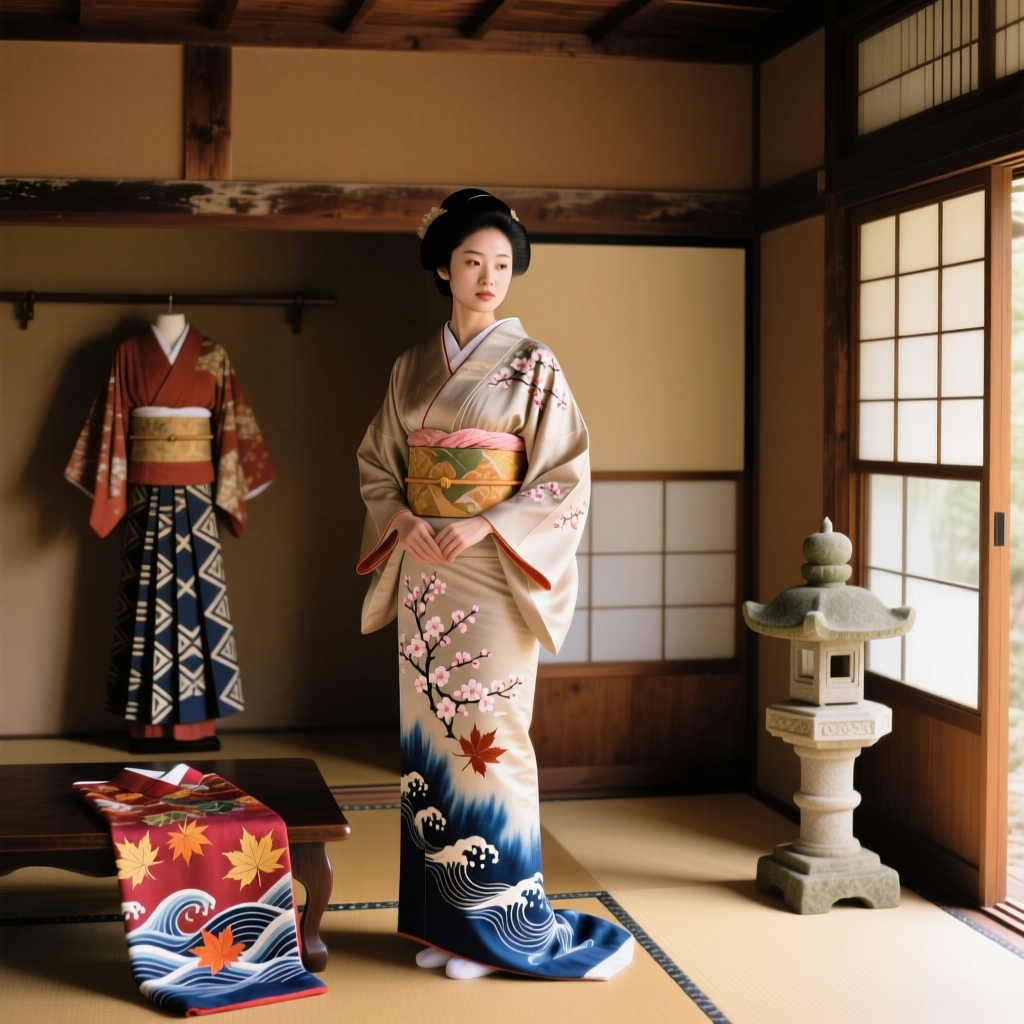
The kimono (literally "thing to wear") is the cornerstone of traditional Japanese clothing for women. Constructed from long, narrow bolts of fabric called tanmono, a kimono is cut into straight panels and sewn together with minimal waste. The resulting T-shaped robe wraps left over right (right over left is reserved exclusively for dressing the deceased) and is secured at the waist by an obi sash. Kimono are typically lined, and the choice of lining color and fabric is considered just as important as the outer material. Silk remains the most prestigious fiber for kimono, though cotton, linen, hemp, and modern synthetics are also widely used. The sleeves, body length, pattern placement, and formality level vary enormously depending on the specific type of kimono.
Furisode: The Unmarried Woman's Formal Statement
The furisode ("swinging sleeves") is the most formal kimono worn by unmarried women. Its defining feature is its extraordinarily long, flowing sleeves — typically measuring between 85 and 114 centimeters in length. These dramatic sleeves historically served a romantic function: young women would swing them to signal interest in a suitor or, conversely, wave them side to side to express refusal. Furisode are lavishly decorated across the entire surface with elaborate dyeing and embroidery, often featuring auspicious motifs such as cranes, pine trees, cherry blossoms, and flowing water. They are worn at coming-of-age ceremonies (seijin-shiki), weddings (by unmarried female relatives of the bride or groom), and other highly formal occasions.
Tomesode: Married Women's Formal Wear
The tomesode is the most formal kimono for married women. Its name translates to "fastened sleeves," referencing the shorter, more practical sleeve length that distinguishes it from the furisode. There are two main categories: kurotomesode (black tomesode), which features family crests (mon) and patterns only below the waistline, worn by the mothers of the bride and groom at weddings; and irotomesode (colored tomesode), which may be worn by married women at a broader range of formal events. The restraint and elegance of the tomesode embody the Japanese aesthetic principle of shibui — understated, refined beauty.
Hōmongi & Tsukesage: Semi-Formal Elegance
The hōmongi ("visiting wear") is a semi-formal kimono suitable for both married and unmarried women. Its distinguishing characteristic is a continuous pattern that flows across the seams — from the back panel to the sleeves and across the front — creating a unified pictorial composition when the garment is laid flat. Hōmongi are appropriate for tea ceremonies, formal parties, and wedding receptions attended as a guest. The tsukesage is similar in formality but features patterns that are confined within individual panels rather than flowing across seams, making it slightly less formal and often more affordable. Both garments represent versatile choices in a woman's kimono wardrobe and are explored further in our guide to kimono types.
Komon & Tsumugi: Everyday & Casual Kimono
For everyday wear, women traditionally turn to the komon ("fine pattern") kimono, which features small, repeating patterns across the entire surface. Komon are considered casual and can be worn for shopping, casual dining, or informal gatherings. Tsumugi refers to kimono made from pongee silk — a slubbed, textured fabric woven from silk noil. Despite being made of silk, tsumugi are classified as casual wear due to their rustic aesthetic, which celebrates the beauty of imperfection in the spirit of wabi-sabi. These garments pair beautifully with simpler, more relaxed obi styles.
Yukata: Summer Cotton Comfort
The yukata is perhaps the most accessible and widely recognized form of traditional Japanese clothing for women today. Originally worn as a bathrobe by the aristocracy during the Heian period, the yukata evolved into a casual summer garment worn by people of all social classes. Made from lightweight, unlined cotton or cotton-blend fabric, yukata feature bold, often playful patterns — from traditional indigo-and-white geometries to modern florals and pop-culture motifs. They are worn at summer festivals (matsuri), fireworks displays, and hot spring resorts, typically paired with a simple hanhaba obi (half-width sash) and geta wooden clogs. For a deeper look at this beloved garment, see our dedicated yukata style guide.
Hakama: Pleated Trousers with Scholarly Roots
The hakama is a pleated, skirt-like garment worn over a kimono. While historically associated with samurai and male courtiers, hakama have been worn by women in specific contexts for centuries. During the Meiji and Taishō periods, hakama became the standard attire for female students — a tradition that endures today, with many women wearing hakama at university graduation ceremonies. Shrine maidens (miko) also wear a distinctive red hakama as part of their ceremonial dress. Women's hakama are typically tied high, just below the bust, creating an elegant, elongated silhouette that differs markedly from the lower-waisted men's style. The combination of a kimono with hakama represents a fascinating intersection of gender, education, and tradition in Japanese culture, a theme we explore in our Japanese textile traditions section.
Haori & Michiyuki: Outerwear & Layering Pieces
Traditional Japanese women's wardrobes also include a range of outerwear. The haori is a hip- or thigh-length jacket worn open over a kimono, often featuring a beautifully decorated lining that is revealed when the wearer moves. Haori can range from highly formal (with family crests and luxurious fabrics) to casual and modern. The michiyuki is a three-quarter-length coat with a distinctive square neckline, designed as a practical yet elegant outer layer for traveling. Both garments demonstrate the Japanese approach to layering — a principle inherited from the Heian period that treats each visible layer as an opportunity for aesthetic expression.
Occasions, Seasons & the Rules of Wear
One of the most remarkable aspects of traditional Japanese clothing for women is the precision with which specific garments are matched to occasions, seasons, and life events. This system of rules — sometimes called kitsuke (the art of dressing) — transforms getting dressed into a form of cultural literacy, where the wearer demonstrates her understanding of social context, seasonal awareness, and aesthetic harmony.
Seasonal Sensitivity: Dressing in Harmony with Nature
Seasonality is perhaps the single most important principle governing traditional Japanese dress. Women are expected to wear garments that reflect the current season not only in weight and fabric but also in color, pattern, and motif. In spring, cherry blossoms, wisteria, and soft pinks and greens dominate. Summer calls for cool-toned fabrics, water motifs, morning glories, and fireworks patterns. Autumn brings maple leaves, chrysanthemums, and warm earth tones, while winter features pine, bamboo, plum blossoms, and snowflake designs. Remarkably, the rule is often to wear a seasonal motif just before that season reaches its peak — wearing cherry blossoms as the buds begin to swell, for instance, rather than waiting until full bloom. This practice reflects the Japanese aesthetic concept of iki — a sophisticated anticipation of beauty rather than a literal representation of it.
Life-Cycle Ceremonies & Milestone Events
Traditional Japanese clothing plays a central role in the major milestones of a woman's life. At the Shichi-Go-San (Seven-Five-Three) festival, young girls aged three and seven are dressed in miniature kimono to visit shrines and pray for health and longevity. The Seijin-shiki (Coming of Age Day) sees twenty-year-old women donning spectacular furisode to mark their entry into adulthood. At weddings, the bride may wear a pure white shiromuku kimono for the ceremony and change into a vibrant iro-uchikake (colored wedding robe) for the reception, while female guests carefully select tomesode or hōmongi appropriate to their relationship with the couple. For funerals, women wear plain black kimono with black obi and subdued accessories, observing strict conventions of mourning dress.
Cultural Practices & Artistic Pursuits
Certain traditional arts and cultural practices in Japan maintain strong associations with specific garments. The tea ceremony (chadō or sencha-dō) calls for understated, refined kimono — typically tsukesage or komon — in colors and patterns that complement the season and the aesthetic of the tea room. Practitioners of ikebana (flower arranging), calligraphy, and traditional dance likewise observe dress conventions appropriate to their discipline. These associations ensure that traditional clothing remains a living practice rather than a museum artifact, continually renewed through the bodies and movements of women engaged in cultural activities.
Regional Variations & Local Textile Traditions
Japan's diverse geography and history have given rise to a rich tapestry of regional textile traditions, each contributing distinctive techniques, materials, and aesthetics to the world of women's traditional clothing. These local variations reflect the interplay between climate, available resources, cultural identity, and historical circumstance.
Kyoto: The Heart of Kimono Culture
No discussion of traditional Japanese clothing is complete without acknowledging Kyoto, the imperial capital for over a millennium and the undisputed heart of kimono culture. Kyoto is home to Nishijin-ori, one of the most prestigious woven textile traditions in Japan, producing sumptuous brocades and damasks used for obi and formal kimono. The city is also closely associated with Kyō-yūzen, a resist-dyeing technique that allows artisans to paint intricate, multi-colored designs directly onto silk — the technique responsible for many of the most breathtaking kimono patterns ever created. Walking through Kyoto's Gion district, one can still encounter maiko (apprentice geisha) dressed in elaborate, long-sleeved kimono with trailing obi, preserving a style of dress that has largely vanished elsewhere.
Okinawa: The Ryūkyū Textile Heritage
The southern island chain of Okinawa, once the independent Ryūkyū Kingdom, possesses textile traditions that differ markedly from those of mainland Japan. Bingata, a vibrant stencil-dyeing technique using bold reds, yellows, and blues, produces fabrics bursting with tropical motifs — hibiscus flowers, banana leaves, and ocean waves. Bashōfu, woven from the fibers of the Japanese fiber banana plant, creates a lightweight, breathable fabric ideally suited to Okinawa's subtropical climate. These textiles represent a distinct sartorial heritage that reflects the Ryūkyū Islands' unique position at the crossroads of Japanese, Chinese, and Southeast Asian cultural influences. Learn more about island textile traditions in our cultural heritage section.
Tōhoku & Northern Japan: Warmth, Resilience & Folk Textiles
In the cold, snow-heavy regions of northern Honshu (Tōhoku), traditional clothing reflects the demands of harsh winters and rural life. Kogin-zashi, a form of decorative sashiko stitching originating in Aomori Prefecture, was developed by farmwomen who reinforced and insulated their hemp work garments with dense geometric embroidery in white cotton thread. The resulting patterns — strikingly modern in their geometric abstraction — transformed functional necessity into folk art. Similarly, Ōtsugijō and other locally woven textiles from the region tend toward heavier, more durable fabrics in muted, earthy tones, reflecting both the landscape and the resourceful spirit of the women who made them.
Kaga Yūzen & Regional Dyeing Traditions
Beyond Kyoto, other regions have developed their own distinguished dyeing traditions. Kaga yūzen, from the Kanazawa area of Ishikawa Prefecture, is characterized by realistic, nature-inspired designs rendered in a distinctive palette of five colors known as Kaga gosai (indigo, ochre, green, purple, and deep red). Unlike the bold, graphic patterns of Kyō-yūzen, Kaga yūzen favors subtle gradations and naturalistic shading, often depicting flowers, birds, and landscapes with painterly delicacy. Other notable regional traditions include Edo komon from Tokyo — ultra-fine stencil-dyed patterns so small they appear solid from a distance — and Arimatsu shibori from Aichi Prefecture, a masterful tie-dyeing tradition producing intricate three-dimensional textures on cotton and silk.
Cultural Significance & Modern Relevance
Traditional Japanese clothing for women is far more than a collection of beautiful garments. It is a complex cultural system that encodes values, relationships, seasonal awareness, artistic sensibility, and social identity into the very fabric of daily life. Understanding its significance requires looking beyond aesthetics to the philosophical and social dimensions that give these garments their enduring power.
The Kimono as Cultural Identity & Social Communication
In Japanese society, what a woman wears communicates volumes about who she is, where she is going, and how she wishes to be perceived. The choice between a furisode and a tomesode instantly signals marital status. The presence or absence of family crests indicates the formality of the occasion. The colors and motifs convey seasonal awareness and aesthetic refinement. In this way, traditional clothing functions as a sophisticated language of social communication — one that requires both speaker (the wearer) and audience (those around her) to be fluent in its grammar. This communicative function helps explain why the rules of kitsuke are taken so seriously: a misstep is not merely a fashion error but a failure of cultural literacy.
Craftsmanship, Artistry & the Living National Treasures
The creation of traditional Japanese clothing involves an extraordinary range of specialized crafts — silk weaving, resist dyeing, hand painting, embroidery, gold leaf application, obi weaving, and more. Many of these techniques require decades of training to master, and Japan's system of Living National Treasures (Ningen Kokuhō) formally recognizes and supports master artisans who preserve these skills at the highest level. The survival of traditional Japanese clothing is therefore inseparable from the survival of these craft traditions. When a woman chooses to wear a hand-painted yūzen kimono or a hand-woven Nishijin obi, she is not only dressing herself but sustaining an entire ecosystem of artistic knowledge passed down through generations. Our textile craft techniques guide explores many of these artisanal processes in detail.
Sustainability, Slow Fashion & the Circular Wardrobe
In an era increasingly concerned with the environmental and ethical costs of fast fashion, traditional Japanese clothing offers a compelling alternative model. Kimono are inherently sustainable garments: they are constructed from straight cuts that produce minimal fabric waste, they can be taken apart and re-sewn to fit different body sizes, and high-quality silk kimono are routinely passed down through generations. The thriving market for vintage and recycled kimono — available in shops across Japan and online — demonstrates that these garments have remarkably long lifespans. Moreover, the seasonal rotation of garments encourages a smaller, more intentional wardrobe rather than constant consumption. These qualities have attracted growing interest from the global slow fashion movement, which sees in the kimono system a blueprint for more thoughtful, sustainable dress.
Contemporary Revival & Global Influence
While Western clothing dominates everyday life in modern Japan, traditional garments continue to hold a cherished place in the national consciousness — and are experiencing a notable revival among younger generations. Rental kimono services have made it affordable and convenient for young women to wear kimono for special outings, while social media has created new communities of kimono enthusiasts who share styling tips, vintage finds, and modern interpretations. On the global stage, the kimono has profoundly influenced Western fashion designers from Madeleine Vionnet to Rei Kawakubo, and its principles of flat construction, wrapping, and layering continue to inspire contemporary design. The ongoing dialogue between Japanese traditional dress and global fashion ensures that these garments remain dynamic, evolving, and deeply relevant — a testament to the enduring power of cultural heritage when it is lived, worn, and loved. Explore more about how traditional garments influence modern style in our comprehensive guides collection.
Frequently Asked Questions
What is the difference between a kimono and a yukata?
The primary differences between a kimono and a yukata lie in formality, fabric, and construction. A kimono is a broader term encompassing all traditional Japanese robes and can be made from silk, cotton, linen, or synthetic fibers. Formal kimono are typically lined, feature elaborate dyeing or weaving, and are worn with multiple accessories including specialized undergarments (nagajuban), tabi socks, and zōri sandals. A yukata, by contrast, is a specific type of casual, unlined cotton kimono originally associated with bathing and summer festivals. Yukata are simpler to put on, require fewer accessories, and are generally far more affordable. While kimono can be appropriate for the most formal occasions in Japanese society, yukata are strictly casual and are most commonly seen at summer events, hot spring resorts, and informal gatherings.
How do you choose the right kimono for your age and marital status?
Traditional conventions link specific kimono types to a woman's age and marital status. Unmarried young women typically wear furisode — kimono with very long, swinging sleeves — for formal occasions, signaling their eligibility and youth. Upon marriage, women transition to tomesode (shorter-sleeved formal kimono), with kurotomesode (black) reserved for the most formal events like attending a child's wedding. Hōmongi and tsukesage are versatile semi-formal options appropriate for women of any age or marital status. In contemporary practice, these rules are observed more flexibly than in the past, but they remain an important framework for formal occasions, particularly weddings and ceremonies. The color palette also shifts with age: younger women tend toward brighter, bolder colors and larger patterns, while older women gravitate toward more subdued tones and smaller, more refined motifs.
What accessories are worn with traditional Japanese women's clothing?
A complete traditional Japanese outfit involves numerous carefully coordinated accessories. The obi (sash) is the most prominent, with styles ranging from the casual hanhaba obi (half-width) to the formal fukuro obi (pouch obi) and maru obi (fully patterned obi). Obi are tied in a variety of decorative knots (musubi), each suited to different garment types and occasions. Beneath the outer kimono, women wear a nagajuban (full-length under-kimono) with a detachable han-eri (half-collar) that peeks out at the neckline. Obi-age (a silk cloth wrapped above the obi) and obi-jime (a decorative cord tied over the obi) add further layers of color and texture. Footwear consists of tabi (split-toe socks) paired with either zōri (flat sandals for formal wear) or geta (wooden clogs for casual wear). Additional accessories include kanzashi (ornamental hairpins), fans, and small pouches or purses designed to complement the ensemble.
Is it appropriate for non-Japanese women to wear traditional Japanese clothing?
Generally speaking, wearing traditional Japanese clothing as a non-Japanese person is widely accepted and even encouraged within Japanese culture — provided it is done respectfully and with genuine appreciation. In Japan, kimono rental shops actively welcome international visitors, and many Japanese people feel pleased and proud to see foreigners taking an interest in their cultural heritage. The key considerations are respect and context: wear the garment correctly (left side over right, appropriate obi tying, suitable footwear), choose styles appropriate to the occasion, and avoid treating sacred or highly ceremonial garments as costumes. It is also important to understand the cultural significance of what you are wearing rather than treating it as mere exotic decoration. When approached with sincerity and care, wearing traditional Japanese clothing can be a meaningful act of cross-cultural appreciation and a beautiful way to participate in Japanese traditions.
Where can you buy or rent traditional Japanese clothing today?
Traditional Japanese clothing can be acquired through a variety of channels, both in Japan and internationally. In Japan, department stores in major cities maintain dedicated kimono floors where new, high-quality garments and accessories can be purchased with professional fitting advice. Specialist kimono shops (gofukuya) offer bespoke services and expert guidance. For more affordable options, Japan has a thriving network of recycle shops (vintage kimono stores) where pre-owned garments in excellent condition can be found for a fraction of their original price — a wonderful option for those interested in sustainable fashion. Rental shops are abundant in tourist areas like Kyoto, Asakusa (Tokyo), and Kanazawa, offering complete outfits with professional dressing services for a day. Internationally, online retailers, auction sites, and specialty importers offer both new and vintage kimono and yukata. For those outside Japan, attending a Japanese cultural festival or visiting a Japanese garden often provides opportunities to experience wearing traditional garments with the help of knowledgeable volunteers. Our cultural heritage hub features additional resources on sourcing and caring for traditional garments from around the world.