Traditional Irish Clothing Before Colonization: A Comprehensive Guide to Gaelic Dress
Long before the arrival of English colonizers & the subsequent imposition of Tudor sumptuary laws, the island of Ireland was home to a vibrant, deeply structured Gaelic society. In this era, clothing was far more than a mere necessity for survival against the damp, windswept Atlantic climate. It was a complex visual language, a marker of social standing, & a profound expression of cultural identity. Traditional Irish clothing before colonization reflects a society deeply connected to its natural environment, its mythological roots, & its intricate legal frameworks.
To understand the garments of early Gaelic Ireland, we must look past the modern, often romanticized stereotypes of Celtic dress. The reality of pre-colonial Irish fashion is a fascinating tapestry of masterful weaving, sophisticated natural dyeing, & practical design tailored to a rugged landscape. From the flowing linen léine to the heavy, fringed wool brat, the attire of the ancient Irish was both highly functional & deeply symbolic. This comprehensive guide explores the origins, characteristics, & enduring legacy of traditional Irish clothing before the profound disruptions of colonization.
The Origins & Evolution of Early Gaelic Dress
The roots of traditional Irish clothing stretch back to the early Celtic migrations & the La Tène cultural influences that swept across Europe during the Iron Age. However, the Irish adapted these continental styles to suit their unique island environment. Unlike the Mediterranean civilizations that favored light, draped fabrics, the early inhabitants of Ireland required garments that provided insulation, water resistance, & mobility across boggy, uneven terrain.
Archaeological evidence, though somewhat limited due to the acidic nature of Irish peat bogs which often degrade organic materials, provides crucial glimpses into this ancient wardrobe. Discoveries such as the remarkably preserved garments found in bog contexts reveal a society that had already mastered the arts of spinning, weaving, & tailoring long before the arrival of the Normans in the twelfth century. These early garments show a clear evolution from simple animal hides to sophisticated, woven textiles that utilized both wool & flax.
The Gaelic society was organized into the tuath (tribe or territory), led by a rí (king) & governed by the complex Brehon Laws. These laws dictated nearly every aspect of daily life, including the production & wearing of clothing. The origins of Irish dress are therefore inextricably linked to the agrarian rhythms of the tuath, where the rearing of sheep for wool & the cultivation of flax for linen were foundational economic activities. For a deeper dive into the broader context of these materials, our guide on ancient Celtic textiles offers further historical insights.
Core Characteristics of Pre-Colonial Irish Garments
The wardrobe of the pre-colonial Irish was built upon a few foundational garments that were layered, belted, & fastened to suit the weather & the wearer's occupation. Both men & women shared similar base garments, though the styling, length, & accessories varied significantly.
The Léine: The Foundational Tunic
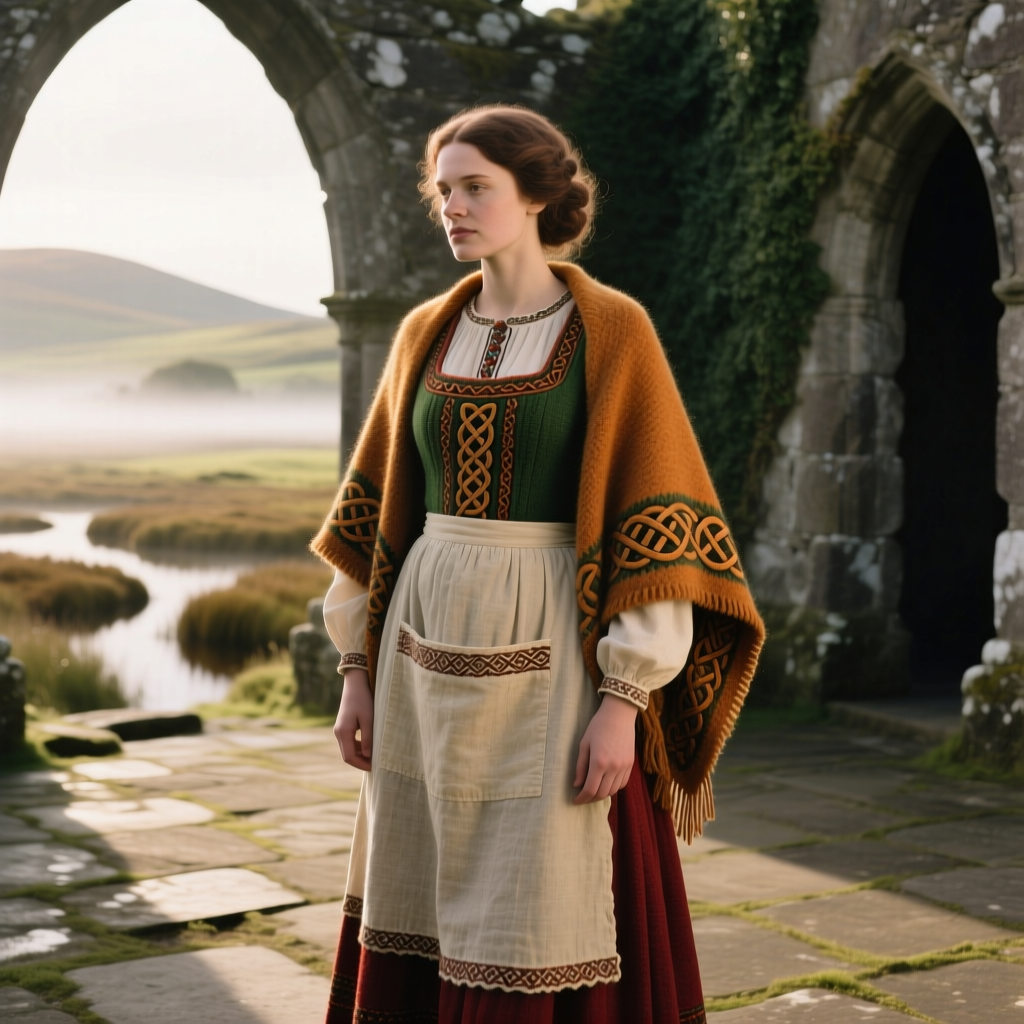
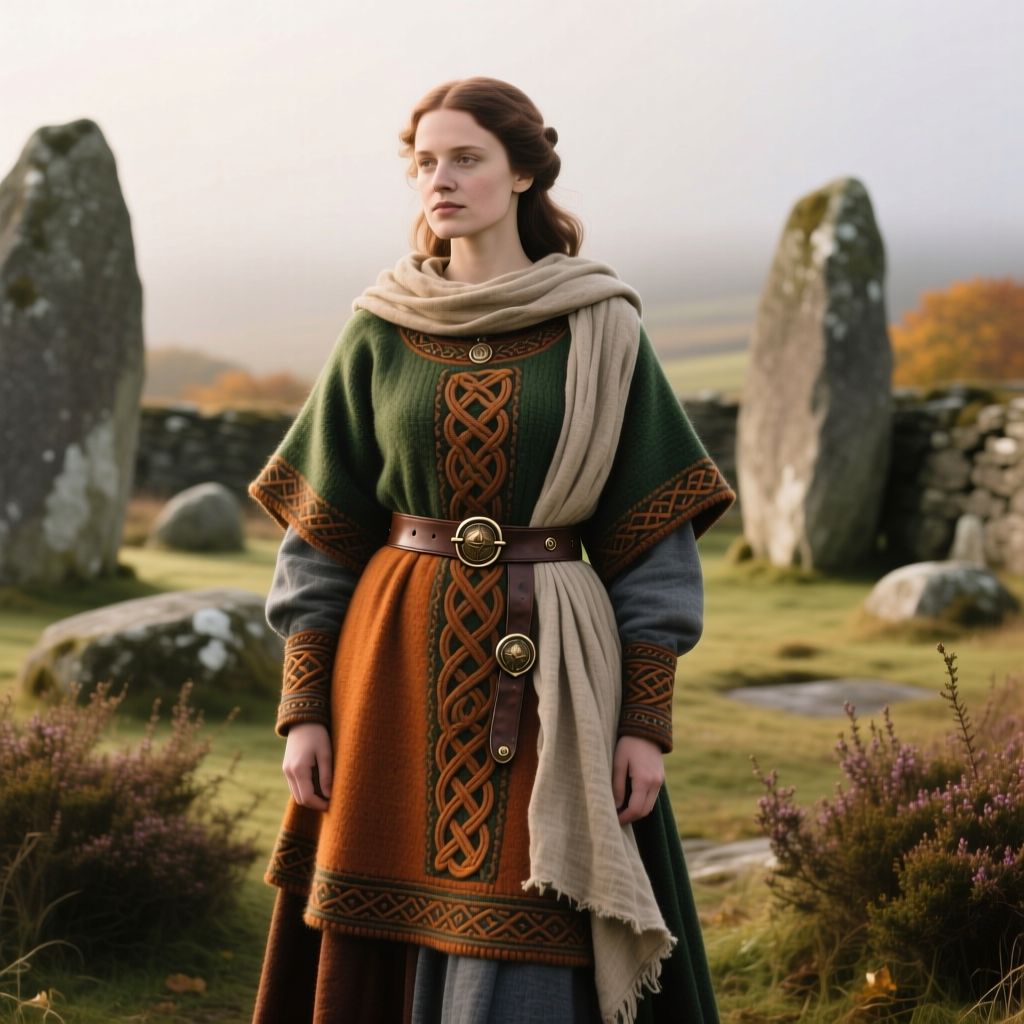
The léine (pronounced 'lay-nuh') was the universal undergarment & primary tunic worn by all classes of Gaelic society. For the lower classes & for summer wear, the léine was typically made of linen, woven from locally grown flax. For the nobility & for winter months, it was crafted from fine, soft wool. The defining characteristic of the léine was its voluminous nature; it was cut wide & long, then drawn up through a belt to create a bloused effect over the waist, allowing for freedom of movement while keeping the lower legs unencumbered.
The sleeves of the léine were often wide & flowing, sometimes reaching past the wrists, a style that later English observers heavily criticized & eventually sought to ban. The neckline was generally round or V-shaped, occasionally adorned with simple embroidery for those of higher status. Women's léines were typically ankle-length, serving as a full dress, while men's versions usually fell to the knees.
The Brat: The Iconic Irish Cloak
If the léine was the foundation of Irish dress, the brat (cloak) was its crowning glory. The brat was a large, semicircular or rectangular piece of heavy, fulled woolen cloth draped over the shoulders. It was the ultimate multi-purpose garment: a coat against the freezing rain, a blanket for sleeping on the ground, & a hood when pulled over the head. The brat was fastened at the chest or shoulder with a dealg (brooch or pin), often made of bronze, silver, or gold depending on the wearer's wealth.
The edges of the brat were frequently fringed, a decorative element that also served to shed water more effectively. The color & quality of the brat were immediate indicators of social rank, a topic strictly governed by native law. The enduring legacy of the cloak in Celtic regions can also be seen when comparing it to Scottish Highland dress, which shares many ancestral similarities.
The Crios & Inar: Belts & Jackets
To gather the voluminous léine, a crios (belt) was essential. While leather belts were used, the most traditional & culturally significant was the woven woolen crios, featuring intricate geometric patterns & vibrant colors. This belt not only secured the tunic but also provided a place to tuck small tools or weapons. Over the léine, warriors & hunters often wore an inar, a shorter, fitted jacket made of wool or leather, which provided extra warmth & protection without restricting the swing of a sword or the draw of a bow.
Brog: Footwear of the Gael
Footwear in early Ireland was dictated by the wet, boggy landscape. The brog (the etymological ancestor of the modern 'brogue' shoe) was a simple, heelless shoe made of rawhide or tanned leather. They were often constructed from a single piece of leather, gathered around the foot with a leather thong. Some variations, particularly in the western islands, resembled the pampootie, a hair-on hide shoe that provided excellent grip on slippery rocks & wet grass.
Textiles, Weaving, & the Art of the Loom
The creation of traditional Irish clothing before colonization was a labor-intensive process that required immense skill & communal effort. The transformation of raw fleece & flax into wearable garments was primarily the domain of women, whose expertise at the loom was highly respected in Gaelic society. The Irish weaving traditions that survive today are direct descendants of these ancient practices.
The primary tool for cloth production was the warp-weighted loom. This upright loom utilized clay or stone weights to keep the vertical warp threads taut while the weaver passed the horizontal weft threads through them using a shuttle. The resulting fabric was then fulled (washed & beaten in water, sometimes with urine or fuller's earth) to shrink & thicken the wool, creating a dense, water-resistant material ideal for the brat.
Dyeing was an equally sophisticated art. The ancient Irish had an intimate knowledge of their local flora, utilizing it to create a vibrant palette that defies the modern assumption that historical clothing was uniformly drab. The exploration of the history of natural dyes reveals the ingenuity of early Irish dyers:
- Saffron (Croch): Perhaps the most famous of Irish dyes, yielding a rich, golden-yellow or deep orange hue. True saffron was expensive & imported, so local dyers often used alternatives like weld, woodruff, or the bark of the alder tree to achieve similar prestige colors.
- Woad (Glass): A plant that, when fermented & processed, produced a range of blues, from pale sky to deep indigo, highly prized by Celtic warriors & nobles.
- Madder & Lichen: Madder root provided deep reds & russets, while various rock lichens (cudbear) were used to create purples & crimsons, colors strictly reserved for the highest echelons of society.
Occasions, Status, & Regional Variations
In Gaelic Ireland, you wore your status on your sleeve—literally. The Brehon Laws, the ancient native legal system, included strict sumptuary laws that regulated the colors, fabrics, & trims a person was legally permitted to wear. This ensured that a person's rank, profession, & wealth were instantly recognizable at any gathering, feast, or battle.
The Hierarchy of Color
According to the Brehon Laws, the number of colors in a single garment was directly tied to social rank. Serfs & slaves were typically restricted to one or two dull colors, such as grey, brown, or undyed wool. Freemen & lesser chieftains could wear up to four or five colors. The highest echelons—the provincial kings & the High King of Tara—were legally entitled to wear garments featuring seven colors, including the highly prized crimson, purple, & saffron. To violate these dress codes was not merely a fashion faux pas; it was a legal offense punishable by fines or worse.
Warriors & the Fianna
The warriors of Gaelic Ireland, particularly the elite bands known as the Fianna, had distinct sartorial requirements. Their clothing needed to be durable, quiet (to allow for stealth hunting & ambush), & unrestrictive. They often favored the shorter inar & tightly wrapped leg wrappings, eschewing the flowing, voluminous léines of the nobility during active campaigns. Their cloaks were often made of darker, mottled wools to provide camouflage in the dense forests & heather-covered hills.
Regional & Climatic Adaptations
While the core garments remained consistent across the island, regional variations existed based on local resources & microclimates. In the rugged, wind-battered western seaboard & the Aran Islands, the wool was often spun thicker, & the brats were heavily oiled or treated with animal fats to repel the relentless Atlantic spray. In the more fertile, sheltered eastern plains, where flax cultivation was easier, finer linens were more prevalent among the common populace, & the overall silhouette could be slightly lighter & more flowing.
The Cultural & Spiritual Significance of Gaelic Attire
Beyond the practical & the legal, traditional Irish clothing before colonization was steeped in mythological & spiritual significance. In Irish lore, garments often possessed magical properties or served as symbols of sovereignty, protection, & divine favor. The Gaelic culture and identity was deeply intertwined with the physical artifacts they created & wore.
The cloak, or brat, held particular spiritual weight. In mythology, the cloaks of the gods & heroes were often imbued with power. Manannán mac Lir, the sea god, possessed a cloak that could change color like the shifting sea & render the wearer invisible. In mortal society, the act of placing one's cloak over another was a profound gesture of protection & submission, while the tearing of a cloak symbolized the breaking of a treaty or a deep, irreparable grief.
Furthermore, the process of creating clothing was surrounded by ritual & superstition. Spinning & weaving were seen as metaphors for the weaving of fate & destiny, echoing the broader Indo-European mythological themes of the Fates or the Norns. Certain dyes were believed to offer protective charms; for instance, red threads woven into a garment were thought to ward off the Aos Sí (the fairy folk) & malicious spirits. Clothing was not just a covering for the body; it was a spiritual armor, a connection to the ancestors, & a reflection of the cosmic order as understood by the early Irish.
When colonization & subsequent English penal laws sought to suppress Gaelic culture, the banning of the saffron léine & the traditional Irish cloak was a deliberate tactic to dismantle this cultural identity. By forcing the Irish to adopt English dress, the colonizers aimed to sever the visual & spiritual ties to the ancient Brehon traditions. Understanding the depth & complexity of pre-colonial Irish clothing is therefore essential to understanding the resilience of the Irish spirit & the enduring power of cultural heritage.
Frequently Asked Questions
What did the ancient Irish wear before the English arrived?
Before English colonization, the ancient Irish primarily wore a combination of the léine (a long, voluminous tunic made of linen or wool) & the brat (a heavy, fringed woolen cloak). These base layers were secured with a crios (a woven belt) & fastened with a dealg (a metal brooch). Footwear consisted of simple leather shoes known as brog. The clothing was designed for the damp climate, emphasizing water resistance, layering, & mobility.
Was the saffron léine actually yellow?
Yes, but the exact shade varied. The term 'saffron' (or croch in Irish) historically referred to a rich, golden-yellow or deep orange-russet color. While true saffron spice was occasionally imported & used by the ultra-wealthy, most 'saffron' dyes in Ireland were derived from local plants like weld, woodruff, or alder bark, which produced similar vibrant yellow & ochre hues. This color was highly prestigious & heavily associated with the Gaelic nobility & warrior classes.
How did Brehon Law regulate Irish clothing?
The Brehon Laws (the native Irish legal system) included strict sumptuary laws that dictated what a person could wear based on their social rank. These laws regulated the number of colors permitted in a single garment. For example, slaves & serfs were restricted to one or two drab colors, while freemen could wear up to four or five. Kings & high-ranking nobles were legally entitled to wear garments featuring up to seven colors, including expensive crimsons & purples. Violating these color codes was a punishable legal offense.
Did pre-colonial Irish people wear tartan or plaid?
The modern concept of specific, named clan tartans is a later Scottish development, but the ancient Irish absolutely wore checked, striped, & patterned fabrics. Archaeological finds & historical texts indicate that Irish weavers created complex geometric patterns, checks, & stripes using differently colored warp & weft threads. However, these patterns were generally a matter of regional weaver preference, available dyes, & personal wealth, rather than strict, codified family or clan identifiers as seen in later Scottish Highland dress.
What materials were used for early Irish footwear?
Early Irish footwear, broadly referred to as brog, was primarily made from rawhide or simply tanned animal leather, usually from cattle or deer. The shoes were often constructed from a single piece of leather that was wrapped around the foot & secured with leather thongs. In coastal & island regions, 'hair-on' hides were sometimes used to create shoes similar to the pampootie, which provided excellent traction on wet rocks & slippery boglands. Wood was rarely used for everyday footwear, though wooden soles may have been employed in specific, extremely wet conditions.