Indian Clothing Before Colonization
Traditional Indian Clothing Before Colonization: A Comprehensive Cultural Guide
Long before European ships anchored on the shores of the Indian subcontinent, a vast and sophisticated civilization had already perfected the art of dressing the human body with elegance, symbolism, and extraordinary craftsmanship. The story of traditional Indian clothing before colonization is one woven into the very fabric of human history — a narrative that stretches back over five millennia to the Indus Valley Civilization and encompasses an astonishing diversity of garments, textiles, and adornment practices.
India's pre-colonial wardrobe was not merely a matter of covering the body. Clothing served as a language of identity, communicating caste, region, marital status, religious affiliation, and social standing through every fold, dye, and embroidered motif. The subcontinent's mastery of cotton cultivation, silk weaving, natural dyeing, and textile embellishment was so renowned that Indian fabrics became some of the most sought-after trade commodities in the ancient world, reaching the courts of Rome, the markets of Southeast Asia, and the trading posts of the Middle East.
Unlike many Western clothing traditions that relied heavily on cutting and stitching fabric to conform to the body's shape, pre-colonial Indian clothing celebrated the art of draping. Unstitched garments were not born from a lack of technological sophistication — indeed, Indian tailors possessed remarkable sewing skills — but from a deeply rooted cultural and philosophical preference for garments that honored the integrity of woven cloth. This guide explores the magnificent world of Indian dress as it existed before colonial influence reshaped the subcontinent's sartorial landscape.
The Ancient Foundations: Origins and Evolution of Pre-Colonial Indian Garments
The earliest evidence of clothing in the Indian subcontinent emerges from the Indus Valley Civilization, one of the world's oldest urban cultures. Archaeological excavations at sites such as Mohenjo-daro and Harappa have revealed terracotta figurines, bronze statues, and seal impressions depicting figures wearing draped garments. The famous bronze "Dancing Girl" statuette, adorned with bangles and a necklace, suggests that even in this early period, personal adornment was an integral part of daily life.
Cotton, the fiber that would come to define Indian textiles, was cultivated in the Indus Valley region thousands of years before it became known to the Western world. The subcontinent's tropical climate proved ideal for growing cotton, and Indian artisans developed spinning and weaving techniques that produced fabrics of remarkable fineness. Ancient texts describe muslins so sheer they were likened to "woven air" or "the skin of a snake," a testament to the extraordinary skill of early Indian weavers.
The Vedic period introduced a more structured approach to clothing, with Sanskrit texts providing detailed references to garments and their appropriate usage. The basic wardrobe consisted of three primary pieces: the antariya (a lower-body drape similar to a dhoti), the uttariya (an upper-body drape or shawl), and the kayabandh (a sash or waistband). This tripartite system formed the foundation upon which centuries of regional variation and innovation would build.
Silk production, known as sericulture, also has ancient roots in India. While China is often credited as the birthplace of silk, India developed its own indigenous silk traditions, particularly in the regions of Assam, Bengal, and the southern peninsula. Varieties such as muga silk (a golden silk unique to Assam), tussar silk, and eri silk were produced using wild silkworm species native to the subcontinent, creating fabrics with textures and colors distinct from Chinese silk. For a deeper exploration of how silk traditions shaped global fashion, visit our guide to the history of silk in fashion.
The Mauryan and Gupta periods are often regarded as golden ages of Indian textile arts. Royal courts became centers of patronage for weavers, dyers, and embroiderers, and the demand for luxurious fabrics drove continuous innovation. Trade along the Silk Road and maritime routes spread Indian textiles — and Indian aesthetic sensibilities — across the known world. Greek and Roman writers marveled at the quality of Indian cottons, and the Roman historian Pliny the Elder famously complained about the enormous sums of money flowing eastward to pay for Indian fabrics.
The Art of Draping: Key Garments and Their Characteristics
The genius of pre-colonial Indian clothing lay in its mastery of the unstitched garment. Rather than cutting fabric into pattern pieces and sewing them together, Indian dressmakers and wearers treated cloth as a fluid medium to be wrapped, pleated, tucked, and draped around the body. This approach offered remarkable versatility — a single length of fabric could be styled in dozens of ways, adapted to different occasions, climates, and activities.
The Antariya and Dhoti
The antariya, the precursor to the modern dhoti, was the foundational lower garment for both men and women in ancient India. Typically a rectangular piece of cotton or silk measuring between three and five meters in length, the antariya was wrapped around the waist and legs, with the fabric passed between the legs and tucked into the waistband at the back — a style known as kaccha. This draping method provided both modesty and freedom of movement, making it practical for everything from agricultural labor to courtly ceremonies.
The dhoti evolved into countless regional variations. In South India, the veshti or mundu was typically wrapped without passing between the legs, creating a more skirt-like silhouette. In Bengal, the dhoti featured distinctive pleating patterns, while in Maharashtra, the nauvari dhoti was draped in a trouser-like style that allowed women to ride horses and engage in physical activities with ease.
The Uttariya and Its Descendants
The uttariya was a versatile upper-body drape that could be worn across the shoulders, over one shoulder, or wrapped around the torso. In its simplest form, it was a rectangular scarf or shawl, but in courtly settings, it could be an elaborate garment of fine silk or muslin, embellished with gold thread embroidery and precious stones. The uttariya is the ancestor of many modern Indian garments, including the dupatta, the chunni, and the pallu (the decorative end of a sari).
The Sari: India's Iconic Draped Garment
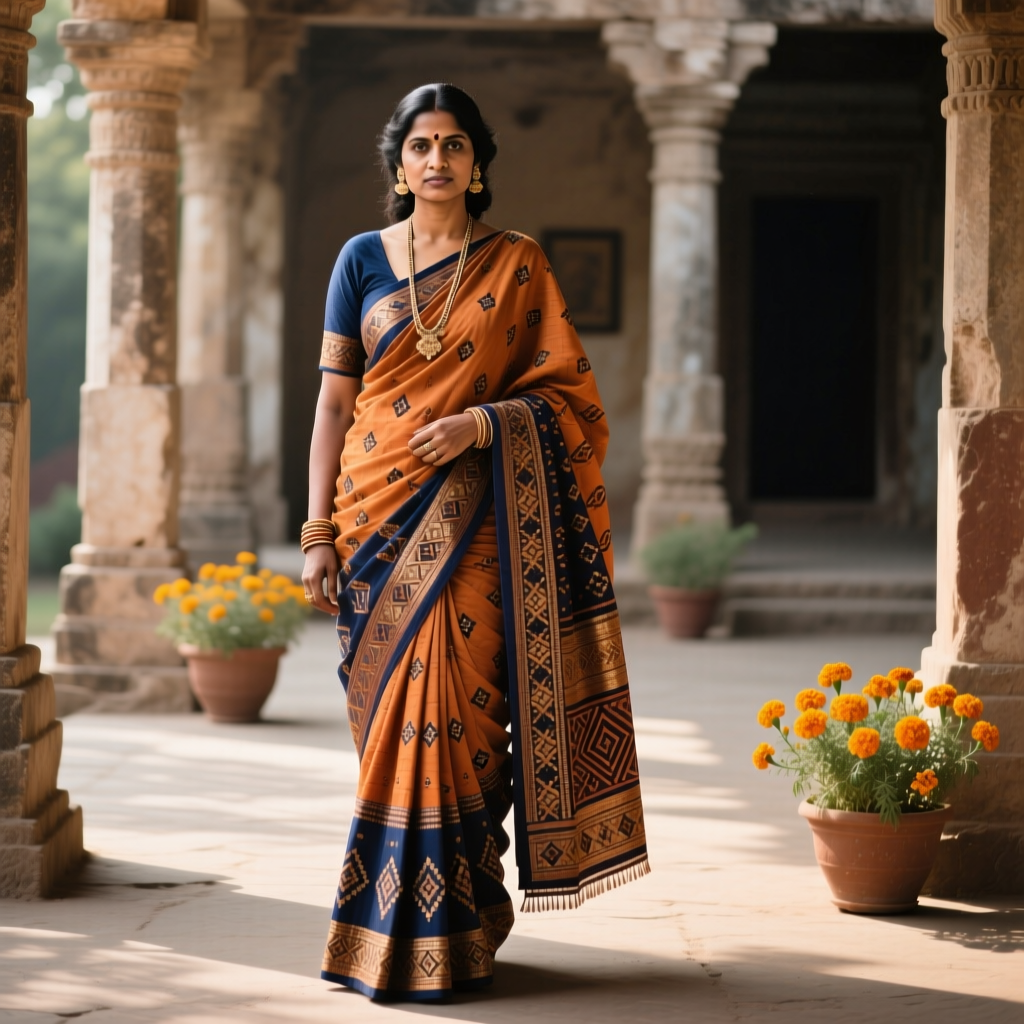
Perhaps no garment is more emblematic of Indian clothing than the sari (also spelled saree). The sari's origins can be traced to the ancient combination of the antariya and uttariya, which gradually evolved into a single, continuous drape. Pre-colonial saris varied enormously in length, fabric, and draping style, reflecting the diversity of the subcontinent's regions and communities.
The Nivi drape (from Andhra Pradesh), the Bengali drape (with its distinctive box pleats and pallu thrown over the left shoulder), the Gujarati drape (with the pallu brought from back to front), the Kodagu drape (from Coorg, with reverse pleats), and the Madisar drape (worn by Tamil Brahmin women) represent just a few of the dozens of traditional draping styles that existed before colonization. Each style reflected local customs, climate considerations, and aesthetic preferences. Learn more about the evolution of draped garments in our global guide to draped garments.
Stitched Garments in Pre-Colonial India
While unstitched garments dominated the Indian wardrobe, stitched clothing was far from unknown. The introduction of needle and thread techniques intensified with various waves of migration and conquest, particularly the arrival of Central Asian and Persian influences. The kurta, a loose-fitting tunic, the angarkha, a wrapped and tied jacket, and the choli, a fitted bodice worn with the sari, all represent pre-colonial stitched garments that became integral to Indian dress.
The salwar kameez, often associated with Mughal influence, has roots in the clothing traditions of Central Asia and the northwestern regions of the subcontinent. The combination of loose trousers (salwar) and a tunic (kameez) was practical for the cooler climates of northern India and became widely adopted, particularly among women in Punjab, Kashmir, and the northwestern frontier regions. For more on the evolution of tunics across cultures, see our comprehensive tunic guide.
Textiles, Dyes, and Embellishments: The Material Culture of Pre-Colonial Dress
The magnificence of pre-colonial Indian clothing cannot be understood without examining the extraordinary textile traditions that produced it. India's mastery of fiber, dye, and decoration was arguably the most advanced in the ancient world, and Indian textile technologies shaped global trade patterns for centuries.
Cotton: The Fiber That Changed the World
India is the birthplace of cotton cultivation and textile production. The species Gossypium arboreum, native to the Indian subcontinent, was domesticated thousands of years ago and became the foundation of one of history's most important industries. Indian weavers developed techniques for spinning cotton into yarn of astonishing fineness — the legendary Dhaka muslins, produced in what is now Bangladesh, achieved thread counts so high that a fifty-meter length of fabric could be folded into a matchbox.
Different regions specialized in different cotton textiles. The Coromandel Coast was famous for its painted and dyed cottons (known in Europe as chintz), Gujarat was renowned for its block-printed cottons and patola (double ikat) silks, and the Deccan plateau produced sturdy, beautifully patterned fabrics that were traded throughout the Indian Ocean world.
Natural Dyes and the Science of Color
Pre-colonial Indian dyers commanded an unparalleled palette of colors derived from natural sources. Indigo, extracted from the Indigofera tinctoria plant, produced blues ranging from pale sky to deep midnight. Madder root yielded rich reds and pinks. Turmeric provided vibrant yellows. The lac insect produced crimson and scarlet hues. Pomegranate rinds created warm ambers and golds. Iron-rich mud could produce deep blacks.
The technique of mordant dyeing — using metallic salts to fix dyes to fabric and create different color effects — was perfected in India to a degree unmatched elsewhere in the world. Indian dyers understood how to use alum, iron, and tin mordants to extract multiple colors from a single dye bath, a skill that gave their fabrics a complexity and richness that European manufacturers struggled to replicate for centuries. The famous kalamkari tradition of Andhra Pradesh, in which fabrics were hand-painted with mordants before dyeing, represents one of the most sophisticated applications of this knowledge.
Embroidery and Surface Ornamentation
Embroidery traditions in pre-colonial India were as diverse as the subcontinent itself. Each region developed distinctive styles that reflected local aesthetics, available materials, and cultural traditions. The zari and zardozi work of northern India used gold and silver threads to create opulent designs on silk and velvet. The kantha embroidery of Bengal transformed old saris into beautifully quilted textiles through running stitch patterns. The phulkari of Punjab used silk thread on cotton to create geometric and floral motifs. The chikankari of Lucknow produced delicate white-on-white shadow work that was prized in courtly settings.
Beyond embroidery, Indian artisans employed a remarkable range of surface decoration techniques. Bandhani (tie-dye) from Rajasthan and Gujarat created intricate dot patterns by binding tiny sections of fabric before dyeing. Block printing using hand-carved wooden blocks allowed for the precise repetition of complex patterns across large lengths of fabric. Brocade weaving, particularly in Varanasi (Banaras), incorporated gold and silver threads directly into the fabric structure, creating textiles of breathtaking opulence. Explore more about these decorative techniques in our guide to textile embellishment techniques.
Regional Variations: A Subcontinent of Sartorial Diversity
One of the most remarkable aspects of pre-colonial Indian clothing was its staggering regional diversity. The Indian subcontinent encompasses an enormous range of climates, cultures, languages, and traditions, and this diversity was reflected in every aspect of dress. What a woman wore in the tropical backwaters of Kerala bore little resemblance to the garments of a woman in the cold mountain valleys of Kashmir, yet both traditions were equally sophisticated and meaningful.
North India
The northern plains and mountain regions saw a blend of indigenous Dravidian and incoming Central Asian and Persian influences. In Rajasthan, women wore the ghagra choli — a long, flared skirt paired with a fitted bodice and a flowing odhni (veil). Men wore the dhoti or pajama (loose drawstring trousers) with an angarkha or short kurta, often topped with a distinctive turban whose style, color, and size communicated community identity and social status.
In Kashmir, the cold climate necessitated warmer garments. The pheran, a long, loose gown worn by both men and women, was typically made of wool or heavy cotton and often featured exquisite ari embroidery. The Kashmiri shawl, woven from the fine underwool of the Changthangi goat (pashmina) or from shahtoosh, became one of the most coveted luxury items in the world. Our guide to shawls and wraps explores this tradition in greater detail.
South India
South Indian clothing traditions were deeply rooted in Dravidian culture and were characterized by a strong preference for unstitched garments. Women typically wore the sari in styles distinct from northern drapes — the madisar (nine-yard sari draped in a trouser style), the coorgi drape, and the simple but elegant mundum neriyathum of Kerala, a two-piece garment consisting of a lower-body wrap and an upper-body cloth, both typically white with gold borders.
Men in South India traditionally wore the veshti (dhoti), often white or cream-colored with a colored or gold border, paired with an angavastram (shoulder cloth). The tropical climate of the southern peninsula made lighter, unstitched garments both practical and comfortable, and the region's silk weaving centers — Kanchipuram, Mysore, and Dharmavaram — produced saris of extraordinary beauty characterized by bold color combinations and intricate temple-border designs.
East India
Bengal, Odisha, and Assam each developed distinctive clothing traditions. Bengali women traditionally wore the sari in a style without pleats, draping the fabric in broad wraps around the body with the pallu falling over the left shoulder and the keys to the household tied at the waist. Bengal was also a center of fine muslin production, and the legendary Jamdani weaving technique — in which decorative motifs are woven into the fabric using a supplementary weft technique — produced saris of ethereal beauty.
Assam's contribution to Indian clothing was its unique wild silk tradition. Muga silk, with its natural golden color, pat silk (a white or off-white mulberry silk), and eri silk (a warm, cotton-like silk) were woven into the mekhela chador, a two-piece garment similar in concept to the sari but with its own distinct draping style. These silks were not only beautiful but also deeply embedded in Assamese cultural identity and ritual life.
West India
Gujarat and Maharashtra developed clothing traditions shaped by their positions as centers of trade and commerce. Gujarati women wore the sari with the pallu brought from the back over the right shoulder and spread across the front — a practical style that displayed the decorative end of the fabric prominently. The bandhani tie-dye tradition produced vibrant fabrics in red, yellow, green, and blue, with patterns ranging from simple dots to elaborate figurative designs.
In Maharashtra, women wore the nauvari (nine-yard) sari draped in the kaccha style, passing the fabric between the legs to create a trouser-like effect. This practical drape was well-suited to the active lives of Maharashtrian women, who were known for their participation in agriculture, trade, and even warfare. Men wore the dhotar (dhoti) with a pheta (turban) and a short bandi (waistcoat).
Cultural Significance: Clothing as Identity, Ritual, and Resistance
In pre-colonial India, clothing was never merely functional or decorative. Every garment carried layers of cultural meaning, serving as a marker of identity, a participant in ritual, and an expression of philosophical and spiritual values. Understanding these deeper dimensions is essential to appreciating the full significance of traditional Indian dress.
Clothing and Social Identity
Garments in pre-colonial India communicated a wealth of social information. The type of fabric, the quality of weaving, the colors used, the style of draping, and the nature of embellishments all conveyed details about the wearer's community, occupation, marital status, and social position. Turban styles in Rajasthan, for example, were so specific to particular communities and occasions that an experienced observer could identify a man's village, caste, and current social role simply by examining his headwear.
Married women in many communities wore specific garments or accessories that distinguished them from unmarried women. In Bengal, the shakha (white conch shell bangle) and pola (red coral bangle) were markers of marriage, while in Maharashtra, the green bangles and specific sari draping styles served the same function. These sartorial codes formed a visual language that structured social interactions and maintained community cohesion.
Clothing in Ritual and Ceremony
Religious and ceremonial occasions demanded specific garments, colors, and fabrics. White was associated with purity and was worn during religious ceremonies, while red symbolized fertility and auspiciousness and was the preferred color for bridal garments in many communities. Saffron and ochre were worn by ascetics and spiritual seekers, representing renunciation of worldly attachments.
Temple traditions across India included the practice of adorning deities with fine garments, and the weaving of cloth for temple use was considered a sacred act. In many South Indian temples, specific weaving communities were entrusted with producing the fabrics used to dress temple deities, and these textiles often featured motifs — such as the peacock, the lotus, and the mango (paisley) — that carried deep spiritual symbolism. Read more about the intersection of clothing and spirituality in our guide to clothing in religious ceremonies.
Clothing and Philosophical Values
The preference for unstitched garments in pre-colonial India was not simply an aesthetic choice but was rooted in philosophical and religious beliefs. In Hindu tradition, unstitched cloth was considered pure (shuddh), while stitched garments were sometimes regarded as less pure. This belief was connected to the idea that piercing fabric with a needle was a form of violence (himsa) against the integrity of the woven cloth. The concept of ahimsa (non-violence), central to Hindu, Buddhist, and Jain philosophies, thus influenced clothing choices at a fundamental level.
The act of weaving itself carried spiritual significance. The loom was seen as a metaphor for the cosmos — the warp threads representing the eternal, unchanging reality and the weft threads representing the transient, manifest world. Weavers in many communities observed rituals and recited prayers while working, and the finest textiles were believed to contain the spiritual energy of their makers.
Textiles as Economic and Political Power
India's textile industry was one of the largest and most sophisticated in the pre-colonial world. Entire regions specialized in particular types of production — Varanasi for brocades, Dhaka for muslins, Surat for cottons, Kanchipuram for silks — and the resulting trade networks connected Indian weavers to markets across the globe. Textile production supported millions of artisans, from cotton farmers and spinners to dyers, weavers, printers, and merchants, forming one of the most complex economic ecosystems in human history.
Royal courts were major patrons of textile arts, and the quality of a ruler's wardrobe was seen as a reflection of the prosperity and cultural sophistication of the kingdom. Mughal emperors, Rajput kings, and South Indian dynasties all maintained royal workshops (karkhanas) where the finest weavers and embroiderers produced garments of unparalleled luxury. The khilat (robe of honor), a ceremonial garment bestowed by a ruler upon a subject or visiting dignitary, was one of the most important political instruments in pre-colonial Indian statecraft.
Frequently Asked Questions
What did people in ancient India wear before the British arrived?
Before British colonization, Indian clothing was predominantly based on draped, unstitched garments. The fundamental wardrobe consisted of the antariya (a lower-body wrap similar to a dhoti), the uttariya (an upper-body drape or shawl), and a waist sash. Women wore various styles of saris, ghagra cholis, and regional two-piece garments, while men wore dhotis, kurtas, angarkhas, and turbans. Stitched garments such as the salwar kameez and choli were also common, particularly in northern and northwestern regions where Central Asian and Persian influences had been integrated into local dress traditions over centuries of cultural exchange.
Why were unstitched garments preferred in traditional Indian clothing?
The preference for unstitched garments was rooted in cultural, philosophical, and practical considerations. In Hindu, Buddhist, and Jain traditions, unstitched cloth was considered ritually pure, as the act of piercing fabric with a needle was seen as a form of violence against the woven material. Practically, unstitched garments were well-suited to India's tropical climate, allowing air circulation and versatility in styling. A single length of fabric could be draped in multiple ways for different occasions, activities, and weather conditions. Additionally, the artistry of Indian weaving was so advanced that displaying the full, uncut beauty of the fabric was considered aesthetically superior to cutting it into pieces.
How did regional climate affect clothing choices in pre-colonial India?
Climate was one of the most significant factors shaping regional clothing variations across the subcontinent. In the hot, humid coastal regions of South India and Bengal, lightweight cotton garments in loose, flowing drapes allowed for maximum air circulation and comfort. In the cold mountain regions of Kashmir and Himachal Pradesh, wool garments, pashmina shawls, and layered clothing provided necessary warmth. In the arid desert regions of Rajasthan, loose-fitting garments covered the body fully to protect against sun and sand, while vibrant colors and mirror-work embroidery reflected the cultural vibrancy of desert communities. The availability of local fibers — cotton in the plains, wool in the mountains, wild silk in the northeastern forests — further shaped regional textile and clothing traditions.
What role did trade play in the development of Indian clothing traditions?
Trade was absolutely central to the evolution of Indian clothing. India was one of the world's largest exporters of textiles for thousands of years, and the demands of international trade drove continuous innovation in weaving, dyeing, and printing techniques. Indian cottons and silks were traded along the Silk Road to Central Asia and China, across the Indian Ocean to Southeast Asia and East Africa, and via maritime routes to the Middle East and Europe. This trade not only spread Indian textile technologies but also brought foreign influences into Indian dress — Persian motifs, Central Asian garment structures, and Chinese silk techniques were all absorbed and reinterpreted within the Indian aesthetic framework. Port cities such as Surat, Masulipatnam, and Calicut became cosmopolitan centers where diverse clothing traditions met and merged.
How did colonization change traditional Indian clothing?
Colonization brought profound changes to Indian clothing traditions. The introduction of Western-style tailored garments — shirts, trousers, coats, and shoes — created new sartorial categories, particularly among men in urban areas who adopted elements of European dress for professional and social contexts. The British colonial administration's dress codes and social expectations pressured Indian elites to incorporate Western garments into their wardrobes. Simultaneously, colonial economic policies devastated India's handloom textile industry by imposing tariffs on Indian fabrics while flooding the market with machine-made British textiles. However, traditional clothing never disappeared — it persisted in rural areas, in ceremonial contexts, and as a symbol of cultural identity. The Swadeshi movement later championed handspun and handwoven cloth (khadi) as an act of political resistance, demonstrating that clothing remained a powerful cultural and political force throughout the colonial period and beyond. For more on how colonization reshaped global dress, explore our cultural heritage archives.
The study of pre-colonial Indian clothing reveals a civilization that understood dress as far more than mere covering — it was an art form, a spiritual practice, an economic engine, and a language of identity. The traditions established in this remarkable era continue to influence Indian fashion and global textile culture to this day, reminding us that the most enduring garments are those woven with meaning.