Traditional Clothing of African Countries: A Comprehensive Cultural Guide
Africa is a continent of extraordinary diversity — home to over 50 nations, thousands of ethnic groups, and an equally vast array of languages, customs, and artistic traditions. Among the most vivid expressions of this cultural richness is traditional clothing. Across the continent, garments serve as far more than mere coverings; they are visual languages that communicate identity, status, spirituality, and history. From the indigo-dyed robes of the Sahel to the intricately beaded adornments of the Maasai, traditional African clothing tells stories that have been woven, dyed, embroidered, and passed down through countless generations.
Understanding the traditional clothing of African countries requires appreciating the deep interconnection between textile arts and social life. In many African societies, cloth has historically functioned as currency, as a medium for recording historical events, and as a sacred object used in rites of passage. The loom, the dye pit, and the embroidery frame have been centers of community knowledge, where artisans — often organized into guilds or family lineages — have preserved techniques that predate written records.
This guide explores the origins, characteristics, regional variations, and enduring cultural significance of traditional clothing across the African continent. Whether you are a student of textile history, a fashion enthusiast, or simply curious about the world's sartorial heritage, this journey through Africa's garment traditions will reveal the profound artistry embedded in every thread.
Origins and Historical Foundations of African Traditional Clothing
The history of clothing in Africa stretches back millennia, long before the continent's borders were drawn by colonial powers. Archaeological evidence suggests that some of the earliest forms of textile production originated on the African continent. Fragments of woven cloth discovered in Egypt date back to approximately 5000 BCE, while cotton cultivation in the Nile Valley and the Sudan region has an equally ancient pedigree.
In West Africa, the tradition of strip-weaving — where narrow bands of cloth are sewn together to create larger textiles — has been practiced for centuries. The Yoruba people of present-day Nigeria developed sophisticated dyeing techniques using indigo, creating the celebrated adire cloth, while the Akan weavers of Ghana produced the world-renowned kente cloth on narrow horizontal looms. These techniques were not merely practical; they were deeply embedded in social structures, with specific patterns, colors, and weaving methods reserved for royalty, priests, or particular clans.
In North Africa, the influence of trans-Saharan trade routes introduced silk, fine wool, and new dyeing methods that blended with indigenous Berber textile traditions. The result was a rich hybrid aesthetic visible in garments like the flowing burnous and the elaborately embroidered caftan. Meanwhile, in East Africa, the Indian Ocean trade network brought cotton, silk, and design influences from India, Persia, and Arabia, giving rise to garments such as the kanga and the kanzu.
Across Southern Africa, animal hides and leather were the primary materials for clothing before the introduction of woven textiles through trade and colonization. The Nguni peoples, including the Zulu and Xhosa, developed remarkable skills in preparing and decorating hides, using beadwork — originally made from ostrich eggshell, bone, and wood, and later from glass beads acquired through trade — to create elaborate decorative patterns laden with symbolic meaning.
What unites these diverse traditions is a shared understanding that clothing is never neutral. Every garment carries meaning, whether it signals a person's age, marital status, social rank, ethnic identity, or spiritual affiliation. This principle remains the cornerstone of traditional African dress to this day.
Regional Variations in Traditional African Garments
The sheer geographic and climatic diversity of Africa has given rise to an astonishing variety of clothing traditions. To understand traditional African clothing, it is helpful to explore the continent region by region, recognizing that within each region there exists further variation among ethnic groups, communities, and individual artisans.
West Africa
West Africa is perhaps the most globally recognized region for traditional textile arts. In Ghana, kente cloth — woven in vibrant, geometric patterns from cotton and silk — is arguably the most iconic African textile. Originally reserved for Ashanti royalty, kente is now worn throughout the region and the African diaspora during celebrations, graduations, and ceremonies of cultural pride. Each kente pattern has a name and a proverb associated with it, transforming the cloth into a vehicle for philosophical expression.
In Nigeria, the Yoruba people are celebrated for their agbada, a flowing, wide-sleeved robe worn by men, often paired with a matching sokoto (trousers) and a fila (cap). The agbada is typically made from richly embroidered fabrics such as aso-oke, a hand-woven cloth produced on narrow-strip looms. Yoruba women traditionally wear the iro and buba — a wrapper skirt paired with a loose blouse — complemented by a gele (head tie) that can be sculpted into elaborate, architectural forms.
Mali is home to bogolanfini, commonly known as mud cloth. This cotton fabric is dyed using fermented mud and plant-based pigments, producing striking black, brown, and white patterns rich in symbolic content. Traditionally worn by hunters as camouflage and spiritual protection, bogolanfini has become a symbol of Malian national identity and a source of inspiration for designers worldwide. For those interested in natural dyeing processes, our guide on natural dyeing techniques explores these methods in greater depth.
In Senegal, the boubou (also called the grand boubou) is the quintessential garment — a long, flowing robe worn by both men and women. Made from cotton, silk, or synthetic fabrics and often heavily embroidered, the boubou is a garment of elegance and dignity worn across Francophone West Africa and into Central Africa.
East Africa
East African clothing traditions reflect the region's history as a crossroads of African, Arab, Indian, and European cultural influences. In Kenya and Tanzania, the kanga is a ubiquitous rectangular cotton cloth printed with bold patterns and, typically, a Swahili proverb or saying along its border. Women wear kangas wrapped around the body, head, or shoulders, and the proverbs printed on them serve as a subtle form of communication — expressing love, offering advice, or even delivering pointed social commentary.
The kanzu, a long white robe worn by men, is the national dress of Tanzania and is widely worn in Kenya, Uganda, and along the Swahili Coast. Derived from Arab and Islamic clothing traditions, the kanzu has been thoroughly adopted into East African culture and is worn for religious ceremonies, weddings, and formal occasions.
In Ethiopia, traditional clothing centers on the habesha kemis for women — a long, white cotton dress with intricate embroidery along the neckline, sleeves, and hem — and the netela, a lightweight cotton shawl draped over the shoulders. Ethiopian men traditionally wear white trousers and a knee-length shirt, often accompanied by a gabi, a thick cotton blanket-wrap used for warmth in the highland climate. The white cotton textiles of Ethiopia, known as shemma, are hand-woven on traditional looms and represent one of the oldest continuous textile traditions in Africa.
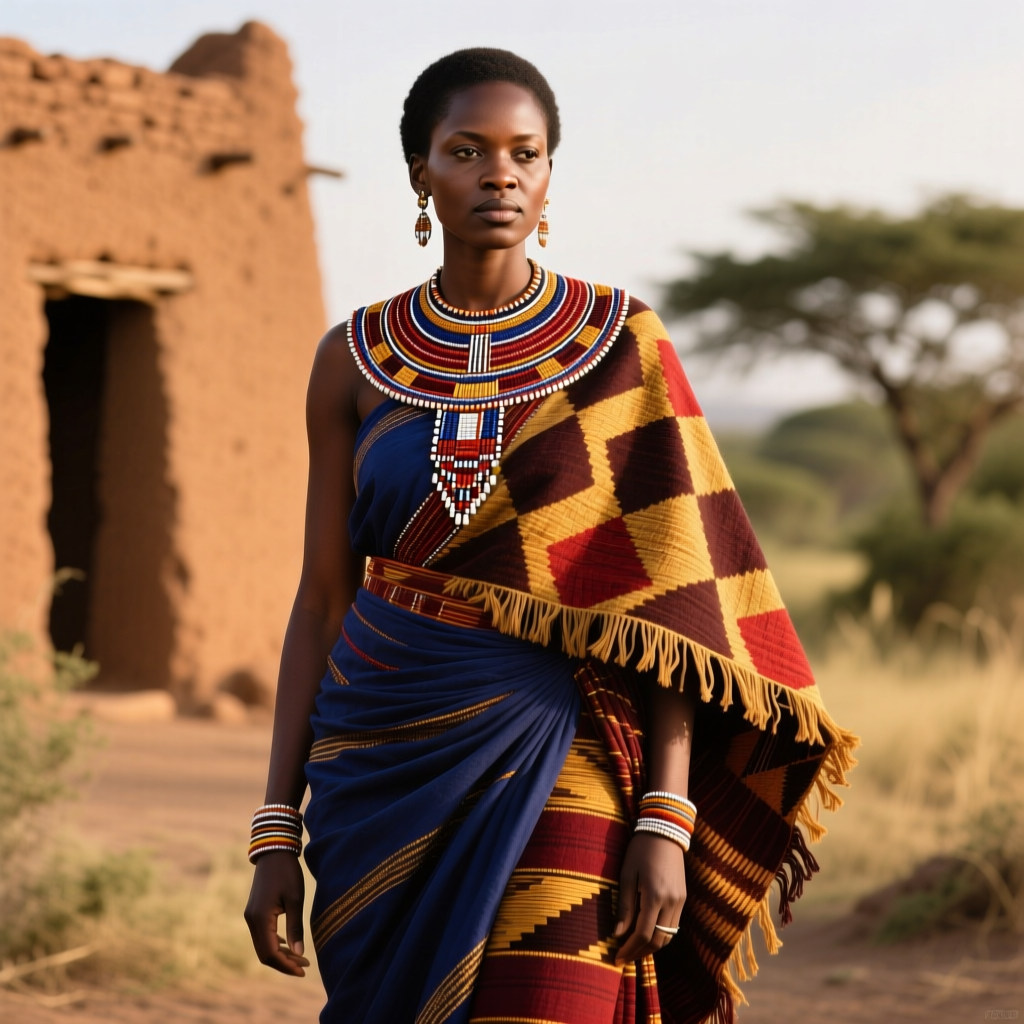
The Maasai people of Kenya and Tanzania are renowned for their distinctive shuka — a thick, woven blanket typically featuring bold red and blue check or plaid patterns, wrapped around the body. Maasai beadwork is equally significant, with elaborate necklaces, bracelets, and headpieces conveying detailed information about age, social status, and clan affiliation.
North Africa
North African clothing traditions reflect the region's position at the intersection of African, Mediterranean, and Middle Eastern cultures. In Morocco, the djellaba — a long, loose-fitting robe with a pointed hood — is worn by both men and women and is considered a national garment. The caftan (or kaftan), a long, ornately decorated robe, is a centerpiece of Moroccan ceremonial dress, particularly for women at weddings and formal celebrations. Moroccan caftans are renowned for their exquisite embroidery, fine fabrics, and meticulous tailoring — a tradition explored further in our article on Moroccan textile heritage.
In Algeria, the haik is a large rectangular cloth, typically white, draped around the body and over the head by women. This garment, with roots in Berber antiquity, has been a symbol of cultural identity and modesty for centuries. In Tunisia, the sefsari serves a similar function, while traditional Tunisian wedding costumes feature elaborate gold-thread embroidery that can take months to complete.
Libya's traditional clothing includes the farmla, a richly embroidered vest worn over a long shirt, and the houli, a large wrap garment worn by women. Across the Maghreb, the burnous — a hooded cloak made from wool or camel hair — remains a practical and iconic garment, particularly in rural and nomadic communities.
Southern Africa
Southern African clothing traditions are deeply connected to the region's pastoral heritage and the creative use of animal hides, beadwork, and, more recently, woven textiles. Among the Zulu people of South Africa, traditional dress varies significantly according to age, gender, and marital status. Unmarried women may wear beaded skirts and leave their upper bodies uncovered, while married women don full-body coverings including the isicholo, a distinctive flared hat that has become an internationally recognized symbol of Zulu identity.
The Xhosa people are known for their use of umbhaco, a white fabric decorated with bold black geometric patterns, fashioned into skirts and wraps. Xhosa beadwork is among the most sophisticated in Africa, with specific color combinations and patterns encoding messages about social standing, romantic availability, and spiritual beliefs.
In Lesotho, the Basotho blanket is the defining element of traditional dress. These wool blankets, originally introduced by European traders, have been wholly embraced and transformed into powerful symbols of Basotho identity. The blankets feature distinctive patterns — including the iconic corncob motif — and are draped over the shoulders in a manner unique to the Basotho people.
The Ndebele people of South Africa and Zimbabwe are celebrated for their vibrant geometric art, which extends to their clothing. Ndebele women wear isiphephetu, a beaded apron, along with stacks of beaded neck rings called idlzila, and their clothing mirrors the bold, colorful geometric patterns painted on their homes.
Central Africa
Central African clothing traditions are shaped by the region's dense rainforests, vast river systems, and diverse ethnic landscape. In the Democratic Republic of the Congo, the liputa — a colorful, patterned wrapper cloth — is the foundation of both men's and women's dress. Congolese fashion is known for its boldness and elegance, with the sapeur subculture (members of the Society of Ambiance-Makers and Elegant People) gaining international recognition for their impeccable, flamboyant tailoring.
Among the Kuba people of the DRC, raffia cloth — woven from the fibers of the raffia palm — is a textile of extraordinary artistry. Kuba raffia cloth, decorated with cut-pile embroidery and appliqué, has been collected by museums worldwide and is considered one of Africa's greatest artistic achievements. The Kuba king's ceremonial skirt, made from multiple panels of decorated raffia cloth, can be over nine meters long.
In Cameroon, the toghu (also called ndop) is a hand-embroidered cloth featuring intricate geometric patterns on dark fabric, traditionally worn by royalty and dignitaries of the Bamenda highlands. This textile has become a symbol of Cameroonian cultural pride and is increasingly worn at national celebrations and diaspora events.
Materials, Techniques, and Craftsmanship
The materials used in traditional African clothing are as diverse as the continent itself, reflecting local environments, trade networks, and technological innovations. Before the widespread availability of imported fabrics, African textile artisans relied on locally sourced fibers, including cotton, silk (both wild and cultivated), wool, raffia, bark cloth, and animal hides.
Cotton has been cultivated and woven across Africa for thousands of years. In West Africa, locally grown cotton was spun into thread by women and woven into cloth by men on narrow-strip looms. The resulting strips, typically between 10 and 30 centimeters wide, were then sewn together edge-to-edge to create larger pieces of fabric. This strip-weaving technique is a hallmark of West African textile production and can be seen in kente, aso-oke, and many other cloths.
Indigo dyeing is one of the most celebrated textile techniques in Africa. From the deep blue adire cloths of the Yoruba to the indigo-dyed garments of the Tuareg people of the Sahara, the use of indigo — extracted from the leaves of the Indigofera plant — has produced some of the continent's most iconic textiles. The resist-dyeing techniques used to create patterned indigo cloth include tie-dye, stitch-resist, and starch-resist methods, each producing distinctive visual effects.
Beadwork is another defining feature of African clothing traditions. While glass beads were historically imported from Europe, India, and the Middle East, African artisans transformed them into uniquely African art forms. Among the Zulu, Xhosa, Ndebele, and Maasai, beadwork is not merely decorative; it is a coded language. Colors, patterns, and the arrangement of beads convey specific messages about the wearer's identity, emotions, and social position.
Embroidery plays a central role in many African clothing traditions, from the gold-thread embroidery of Moroccan caftans to the cross-stitch patterns of Ethiopian habesha kemis dresses. In many cultures, the quality and complexity of embroidery directly correlates with the wearer's social status, with the finest pieces requiring hundreds of hours of skilled handwork. Explore more about these techniques in our guide to embroidery traditions worldwide.
Bark cloth, made by beating the inner bark of certain trees (particularly the Ficus species) until it becomes soft and pliable, was historically used for clothing in parts of Uganda, Central Africa, and Madagascar. In Uganda, bark cloth production was recognized by UNESCO as an Intangible Cultural Heritage of Humanity, underscoring its cultural importance.
Cultural Significance and Ceremonial Use
Traditional African clothing is inseparable from the ceremonies, rituals, and social structures that define community life. Across the continent, specific garments are designated for specific occasions, and wearing the wrong clothing for a particular event can carry serious social consequences.
Rites of passage are among the most important occasions for traditional dress. In many West African societies, a young person's transition to adulthood is marked by the presentation of new clothing. Among the Akan of Ghana, a child's naming ceremony involves the use of specific cloths, while puberty rites for young women involve elaborate adornment with beads, cloth, and body decoration. In Southern Africa, Xhosa initiation ceremonies involve distinct clothing changes that mark each stage of the transition from childhood to adulthood.
Weddings are occasions of extraordinary sartorial display across Africa. In Yoruba culture, the bride and groom, along with their families, often wear matching aso-oke outfits — a practice known as aso-ebi — that visually unites the two families and demonstrates social solidarity. In Ethiopia, the bride's habesha kemis for the wedding day may feature embroidery so fine and dense that the garment becomes a family heirloom. Moroccan weddings involve multiple outfit changes for the bride, with each caftan or takchita (a two-piece dress) more elaborate than the last.
Funerals also have prescribed dress codes. In many Ghanaian communities, mourners wear specific colors depending on their relationship to the deceased and the stage of the mourning period. Red, black, brown, and white all carry different funerary meanings, and the quality of the cloth worn by the bereaved family reflects the honor accorded to the departed. The famous fantasy coffins of Ghana are matched by equally expressive mourning cloths, creating a total aesthetic environment for the farewell ceremony.
Royal and chieftaincy ceremonies represent the apex of traditional African clothing. Kings, queens, and chiefs across the continent wear garments of extraordinary richness and complexity. The Ashanti king's kente cloth, the Benin oba's coral-bead regalia, and the Kuba king's raffia skirt are all examples of clothing that functions as a manifestation of political and spiritual authority. These garments are often considered sacred, and their production is governed by strict protocols and taboos.
Religious and spiritual practices also shape clothing traditions. In many African indigenous religions, priests and priestesses wear specific garments that identify their spiritual role and the deity they serve. Among the Yoruba, priests of different orishas (deities) wear distinct colors — white for Obatala, red for Shango, and so on. In Sufi Islamic communities across North and West Africa, the simple white or cream-colored robe symbolizes spiritual purity and devotion.
Traditional African Clothing in the Modern World
Traditional African clothing has not remained static; it has evolved continuously, absorbing new materials, techniques, and influences while retaining its core cultural meanings. In the contemporary era, African traditional garments have gained unprecedented global visibility, appearing on international fashion runways, in films, and at diplomatic events.
Across the continent, many Africans wear a blend of traditional and Western-style clothing in daily life, reserving traditional garments for ceremonies, celebrations, and formal occasions. However, there has been a powerful movement — particularly among younger generations — to incorporate traditional textiles and silhouettes into everyday fashion. Designers across Africa and the diaspora are creating modern interpretations of the agbada, the boubou, and the kanga, making these garments accessible to new audiences while honoring their cultural roots.
The global fashion industry has increasingly recognized the value and artistry of African textiles, though this attention has also raised important questions about cultural appropriation and the ethics of using traditional designs without proper attribution or benefit-sharing. Many advocates and organizations are working to protect African textile heritage through intellectual property frameworks, fair-trade initiatives, and community-led preservation programs.
Technology has also played a role in the evolution of traditional African clothing. Digital printing techniques now allow for the mass production of fabrics that mimic traditional patterns, making them more affordable and accessible. At the same time, social media platforms have given African designers and artisans direct access to global markets, enabling them to share their work and their stories with audiences around the world.
Perhaps most importantly, traditional African clothing continues to serve its fundamental purpose: connecting individuals to their communities, their ancestors, and their identities. Whether it is a young woman wearing her grandmother's kente cloth at her university graduation, a groom donning an embroidered agbada on his wedding day, or an elder wrapping a Basotho blanket around their shoulders on a cold highland morning, these garments remain living, breathing expressions of African culture and continuity.
Frequently Asked Questions
What is the most widely recognized traditional African garment?
While it is difficult to single out one garment from such a diverse continent, the kente cloth of Ghana and the boubou (grand boubou) of West Africa are among the most internationally recognized traditional African garments. Kente, with its vivid geometric patterns and royal associations, has become a global symbol of African heritage and pride. The boubou, a flowing, elegantly embroidered robe, is worn across a vast region of West and Central Africa and is synonymous with African sartorial elegance.
What materials are traditionally used to make African clothing?
Traditional African clothing is made from a wide range of materials depending on the region and culture. Common materials include cotton (locally grown and hand-woven in many areas), silk (both wild African silk and imported varieties), wool (particularly in North and Southern Africa), raffia palm fiber (in Central Africa), bark cloth (in parts of East and Central Africa), and animal hides and leather (particularly among pastoral communities in Southern and East Africa). Glass beads, cowrie shells, and metal ornaments are frequently used as decorative elements.
How do colors and patterns in African clothing convey meaning?
In many African cultures, colors and patterns in clothing carry specific symbolic meanings. For example, in kente cloth, gold represents royalty and wealth, green symbolizes growth and renewal, blue signifies peace and harmony, and black represents maturity and spiritual energy. Among the Zulu, beadwork colors encode messages about love, marriage, and social status — white beads symbolize purity and love, while red can represent passion or heartache depending on context. These meanings vary between cultures, making each textile tradition a unique visual language that requires cultural knowledge to fully interpret.
Is traditional African clothing still worn today?
Yes, traditional African clothing is very much alive and widely worn across the continent and in African diaspora communities worldwide. While many Africans wear Western-style clothing for everyday activities, traditional garments remain the standard for important occasions such as weddings, funerals, naming ceremonies, religious observances, chieftaincy events, and national celebrations. There is also a growing movement among young Africans to integrate traditional textiles and silhouettes into contemporary fashion, ensuring that these traditions continue to evolve and remain relevant for future generations.
How can I respectfully wear or purchase traditional African clothing?
Wearing traditional African clothing respectfully begins with understanding the cultural context of the garment. Research the specific tradition, learn about its significance, and, where possible, purchase directly from African artisans, cooperatives, or designers who can provide authentic pieces and explain their cultural meaning. Avoid wearing garments that hold sacred or restricted significance — such as royal regalia or ceremonial vestments — unless you have been explicitly invited to do so. Supporting fair-trade initiatives and organizations that protect textile heritage is one of the best ways to honor and sustain these remarkable traditions while ensuring that the communities who created them benefit from their global appreciation.