Draft Zero-Waste Slavic Rubakha Folk Shirts in 2026
The Renaissance of Zero-Waste Historical Construction
In 2026, the intersection of sustainable fashion and historical garment revival has reached an unprecedented peak. As the global textile industry grapples with environmental impacts, modern makers and designers are looking backward to move forward. Traditional European folk dress, particularly the Slavic rubakha (and its Scandinavian counterpart, the särk), offers a masterclass in zero-waste pattern drafting. Long before the concept of 'sustainability' entered the fashion lexicon, rural European communities utilized every single inch of their handwoven textiles. By studying these historical construction patterns, today's sewists can create beautiful, culturally rich garments that produce absolutely no fabric waste.
According to recent data from the Europeana Fashion and Costume archives, the preservation of traditional folk dress techniques is not just about maintaining cultural heritage; it is about recovering lost knowledge of resource-efficient garment engineering. This guide will walk you through the exact geometric principles, measurements, and construction techniques required to draft and sew a traditional Slavic rubakha using zero-waste methodologies in 2026.
The Geometry of the Rubakha: Understanding Rectangular Blocks
Unlike modern commercial sewing patterns that rely on curved armholes, princess seams, and complex darts to contour the body, traditional folk shirts are based entirely on straight lines and rectangles. This geometric approach was born out of necessity. Historically, fabric was woven on narrow looms, typically producing cloth between 36 and 40 inches wide. Cutting curves into this hard-won linen or hemp would result in unusable scraps, which was economically unfeasible for rural farming communities.
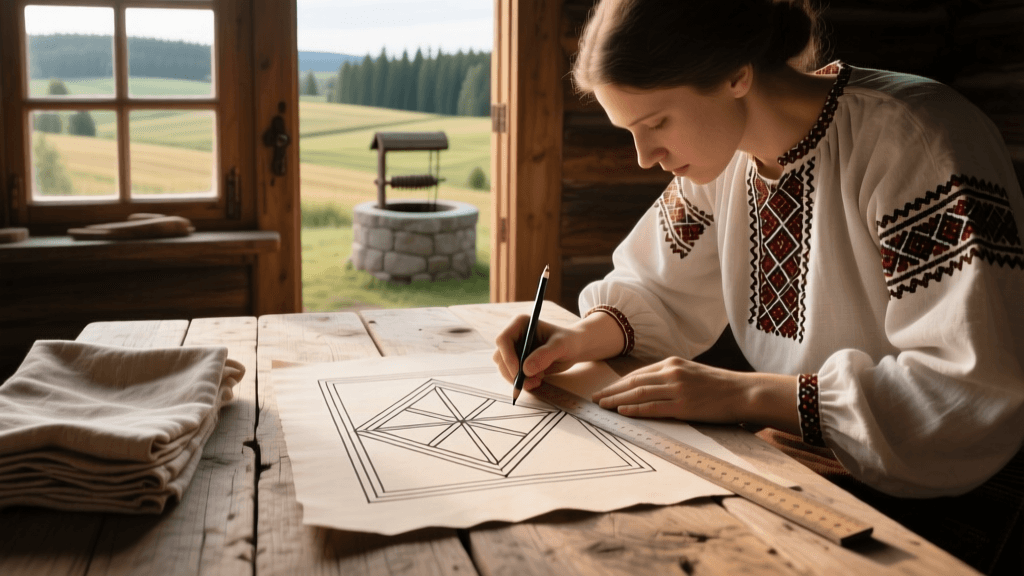
The genius of the rubakha lies in its modular, rectangular construction. The garment is essentially a series of interlocking rectangles and squares that fold, gather, and drape over the human form. The width of the loom dictated the width of the fabric, and the pattern was designed to fit within these constraints perfectly. When you draft a rubakha today, you are engaging in a mathematical puzzle where the final equation must equal zero waste.
Essential Tools and Materials for 2026
Sourcing the right materials is critical for achieving the authentic drape and structure of a folk shirt. In 2026, European flax cooperatives have introduced new mid-weight linens that perfectly mimic historical handwoven textiles while offering modern consistency. When selecting your fabric, you must consider the weight, as it will dictate how the rectangular blocks gather at the neckline and cuffs.
| Fabric Type | Weight (oz/yd²) | Drape Quality | Best Use in Rubakha |
|---|---|---|---|
| Handkerchief Linen | 3.5 - 4.5 | Fluid, sheer | Summer shirts, fine gathering at cuffs |
| Mid-Weight Bleached Linen | 5.0 - 6.5 | Structured but soft | Everyday wear, holds geometric shape well |
| Heavy Rustic Hemp/Linen | 7.0 - 9.0 | Stiff, durable | Outerwear shirts, winter base layers |
| Raw Unbleached Linen | 5.5 - 7.0 | Crisp, textured | Working shirts, takes heavy embroidery well |
| Cotton-Linen Blend (Modern) | 4.0 - 5.5 | Soft, breathable | Budget-friendly alternative, less historical accuracy |
To draft your pattern, you will need a few essential tools. While traditional tailors used chalk and wooden rulers, the 2026 maker's toolkit includes digital aids. Open-source software like Seamly2D (updated in early 2026 with historical zero-waste modules) allows you to input your exact loom-width fabric dimensions and automatically calculate the optimal rectangular block layout to ensure zero waste. You will also need a flexible fiberglass measuring tape, a clear acrylic quilting ruler for perfect 90-degree angles, and water-soluble fabric markers.
Step-by-Step Pattern Drafting Instructions
Drafting the rubakha requires abandoning the modern concept of 'sizes' and instead focusing on proportional body measurements. The entire pattern is derived from three primary measurements: your shoulder-to-hem length, your maximum bicep circumference, and your hip circumference.
Step 1: The Central Body Block
The main body of the shirt can be constructed in two ways: with a shoulder seam, or as a single continuous 'poncho' fold. For the true zero-waste poncho fold, take your shoulder-to-hem measurement, double it, and add two inches for hem and seam allowances. This long rectangle forms the front and back of the shirt. The width of this block is simply the full width of your fabric (e.g., 38 inches). You will cut a slit down the center fold for the head opening, which is later finished with a standing collar or a deep front slit with a button loop.
Step 2: Sleeves and the Lastovitsa (Gusset)
The sleeves are straightforward rectangles. The length is your arm measurement from shoulder to wrist, and the width must accommodate your bicep plus at least four inches of ease. However, the true magic of the Slavic pattern is the lastovitsa, or underarm gusset. This is a small square of fabric (typically 4x4 to 6x6 inches) inserted at the intersection of the sleeve and the body block. The gusset provides the necessary mobility for the arms, allowing the wearer to lift their arms high without pulling the entire body of the shirt upward. Cutting these gussets from the negative space left over from the sleeve or body block cuts is how you maintain the zero-waste principle.
Step 3: Side Gores (Klin)
If the width of your body block is not wide enough to comfortably cover your hips, you will add side gores, known as klins. These are long, narrow triangles or rectangles inserted into the side seams from the hem up to the waist or armpit. In a strict zero-waste layout, the side gores are cut from the exact same fabric width by slicing a rectangle diagonally, creating two mirrored triangular gores that perfectly utilize the remaining cloth.
Construction Techniques and Seam Finishes
Because folk garments were subjected to rigorous agricultural labor and frequent washing, the seam finishes had to be virtually indestructible. In 2026, modern sewists often resort to sergers, but historical authenticity demands the run-and-fell (flat-felled) seam. This technique encases all raw edges within the seam itself, preventing fraying without the need for any synthetic threads or overlocking machinery.
To execute a run-and-fell seam, place your fabric pieces wrong sides together and sew a standard seam. Trim one seam allowance down to half its width, fold the longer allowance over the shorter one, press flat, and topstitch it down to the garment. This creates a clean, durable finish on both the inside and outside of the shirt. The Textile Research Centre frequently highlights how these robust seam techniques contributed to the multi-generational lifespan of historical European folk garments, a stark contrast to today's fast fashion.
Embroidery in traditional Slavic dress was not merely decorative; it was deeply symbolic and structurally functional. Heavy cross-stitch or blackwork embroidery was concentrated at the 'vulnerable' points of the garment: the neckline, the cuffs, the hem, and the shoulder seams. Historically, it was believed that these intricate geometric patterns acted as protective talismans against evil spirits entering the body through the garment's openings. From a construction standpoint, the dense embroidery also reinforced high-stress areas, acting as a natural stabilizer for the linen.
Adapting Historical Patterns for Modern Bodies
While the geometry of the rubakha is timeless, modern bodies and modern aesthetic preferences sometimes require subtle adaptations. The traditional shirt is exceptionally voluminous, often featuring massive amounts of fabric gathered tightly into a small collar and narrow cuffs. If you prefer a more tailored silhouette for contemporary 2026 streetwear integration, you can reduce the width of the body block and the sleeves.
However, you must maintain the integrity of the gusset. If you remove the lastovitsa and attempt to curve the armhole like a modern shirt pattern, you will destroy the zero-waste layout and the historical mobility of the garment. Instead, keep the rectangular armhole and gusset, but simply reduce the width of the sleeve rectangle. This preserves the historical engineering while updating the visual proportion. Furthermore, utilizing digital pattern-making tools allows you to visualize the fabric layplan on a screen before making a single cut, ensuring that your modern adaptations do not compromise the zero-waste ethos.
Conclusion
Drafting a zero-waste Slavic rubakha is a profound exercise in historical empathy and sustainable design. By embracing the rectangular blocks, the ingenious underarm gussets, and the indestructible flat-felled seams, you are participating in a textile tradition that spans centuries. As we navigate the environmental challenges of 2026, the lessons embedded in European folk dress offer a clear, actionable path forward: design with intention, respect the boundaries of the material, and create garments meant to outlive their makers. For further research into historical European textiles and construction methods, the Metropolitan Museum of Art's European Sculpture and Decorative Arts department provides an invaluable repository of surviving garments and textile fragments to inspire your next historical sewing project.