Drafting Zero-Waste Slavic Folk Shirts: 2026 Pattern Guide
The Geometry of the Traditional Rubakha and Košulja
Long before the modern sustainable fashion movement popularized the concept of zero-waste pattern cutting, Eastern European and Balkan artisans were mastering the art of the straight-grain garment. The traditional Slavic rubakha (or kosovorotka) and the Balkan košulja are masterclasses in geometric efficiency. Woven textiles were historically labor-intensive and precious; wasting fabric by cutting curved armholes or shaped side seams was simply unthinkable. Instead, these folk shirts rely entirely on rectangles, squares, and triangles, utilizing 100% of the woven cloth while providing remarkable mobility through clever structural inserts.
As we move through 2026, the intersection of historical costume construction and modern eco-conscious making has never been more relevant. Makers, historical reenactors, and sustainable fashion designers are returning to these ancient drafting techniques to minimize textile waste. According to the Victoria and Albert Museum's costume archives, the structural integrity of these historical garments often outlasted modern curved-seam counterparts precisely because they respected the natural grid of the woven fabric, avoiding bias-stretch and seam tearing.
Essential Materials: 2026 Sustainable Linen Sourcing
To authentically recreate a Slavic or Balkan folk shirt while adhering to 2026 sustainability standards, your choice of textile is paramount. Historically, these shirts were made from hand-woven hemp or linen. Today, the gold standard for eco-friendly woven textiles is European Flax-certified linen. Organizations like Masters of Linen track the supply chain from field to yarn, ensuring zero-irrigation and zero-waste processing.
- Summer Shirts (Base Layer): Opt for a medium-weight linen, approximately 150 to 180 gsm. This provides enough opacity for a base layer while allowing breathability.
- Winter Overshirts (Outer Layer): Select a heavy-weight linen or a linen-wool blend, ranging from 220 to 280 gsm, to provide structure and warmth.
- Fabric Width: Traditional hand-woven looms produced narrow cloth (often 40-60 cm wide). Modern linen typically comes in 150 cm widths. To mimic historical construction on modern fabric, you must calculate your panels to nest perfectly within the 150 cm width, leaving absolutely no scraps.
Step-by-Step Zero-Waste Pattern Drafting
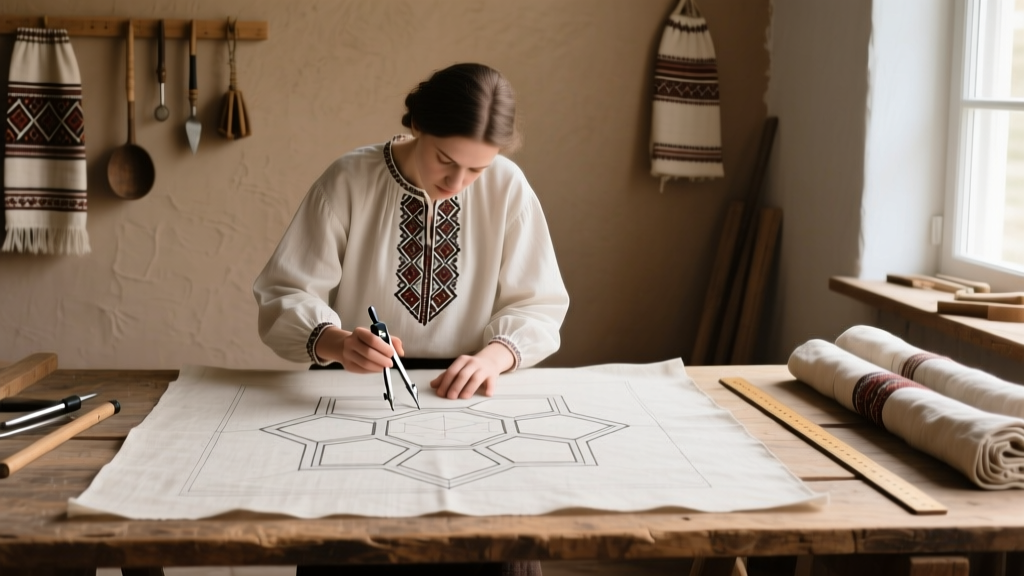
Drafting a rubakha requires abandoning modern slopers and embracing modular geometry. The following measurements and calculations will yield a traditional, comfortable fit with the characteristic voluminous drape of Eastern European folk dress.
1. The Main Body Panels
The core of the shirt consists of two large rectangles (front and back) or a single continuous piece folded over the shoulder. For a standard 150 cm wide fabric, you can cut the front and back panels side-by-side if the chest measurement allows, or stack them vertically.
- Width Calculation: (Full Chest Circumference / 2) + 10 cm of historical ease + 2 cm seam allowance. For a 100 cm chest, each panel is 62 cm wide.
- Length Calculation: Measure from the nape of the neck to the desired hemline (traditionally mid-thigh for men, calf-length for women's chemises). Add 4 cm for hem and shoulder seams.
- Neckline: A simple slit or small rectangular gusset is cut at the center fold. No curved necklines are used.
2. Rectangular Sleeves
Sleeves are cut as straightforward rectangles. The grainline runs parallel to the arm, ensuring the fabric drapes cleanly without twisting.
- Width: Bicep circumference + 15 cm ease + seam allowances. The historical silhouette favors a wide, billowing sleeve.
- Length: Shoulder point to wrist + 4 cm for cuff and shoulder seams.
3. The Underarm Gusset (Lastovitsa)
Because the rectangular sleeve is sewn flat to the rectangular body panel, lifting the arm would pull the entire side seam upward, restricting movement and risking a tear. The solution is the lastovitsa, a square gusset inserted at the underarm intersection.
- Dimensions: Typically a 12 cm x 12 cm or 15 cm x 15 cm square.
- Function: This square acts as a pivot point, distributing the tension of arm movement across four seams rather than one, granting the wearer complete overhead mobility.
4. Side Godets (Klin)
To allow for walking and sitting without adding excessive bulk to the waist, triangular godets are inserted into the side seams, starting from the hem and tapering up to the waist or the bottom of the underarm gusset. These triangles are often cut from the negative space left over from sleeve or gusset cutting, ensuring the zero-waste mandate is fulfilled.
Comparison of Regional Sleeve Constructions
While the geometric foundation remains consistent across Eastern Europe, regional variations dictate how the sleeve interacts with the cuff and the body. Below is a comparison of three distinct regional approaches to sleeve construction documented in folk textile studies, such as those preserved by the Adam Mickiewicz Institute.
| Region / Garment | Sleeve Shape | Cuff Treatment | Gusset Placement |
|---|---|---|---|
| Slavic Rubakha (East) | Straight rectangle, moderate width | Simple narrow band or drawstring tie | Standard 12cm square underarm |
| Balkan Košulja (South) | Extremely wide rectangle, gathered heavily | Wide, tightly embroidered structural cuff | Diamond-shaped gusset, often embroidered |
| Carpathian Chemise | Tapered via triangular under-sleeve inserts | Flared ruffle (fodros) at the wrist | Integrated into the under-sleeve triangle |
Assembly Techniques and Historical Seam Finishes
Constructing a zero-waste folk shirt requires specific seam finishes to ensure longevity, especially since the seams lie entirely on the straight grain and are subject to high friction.
- Felled Seams: The primary structural seams (shoulders, side seams, and sleeve attachments) should be flat-felled. This encloses the raw edges entirely, preventing fraying and creating a highly durable join that can withstand repeated laundering and physical labor.
- Whipstitching Hems: Instead of folding and machine-stitching the hem, historical accuracy and zero-waste ethics dictate using a fine whipstitch or a rolled hem, preserving the maximum length of the garment.
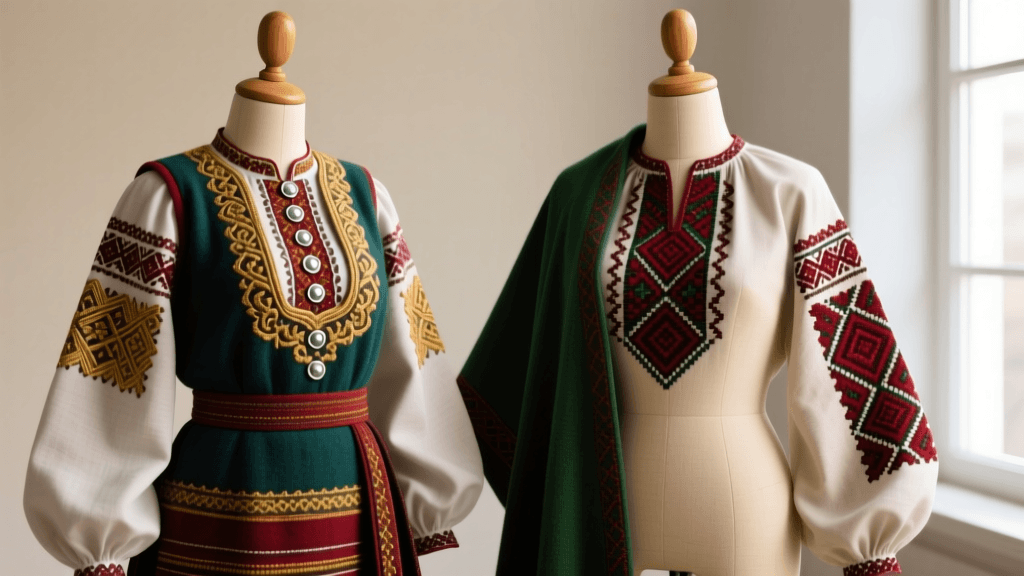
- Structural Embroidery: In Slavic and Balkan traditions, embroidery (such as the vyshyvanka or haptic patterns) was not merely decorative. Cross-stitch and counted-thread work were heavily concentrated at the neckline, cuffs, and hem—the exact points where the fabric is most vulnerable to wear and tearing. The dense thread network acts as a physical reinforcement, stabilizing the woven grid. In 2026, modern makers can replicate this using water-soluble stabilizers and computerized embroidery machines to map historical reinforcement patterns precisely over structural stress points.
Modern Adaptations for the 2026 Maker
While the geometry is ancient, the tools available to the 2026 maker allow for unprecedented precision in zero-waste nesting. Software like CLO3D and the open-source Valentina pattern drafting program allow designers to digitally nest the rectangular panels, gussets, and godets within the exact width of their chosen linen before a single cut is made. By adjusting the length of the side godets by mere millimeters in the digital space, makers can guarantee that the negative space perfectly forms the underarm gussets, achieving a true 100% fabric utilization rate.
Furthermore, the use of low-power CO2 laser cutters in small-scale 2026 studios allows for the precise cutting of linen without fraying the edges, as the heat seals the fibers slightly. This makes the subsequent flat-felling and whipstitching processes significantly cleaner and more durable.
By embracing the drafting techniques of the rubakha and košulja, modern garment makers do more than revive European folk dress; they adopt a time-tested, mathematically perfect approach to sustainable fashion. The zero-waste geometric pattern is a testament to the ingenuity of historical artisans, proving that true sustainability is not a modern invention, but a historical standard waiting to be rediscovered.