Greek Chiton & Roman Stola Guide 2026: Draping & Patterns
The Enduring Legacy of Classical Antiquity in 2026
The fascination with classical antiquity continues to shape historical reenactment, theatrical costuming, and neoclassical fashion in 2026. Unlike the highly tailored and structured garments of later European folk traditions, the foundational dress of ancient Greece and Rome relied entirely on the art of draping. Understanding the mechanics of the Greek chiton and the Roman stola is essential for anyone looking to authentically recreate these iconic silhouettes. According to the World History Encyclopedia's guide on Greek Clothing, the ancient Greeks viewed the uncut, rectangular cloth not as a limitation, but as a canvas that celebrated the natural form of the human body.
In this comprehensive 2026 guide, we will explore the structural differences between Hellenic and Roman garments, provide actionable draping instructions, and analyze the modern textile market to help you source the most historically accurate and sustainable fabrics available today. Whether you are preparing for a Hellenic festival, a university theater production, or simply studying the evolution of European folk dress, mastering these ancient techniques is paramount.
Understanding the Greek Chiton: Doric vs. Ionic
The chiton was the quintessential garment of ancient Greece, worn by both men and women. However, it was not a single, uniform design. The two primary variations—the Doric and the Ionic—differed significantly in fabric, construction, and draping style.
The Doric Chiton (Peplos)
The Doric chiton, often referred to as the peplos when worn by women, was the older and more traditional style. It was typically crafted from heavy, woven wool, which provided structure and warmth. The defining feature of the Doric chiton was the apoptygma, a deep overfold at the top edge of the garment that draped down over the chest and back. This overfold was pinned at the shoulders using large, heavy fibulae (brooches). The heavy wool allowed the fabric to fall in thick, sculptural folds that are prominently visible in surviving classical marble statues.
The Ionic Chiton
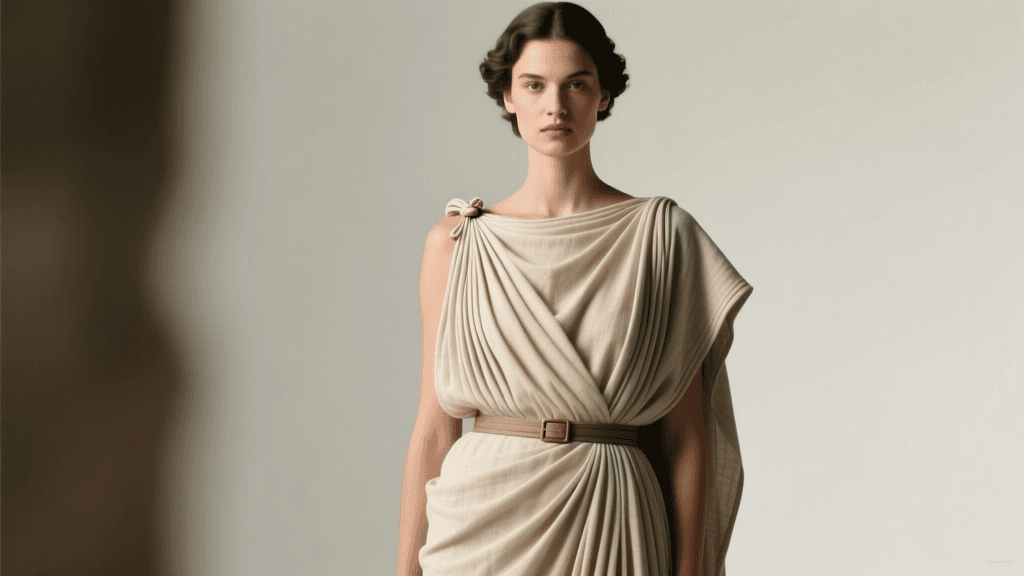
As trade expanded and lighter textiles became available, the Ionic chiton gained popularity. Made from fine, lightweight linen or imported silk, the Ionic chiton was much wider than its Doric counterpart. Instead of a single overfold and two shoulder pins, the Ionic chiton was gathered and pinned at multiple points along the arms, creating a delicate, flowing sleeve effect. Because the fabric was so fine, it was often belted at the waist or just under the bust, creating a bloused effect known as the kolpos.
The Roman Stola and Toga: Status and Structure
While Greek clothing emphasized the natural drape of the body, Roman clothing was heavily codified to reflect social status, citizenship, and gender. The transition from Greek to Roman dress represents a fascinating evolution in European textile history.
The Stola: Garment of the Roman Matron
The stola was the traditional, formal garment of the respectable married Roman woman (the matrona). Worn over a base tunic (tunica interior), the stola was a long, sleeveless dress suspended from the shoulders by small straps or clasps. As noted in the World History Encyclopedia's overview of Roman Clothing, the stola was more than just a piece of clothing; it was a legal and social symbol of modesty and virtue. A key identifying feature of the stola was the institia, a decorative flounce or border sewn along the bottom hem, which distinguished the matron from unmarried women or those of lower social standing.
The Toga: The Semicircular Mantle
The toga was the ultimate symbol of Roman male citizenship. Unlike the rectangular Greek chiton, the toga was cut in a massive semicircle, sometimes measuring up to 18 feet in width. Draping the toga was a complex, time-consuming process that required the assistance of a slave. The fabric was folded, wrapped around the body, and thrown over the left shoulder, creating distinct architectural folds such as the sinus (a deep pouch across the chest) and the umbo (a decorative knot of fabric at the front). Due to its immense weight and restrictive nature, the toga was reserved for formal public appearances, political duties, and religious ceremonies.
2026 Fabric Sourcing and Material Guide
Sourcing historically accurate fabrics has evolved significantly. In 2026, the historical reenactment and neoclassical fashion communities have seen a massive shift towards sustainable, ethically sourced textiles that mimic the drape of ancient weaves. When recreating these garments, the weight and weave of the fabric will dictate the success of your drape. Below is a comparison chart of the most recommended fabrics for classical garments in the current market.
| Fabric Type | Historical Accuracy | 2026 Avg Cost/Yard | Drape Quality | Best Used For |
|---|---|---|---|---|
| Heavyweight Linen (8-10 oz) | High | $32.00 | Crisp, Structured | Ionic Chiton, Base Tunics |
| Lightweight Tropical Wool | Very High | $45.00 | Fluid, Heavy, Sculptural | Doric Peplos, Roman Toga |
| Bamboo-Linen Blend | Moderate | $24.00 | Soft, Breathable, Fluid | Summer Reenactment, Theater |
| Raw Dupioni Silk | High (Elite) | $68.00 | Lustrous, Stiff, Delicate | Elite Stola Overlays, Ceremonial |
| Unbleached Cotton Muslin | Low | $12.00 | Light, Clinging | Prototyping, Budget Costuming |
Note: For the most authentic Doric peplos, avoid modern synthetic blends. The synthetic fibers lack the necessary weight to pull the wool into the deep, vertical flutes characteristic of classical Greek sculpture.
Step-by-Step Draping Guide: The Doric Chiton
Recreating the Doric chiton requires no sewing, only precise measuring, folding, and pinning. Follow these steps to achieve an authentic classical silhouette.
- Step 1: Measure the Fabric. You will need a single rectangle of lightweight wool or heavy linen. The height of the fabric should be equal to the wearer's height from the shoulder to the ankle, plus 12 inches for the kolpos (blousing). The width should be 1.5 to 2 times the wearer's hip circumference.
- Step 2: Create the Apoptygma. Fold the top edge of the fabric down towards the outside (the side that will face the public). The depth of this fold should reach from the shoulder to the waist or hips, depending on the desired style.
- Step 3: Wrap and Pin. Wrap the fabric around the body, with the fold at the top. Bring the two top corners together at the wearer's shoulders. Secure them using heavy, historically accurate bronze or iron fibulae.
- Step 4: Secure the Sides. The sides of the chiton can be left open (traditional for the peplos, revealing the leg when walking) or pinned/stitched closed from the armpit to the hem for modesty.
- Step 5: Belt and Blouse. Tie a woven wool or leather belt around the waist. Pull the fabric up and over the belt to create the kolpos. Adjust the overfold so it hangs evenly over the belt, hiding it completely.
Accessories: Fibulae, Belts, and Footwear
No classical garment is complete without its accompanying accessories. In 2026, the market for historical accessories has benefited from advanced 3D scanning and lost-wax casting techniques, allowing reenactors to purchase exact replicas of museum artifacts. For visual inspiration and to study the intricate designs of surviving bronze clasps, the Metropolitan Museum of Art's Greek and Roman Art collection remains an invaluable digital resource.
Fibulae (Brooches): Essential for securing the chiton at the shoulders. Look for 'bow fibulae' or 'disc fibulae' cast in solid bronze. Avoid modern, flimsy costume jewelry pins, as they will tear heavy wool and ruin the historical illusion.
Footwear: The most common footwear for both Greeks and Romans was the krepides or calcei—leather sandals with intricate strapwork. For indoor settings or theatrical stages, bare feet or simple leather wrap sandals are acceptable. For outdoor festivals in 2026, many reenactors opt for historically styled sandals with modern orthotic inserts hidden beneath the leather straps to ensure comfort during long days of wear.
Jewelry and Hair: Women would often wear their hair bound in a kekos (a snood or hairnet) or tied back with a simple ribbon (taenia). Gold or bronze arm bands (peribrachionia) and simple hoop earrings complete the classical aesthetic without overwhelming the drape of the garment.
Conclusion
The transition from the uncut, flowing rectangles of the Greek chiton to the complex, status-driven semicircles of the Roman toga represents a foundational chapter in the history of European folk dress. By understanding the geometry, textile requirements, and social context of these garments, modern enthusiasts can bring the ancient world to life with unprecedented accuracy. Whether you are sourcing sustainable tropical wool for a Doric peplos or mastering the intricate folds of a Roman stola, the principles of classical draping remain as relevant and beautiful in 2026 as they were millennia ago.