Sustainable Kusaki-Zome: 2026 Guide to Japanese Plant Dyes
The Renaissance of Japanese Natural Dyes in 2026
As the global fashion industry faces mounting pressure to reduce its environmental footprint, the ancient Japanese art of kusaki-zome (plant and tree dyeing) is experiencing a profound renaissance. In 2026, the shift toward circular fashion and regenerative agriculture has propelled traditional Japanese natural dyes from niche artisanal practices into the forefront of sustainable textile design. Unlike synthetic dyes, which rely on petrochemicals and contribute heavily to microplastic pollution and water toxicity, kusaki-zome utilizes biodegradable, locally foraged, and organically cultivated botanicals.
The Japanese Ministry of Economy, Trade and Industry (METI) continues to champion the preservation of these techniques, recognizing them not just as cultural heritage, but as vital blueprints for a sustainable future. According to METI's ongoing initiatives in traditional crafts promotion, integrating ancestral knowledge with modern eco-friendly methodologies is key to reducing the textile industry's carbon and water footprint. Today, we explore how artisans and home dyers are utilizing Japanese botanicals through zero-waste, eco-conscious methods.
Top Sustainable Japanese Dye Plants
The foundation of kusaki-zome lies in the selection of botanicals. In 2026, the most sustainable practices prioritize plants that require minimal water, no synthetic fertilizers, and low-energy extraction methods. Here are the three pillars of the modern Japanese natural dye studio.
1. Ai (Japanese Indigo - Persicaria tinctoria)
While tropical indigo (Indigofera tinctoria) requires high heat and extensive water for extraction, Japanese indigo (Persicaria tinctoria) thrives in temperate climates and can be processed using cold-water fermentation. In 2026, Tokushima and Saitama prefectures have seen a surge in regenerative ai farming, where the plant is grown alongside nitrogen-fixing cover crops to restore soil health. The leaves are harvested, dried, and composted with wood ash and sake to create sukumo (fermented indigo). Because the dye vat operates at room temperature (around 20°C to 25°C), it eliminates the need for energy-intensive heating, making it a cornerstone of low-carbon textile production.
2. Kakishibu (Persimmon Tannin)
Kakishibu is the dark, tannin-rich juice extracted from unripe, astringent persimmons. Historically used to waterproof paper, treat fishing nets, and strengthen textiles, it is now a favorite among sustainable fashion designers. The extraction process is entirely passive: the green persimmons are crushed and left to ferment in open vats for up to two years, requiring zero external energy. When applied to cotton, hemp, or silk, kakishibu acts as both a dye and a natural mordant. Furthermore, fabrics dyed with persimmon tannin are naturally antibacterial, insect-repellent, and water-resistant, reducing the need for chemical fabric finishes.
3. Yomogi (Japanese Mugwort)
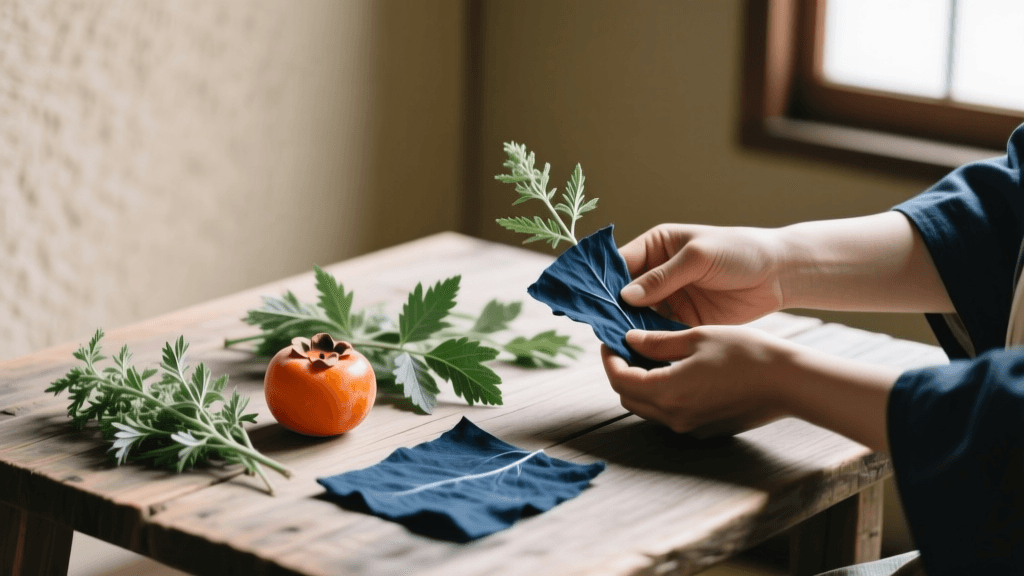
Yomogi is a prolific, fast-growing perennial weed found throughout Japan. Foraging yomogi requires no land allocation, no irrigation, and no pesticides, making it the ultimate zero-waste dye source. When simmered, yomogi yields beautiful, earthy tones ranging from soft olive greens to muted yellows, depending on the mordant used. In 2026, urban dye studios in Tokyo and Kyoto are partnering with local foragers to harvest invasive yomogi patches, turning an ecological management task into a valuable textile resource.
Eco-Friendly Mordanting: Moving Beyond Heavy Metals
Historically, many natural dyes required metallic mordants like alum, copper, or chrome to bind the pigment to the fiber. While alum is relatively safe, heavy metals like chrome are highly toxic and contradict the ethos of sustainable fashion. The Victoria and Albert Museum's extensive research on natural dyes and historical textiles highlights how early dyers utilized organic alternatives, a practice that has been heavily optimized for modern eco-studios.
In 2026, the standard for sustainable kusaki-zome relies on bio-mordants and natural modifiers:
- Soy Milk Binder: For cellulose fibers like cotton and hemp, which naturally resist plant dyes, a soak in organic, unflavored soy milk coats the fibers in plant-based proteins. This mimics the structure of silk and wool, allowing dyes like yomogi and madder to bond permanently without metallic salts.
- Upcycled Iron Liquor: To shift colors (e.g., turning yomogi from yellow to deep forest green), dyers use iron modifiers. Instead of buying synthetic iron powder, eco-studios create 'iron liquor' by soaking rusted, upcycled nails in a mixture of water and white vinegar for several weeks.
- Wood Ash Lye (Aku): Untreated wood ash from local kilns and fire pits is soaked in water to create an alkaline solution. This aku is used to shift the pH of dye baths, brightening yellows and deepening reds naturally.
Zero-Waste Water Conservation in the Dye Studio
Water usage is a critical metric in textile sustainability. The Ellen MacArthur Foundation's reports on fashion and the circular economy emphasize the necessity of closed-loop water systems. Modern kusaki-zome practitioners in 2026 employ several strategies to ensure zero wastewater pollution:
- Sequential Dye Baths: A primary dye bath is used for dark, saturated pieces. Once exhausted, the same water is used for lighter, secondary pieces, and finally, a third set of fabrics is dyed in the pale remnants.
- Botanical Irrigation: Because kusaki-zome uses only plant matter and bio-mordants, the exhausted dye water is non-toxic. Once cooled and pH-balanced, the water is used to irrigate acid-loving garden plants or compost piles, returning nutrients to the soil.
- Rainwater Harvesting: Artisanal studios are increasingly integrating rainwater catchment systems to supply their scouring and dyeing vats, bypassing the use of treated municipal water entirely.
Step-by-Step: Zero-Waste Yomogi Dyeing Guide
To put these 2026 sustainable practices into action, here is a practical guide to dyeing organic cotton using foraged yomogi and a soy milk binder.
Materials Needed: 100g organic PFD (prepared for dyeing) cotton, 500g fresh yomogi leaves, 1 liter organic soy milk, 100ml upcycled iron liquor, and a stainless steel pot.
- Protein Binding: Soak the scoured cotton in a 1:5 ratio of soy milk to water for 12 hours. Wring out gently (do not rinse) and let it dry completely. This creates a protein layer for the dye to adhere to.
- Pigment Extraction: Place the fresh yomogi in a pot, cover with just enough rainwater to submerge the leaves, and simmer at 80°C for 45 minutes. Strain the liquid through a reusable cotton cloth. Repeat the simmering process once more and combine both liquids.
- The Dye Process: Submerge the soy-treated cotton into the warm yomogi bath. Maintain a temperature of 60°C for one hour, stirring gently to ensure an even, mottled-free finish.
- Iron Modification: Remove the fabric and let it oxidize in the air for 15 minutes. Submerge it in a diluted iron liquor bath (1 part iron liquor to 20 parts water) for 10 minutes. Watch the fabric shift from a soft yellow-green to a rich, deep olive.
- Final Wash: Rinse the fabric in cold rainwater until it runs clear, then hang to dry in the shade to prevent UV fading.
Comparison: Synthetic vs. Eco-Friendly Kusaki-Zome
Understanding the environmental impact of our choices is crucial. Below is a comparison of conventional synthetic dyeing versus the 2026 standard for sustainable kusaki-zome.
| Metric | Conventional Synthetic Dyes | Sustainable Kusaki-Zome (2026) |
|---|---|---|
| Primary Ingredients | Petrochemicals, heavy metals, synthetic fixatives | Foraged plants, agricultural byproducts, bio-mordants |
| Energy Requirement | High (requires boiling and prolonged high heat) | Low to Medium (cold fermentation, solar curing, low simmer) |
| Water Toxicity | Highly toxic; requires intensive chemical treatment | Non-toxic; safe for soil irrigation and composting |
| Microplastic Shedding | High (especially with synthetic fiber/dye pairings) | Zero (used exclusively on natural, biodegradable fibers) |
| End of Life | Leaches toxins in landfills | Fully biodegradable; returns to the earth safely |
Looking Forward: The Future of Botanical Color
The integration of kusaki-zome into contemporary fashion is not merely a nostalgic retreat to the past; it is a forward-looking innovation. As consumers in 2026 demand greater transparency and ecological responsibility, the meticulous, zero-waste methods of Japanese plant dyeing offer a scalable, beautiful alternative to the toxic norms of fast fashion. By embracing regenerative agriculture, upcycled mordants, and closed-loop water systems, we honor the deep cultural roots of Asian traditions while actively healing the planet. Whether you are a professional textile designer or a curious home crafter, the botanical world offers an infinite, sustainable palette waiting to be explored.