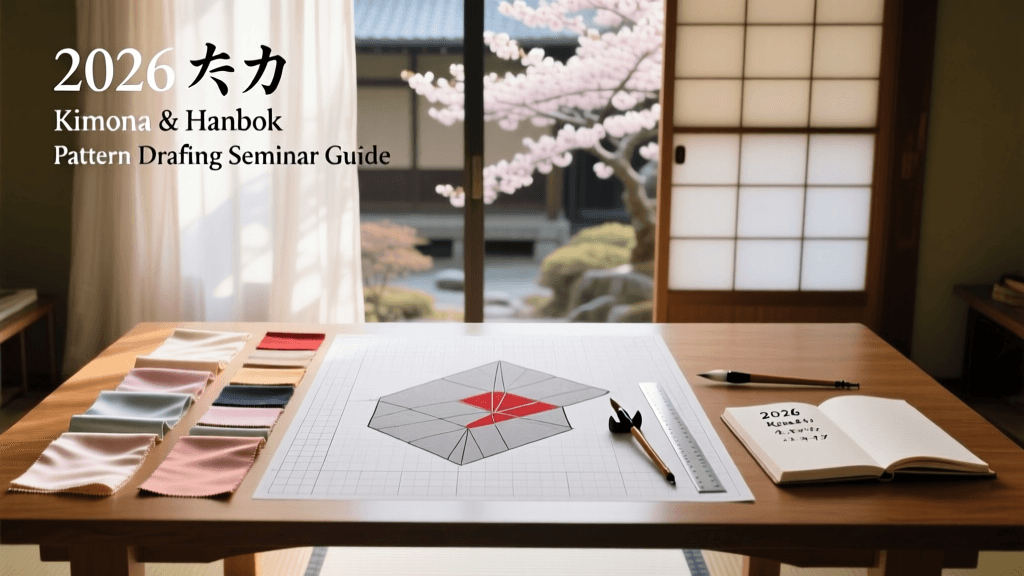
Zero-Waste Kimono Construction: Tanmono Techniques 2026
The Genius of Tanmono: Zero-Waste Pattern Cutting
In the global push toward circular fashion in 2026, the modern apparel industry is desperately seeking solutions to the 15% to 20% fabric waste typically generated by Western curved pattern cutting. Yet, centuries before the term 'zero-waste' entered the sustainability lexicon, Japanese artisans perfected a garment construction system that leaves virtually no textile scraps behind. This system is rooted in the tanmono, the traditional narrow-width bolt of fabric used to construct the kimono. By examining the structural genius of tanmono cutting, modern sewists and fashion designers in 2026 are rediscovering a blueprint for truly sustainable garment creation.
Unlike Western tailoring, which relies on carving out complex, curved shapes (like armholes and princess seams) from wide fabric bolts and discarding the negative space, the kimono is constructed entirely from straight, rectangular panels. According to the Metropolitan Museum of Art's Heilbrunn Timeline of Art History, the fundamental structure of the kimono has remained remarkably consistent for centuries, precisely because its geometric efficiency is inextricably linked to the loom technology and resource conservation of historical Japan.
Standard Measurements and the 36cm Bolt Rule
The foundation of kimono construction is the tanmono bolt. A standard tanmono is woven to a specific, narrow width—typically between 36 and 40 centimeters (about 14 to 15.5 inches)—and a length of roughly 11 to 12 meters. This specific width was historically dictated by the physical constraints of the traditional backstrap loom and the width of a human body panel.
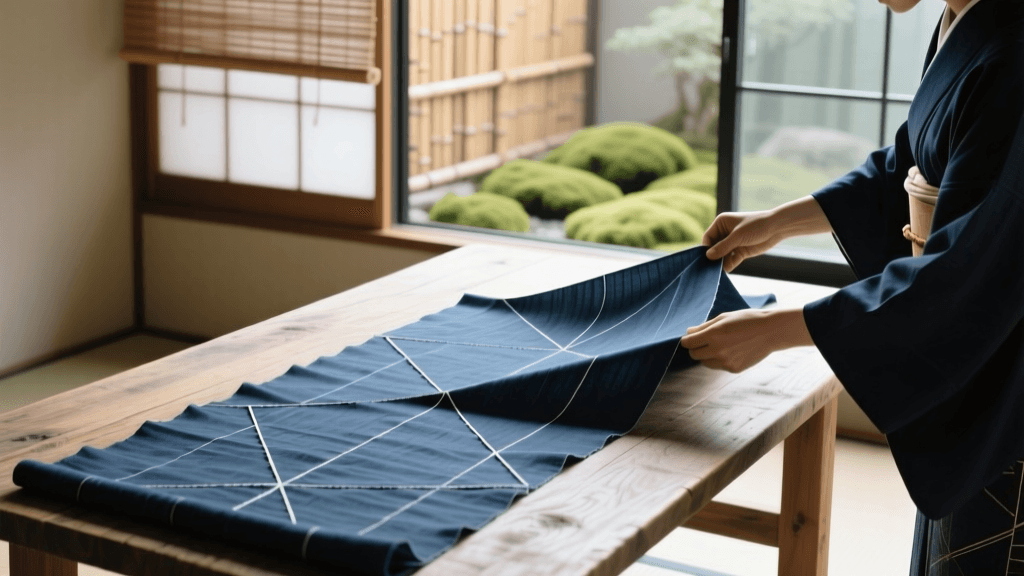
When constructing a standard women's kimono, the entire bolt is utilized. The fabric is cut into eight primary rectangular pieces: two main body panels (mi-goro), two narrower front overlap panels (okumi), two sleeves (sode), and a collar (eri). Because the cuts are strictly linear and follow the grain of the fabric, there is zero negative space left behind. Even the smallest remnants are utilized for accessories or patchwork, achieving a 100% material yield that modern zero-waste design software is still trying to emulate.
Comparison: Tanmono vs. Western Tailoring (2026 Industry Standards)
| Construction Feature | Traditional Tanmono (Kimono) | Standard Western Tailoring |
|---|---|---|
| Fabric Width | Narrow (36-40 cm) | Wide (115-150 cm) |
| Pattern Shapes | Straight rectangles | Curved, complex geometries |
| Material Waste | 0% (Entire bolt used) | 15% - 20% average waste |
| Seam Allowances | Left inside, untrimmed | Trimmed and finished/serged |
| End-of-Life Recyclability | Seamlessly dismantled for reuse | Difficult due to mixed cuts/finishes |
The Straight-Line Stitch: Construction Without Darts
The construction techniques required to assemble a tanmono garment are as deliberate as the cutting process. Because the human body is curved and the fabric panels are straight, the kimono relies on draping and folding rather than darts and seams to achieve a fit. The side seams are left partially open under the arms, creating the miyatsukuchi (armhole openings), which allow the garment to drape naturally and provide ventilation.
The stitching itself is designed for longevity and eventual deconstruction. The primary side and sleeve seams utilize a stitch called hon-busui, a running stitch that is strong yet yields slightly to the movement of the wearer. More importantly, the seam allowances inside a kimono are never trimmed. They are folded and left intact within the garment. This excess fabric acts as a structural buffer, allowing the kimono to be unpicked, re-sized, or re-draped for a different wearer over its multi-generational lifespan.
Basting and the Art of Shitsuke-ito
Another unique construction technique is the use of shitsuke-ito (basting threads). When a kimono is stored or newly purchased, long, loose basting stitches are applied along the outer edges of the sleeves and hem. These threads prevent the delicate silk from creasing or losing its shape while folded in a tatoushi (storage paper). Before wearing, these threads are simply pulled out. This temporary construction method highlights a philosophy where the garment is viewed as a fluid, ongoing project rather than a rigid, static product.
The Arai-Hari System: Washing by Dismantling
Perhaps the most revolutionary aspect of tanmono construction from a 2026 sustainability perspective is the arai-hari (wash and stretch) process. Because a kimono is constructed from straight panels with untrimmed seam allowances, it can be completely taken apart at the seams when it becomes soiled. The individual rectangular panels are then washed, stretched on bamboo frames to dry, and re-sewn. This process effectively restores the textile to a brand-new state without the harsh mechanical agitation of modern washing machines, which degrade fibers and release microplastics into water systems.
As noted by the Ellen MacArthur Foundation, extending the active life of a garment by just nine months reduces its carbon, water, and waste footprints by 20-30%. The arai-hari system extends the life of a kimono not by months, but by centuries, embodying the ultimate circular economy model that modern textile engineers are currently striving to replicate.
Modern Applications in 2026 Sustainable Fashion
In 2026, the environmental cost of fast fashion has prompted a massive shift toward zero-waste pattern making. Leading sustainable design curriculums in Tokyo, London, and New York are now incorporating tanmono principles into their core coursework. Designers are intentionally sourcing narrow-width organic linens and peace silks, forcing themselves to design within the 36cm constraint to eliminate cutting room waste.
Furthermore, the UN Environment Programme (UNEP) has heavily promoted traditional, low-impact garment construction methods as a viable alternative to the hyper-accelerated, waste-heavy production models of the past decade. Contemporary brands are adopting the 'untrimmed seam allowance' rule, creating modular clothing that can be easily unpicked and resized by the consumer, mimicking the generational adaptability of the traditional kimono.
Notable 2026 Design Adaptations
- Modular Workwear: Utilizing straight-line cutting to create heavy canvas work jackets that can be disassembled and patched without specialized sewing equipment.
- Narrow-Loom Denim: A revival of shuttle-loom selvedge denim, woven to 36cm widths, constructed using kimono-inspired straight seams to maximize the use of premium, water-intensive cotton.
- Zero-Waste Loungewear: Using the okumi (front overlap) panel concept to create wrap-style garments that require no zippers, buttons, or elastic, making the garment 100% biodegradable at the end of its life.
How to Start Sewing with Tanmono Principles
For home sewists and independent designers looking to integrate Asian construction traditions into their 2026 workflow, adopting the tanmono mindset requires a shift in both material sourcing and pattern drafting. Here is an actionable guide to beginning your zero-waste journey:
- Source Narrow Fabrics: Seek out traditional narrow-width fabrics (approx. 14-15 inches wide). Many specialty weavers and heritage mills now offer narrow-width organic cottons and linens specifically for zero-waste designers.
- Draft in Rectangles: Abandon curved armholes and princess seams. Draft your patterns using only geometric rectangles and squares. Use gussets under the arm if additional mobility is required, a technique historically used in Asian peasant garments.
- Preserve Your Seam Allowances: Do not trim or serge your seam allowances. Fold them inward and enclose them in a flat-felled or French seam. This leaves the original fabric width intact inside the garment for future alterations.
- Use Temporary Basting: Instead of permanent topstitching for hems and facings, experiment with heavy basting stitches that allow you to adjust the hem length or replace a damaged facing without damaging the base textile.
- Design for Disassembly: Use 100% cotton or silk thread when sewing natural fibers. If the garment ever needs to be composted or chemically recycled, the thread will break down alongside the fabric, avoiding the microplastic contamination caused by modern polyester threads.
By looking to the intricate, waste-free construction techniques of the Japanese kimono, the modern fashion industry can find a proven, centuries-old roadmap to true sustainability. The tanmono system proves that zero-waste is not a modern invention, but a historical standard of respect for the materials we wear.