Zero-Waste Kimono and Hanbok Construction Methods 2026
The Philosophy of Straight-Line Cutting in Asian Dress
In 2026, the global fashion industry's aggressive pivot toward circularity and zero-waste design has placed a massive spotlight on historical garment construction. While Western tailoring traditionally relies on curved pattern cutting that leaves behind 15% to 20% of fabric as scrap, East Asian dress traditions have perfected the art of zero-waste construction for centuries. By utilizing straight-line cutting and flat-patterning, traditional garments like the Japanese kimono and the Korean hanbok maximize every single thread of the textile. For modern makers, bespoke tailors, and sustainable fashion historians, understanding these ancestral techniques is no longer just an academic exercise; it is a vital blueprint for the future of ethical garment creation.
The core philosophy of East Asian flat-pattern cutting revolves around the loom. Rather than cutting fabric into complex, curved shapes to fit the human body, traditional Asian garments are engineered to drape, fold, and tie. The fabric is respected as a continuous, unbroken plane. As The Metropolitan Museum of Art notes in its historical analysis of Japanese dress, the structural integrity and aesthetic beauty of the kimono rely entirely on the unbroken canvas of the textile, allowing the surface design to remain uninterrupted by complex tailoring darts or curved seams.
Kimono Construction: The Tanmono Standard
The foundation of kimono construction is the tanmono, a standardized bolt of fabric. In 2026, while modern textile mills produce varied widths for Western-style clothing, authentic kimono silk and hemp are still woven to strict traditional dimensions. A standard tanmono measures approximately 36 to 40 centimeters (14 to 16 inches) in width and 11 to 12 meters (36 to 39 feet) in length. This specific width is historically dictated by the physical reach of the weaver's arms on a traditional handloom.
A complete kimono is constructed from exactly eight rectangular panels cut directly from this single bolt:
- Two Body Panels (Migoro): Forming the front and back of the garment.
- Two Sleeve Panels (Sode): Creating the iconic draping sleeves.
- Two Overlap Panels (Okumi): Providing the overlapping front closure.
- One Collar (Eri): Folded to create the neckband.
- One Sleeve Trim (Tomosode/Take): Used for finishing edges.
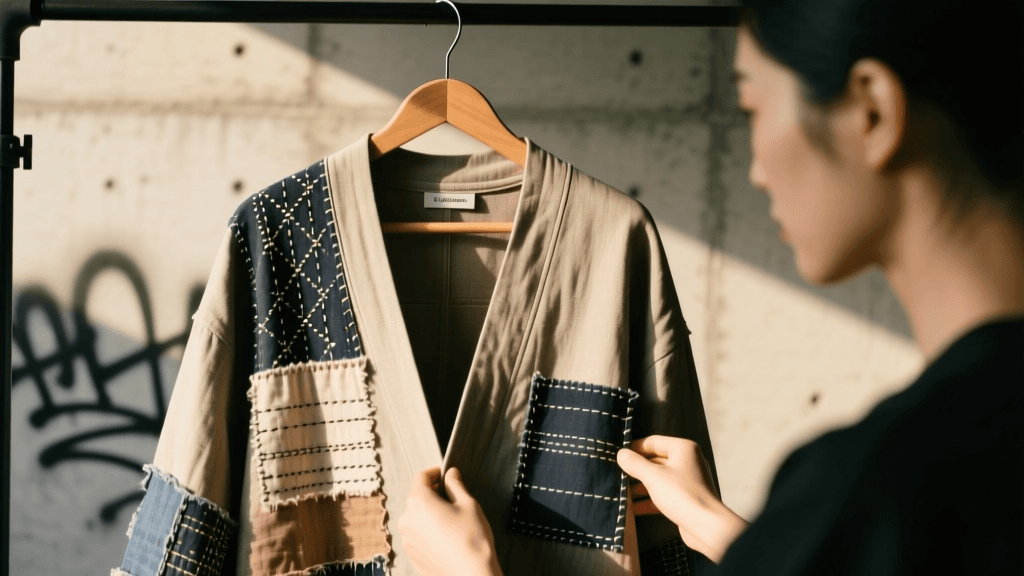
Because the panels are cut in straight lines parallel to the selvedge (the finished edge of the fabric known as the waku), there is virtually zero fabric waste. The selvedge edges are often left intact and hidden inside the seams, preventing fraying without the need for modern overlocking or serging. Furthermore, the kimono is constructed using shitsuke (temporary basting threads) and long, running stitches. This allows the garment to be completely disassembled, washed, re-dyed, and resewn multiple times over its lifespan, making it the ultimate circular fashion garment.
Hanbok Construction: Flat Patterning and Curved Accents
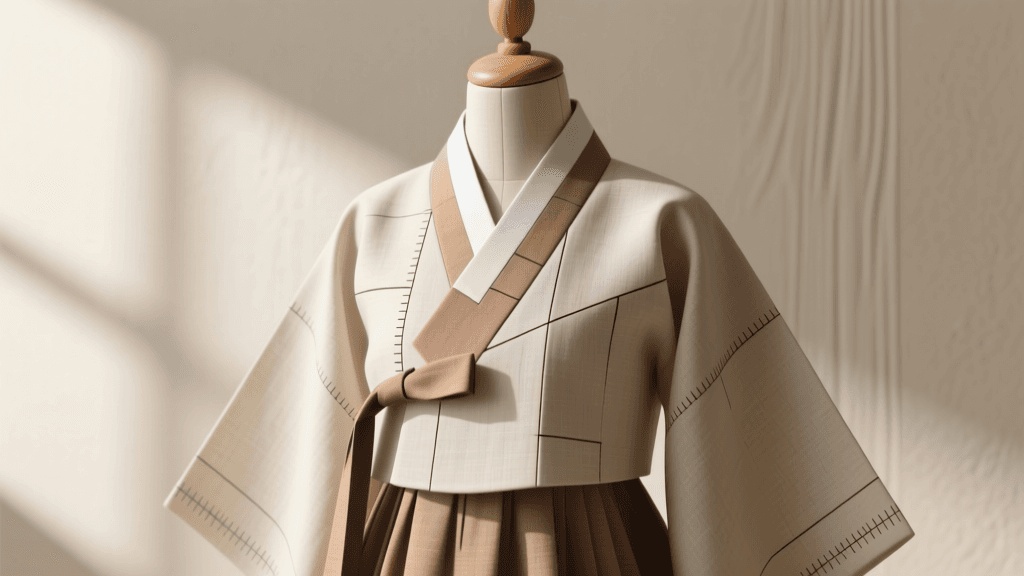
While sharing the zero-waste ethos of the kimono, the Korean hanbok introduces subtle structural variations that create its signature voluminous silhouette. As detailed by Encyclopædia Britannica, the hanbok is characterized by its vibrant colors and simple lines without pockets, traditionally consisting of a jeogori (jacket) and chima (wrap-around skirt) for women, or baji (trousers) for men.
The fabric bolt used for hanbok, known as saedan, follows a similar straight-line cutting methodology. However, the jeogori features a unique construction element called the baerae. While the main body panels are cut flat and straight, the baerae is a subtle, curved underarm seam that mimics the gentle curve of a traditional Korean roofline. This single curve allows for greater arm mobility and creates a beautiful, rounded drape when the arms are lowered.
Another critical construction element is the goreum, the long, flowing ribbons used to tie the jeogori closed. In 2026, contemporary hanbok makers are experimenting with the proportions of the goreum, using digital textile printing to embed micro-patterns that only become visible when the ribbons are tied in the traditional asymmetric bow. The chima is constructed from multiple rectangular panels gathered into a waistband, utilizing the full width of the fabric to create the iconic bell-shaped volume without the need for structural petticoats.
2026 Sustainable Revival: Digital Tools Meet Ancient Methods
The year 2026 has seen a remarkable synthesis of ancient flat-patterning techniques and cutting-edge digital fashion technology. Modern makers and sustainable fashion houses are utilizing 3D body scanning and advanced simulation software like CLO3D and Browzwear to adapt straight-line construction for diverse, non-standard body types. Historically, kimono and hanbok were sized by adjusting the width of the overlapping panels and the depth of the folds. Today, digital avatars allow tailors to simulate the drape of a 38cm tanmono on a plus-size or petite digital model, calculating the exact placement of the okumi (overlap) to ensure perfect proportions before a single physical cut is made.
Additionally, laser-cutting technology is being employed to seal the edges of delicate 2026 smart-silks and lab-grown spider silk blends. These modern bio-textiles, engineered for temperature regulation and biodegradability, can fray more easily than traditional heavy crepe silks. Precision laser-cutting ensures perfectly straight panels while simultaneously heat-sealing the microscopic fibers, maintaining the zero-waste philosophy while adapting to next-generation materials.
Comparison: Kimono vs. Hanbok Construction Metrics
Understanding the technical differences between these two traditions is essential for makers looking to implement flat-pattern cutting in their own 2026 collections. Below is a comparative analysis of their construction metrics.
| Metric | Japanese Kimono | Korean Hanbok (Jeogori/Chima) |
|---|---|---|
| Fabric Bolt Name | Tanmono | Saedan |
| Standard Bolt Width | 36 - 40 cm | 40 - 50 cm (varies by era/style) |
| Primary Cutting Style | Strictly Rectangular / Straight | Mostly Rectangular with Baerae curve |
| Fastening Method | Obi (external sash/belt) | Goreum (integrated tied ribbons) |
| Seam Allowance | Generous, folded inside (waku intact) | Moderate, often finished with binding |
| Fabric Waste Percentage | ~0% (True Zero-Waste) | ~1-2% (Minor trimming at curves) |
| 2026 Material Trend | Recycled Tsumugi silk, Hemp blends | Organic Ramie, Bio-engineered dyes |
Practical Guide: Sourcing and Prepping Fabric in 2026
For designers and hobbyists looking to practice authentic straight-line construction, sourcing the correct materials is the first critical step. The market for traditional textile bolts has evolved significantly by 2026, with a strong emphasis on traceable, sustainable supply chains.
Sourcing Authentic Bolts
Authentic silk tanmono can be sourced directly from heritage weaving cooperatives in regions like Nishijin (Kyoto) and Chichibu. In 2026, a premium, hand-woven silk tanmono typically ranges from $350 to $800, reflecting the fair-wage initiatives and sustainable sericulture practices now standard in the industry. For more accessible practice, organic hemp and cotton-linen blends woven to the exact 38cm specification are available from specialized online textile purveyors for $80 to $150 per bolt.
Preparation: The Yu-no-hoshi Process
Before cutting, traditional silk must undergo yu-no-hoshi (steam stretching). In a modern 2026 studio, this is achieved using precision climate-controlled steam tables. The fabric is gently steamed and stretched along the grain to pre-shrink the fibers and align the warp and weft. Skipping this step will result in warped rectangular panels and misaligned seams, destroying the geometric harmony essential to both kimono and hanbok construction.
Stitching Techniques: Hon-Buse and Edge Finishing
The construction of the kimono relies heavily on the hon-buse (full lining) technique for high-end garments, or edge-folding for unlined summer wear (hitoe). When sewing the long side seams, makers use a running stitch with high-quality silk thread. The seam allowance is not trimmed; instead, it is folded inward, encasing the raw edges and the selvedge. This creates a reversible garment and adds structural weight to the hem, allowing the kimono to drape elegantly over the body.
In hanbok construction, edge finishing is often achieved through seon (piping or binding). The collar (git) of the jeogori is reinforced with a removable white collar cover (dongjeong), which can be easily replaced when soiled. This modular approach to garment maintenance is a brilliant example of historical design solving modern sustainability issues—extending the life of the garment without the need for intensive dry cleaning.
Conclusion: The Future is Flat
As the fashion industry in 2026 grapples with the environmental devastation caused by Western-style curved pattern cutting and fast fashion, the wisdom of Asian dress traditions offers a proven, elegant solution. The straight-line construction methods of the kimono and hanbok prove that zero-waste design does not require sacrificing beauty, volume, or cultural significance. By studying the tanmono and saedan, modern makers can unlock a sustainable paradigm where the textile is honored, waste is eliminated, and the garment is designed to endure for generations.