Decoding Imperial Chinese Rank Badges and Color Codes
The Language of Silk: Color Codes in Imperial China
In Imperial China, clothing was never merely functional or aesthetic; it was a strictly regulated visual language that communicated the wearer's exact social standing, political rank, and cosmic alignment. Nowhere was this more evident than in the sumptuary laws governing the Ming (1368–1644) and Qing (1644–1912) dynasties. According to the Metropolitan Museum of Art's Heilbrunn Timeline of Art History, the Qing court enforced rigid dress codes where every hue, motif, and textile technique was legally prescribed based on the wearer's rank.
The Hierarchy of Hues
Color was the first indicator of status, visible from a distance before the intricate details of embroidery could be discerned. The imperial color palette was deeply rooted in the Five Elements theory (Wuxing) and cosmological directions.
- Bright Yellow (Minghuang): Reserved exclusively for the Emperor, the Empress, and the Empress Dowager. This color represented the center of the universe and the earth element. Wearing bright yellow without imperial decree was a treasonous offense punishable by death.
- Apricot Yellow (Xinghuang): Designated for the Crown Prince and the Emperor's sons. It was slightly muted, acknowledging their royal blood while maintaining the supremacy of the Emperor's bright yellow.
- Golden Yellow (Jinhuang): Worn by high-ranking imperial princes and nobility of the first and second degrees.
- Blue and Black: The standard colors for court officials and lower-ranking nobility. The Victoria and Albert Museum notes that while Ming officials frequently wore red or dark blue robes, the Qing dynasty standardized dark blue and black for most official court functions, reserving bright colors for specific ceremonial occasions or imperial family members.
- Red (Crimson): Associated with the south, fire, and joy. While used in wedding garments across all classes, in the court, specific shades of crimson were reserved for high-ranking officials during auspicious state rituals.
Decoding the Buzi (Mandarin Squares)
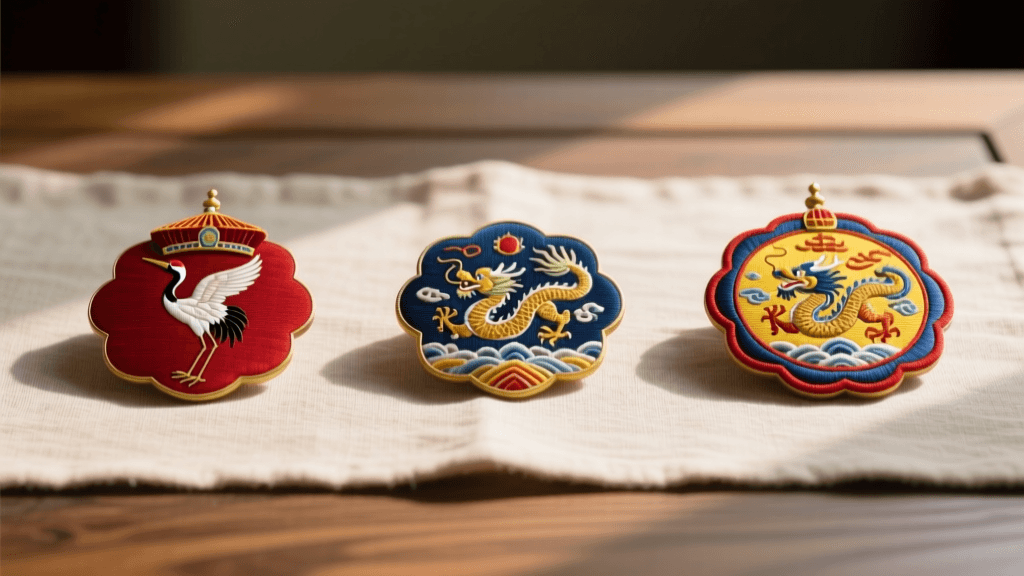
While color established the broad tier of nobility, the Buzi—commonly known in the West as Mandarin Squares—pinpointed the exact civil or military rank of an official. Introduced during the Ming dynasty and refined under the Qing, these intricately embroidered badges were worn on the front and back of the outer surcoat (bufu).
The British Museum's textile collection highlights how civil officials were represented by birds (symbolizing elegance and literary grace), while military officials were represented by mythical and real beasts (symbolizing courage and martial prowess).
Table: Qing Dynasty Rank Badges (1644–1912)
| Rank | Civil Official (Bird) | Military Official (Beast) |
|---|---|---|
| 1st Rank | Red-Crowned Crane | Qilin (Mythical Chimera) |
| 2nd Rank | Golden Pheasant | Lion |
| 3rd Rank | Peacock | Leopard |
| 4th Rank | Wild Goose | Tiger |
| 5th Rank | Silver Pheasant | Bear |
| 6th Rank | Egret | Panther |
| 7th Rank | Mandarin Duck | Rhinoceros |
| 8th Rank | Quail | Seal (or Sea Horse) |
| 9th Rank | Paradise Flycatcher | Sea Horse |
Collector's Note: Unlike Ming dynasty badges, which were often woven directly into the fabric of the robe in two large, continuous pieces, Qing dynasty badges were typically made as separate squares (approx. 28-30 cm each) and sewn onto the surcoat. The front badge was split down the middle to accommodate the coat's central opening.
A Buyer’s Guide to Reproduction and Antique Buzi
For historians, theatrical costumers, and serious collectors of Asian traditions, acquiring accurate Mandarin squares requires a keen eye for material, technique, and historical accuracy. Whether you are sourcing an antique piece or commissioning a historically accurate reproduction, understanding the market and craftsmanship is essential.
Measurements and Specifications
When commissioning or verifying a Qing-era reproduction, exact measurements are critical. Authentic Qing squares measure between 28 cm and 30 cm (11 to 11.8 inches) on each side. Ming reproductions should be larger, often exceeding 35 cm, and should feature the sun motif (representing the Emperor) in the top left or right corner, a detail frequently omitted in later Qing pieces.
Materials and Techniques: Kesi vs. Embroidery
The value and historical accuracy of a badge depend heavily on its creation method:
- Kesi (Silk Tapestry): Translating to 'cut silk,' this technique uses a loom to weave the design directly into the fabric, creating a pattern that looks identical on both sides. Kesi badges were the most expensive and prestigious, often worn by top-tier nobility. Cost: Custom Kesi reproductions from master weavers in Suzhou, China, cost between $1,500 and $4,000 USD and require a lead time of 6 to 10 months.
- Su Embroidery (Suzhou Stitch): Characterized by incredibly fine, flat stitches that create a painterly, photorealistic effect. Cost: High-quality Su embroidery reproductions range from $400 to $900 USD, with a production time of 3 to 5 months.
- Peking Knot (Seed Stitch): A heavily textured, durable stitch commonly used for military badges to give the animal motifs a rugged, scaled appearance. Cost: $300 to $600 USD.
Sourcing Antique Badges: Costs and Red Flags
The antique market for Buzi is robust, but fraught with late-19th-century tourist trade fakes and modern synthetic reproductions.
- Pricing: A genuine, well-preserved 19th-century Qing civil badge (e.g., a 4th rank Wild Goose) typically sells at auction for $800 to $2,500 USD. First-rank Crane or Qilin badges, especially those featuring real gold thread and kingfisher feather inlay (tian-tsui), can exceed $10,000 USD.
- Dye Verification: Before 1860, Chinese dyers used natural sources: indigo for blue, safflower for red, and pagoda tree buds for yellow. After the 1860s, synthetic aniline dyes from Europe flooded the market. An antique badge with harsh, unfaded magenta or bright chemical green is likely post-1880 or a modern fake.
- Metal Thread Tarnish: Authentic gold thread was made by wrapping gilt paper or thin gold leaf around a silk core. It should show subtle, organic tarnishing. Modern reproductions often use synthetic metallic yarns that remain unnaturally bright or flake into plastic-like shards.
Caring for and Displaying Rank Badges
Whether you possess a fragile 18th-century antique or a newly commissioned Kesi masterpiece, proper archival care is non-negotiable to preserve the silk proteins and natural dyes.
Archival Mounting and Framing
Never glue or tape a silk badge to a backing board. Use 100% cotton rag, acid-free mat boards and mount the textile using a tension mount or invisible archival stitching. Frame the piece behind UV-filtering Optium Museum Acrylic, which blocks 99% of harmful ultraviolet rays and reduces static buildup that can pull fragile gold threads from the weave.
Climate Control
Silk is highly susceptible to mold in humidity and becomes brittle in dry heat. Display or store your textiles in a climate-controlled environment maintaining a strict Relative Humidity (RH) of 50% (±5%) and a temperature of 68°F (20°C). If storing in a vault, wrap the badges in unbleached, washed muslin cloth and place them flat in acid-free Hollinger boxes; never fold a Kesi badge, as the tapestry weave is prone to permanent cracking along the fold lines.
Conclusion
The Buzi and the strict color codes of Imperial China represent one of the most sophisticated systems of sartorial communication in human history. By understanding the nuanced differences between a civil crane and a military tiger, or the profound distinction between bright yellow and apricot, collectors and enthusiasts do more than acquire beautiful textiles—they preserve the intricate social fabric of a bygone empire.