Chinese Drawloom Weaving: 2026 Yunjin Brocade Revival Guide
The Resurgence of the Chinese Drawloom in 2026
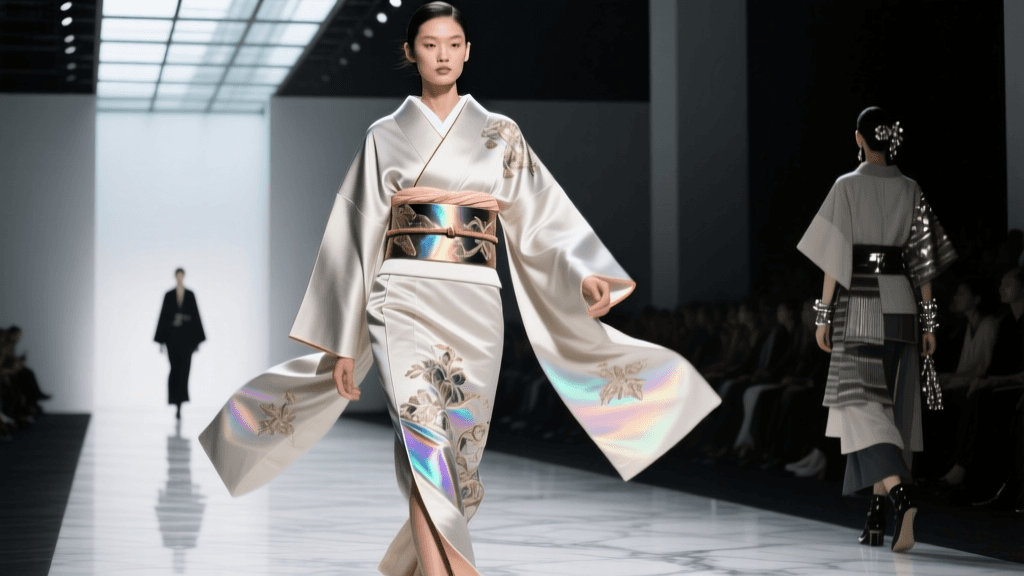
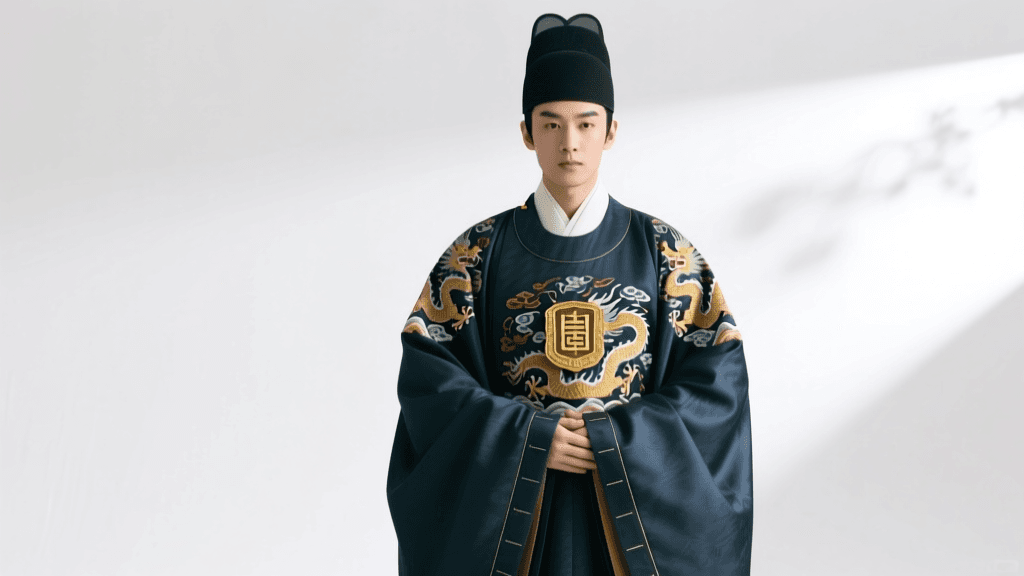
As we navigate the fashion and textile landscape of 2026, the Xin Zhongshi (new Chinese style) movement has evolved from a niche aesthetic into a dominant global force. At the very heart of this sartorial revolution lies the ancient Chinese drawloom, known as the Hua Lou, and its most magnificent creation: Nanjing Yunjin (cloud brocade). For centuries, this intricate weaving technique was reserved exclusively for imperial dragon robes and court garments. Today, contemporary artisans and high-fashion houses are reviving these ancient weaving techniques, blending them with modern silhouettes to create breathtaking textiles that honor Asian traditions while pushing the boundaries of sustainable, slow fashion.
According to the UNESCO Intangible Cultural Heritage registry, the Nanjing Yunjin brocade technique represents the pinnacle of Chinese silk weaving. In 2026, the integration of these heritage textiles into everyday luxury wardrobes has sparked a renewed interest in traditional loom mechanics, prompting a new generation of weavers to master the massive, multi-level wooden structures that make this art form possible.
Silk Road Exchanges and the Origins of Yunjin
To understand the complexity of the Chinese drawloom, one must look back at the historic Silk Road exchanges. Yunjin is famous for its liberal use of gold and silver threads, as well as peacock feather yarns. The incorporation of metallic threads into Chinese silk weaving was heavily influenced by Central Asian and Persian textile traditions introduced via the Silk Road during the Tang and Yuan dynasties. By the Ming Dynasty, the Hua Lou had been perfected to accommodate these heavy, supplementary wefts, allowing weavers to create the raised, jewel-like patterns that characterize Yunjin. As noted by the Metropolitan Museum of Art, the cross-pollination of weaving technologies along the Silk Road fundamentally altered the trajectory of Chinese textile production, culminating in the sophisticated drawlooms used in Nanjing and Suzhou.
Anatomy of the Traditional Hua Lou (Drawloom)
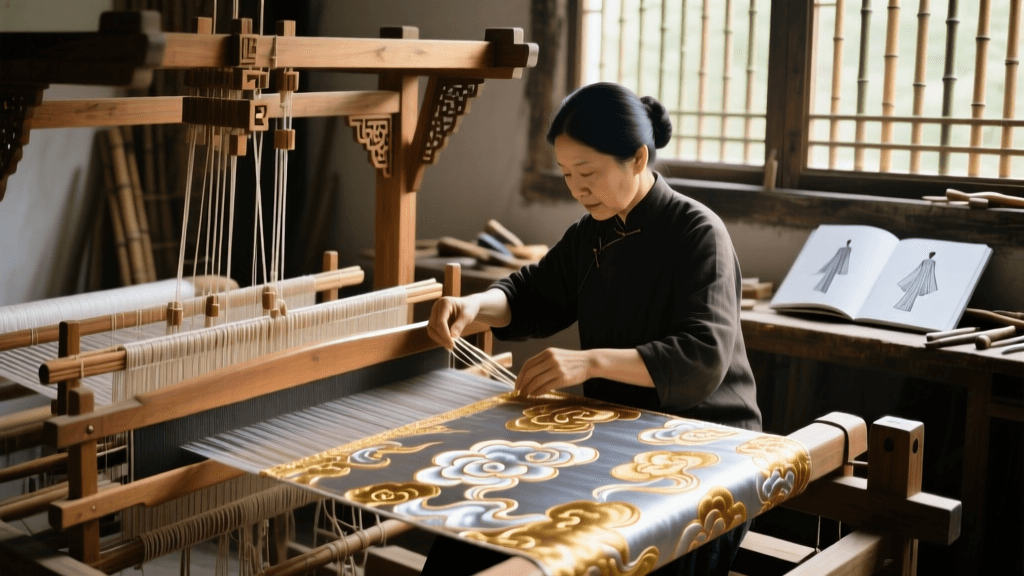
The traditional Hua Lou is a marvel of ancient engineering. Measuring up to 5 meters long and 4 meters tall, it requires two operators: the weaver, who sits at the lower level managing the shuttles and treadles, and the "drawboy" (or pattern puller), who sits on the upper platform and manipulates the pattern harness (hua ben). In 2026, while the fundamental mechanics remain unchanged, modern artisan studios have introduced ergonomic and material upgrades to accommodate smaller studio spaces and reduce physical strain.
| Feature | Traditional Ming Dynasty Loom | 2026 Artisan Studio Edition |
|---|---|---|
| Dimensions | 5m (L) x 4m (H) x 1.5m (W) | 2.5m (L) x 2.2m (H) x 1m (W) |
| Frame Material | Aged Elm or Camphor Wood | Sustainably Sourced Bamboo & Carbon-Fiber Joints |
| Pattern Harness | Hand-tied Cotton Cords | Laser-cut Recycled Nylon Loops |
| Heddle Count | Up to 15,000+ individual heddles | Modular Heddle Bars (up to 8,000 per module) |
| Tension System | Manual Wooden Ratchets | Hydraulic-Assisted Micro-Tensioners |
Step-by-Step Yunjin Weaving Technique
Weaving Yunjin on a drawloom is a painstakingly slow process. A master weaver in 2026 can typically produce only 5 to 6 centimeters of fabric per day. The technique relies on a complex system of memory and manual dexterity. Here is a breakdown of the core workflow for creating a traditional cloud brocade motif:
- Designing the Pick (Tiao Hua): The process begins off-loom. A pattern master translates the desired motif into a grid, which is then used to tie the pattern harness (hua ben). This harness acts as a physical, programmable memory bank for the loom.
- Shed Formation: The drawboy pulls specific cords on the upper level based on the sequence dictated by the pattern master. This lifts the exact warp threads required for that single pass of the weft.
- Digging the Weft (Wa Hua): Unlike standard brocades where the weft runs continuously from edge to edge, Yunjin utilizes a technique where colored supplementary wefts are only inserted where the pattern demands. The weaver uses small, bamboo stick shuttles to "dig" or place the colored silk and gold threads strictly within the motif's boundaries.
- Beating and Advancing: The weaver uses the heavy wooden batten to beat the weft tightly against the fell of the cloth, ensuring the dense, tapestry-like structure that gives Yunjin its durability and rich texture.
Sourcing Materials and Looms for Modern Artisans
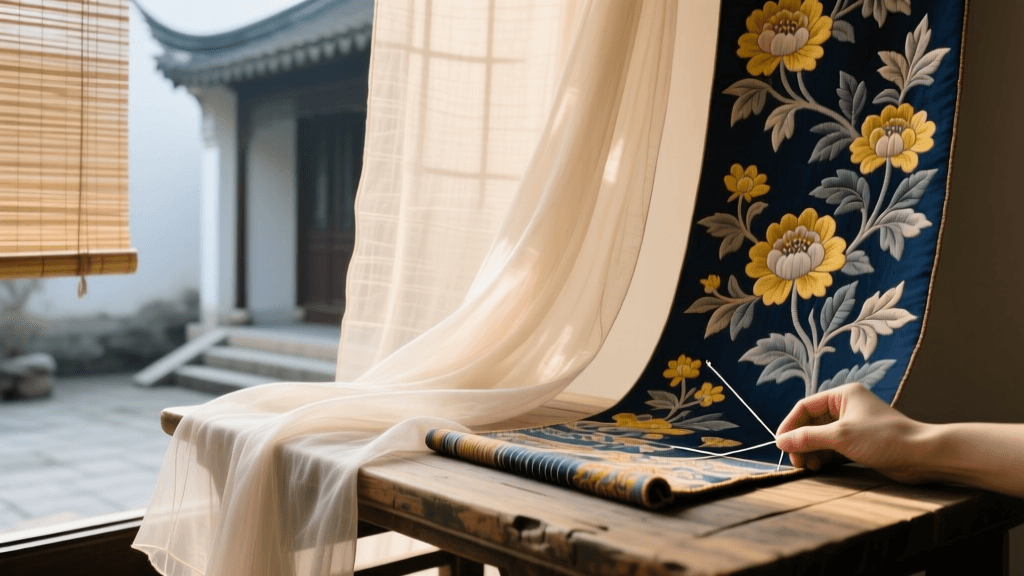
For textile enthusiasts and designers looking to engage with this ancient craft in 2026, sourcing authentic materials is paramount. The market for traditional weaving supplies has become highly specialized. According to industry reports featured in Encyclopædia Britannica, the authenticity of Yunjin relies heavily on the quality of its raw materials, particularly the metallic threads and high-grade mulberry silk.
- Mulberry Silk Warp: Grade 6A raw mulberry silk remains the standard. In 2026, expect to pay approximately $140 per kilogram for premium, degummed warp threads sourced from Jiangsu province.
- Gold and Silver Foil Threads: Traditional Yunjin uses real gold leaf applied to paper or animal membrane, then cut into micro-strips and wrapped around a silk core. Authentic 2026 gold-wrapped thread costs roughly $480 per 100-meter spool.
- Peacock Feather Yarn: Sourced ethically from molting peacocks, this iridescent yarn is twisted with silk and used for high-end accents. It retails for about $220 per 50 grams.
- Studio Drawlooms: Commissioning a custom 2026 Artisan Studio Edition drawloom from master woodworkers in Suzhou typically costs between $4,500 and $8,000, depending on the complexity of the pattern harness and shipping logistics.
Integrating Yunjin into the 2026 Xin Zhongshi Wardrobe
The 2026 Xin Zhongshi movement is defined by its practicality and wearability. Rather than creating full, heavy traditional robes, contemporary designers are utilizing Yunjin as strategic accents. We are seeing cloud brocade panels integrated into the lapels of structured wool blazers, as wide waistbands on flowing wide-leg trousers, and as durable, luxurious overlays on modern structured handbags. This approach not only makes the ancient textile accessible for daily wear but also drastically reduces the time and cost associated with full-garment weaving, allowing artisans to focus on ultra-high-density motifs.
Caring for Handwoven Yunjin Textiles
Because Yunjin incorporates metallic threads and dense silk structures, proper storage and maintenance are critical to preserving the garment's structural integrity and luster.
- Climate Control: Store Yunjin garments in a climate-controlled environment with a relative humidity of 45% to 55%. Fluctuations in humidity can cause the silk core of the gold threads to expand and contract, leading to metallic flaking.
- UV Protection: Never display or store Yunjin in direct sunlight. The dyes used in traditional silk weaving, even modern colorfast variants, are susceptible to UV degradation.
- Archival Packing: When storing for the season, wrap the textile in unbleached, acid-free cotton muslin or archival tissue paper. Never use plastic garment bags, as they can trap moisture and emit off-gassing chemicals that tarnish the silver and gold threads.
- Cleaning: Avoid dry cleaning or water washing. Surface dust should be gently removed using a soft, natural-bristle brush or a low-suction vacuum with a micro-screen attachment.
By understanding the mechanics of the Chinese drawloom and respecting the ancient techniques of Yunjin weaving, modern artisans and fashion enthusiasts can ensure that this magnificent piece of Asian heritage continues to thrive and inspire in 2026 and beyond.