Ming Court Fashion Evolution: A Guide to Buzi and Mang Robes
The Evolution of Ming Dynasty Court Fashion
The Ming Dynasty (1368–1644) represents a zenith in the evolution of Chinese court fashion, characterized by a meticulous return to Han-centric traditions following the Mongol-led Yuan Dynasty. The Hongwu Emperor instituted strict sumptuary laws that dictated every aspect of court attire, transforming clothing into a highly visible ledger of social hierarchy, political favor, and cosmic order. According to the Metropolitan Museum of Art's Heilbrunn Timeline of Art History, the Ming court's emphasis on ritual and antiquity led to the revival of ancient garment structures, such as the cross-collar right-over-left (jiaoling youren) and the wide-sleeved silhouettes of the Han and Tang eras, albeit refined with unprecedented textile technologies.
Unlike the relatively fluid fashion of the preceding Song Dynasty, Ming court fashion was rigidly codified. The evolution of these garments was not merely aesthetic; it was a tool of statecraft. The imperial workshops in Nanjing and Suzhou produced staggering quantities of silk brocades, kesi (cut silk tapestry), and gauze, establishing a sartorial language that would deeply influence neighboring regions, including Joseon Korea and the Ryukyu Kingdom. For modern collectors, historical reenactors, and bespoke tailors, understanding this evolution is the first step toward accurately recreating or acquiring these magnificent garments.
Hierarchy in Silk: Mang, Feiyu, and Douniu Robes
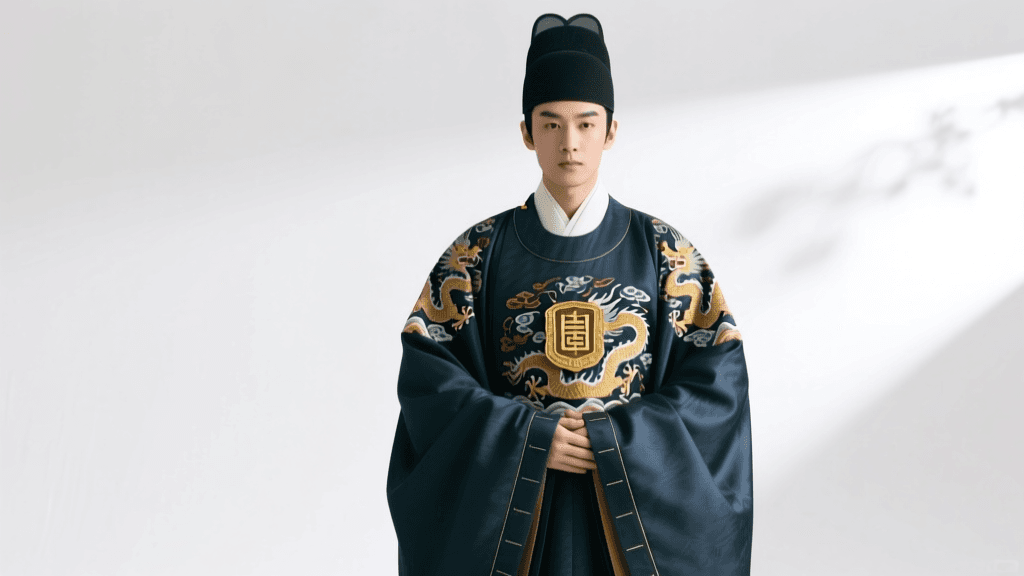
At the apex of Ming court fashion, below the Emperor's exclusive Dragon Robe (Longpao), existed a tiered system of cifu (bestowed robes). These were granted by the Emperor to high-ranking officials, military generals, and favored eunuchs. The three most prominent bestowed robes were the Mang (python), Feiyu (flying fish), and Douniu (bullfighting) robes. Despite their names, these garments did not depict actual animals but rather mythological creatures that served as visual stepping-stones to the imperial dragon.
- Mang Robe (蟒袍): Featuring a four-clawed dragon-like creature. It was the highest honor short of imperial status, often granted to senior ministers and regional governors.
- Feiyu Robe (飞鱼服): Adorned with a creature possessing a dragon's head, fish-like fins, and a serpentine tail. It was heavily associated with the Jinyiwei, the Emperor's elite secret police and honor guard.
- Douniu Robe (斗牛服): Depicting a horned, dragon-like beast associated with the stars. It was typically bestowed upon mid-level military officials and censorate members.
Table: Ming Court Robe Hierarchy & Modern Reproduction Guide
| Garment Type | Primary Motif | Historical Wearer | Modern Fabric Recommendation | Estimated Reproduction Cost (USD) |
|---|---|---|---|---|
| Mang Robe | Four-clawed Python | Senior Ministers, Princes | Nanjing Yunjin Brocade, Gold Thread | $1,200 - $3,500 |
| Feiyu Robe | Flying Fish (Dragon-Fish) | Jinyiwei, Elite Guards | Silk Jacquard, Woven Metallic Yarn | $600 - $1,500 |
| Douniu Robe | Horned Celestial Bull | Censors, Mid-level Military | Heavy Silk Damask, Embroidered Patches | $400 - $900 |
| Buzi (Rank Badge) | Specific Birds/Beasts | Civil and Military Officials | Hand-embroidered Silk on Gauze | $300 - $2,000+ |
The Buzi System: Decoding Ming Rank Badges
While the bestowed robes were reserved for special occasions and imperial favors, the daily uniform of the Ming bureaucracy relied on the Buzi (补子), or rank badges. Sewn onto the front and back of the official's round-collar robe (yuanlingpao), these square patches functioned as a literal resume of the wearer's civil or military rank. As noted by the Victoria and Albert Museum's extensive textile archives, the Ming dynasty solidified the avian and beast motifs that would carry through to the Qing dynasty, though the Ming badges were notably larger and often featured intricate gold-leaf couching and vibrant, un-faded silk threads.
Civil Officials (Birds): Ranging from the Red-Crowned Crane (First Rank) to the Paradise Flycatcher (Ninth Rank), birds symbolized literary elegance and administrative grace.
Military Officials (Beasts): Ranging from the Qilin (First Rank) to the Sea Horse (Ninth Rank), beasts symbolized martial prowess and courage.
For modern tailors and collectors, authenticating or recreating a Ming Buzi requires attention to the background. Unlike Qing badges, which often featured a solid or highly stylized wave-and-rock background, Ming badges frequently utilized a more open, cloud-suspended composition, and the bird or beast was almost always depicted in profile, facing inward toward the center of the chest.
Practical Tailoring: Recreating the Mang Robe
Recreating a historically accurate Ming Mang robe requires a departure from modern Western tailoring. The garment relies on flat-pattern cutting, utilizing the natural drape of the silk rather than darts or structured seams to shape the body. Below is a practical guide for bespoke tailors and advanced cosplayers looking to draft a traditional Ming court robe.
Essential Measurements and Pattern Drafting
- Body Length (衣长): Measure from the prominent vertebra at the base of the neck to the ankle bone. For an average height of 175cm, the robe length should be approximately 135cm to 140cm, ensuring it grazes the floor when worn with traditional court boots.
- Sleeve Width and Length (袖宽/袖长): Ming court sleeves were dramatically wide to project authority and house court tablets (hu). The sleeve length should extend past the fingertips by at least 15cm. The sleeve opening (袖口) should measure between 60cm and 80cm in circumference, tapering slightly at the armpit to allow for arm movement without collapsing the silhouette.
- Collar Structure (领口): The cross-collar must overlap right-over-left. The inner collar (中衣) should be visible, typically in pristine white silk. The outer collar width should be cut to 8cm, folding down to a finished width of 4cm, framing the neck rigidly.
- Side Slits (开衩): Ming court robes often featured side slits beginning at the hip to facilitate movement and reveal the layered pleated skirts (mamianqun) worn beneath. The slit should measure approximately 60cm to 70cm in length.
Fabric Selection and Sourcing
The soul of a Ming court garment lies in its textile. Historical analysis of Chinese dress and textiles via Encyclopædia Britannica highlights the supremacy of Jiangnan silk weaving centers during this era. For a premium, museum-quality reproduction, source Nanjing Yunjin (Cloud Brocade). This UNESCO-recognized intangible cultural heritage fabric incorporates peacock feather threads and real gold foil. Expect to pay between $150 and $300 USD per meter, requiring roughly 8 to 10 meters for a full robe with wide sleeves.
For a more budget-conscious but visually accurate alternative, seek out Silk Jacquard Brocade from modern mills in Suzhou or Hangzhou. Look for a fabric weight of at least 120g/m² to ensure the heavy drape required for court attire. Avoid lightweight habotai or chiffon, as they lack the structural integrity to support heavy metallic embroidery and will cling to the body, ruining the imposing court silhouette. Budget approximately $30 to $60 USD per meter for high-grade silk jacquard.
Embroidery Timing and Techniques
If you are commissioning a hand-embroidered Buzi or adding supplementary embroidery to a woven robe, prepare for a significant time investment. Traditional Suzhou embroidery (Su Xiu) or Beijing embroidery (Jing Xiu) utilizing metallic couching techniques requires a master artisan approximately 150 to 300 hours to complete a single pair of high-rank badges. When commissioning, always specify the use of panjin (gold thread wrapped around a silk core) rather than synthetic metallic yarns, which tarnish and lack the dimensional brilliance of historical threads. Factor in a lead time of 3 to 6 months for bespoke hand-embroidery.
Preservation and Care for Silk Brocades
Owning or recreating Ming-style court fashion comes with strict maintenance requirements. Silk brocades, especially those woven with metallic threads, are highly susceptible to humidity, UV degradation, and structural stress.
- Storage: Never hang a heavy Ming-style brocade robe on a standard wire or wooden hanger; the weight of the fabric will tear the shoulder seams over time. Store the garment flat in an acid-free archival box, interleaved with unbleached, acid-free tissue paper to prevent the metallic threads from oxidizing and staining the silk.
- Cleaning: Avoid dry cleaning, as the harsh chemicals will strip the natural sericin from the silk and dissolve the adhesives used in historical gold threads. Spot clean only with distilled water and a specialized silk detergent, or consult a professional textile conservator for deep cleaning.
- Environment: Maintain a storage environment with a relative humidity of 45-55% and a temperature around 18°C (65°F) to prevent mold growth and fiber embrittlement.
Conclusion
The evolution of Ming Dynasty court fashion is a masterclass in using textiles to project power, order, and cultural renaissance. Whether you are a historian studying the sociopolitical implications of the Buzi system, or a tailor drafting the sweeping sleeves of a Mang robe, the garments of this era demand respect for their intricate construction and profound symbolism. By adhering to historical measurements, sourcing authentic brocades, and understanding the rigid hierarchy of court motifs, modern creators can keep the majestic legacy of Ming sartorial artistry alive.