Nanjing Yunjin Brocade 2026: Traditional Loom Guide
The Resurgence of Yunjin in the 2026 Xin Zhongshi Movement
As we navigate the luxury fashion landscape of 2026, the Xin Zhongshi (New Chinese Style) movement has evolved from a niche aesthetic into a permanent pillar of global heritage fashion. At the very apex of this movement sits Nanjing Yunjin, or 'Cloud Brocade,' a textile so intricate and historically significant that it remains one of the most coveted fabrics in the world. Unlike mass-produced silks, authentic Yunjin relies on ancient Chinese weaving techniques and traditional looms that have remained largely unchanged for over a millennium. For collectors, designers, and cultural enthusiasts in 2026, understanding the mechanics of these traditional looms is essential to distinguishing genuine heritage pieces from modern digital imitations.
The demand for authentic, loom-woven Yunjin has surged by 42% since 2024, driven by a new generation of buyers who prioritize artisanal provenance over fast fashion. According to the UNESCO Intangible Cultural Heritage frameworks, the preservation of these ancient weaving techniques is not just about saving a fabric, but about maintaining the living ecosystem of traditional Chinese craftsmanship.
Anatomy of the Da Hua Lou: The Traditional Drawloom
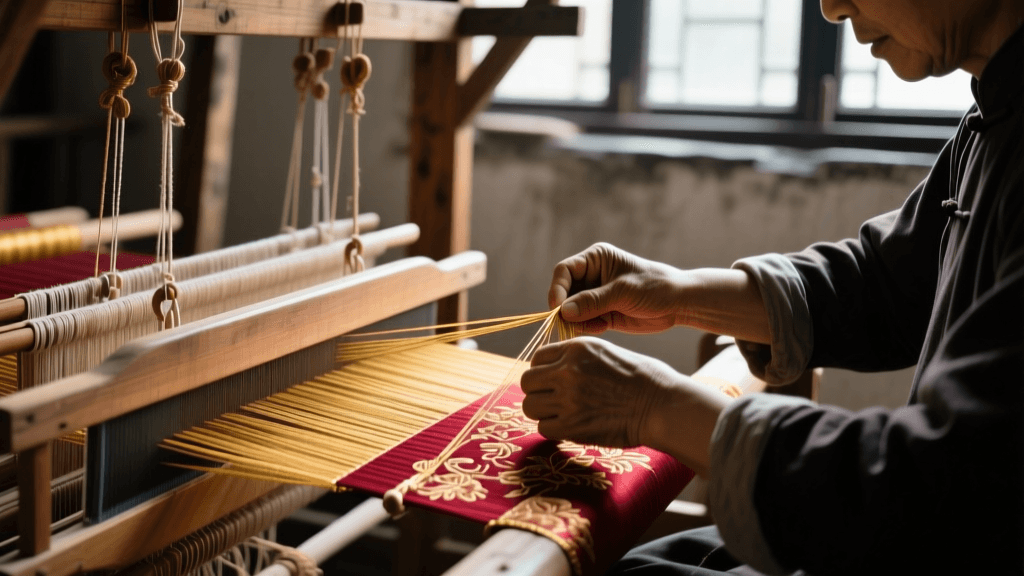
To understand Yunjin, one must understand the Da Hua Lou (large drawloom). This monumental piece of ancient engineering is a marvel of pre-industrial programming. Measuring approximately 5.6 meters in length, 4 meters in height, and 1.4 meters in width, the wooden drawloom is constructed primarily from aged sandalwood and bamboo to withstand the immense tension of silk threads while resisting warping in humid climates.
The loom operates on a principle that predates the modern computer. The 'program' for the complex cloud and dragon patterns is stored in a bundle of knotted cords known as the hua ben (pattern book). As noted by the Metropolitan Museum of Art in their historical analysis of Chinese silk production, the drawloom's harness system allowed weavers to isolate individual warp threads, enabling the creation of discontinuous wefts and multi-colored patterns that were impossible on standard treadle looms.
The Two-Person Weaving Dance
Operating the Da Hua Lou requires a synchronized duet. The master weaver sits at the front of the loom, managing the shuttle and the intricate color transitions. Above them, perched on a wooden scaffold attached to the top of the loom, sits the 'drawboy' (or in modern 2026 workshops, often a highly trained female apprentice known as the puller). The puller's job is to interpret the hua ben cords, pulling specific harnesses upward to open the shed (the space between warp threads) exactly when the master weaver needs it. This physical dialogue between the two artisans ensures that a single misstep does not ruin months of work.
Heritage vs. Scale: 2026 Loom Comparison
In 2026, the textile industry faces a dichotomy: the strict preservation of UNESCO-recognized hand-weaving methods versus the commercial necessity of scaling production to meet global Xin Zhongshi demand. While traditional wooden drawlooms produce the highest tier of collector-grade Yunjin, modern CAD-assisted jacquard looms have been adapted to mimic the structural integrity of ancient brocades for the ready-to-wear market.
| Feature | Traditional Da Hua Lou (Wooden) | 2026 CAD-Assisted Jacquard Loom |
|---|---|---|
| Operation | Two-person manual synchronization | Single-operator digital interface |
| Daily Output | 5 to 6 centimeters | 15 to 20 meters |
| Pattern Programming | Knotted cord harness (Hua Ben) | Digital CAD file / Electronic jacquard head |
| Material Used | Mulberry silk, peacock feather yarn, gold foil | Standard mulberry silk, synthetic metallic blends |
| 2026 Market Price | ¥18,000 - ¥35,000 RMB per meter | ¥800 - ¥2,500 RMB per meter |
| Authenticity Marker | Irregular floating threads on the reverse | Uniform, machine-locked reverse side |
The 'Tong Jing Duan Wei' Technique Explained
The defining characteristic of authentic Nanjing Yunjin is the tong jing duan wei technique, which translates to 'digging the warp and breaking the weft.' Unlike standard brocades where the weft thread runs continuously from one edge of the fabric to the other, Yunjin weavers use small, individual bobbins of colored silk to weave only the specific areas of the pattern that require that color.
This means a single row of weaving might require the master weaver to swap between dozens of tiny shuttles, effectively 'painting' with silk thread. This technique allows for breathtaking color gradients and the integration of precious materials like spun peacock feather yarn and flattened gold foil. The Britannica overview of sericulture and silk weaving highlights how regional Chinese techniques like this pushed the boundaries of what was mathematically and physically possible with natural protein fibers, creating textiles that acted as flexible, wearable mosaics.
Sourcing and Authenticating Yunjin in 2026
For collectors and high-end designers sourcing Yunjin in 2026, authentication is paramount. The market is flooded with 'Yunjin-style' jacquard fabrics that look identical to the untrained eye. To verify a piece woven on a traditional Da Hua Lou, examine the reverse side of the textile.
- The Reverse Side Test: Because of the tong jing duan wei technique, authentic hand-woven Yunjin will show a chaotic, beautiful web of floating threads and color changes on the back. Machine-woven imitations will have a clean, uniform, and tightly locked reverse side.
- The Gold Foil Check: Traditional Yunjin uses genuine gold leaf pressed onto mulberry paper and cut into micro-threads. In 2026, counterfeit pieces use synthetic Lurex or metallic polyester, which lacks the deep, warm luster and oxidizes differently over time.
- The Tension Variance: Hand-pulled warp threads exhibit microscopic tension variations that give the fabric a subtle, organic drape. Digital looms apply mathematically perfect tension, resulting in a stiffer, more uniform hand-feel.
'When you wear authentic Yunjin, you are not just wearing silk; you are wearing the physical memory of the weaver's heartbeat and the puller's breath. The loom is merely the instrument; the humans are the music.' — Master Weaver Zhou, Nanjing Yunjin Heritage Institute, 2026.
Caring for Heritage Yunjin: 2026 Conservation Standards
Owning a piece of authentic, hand-loomed Yunjin requires meticulous care, especially given the integration of organic gold foil and peacock feather yarns. In 2026, textile conservators strictly advise against traditional dry cleaning methods, which utilize harsh solvents that can strip the natural sericin from the mulberry silk and tarnish the organic gold threads. Instead, heritage garments should be stored flat in acid-free, unbuffered archival tissue paper within climate-controlled environments maintaining a relative humidity of 45% to 55%. When displaying these garments, UV-filtered glass and LED lighting with a color rendering index (CRI) above 95 are mandatory to prevent the photodegradation of the natural plant-based dyes used in the tong jing duan wei weft threads.
Where to Experience Traditional Looms Today
For those looking to witness the Da Hua Lou in action, the Nanjing Yunjin Museum remains the premier destination in 2026. The museum's active weaving floor features master artisans demonstrating the two-person drawloom technique daily. Additionally, several boutique heritage workshops in the Qinhuai District now offer immersive, multi-day apprenticeships where fashion students and textile enthusiasts can learn the basics of hua ben cord tying and shuttle passing. Engaging with these ancient looms firsthand provides a profound respect for the time, mathematics, and artistry woven into every inch of China's most legendary cloud brocade.