Kimono Tanmono Zero-Waste Cutting: 2026 Construction Guide
The Renaissance of Zero-Waste: Understanding Tanmono in 2026
As the global fashion industry faces stringent sustainability mandates in 2026, designers and home sewists are increasingly looking to historical construction methods for inspiration. Few traditions are as inherently sustainable as the Japanese kimono. Unlike Western pattern drafting, which curves and contours fabric to the body—leaving behind up to 20% of the material as offcuts—the traditional kimono is constructed using a system called Tanmono. This method relies entirely on straight-line cutting (chokusen-dachi), ensuring that every single inch of the woven fabric bolt is utilized in the final garment.
The Tanmono system is not merely a historical curiosity; it is a masterclass in geometric efficiency. By understanding how a single, continuous bolt of fabric is transformed into a complex, draped garment without generating waste, modern makers can apply these zero-waste principles to contemporary wardrobes. According to the Victoria and Albert Museum's Asian Collections, the structural integrity and modularity of the kimono allow it to be entirely disassembled, cleaned, and re-sewn, a circular lifecycle that modern 2026 sustainable fashion brands are desperately trying to replicate.
The Anatomy of the Tanmono Bolt
A standard kimono bolt is woven to a very specific width, historically dictated by the width of the traditional backstrap loom. Today, a standard silk Tanmono measures approximately 38 centimeters (about 15 inches) in width and 11.5 to 12 meters in length. This precise dimension is the foundation of the zero-waste philosophy. The entire bolt is cut into eight rectangular panels, which are then sewn together using straight seams. Because the pieces are rectangular, there are no curved armholes, no shaped side seams, and absolutely no fabric waste.
Panel Breakdown and Measurements
When constructing a standard women's kimono (such as a komon or yukata), the 12-meter bolt is divided into the following eight panels. Below is the standard allocation for a garment tailored to an average height of 160 cm (approx. 5'3").
| Panel Name | English Translation | Quantity | Approximate Cut Length | Function |
|---|---|---|---|---|
| Migoro | Body Panels | 2 | Full remaining length (approx. 4.5m each, folded) | Forms the front and back of the main torso. |
| Okumi | Front Overlap Panels | 2 | Approx. 2.2 meters | Creates the overlapping front closure. |
| Sode | Sleeves | 2 | Approx. 1.1 meters (folded in half) | Forms the deep, pouch-like kimono sleeves. |
| Eri | Collar | 1 | Approx. 1.2 meters | The main structural neckband. |
| Tomoeri | Collar Cover | 1 | Approx. 0.5 meters | Protects the main collar at the nape of the neck. |
Essential Tools for 2026 Kimono Construction
While modern sewing machines are ubiquitous, authentic kimono construction (tenui) is done entirely by hand to preserve the drape and flexibility of the silk. If you are embarking on a kimono construction project in 2026, you will need a specialized toolkit:
- Shitsuke Thread: A lightly twisted, soft cotton basting thread. It is thick enough to hold layers together but breaks easily when removed, preventing damage to delicate silks.
- Herabera: A traditional bamboo or tortoiseshell spatula used to press seams and crease fabric without the harsh heat of a modern iron, which can scorch 2026 peace-silk blends.
- Japanese Hand Needles (Hari): Unlike Western needles, Japanese needles have a very fine point and a large, elongated eye to accommodate thick silk threads. A 45mm length is standard for general seaming.
- Chalk or Soap Slivers: For marking straight lines on dark fabrics. Avoid modern wax-based tailors' chalk, which can stain natural fibers.
Mastering the Kise Seam Technique
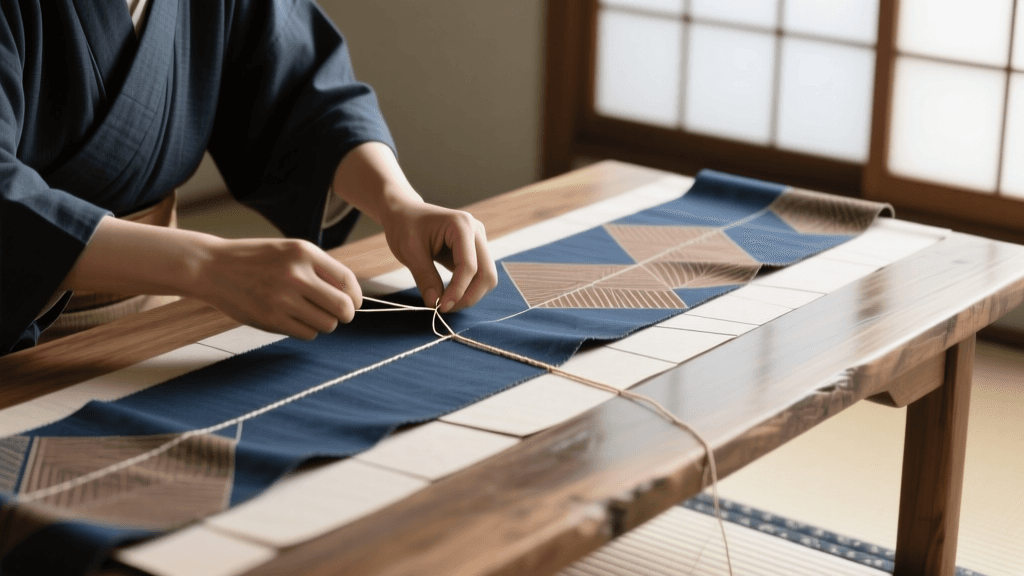
The true secret to the kimono's elegant drape lies not in the cutting, but in the seaming. Western garments typically press seam allowances flat and open. In kimono construction, seams are finished using a technique called Kise (folded seam allowance). This creates a soft, rolled edge that allows the garment to fold flat and drape fluidly over the body.
Step-by-Step Kise Execution
- Initial Basting (Shitsuke): Place your two rectangular panels right sides together. Baste them with a running stitch exactly 1.5 cm from the raw edge. This is your structural seam line.
- Sewing the Structural Seam: Using a fine silk thread, sew directly over your basting line with a tight running stitch (approx. 12-15 stitches per inch). Remove the basting thread.
- The Kise Fold: Press the seam allowance to one side (usually toward the back of the garment). Now, fold the top layer of the seam allowance under by exactly 0.3 cm to 0.5 cm. This creates a tiny, hidden tuck.
- Blind Catching: Using a needle and fine thread, catch the folded edge of the seam allowance to the backing fabric with tiny, nearly invisible blind stitches. The seam allowance is now secured, but the slight fold (the kise) acts as a hinge, giving the seam a soft, rounded profile rather than a hard, pressed edge.
"The Kise seam is what separates a rigid costume from a living garment. It allows the silk to breathe and shift with the wearer's movements, a concept that modern zero-waste designers are finally beginning to appreciate." — Master Artisan Yuki Tanaka, 2026 Kyoto Textile Symposium.
Adapting Tanmono for Western Fabric Widths
The greatest challenge for international sewists in 2026 is sourcing authentic 38cm wide Tanmono bolts outside of Japan. Most commercial silks, linens, and sustainable cupro fabrics come in standard Western widths of 115 cm (45 inches) or 150 cm (60 inches). Fortunately, you can simulate the Tanmono system using wider yardage.
To adapt a 115 cm wide fabric, you must cut your panels to the required 38 cm width and then seamlessly join the offcuts to create the illusion of a continuous bolt. When cutting the Migoro (body panels), cut two 38 cm strips along the selvage. The remaining 39 cm strip can be cut down to create the Okumi (overlap panels) and the Sode (sleeves). Any smaller remnants should be preserved for the Eri (collar) or used for internal reinforcement patches (tomae). By meticulously planning your layout, you can maintain the zero-waste ethos even when working with non-traditional fabric widths.
Sourcing Materials in 2026
Sourcing authentic materials has evolved significantly. While traditional silk weaving hubs like Tango and Yuki continue to produce exquisite Tanmono, the costs have risen due to artisan shortages. In 2026, a bolt of authentic silk Tango chirimen (crepe) typically ranges from $450 to $900 USD, while highly prized Oshima tsumugi (mud-dyed pongee) can exceed $3,000 USD.
For those practicing construction techniques or seeking sustainable alternatives, the 2026 market offers excellent options. High-grade cupro (a regenerated cellulose fiber made from cotton linter) mimics the drape and cool touch of silk beautifully and is widely available in pre-cut 38 cm widths from specialized zero-waste textile suppliers in Europe and North America, usually priced between $120 and $180 USD per bolt. Linen-cotton blends are also highly recommended for constructing yukata (casual summer kimono), offering breathability and structural stability for beginners learning the Kise seam.
Conclusion
The construction of the Japanese kimono is a testament to the brilliance of historical engineering. By embracing the Tanmono system and mastering techniques like the Kise seam, modern makers do more than just sew a garment; they participate in a centuries-old dialogue between human form and textile. As highlighted by the Metropolitan Museum of Art Asian Art Department, the kimono remains one of the most structurally sophisticated garments in global history. In 2026, applying these zero-waste, straight-line construction techniques is not just an act of cultural preservation—it is a vital step forward in the evolution of sustainable fashion design.