Decoding Sogdian Pearl Roundel Silks: 2026 Conservation Insights
The Legacy of Silk Road Textile Exchanges
The Silk Road was never merely a conduit for spices, precious metals, and jade; it was a vibrant, sprawling superhighway of aesthetic, cultural, and technological exchange. As we navigate through 2026, the study of Silk Road textile exchanges has entered an unprecedented golden age, driven by remarkable archaeological preservation and next-generation conservation technologies. Among the most captivating artifacts to emerge from the arid sands of Central Asia are the samitum silks featuring the iconic Sogdian pearl roundel motif. Unearthed primarily from the Astana Tombs in the Turfan Depression and the Mogao Caves near Dunhuang, these textiles offer a masterclass in ancient globalization. Today, advanced archaeological textile conservation is allowing researchers to decode the precise trade routes, weaving technologies, and cross-cultural dialogues embedded in every thread of these 8th-century masterpieces.
Understanding Samitum: A Weaving Revolution
To appreciate the significance of these archaeological finds, one must first understand the technological leap that samitum represented in the history of Asian traditions. Early Han dynasty silks were predominantly warp-faced weaves (known as jingjin), where the longitudinal warp threads dominated the surface, restricting patterns to relatively narrow, geometric, or linear bands. However, as trade routes expanded westward, Chinese weavers encountered Central Asian and Sasanian Persian textiles woven on different loom structures.
The Mechanics of Weft-Faced Compound Twill
samitum is a weft-faced compound twill. In this complex structure, the warp threads are entirely hidden by the weft threads, which are packed densely together. This technique allowed weavers to create expansive, vividly colored, and highly detailed pictorial motifs that were impossible to achieve with traditional warp-faced methods. By the mid-Tang dynasty (circa 8th century), Chinese imperial workshops had not only adopted the samitum technique but had perfected it, merging indigenous silk sericulture with Western loom technology. In 2026, digital loom simulations developed by textile historians have finally mapped the exact harness configurations and draw-cord arrangements required to recreate these specific Astana tomb fragments, proving that a single bolt of pearl roundel silk required the synchronized labor of a master weaver and a draw-boy operating a complex drawloom.
The Sogdian Pearl Roundel: A Motif of Global Exchange
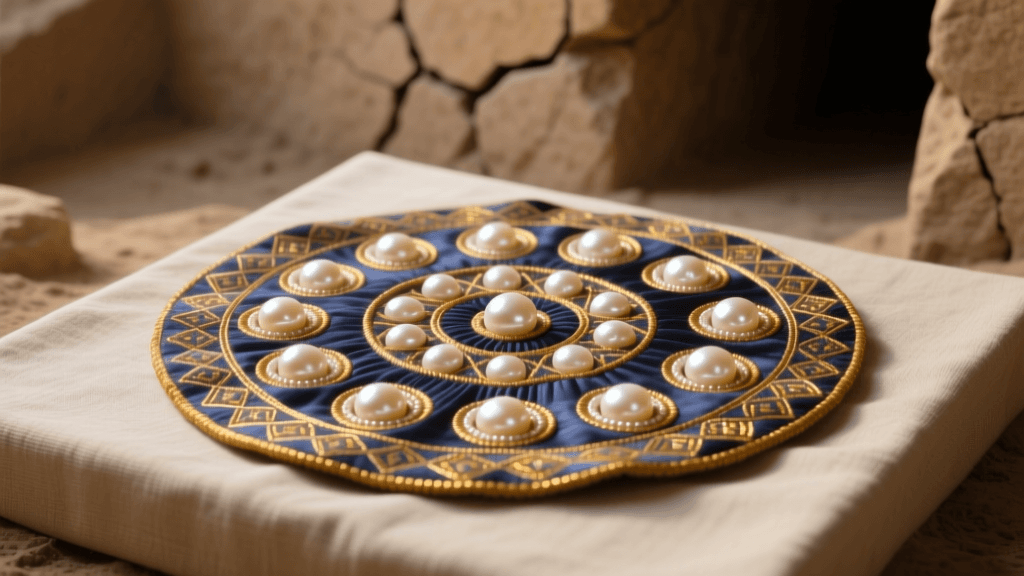
The visual hallmark of these Silk Road exchanges is the pearl roundel motif. Characterized by a circular border composed of stylized pearl dots enclosing confronting or solitary animals—such as winged horses, boars, lions, and ducks—this design originated in Sasanian Persia. It was subsequently adopted and heavily traded by the Sogdians, an Eastern Iranian people who served as the primary merchant class of the Silk Road.
When Sogdian merchants brought these textiles to the Tang capital of Chang'an, they sparked a massive fashion trend among the Chinese aristocracy. Tang weavers began producing their own versions of the pearl roundel silk, blending the Sasanian structural motif with distinctly Chinese aesthetic sensibilities, such as replacing the Sasanian boar with the Chinese phoenix or adding lotus blossoms to the roundel's exterior. According to the UNESCO Silk Roads Programme, these hybrid textiles are some of the most vital material evidence we have of the syncretic culture that flourished along the trade routes, demonstrating how foreign luxury goods were localized and integrated into domestic Asian traditions.
2026 Breakthroughs in Archaeological Textile Conservation
The extreme fragility of 1,200-year-old silk presents a monumental challenge for conservators. Excavated from the hyper-arid environment of the Turfan Depression, these textiles are highly susceptible to light degradation, fluctuating humidity, and mechanical stress. Fortunately, the conservation landscape in 2026 has shifted entirely away from invasive physical sampling toward non-destructive, high-resolution digital and chemical mapping.
Multispectral Imaging and Synchrotron Analysis
In previous decades, identifying the organic dyes used in Silk Road textiles required cutting microscopic snippets from the artifact for High-Performance Liquid Chromatography (HPLC). Today, conservators utilize synchrotron-based micro-X-ray fluorescence (XRF) and multispectral imaging to map dye distributions across the entire garment without ever touching the fibers. This 2026 standard of care has revealed astonishing details: researchers can now differentiate between indigenous Chinese madder and imported Rubia tinctorum from the Mediterranean, effectively tracing the exact geographic origin of the dye batches used in specific Astana tomb garments.
| Conservation Aspect | Late 20th Century Approach | 2026 Advanced Approach |
|---|---|---|
| Dye Identification | Destructive HPLC sampling of thread snippets | Non-invasive Synchrotron XRF and Raman spectroscopy mapping |
| Pattern Reconstruction | Manual graph paper plotting and physical tracing | AI-assisted photogrammetry and 3D digital twin generation |
| Structural Stabilization | Synthetic backing adhesives and rigid mounting | Nano-cellulose aerosol consolidation and magnetic levitation mounts |
| Archive Access | Physical microfilm, restricted catalog access | Cloud-based spectral databases and open-source VR museum tours |
Tracing the Trade Routes Through Thread and Motif
The data yielded from these 2026 conservation efforts has fundamentally rewritten our understanding of Silk Road logistics. By analyzing the metallic threads—often flat strips of gold or silver wound around a silk core—found in premium pearl roundel silks, metallurgists have matched the trace element signatures to specific mining regions in the Tianshan mountains and the Iranian plateau. Furthermore, the International Dunhuang Programme (IDP) has recently integrated AI-driven pattern recognition into its digital archives, allowing researchers to instantly cross-reference fragmented pearl roundel motifs found in Turfan with matching textile scraps discovered as far west as Antinoöpolis in Egypt and as far east as Nara, Japan. This interconnected database proves that the Sogdian pearl roundel was not just a regional trend, but a truly global luxury brand of the early medieval period.
The Sasanian and Byzantine Influences
Beyond the Sogdian middlemen, the textiles reveal a complex web of Sasanian and Byzantine influences. The confronting cocks motif, frequently found in Astana silks, carries Zoroastrian connotations of light and the dawn, reflecting the religious beliefs of the Sasanian Empire. Yet, the specific twining techniques used to finish the selvages of these silks often mirror Byzantine workshop practices. This blending of Persian iconography, Sogdian commerce, Byzantine finishing techniques, and Chinese material execution is the very definition of Silk Road syncretism.
Actionable Guide: Studying Silk Road Textiles in 2026
For textile historians, fashion designers, and enthusiasts of Asian traditions, accessing and studying these archaeological marvels has never been more accessible. If you are looking to research or draw inspiration from Silk Road textile exchanges this year, consider the following actionable resources:
- Digital Twin Archives: Utilize the IDP's newly upgraded 2026 spectral database. You can download high-resolution, multi-layered TIFF files that allow you to toggle between visible light, infrared, and ultraviolet views of the Astana silks, revealing hidden underdrawings and faded dye layers.
- Museum Exhibitions: The Xinjiang Uygur Autonomous Region Museum in Urumqi has unveiled a state-of-the-art, climate-controlled textile pavilion in 2026, featuring interactive augmented reality (AR) displays that overlay the original, vibrant colors onto the faded physical garments.
- Conservation Literature: Follow the latest publications from the Getty Conservation Institute, which frequently partners with Central Asian heritage sites to publish open-access white papers on the nano-conservation of archaeological protein fibers.
- Reconstruction Workshops: Several traditional weaving guilds in Hangzhou and Suzhou now offer masterclasses based on the 2026 digital loom reconstructions, allowing contemporary weavers to physically experience the tension and rhythm of the Tang dynasty samitum drawloom.
Conclusion
The Sogdian pearl roundel silks of the Astana Tombs are far more than beautiful remnants of antiquity; they are woven manuscripts that document the ambitions, aesthetics, and technological prowess of the ancient world. As 2026 conservation technologies continue to peel back the layers of time without damaging the fragile fibers, we gain an ever-clearer picture of a world deeply interconnected by the desire for beauty and luxury. For those dedicated to the study of Asian traditions, these textiles serve as a poignant reminder that fashion and fabric have always been at the very forefront of human exchange, bridging continents and cultures one thread at a time.