Mulberry vs Tussar Silk for Handloom Saris: 2026 Guide
The Evolution of Handloom Silk in 2026
As we navigate the traditional garment landscape in 2026, the demand for traceable, ethically sourced textiles has fundamentally shifted how weavers and consumers approach the classic Asian sari. While synthetic blends and mass-produced power-loom fabrics flooded the market in the previous decade, 2026 has seen a massive resurgence in the appreciation for authentic, handwoven natural fibers. For enthusiasts of South Asian traditional dress, choosing the right silk is no longer just about aesthetics; it is about understanding the textile's origin, its environmental footprint, and its structural behavior. When commissioning or purchasing a handloom sari, the two most prominent and historically significant silks dominate the conversation: cultivated Mulberry silk and wild Tussar silk. Understanding the distinct properties of these two fibers is essential for making an informed investment in your traditional wardrobe this year.
Mulberry Silk: The Gold Standard of Drape and Sheen
Mulberry silk is the most widely produced and highly prized cultivated silk in the world, accounting for the vast majority of premium traditional garments. It is produced by the Bombyx mori silkworm, which is reared indoors and fed an exclusive diet of mulberry leaves. This highly controlled environment results in a fiber that is remarkably uniform in diameter, typically measuring between 12 to 15 microns. Because the filament is continuous and unbroken—often stretching up to 900 meters from a single cocoon—Mulberry silk yarn possesses an unparalleled tensile strength and a smooth, glass-like surface.
In the context of handloom saris, such as the iconic Kanchipuram or Banarasi weaves, Mulberry silk provides a heavy, fluid drape that clings elegantly to the body's contours. The fiber's triangular prism-like structure refracts incoming light at different angles, giving the fabric its signature luminous sheen. In 2026, advancements in eco-friendly reactive dyes have allowed weavers to achieve deeper, more colorfast jewel tones on Mulberry silk without compromising the fiber's natural sericin coating, making it the undisputed choice for high-end ceremonial and bridal wear.
Tussar Silk: The Breathable, Textured Wild Silk
Tussar silk, often referred to as Kosa or wild silk, offers a starkly different textile experience. It is harvested from several species of wild silkworms, primarily Antheraea mylitta, which feed on the leaves of indigenous forest trees like Sal and Arjun. Unlike the controlled cultivation of Mulberry silk, Tussar silkworms roam freely in their natural habitats, primarily across the eastern and central Indian states of Jharkhand, Bihar, and Odisha.
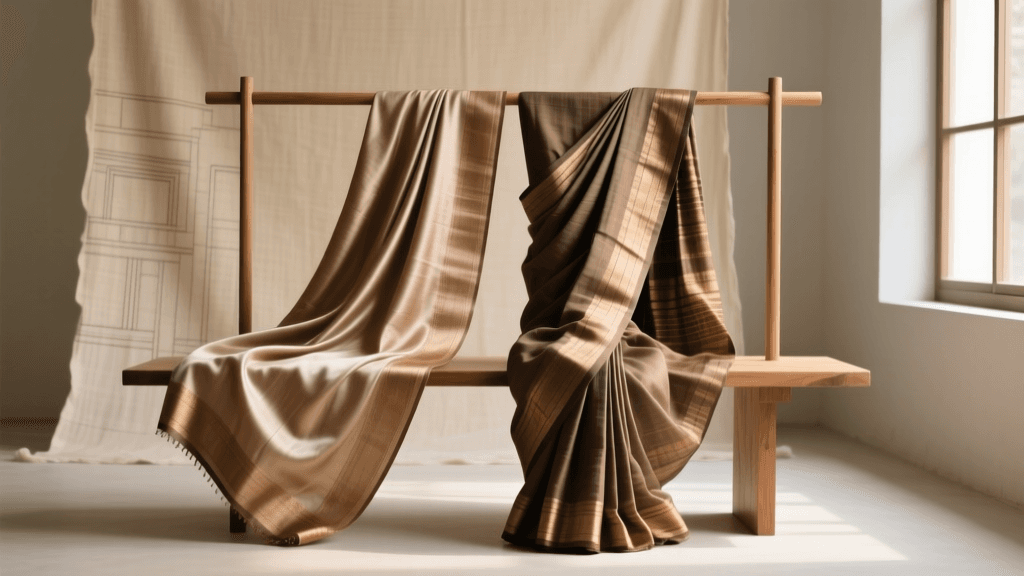
Because the wild cocoons are often pierced by the emerging moth (or harvested after the moth leaves, aligning with the growing 2026 demand for Ahimsa or peace silk practices), the Tussar fiber is a staple fiber rather than a continuous filament. This results in a yarn that is inherently textured, slightly porous, and possesses a beautiful, irregular slub. Tussar silk naturally exhibits a rich, muted copper or golden-beige undertone. It lacks the blinding high-gloss finish of Mulberry silk, offering instead a sophisticated, matte-to-satin luster that appeals to contemporary buyers seeking understated elegance and superior breathability in warmer climates.
Head-to-Head Comparison: Mulberry vs. Tussar
To help you decide which textile best suits your 2026 wardrobe needs, we have compiled a comprehensive comparison of their structural and practical characteristics.
| Feature | Mulberry Silk (Cultivated) | Tussar Silk (Wild) |
|---|---|---|
| Fiber Source | Bombyx mori (Mulberry leaves) | Antheraea mylitta (Sal/Arjun leaves) |
| Thread Uniformity | Highly uniform, continuous filament | Irregular, textured staple with slubs |
| Natural Color | Brilliant stark white (easily bleached) | Natural golden, copper, or beige |
| Drape Quality | Heavy, fluid, and highly structured | Lightweight, airy, and slightly stiff |
| Breathability | Moderate (better for climate control) | High (highly porous and cool) |
| 2026 Avg Price (USD) | $150 - $800+ (depending on Zari) | $80 - $400 |
| Best Climate | Temperate, air-conditioned, or winter | Hot, humid, and tropical summers |
Dye Affinity, Zari Compatibility, and Weaving
The chemical structure of these two silks dictates how they interact with dyes and metallic threads. Mulberry silk's smooth fibroin protein structure has a high affinity for both acid and reactive dyes, allowing it to absorb vibrant, saturated colors uniformly. This makes it the perfect canvas for the intricate, multi-colored meenakari and jal patterns seen in Banarasi weaves. Furthermore, the high tensile strength of Mulberry silk warp threads can withstand the heavy friction of metallic zari (gold or silver threads) on traditional jacquard pit looms without snapping.
Tussar silk, being more porous and chemically distinct, absorbs dyes differently. While it can be dyed bright colors, it truly shines when paired with natural, organic dyes—such as indigo, madder root, and turmeric—which complement its earthy base tone. In 2026, the fusion of Tussar silk with minimalist, block-printed motifs or delicate kantha embroidery is highly sought after. However, because Tussar yarn is weaker and more brittle than Mulberry, it is rarely used as a warp for heavy zari brocades; instead, it is usually woven with a cotton or Mulberry silk warp and a Tussar weft to maintain structural integrity.
Sourcing and Verifying Authenticity in 2026
With the rise of sophisticated artificial silks (like high-grade mercerized cotton or advanced polyester blends), verifying the authenticity of your handloom purchase is more critical than ever. The Silk Mark Organization of India remains the paramount authority for textile verification. In 2026, their holographic, blockchain-linked QR tags allow consumers to scan a sari and instantly view the fiber composition, the weaver's cooperative origin, and the exact loom location.
Additionally, buyers should look for Geographical Indication (GI) tags. The Ministry of Textiles strictly regulates GI tags, ensuring that a sari labeled as "Bhagalpur Tussar" or "Kanchipuram Mulberry" genuinely originates from those specific regions and adheres to traditional weaving parameters. When shopping at boutique ateliers or online heritage platforms, always request the GI certificate and the Silk Mark label before completing a high-value transaction.
Garment Care and Longevity
The care regimens for these two textiles differ significantly due to their protein structures. Mulberry silk is highly sensitive to alkaline substances and UV degradation. In 2026, the standard for maintaining heirloom Mulberry saris involves professional, eco-friendly hydrocarbon dry cleaning, followed by storage in unbleached, acid-free cotton muslin bags. Storing Mulberry silk in plastic is strictly forbidden, as it traps moisture and leads to the permanent yellowing of the sericin.
Tussar silk is slightly more forgiving but prone to water spotting. If a Tussar sari gets wet, it can develop dark, permanent rings if not dried uniformly. For minor stains, a pH-neutral, enzyme-free textile cleanser applied with a microfiber cloth is recommended. Because Tussar fibers are shorter and more prone to fraying at the hemlines, modern tailoring techniques in 2026 often involve reinforcing the fall (the inner hem guard) with a soft, hand-loomed cotton to prevent the wild silk from tearing under the weight of the pleats.
Styling and Occasion Mapping
Choosing between Mulberry and Tussar ultimately comes down to the occasion and the desired silhouette. Mulberry silk, with its rich weight and reflective sheen, is the undisputed champion of evening events, winter weddings, and formal diplomatic gatherings. It holds sharp pleats beautifully and provides a regal, structured silhouette that photographs brilliantly under artificial lighting.
Conversely, Tussar silk is the quintessential daytime textile. Its matte finish and breathable weave make it ideal for outdoor summer festivals, daytime pujas, and contemporary corporate settings where understated elegance is preferred over ostentatious display. According to the historical archives and textile studies preserved by institutions like the Victoria and Albert Museum, wild silks have long been favored by ascetics and scholars for their connection to the natural forest environment, a philosophical underpinning that still resonates with modern, eco-conscious consumers today.
Final Thoughts for the 2026 Buyer
The choice between Mulberry and Tussar silk is not a matter of one being superior to the other; rather, it is a choice between two distinct textile philosophies. Mulberry silk represents human mastery over nature—cultivated, refined, and brilliantly luminous. Tussar silk represents a harmonious coexistence with the wild—textured, earthy, and profoundly breathable. By understanding the microscopic and macroscopic differences between these two magnificent fibers, you can curate a traditional garment collection in 2026 that is not only visually stunning but also deeply rooted in the rich, sustainable heritage of Asian textile arts.