Best Online Marketplaces for Custom Silk Hanbok in 2026
The 2026 Landscape of Authentic Hanbok E-Commerce
The global appreciation for traditional Asian garments has reached unprecedented heights in 2026, driven by a renewed interest in heritage craftsmanship and sustainable fashion. However, as the popularity of the Korean hanbok surges, so does the proliferation of mass-produced, polyester 'costume-grade' replicas on generic e-commerce platforms. For collectors, cultural enthusiasts, and those seeking genuine ceremonial wear, navigating the online marketplace requires a discerning eye and an understanding of traditional textiles.
In 2026, the most significant shift in Asian traditional garment shopping is the move toward direct-to-artisan e-commerce. Buyers are no longer reliant on third-party dropshippers. Instead, they are utilizing specialized Korean platforms that connect global consumers directly with master weavers and tailors. According to the Korea Craft & Design Foundation, the integration of digital authenticity certificates and AI-assisted measuring tools has made purchasing custom-fitted, heritage-grade garments from overseas more accessible and secure than ever before.
Top Trusted Online Marketplaces for Silk Hanbok
If you are looking to invest in an authentic hanbok made from traditional materials like Myeongju (a premium Korean silk woven from raw silk threads), you must look beyond standard retail giants. Here are the premier marketplaces for 2026:
1. Idus (Global Artisan Tier)
Originally a domestic powerhouse for handmade goods, Idus has fully optimized its global shipping interface as of 2026. It is the premier destination for bespoke hanbok. Artisans on Idus often hold regional intangible cultural heritage certifications. When browsing, look for sellers offering 'Myeongju' or 'Soksaeng' silk. The platform allows direct messaging with tailors to discuss custom color palettes, embroidery motifs (such as the auspicious peony or crane), and precise collar (dongjeong) thickness.
2. Gmarket Global (Heritage Verified Sellers)
While Gmarket is a general retailer, its 2026 'Heritage Verified' filter is an invaluable tool for international buyers. This badge, introduced in late 2025 in partnership with Korean cultural ministries, guarantees that the garment is manufactured in domestic ateliers using traditional flat-pattern cutting techniques. Gmarket is particularly reliable for purchasing individual components, such as a high-quality chima (skirt) or baji (trousers), to mix and match with existing pieces.
3. Hanbok Advancement Center Endorsed Web-Stores
For those seeking absolute historical accuracy, the official web portals endorsed by Korean cultural heritage organizations remain the gold standard. These stores prioritize historical reconstruction, offering garments based on specific Joseon-era silhouettes. The Victoria and Albert Museum's Asian collections frequently highlight the structural brilliance of historical Korean tailoring, and these endorsed shops replicate those exact internal tying mechanisms and seam allowances.
Material Comparison: Fast-Fashion vs. Authentic Silk
Understanding the material is the most critical step in online hanbok shopping. The table below outlines the stark differences between the mass-market garments commonly found on Western e-commerce sites and the authentic silk pieces available through Korean artisan marketplaces in 2026.
| Feature | Mass-Market Polyester (Generic Sites) | Authentic Myeongju Silk (Artisan Marketplaces) |
|---|---|---|
| Price (Full Set) | $45 - $95 USD | $650 - $1,400 USD |
| Textile Breathability | Low (traps heat, uncomfortable for long wear) | High (temperature regulating, natural sheen) |
| Collar (Dongjeong) | Glued synthetic, permanently attached | Detachable, hand-stitched cotton, easily replaced |
| Silhouette & Drape | Stiff, requires petticoats to force volume | Natural structural volume via traditional pleating |
| Longevity | 1-3 wears (seams fray, fabric pills) | Generational (with proper airing and storage) |
As noted by textile historians, the natural sheen and structural integrity of authentic silk cannot be replicated by synthetic fibers. The investment in genuine Myeongju silk ensures the garment drapes correctly, honoring the traditional silhouette that has been celebrated for centuries.
Mastering Online Custom Measurements
Unlike Western tailoring, which often relies on form-fitting darts and seams, the hanbok is constructed using flat, linear pattern pieces that wrap and tie around the body. In 2026, many Korean platforms utilize AI-driven photogrammetry apps to scan your body and generate a measurement card. However, knowing how to manually verify these measurements is essential for a perfect fit.
When submitting your custom measurement form to an artisan on Idus or Gmarket, you must provide the following specific data points:
- Underbust / Ribcage Circumference: The chima (skirt) does not sit on the natural waist or hips; it is tied securely just below the bust line. An inaccurate measurement here will result in the skirt slipping or restricting breathing.
- Nape to Wrist (with arm extended): The jeogori (jacket) sleeves are designed to cover the hands slightly when the arms are resting, but the traditional curved sleeve (baerae) requires precise arm-length data to ensure the curve sits elegantly at the elbow and wrist.
- Shoulder Width (Nape to Shoulder Edge): Because the jeogori lacks structured shoulder seams, the collar must lay flat against the collarbones. Providing your exact shoulder span ensures the git (collar band) does not gape.
- Dongjeong Preference: Specify if you prefer a traditional wide white collar (typically 4-5 cm) or a slightly narrower modern adaptation (2.5-3 cm).
For comprehensive guides on traditional wearing etiquette and the cultural significance of these silhouettes, the Korea Tourism Organization provides excellent visual primers that can help you understand how the garment should ideally sit on the body before you finalize your order.
Verifying Authenticity and Craftsmanship
When shopping on Korean domestic sites that offer global forwarding, always look for the 'K-Craft Heritage' digital watermark, a blockchain-verified certificate introduced in 2025 to protect traditional artisans from counterfeit claims. This certificate details the origin of the silk (often sourced from Nonsan or Sangju), the natural dyeing methods used (such as persimmon tannin dyeing, or gammul), and the name of the master tailor.
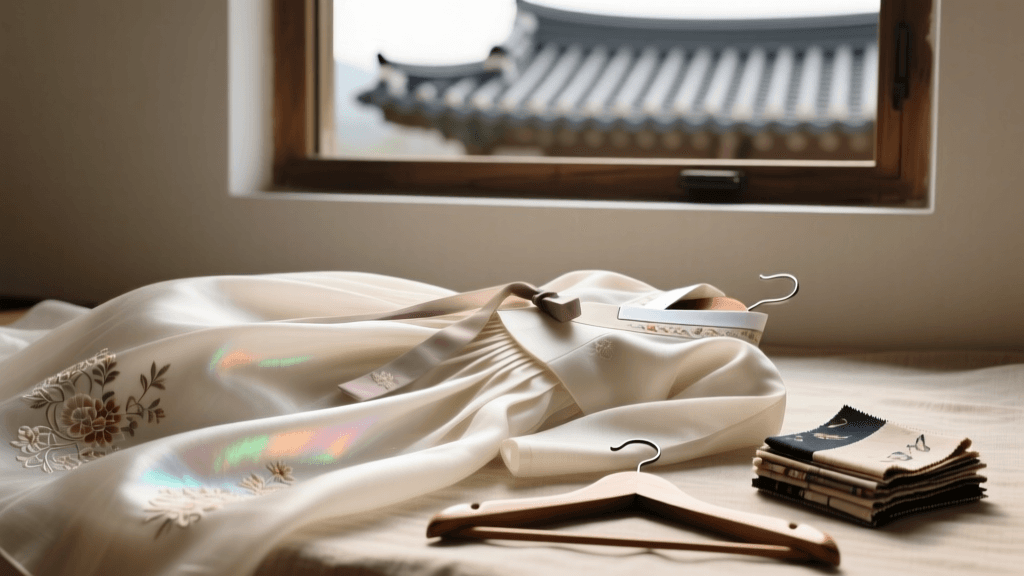
'True Myeongju silk is characterized by its subtle, uneven texture. Unlike the flawless, glass-like surface of machine-woven synthetic satins, authentic hand-woven silk possesses a living, breathing topography that catches the light in organic, shifting waves.'
Shipping, Import Duties, and Silk Care in 2026
Ordering directly from South Korea involves navigating international logistics. As of 2026, most premium hanbok artisans ship via DHL or FedEx's specialized 'Textile & Heritage' courier tiers, which offer climate-controlled transit to prevent silk from being exposed to extreme humidity or freezing temperatures during air freight. Expect shipping costs to range between $45 and $85 USD, with delivery times averaging 7 to 12 business days.
Customs and Duties: Be prepared to pay import duties on luxury textiles. In the US and EU, garments classified under 'silk traditional ceremonial wear' may be subject to a 5% to 12% import tax depending on your local 2026 trade regulations. Always ask the seller to provide the correct HS (Harmonized System) code for hand-woven silk apparel to avoid misclassification as mass-produced synthetic costumes.
Care and Storage: Once your custom hanbok arrives, proper care is paramount. Never machine wash authentic Myeongju silk. In 2026, the standard of care involves professional dry cleaning using liquid silicone solvents, which are gentler on natural dyes than traditional perc chemicals. Between wears, air the garment out in a shaded, well-ventilated room. Store the chima and jeogori separately in breathable cotton garment bags, and insert natural camphor wood blocks to deter moths without introducing harsh chemical odors into the delicate silk fibers.
Conclusion
Purchasing an authentic hanbok online in 2026 is no longer a gamble; it is a highly refined process that connects you directly with the custodians of Korean textile heritage. By utilizing specialized artisan marketplaces, understanding the unique flat-pattern measurement requirements, and insisting on certified Myeongju silk, you ensure that your garment is not merely a piece of clothing, but a wearable work of art that honors centuries of Asian tradition.