Miao Pleated Skirts & Silverwork: Guizhou Folk Dress Guide
The Living Textiles of Guizhou's Miao Communities
Nestled in the misty, karst mountain ranges of southwestern China's Guizhou Province, the Miao (Hmong) people have cultivated one of the most visually striking and technically complex sartorial traditions in Asia. Unlike many cultures that relied on written language to pass down their history, the Miao encoded their migration stories, cosmological beliefs, and clan identities into their textiles and metalwork. Today, the regional folk dress of the Miao remains a vibrant, living tradition, particularly evident during the Lusheng Festival and the Sisters' Meals Festival.
For textile collectors, cultural historians, and slow-fashion enthusiasts, understanding the anatomy of Miao dress requires looking beyond the vibrant surface. It demands an appreciation of the hundreds of hours of labor, the precise regional variations, and the specialized knowledge required to source and care for these garments today.
Miao clothing is not merely decorative; it is a wearable epic, a historical archive for a people who, for centuries, recorded their migrations and myths in thread rather than text.
Anatomy of the Bai Zhe Qun (Hundred-Pleat Skirt)
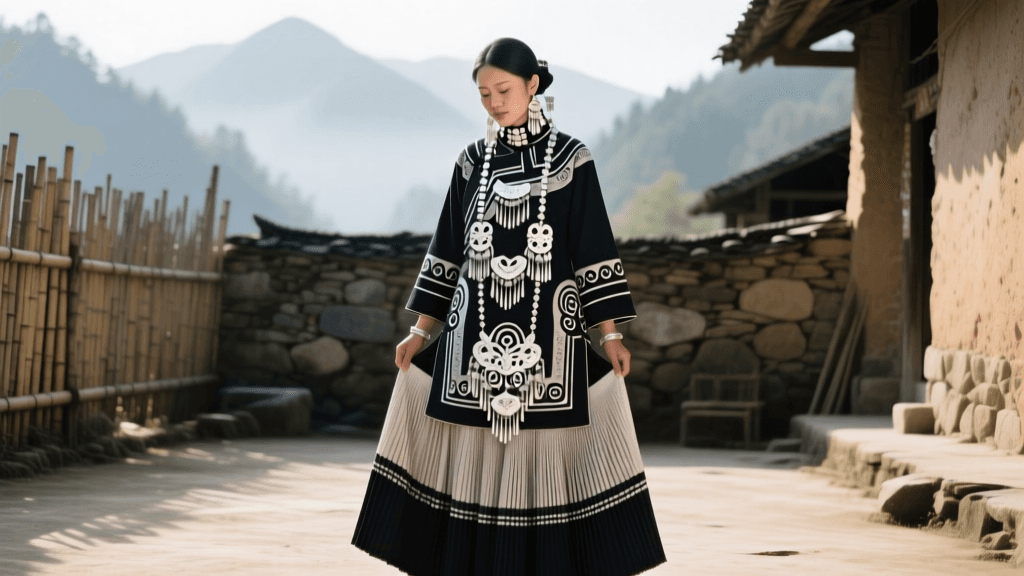
The cornerstone of traditional Miao women's festival attire is the Bai Zhe Qun, or 'hundred-pleat skirt.' Despite the name, a master-crafted skirt often contains between 300 and 500 microscopic, uniform pleats. The creation of this garment is a masterclass in structural textile engineering.
The Indigo Dyeing and Pleating Process
The base fabric is hand-woven cotton, repeatedly dyed in vats of fermented natural indigo (Persicaria tinctoria) until it achieves a deep, nearly black-blue hue. The fabric is then brushed with a starch made from fern root or rice water to stiffen it. Artisans use a specialized bamboo splint tool to fold the fabric into uniform pleats, sometimes as narrow as 2 millimeters. The pleated bundle is then tightly bound with hemp string and steamed over a wood fire for hours to permanently set the folds.
Measurements and Sizing
Because the skirt is wrapped and tied rather than tailored to a specific waistline, it is highly adaptable, but the fabric requirements are staggering.
- Fabric Required: 12 to 15 meters of hand-woven cotton are required to create a single skirt that measures roughly 60 to 80 centimeters in circumference when folded.
- Length: Skirts vary dramatically by region, ranging from 15 cm (miniskirt style in Danzhai) to 90 cm (ankle-length in Leishan).
- Weight: A heavily embroidered, fully pleated festival skirt can weigh between 1.5 kg and 3 kg due to the dense silk thread work and stiffened indigo cotton.
The Weight of Ancestors: Miao Silver Jewelry
No Miao festival ensemble is complete without its accompanying silverwork. Silver is believed to possess protective qualities, capable of warding off evil spirits and illuminating the path to the ancestral realm. According to collection archives at the British Museum, Miao silversmithing represents one of the most sophisticated folk metalworking traditions in Southeast Asia.
Components of the Silver Set
A full festival silver set includes a massive horned headdress, multiple layered neck rings (torques), chest plates, hairpins, and bracelets. The silversmiths utilize advanced techniques such as filigree, repoussé, and granulation, often drawing motifs from nature, such as dragons, butterflies, and birds.
- Total Weight: A complete bridal or festival silver set can weigh anywhere from 5 kg to over 10 kg (11 to 22 lbs). The physical endurance required to dance in the Lusheng festival while bearing this weight is considered a mark of strength and grace.
- Purity Standards: Traditional Miao silver is exceptionally pure. Modern authentic pieces are stamped S990 or S999, indicating 99.0% to 99.9% pure silver, which makes the metal softer and more suitable for intricate filigree work than standard sterling (S925).
Regional Variations Across Guizhou
Guizhou's mountainous topography historically isolated villages from one another, resulting in hyper-localized 'sub-styles' of dress. The Metropolitan Museum of Art notes that these regional distinctions serve as immediate visual identifiers of a wearer's village, marital status, and clan lineage.
| Region / County | Skirt Style & Length | Dominant Embroidery Motif | Silver Headdress Shape | Avg. Silver Set Weight |
|---|---|---|---|---|
| Xijiang (Leishan) | Long (70-90 cm), heavy pleats | Butterfly Mother, Water Dragon | Massive Water Buffalo Horns | 7 - 10 kg |
| Danzhai | Short (15-25 cm), 'miniskirt' style | White Pheasant, Birds | Floral Crowns, smaller horns | 3 - 5 kg |
| Huangping | Medium (50-60 cm), geometric batik | Geometric patterns, Stars | Flared Crown / Sunburst | 4 - 6 kg |
| Rongjiang | Wrap-around, apron-heavy | Mythological beasts, Rivers | Comb-style hairpins | 2 - 4 kg |
Practical Guide: Sourcing and Purchasing Today
For collectors and enthusiasts looking to acquire authentic Miao garments and silverwork, navigating the markets of Guizhou requires a blend of cultural respect and sharp bargaining skills. The rise of cultural tourism has flooded areas like Xijiang Miao Village with mass-produced, machine-embroidered replicas. Here is how to source authentic pieces.
Where to Buy
- Kaili Sunday Market: The most authentic trading hub. Villagers from surrounding mountains come to sell vintage textiles, raw indigo cloth, and handmade silver. Arrive by 7:00 AM for the best selection.
- Shiqiao Village (Danzai): Famous for its traditional paper-making and batik. You can commission custom indigo-dyed pleated skirts directly from the cooperatives here.
- Xijiang Miao Village: Highly commercialized. While convenient, you must be vigilant. Avoid shops selling 'antique' skirts that smell of chemical dyes or feature perfectly uniform, machine-stitched embroidery.
Costs and Timing
- Custom Embroidered Jacket: $400 - $1,200 USD. Lead time: 4 to 8 months, as a single jacket can require over 100,000 individual silk stitches using the 'broken-thread' technique.
- Vintage Pleated Skirt (Mid-20th Century): $300 - $800 USD depending on condition, pleat density, and the presence of rare silk-brocade panels.
- Silverwork: Priced by weight plus craftsmanship. Expect to pay the daily spot price of silver plus an artisan fee. Roughly 15 to 30 RMB per gram. A 2kg custom horn headdress will cost approximately $450 - $900 USD.
Garment Care: Preserving Indigo and Silver
Owning a piece of Miao folk dress comes with strict preservation requirements, as the natural materials used are highly reactive to modern environments.
Caring for Indigo-Dyed Cotton
Natural indigo is not chemically bonded to the cotton fiber; it sits on the surface. Therefore, a newly dyed Miao skirt will 'bleed' blue for the first few years.
- Washing: Never use commercial detergents or warm water. Hand-wash gently in cold water with a dash of white vinegar to help set the dye.
- Drying: Always dry in the shade. Direct UV sunlight will rapidly fade the deep blue-black hue to a dull gray.
- Storage: Store the skirt tightly rolled or bound in its original pleated state. Hanging it will cause the stiffened pleats to drop and stretch out of shape over time.
Maintaining S999 Pure Silver
Because S999 silver lacks the copper alloy found in sterling silver, it is softer and more prone to scratching, but it also oxidizes differently.
- Tarnish Removal: Do not use harsh chemical dips. Use a soft, untreated microfiber cloth to gently buff the silver. For deep crevices in filigree work, use a soft-bristled baby toothbrush with a paste made of baking soda and water.
- Storage: Store silver pieces in individual anti-tarnish flannel bags with silica gel packets to control humidity, which accelerates oxidation in Guizhou's damp climate.
The Future of Miao Craftsmanship
The transmission of Miao textile and silversmithing traditions faces the dual threats of rural-to-urban youth migration and the influx of cheap, synthetic alternatives. However, a new wave of social enterprises and initiatives recognized by UNESCO's Intangible Cultural Heritage frameworks are helping to stabilize the craft. By paying fair-trade wages for the immense time required to create a single pleated skirt or filigree horn, conscious collectors and global fashion houses can ensure that the Miao 'wearable epic' continues to be written in thread and silver for generations to come.