Chinese Drawloom Weaving & Yunjin Brocade Revival in 2026
The Resurgence of the Da Hua Lou in 2026
In the evolving landscape of global fashion and textile preservation, the year 2026 has marked a monumental renaissance for ancient Chinese weaving techniques. At the forefront of this revival is the Yunjin brocade, a luxurious fabric historically reserved for imperial dragon robes, and the magnificent Da Hua Lou, the traditional Chinese drawloom used to create it. As the Xin Zhongshi (New Chinese Style) movement matures from a niche aesthetic into a dominant force in international luxury fashion, designers and artisans are looking backward to move forward. They are integrating authentic, hand-loomed Yunjin textiles into modern silhouettes, bridging a gap that spans over a millennium of sartorial history.
Yunjin, which translates to 'cloud brocade' due to its vibrant, cloud-like patterns and shimmering textures, was inscribed on the UNESCO Representative List of the Intangible Cultural Heritage of Humanity. According to the UNESCO Intangible Cultural Heritage archives, the complex weaving techniques required to produce Yunjin cannot be fully replicated by modern automated machinery. This inherent limitation has become its greatest asset in 2026, as luxury consumers increasingly demand authenticity, human craftsmanship, and sustainable, slow-fashion methodologies over mass-produced synthetics.
Anatomy of the Traditional Chinese Drawloom
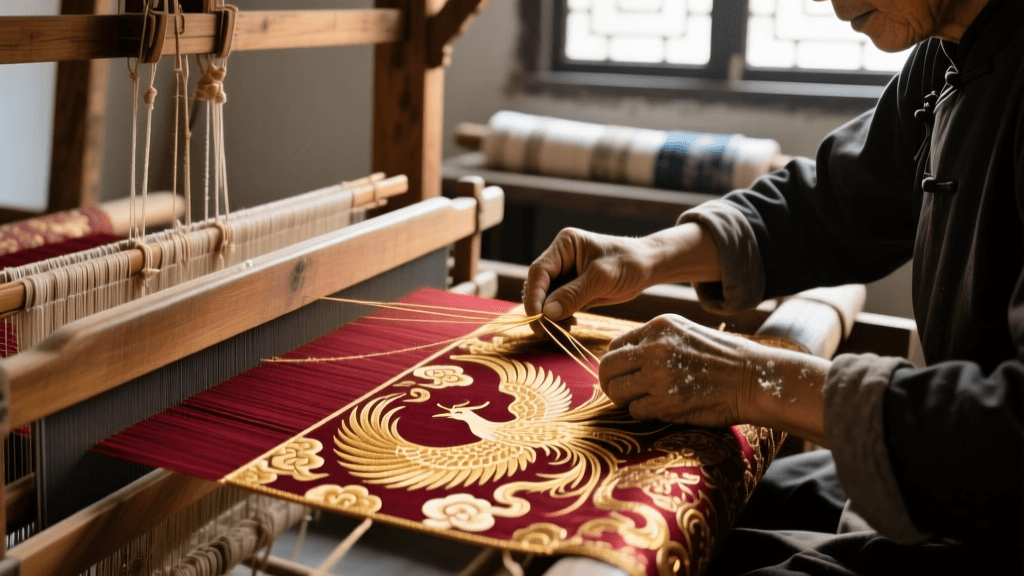
The Da Hua Lou is not merely a tool; it is a towering, intricate piece of wooden engineering that operates much like a 15th-century binary computer. Standing approximately 4 meters high, 5.6 meters long, and 1.4 meters wide, the drawloom requires a highly synchronized team to operate. Historically, this involved a master weaver seated at the front to manage the shuttle and beat the weft, and a 'drawboy' seated in the upper scaffolding to pull the pattern cords.
In 2026, while the physical dimensions and bamboo-and-wood construction of the authentic preservation looms remain unchanged, the environment in which they operate has been modernized. Climate-controlled studios in Nanjing and Suzhou now house these massive structures, ensuring the silk warps do not snap due to humidity fluctuations. The pattern cords, which dictate the intricate floral and draconic motifs, are still tied by hand. A single complex pattern can require over 100,000 individual knots in the harness system. Memorizing and executing the sequence of cord pulls is a cognitive feat that takes master artisans decades to perfect.
The Tongjing Duanwei Technique
The defining characteristic of Yunjin brocade is the 'Tongjing Duanwei' technique, which translates to 'interlocking warps and broken wefts.' Unlike standard continuous weft weaving, where a single thread of yarn passes entirely from one edge of the fabric to the other, Tongjing Duanwei involves using small, individual bobbins of colored weft threads that only interlock where a specific color is needed in the pattern. This is essentially a woven tapestry technique applied to fine silk.
This method allows for an astonishing degree of color variation and gradient blending within a single row of weaving. In 2026, master weavers utilize this technique to create photorealistic botanical motifs and subtle ombre effects that remain impossible for digital jacquard looms to mimic authentically. The structural integrity of the fabric is maintained by the continuous warp, while the discontinuous wefts provide the lavish, heavily textured surface that gives Yunjin its characteristic three-dimensional relief.
Materials of the Imperial Loom: Silk, Gold, and Feathers
The opulence of Yunjin brocade is intrinsically tied to its raw materials. In contemporary 2026 production, authentic Yunjin studios adhere strictly to traditional material sourcing to maintain the textile's cultural and monetary value. The primary materials include:
- Mulberry Silk: The foundation of both the warp and the base weft, prized for its high tensile strength and natural luster.
- 24K Gold Foil Strips: Ultra-thin sheets of pure gold are applied to specialized paper or animal membrane, then cut into microscopic threads and wrapped around a silk core. This creates a flexible, non-tarnishing metallic yarn that catches the light dynamically.
- Peacock Feather Yarn: Perhaps the most exclusive material used in 2026, peacock feather filaments are carefully spun with silk to create an iridescent, structural weft that shifts between emerald, sapphire, and bronze depending on the viewing angle.
- Silver and Copper Threads: Used for shading and creating depth in complex cloud and water motifs.
Yunjin Brocade in the 2026 Xin Zhongshi Movement
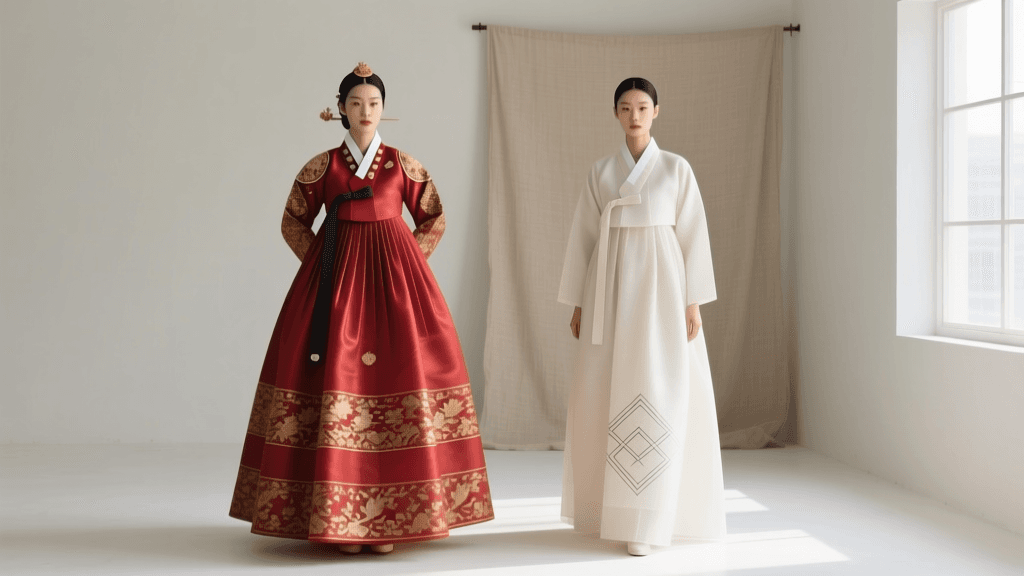
The Xin Zhongshi movement of 2026 has moved beyond simply slapping traditional Mandarin collars onto modern shirts. Today's leading Asian fashion houses are utilizing Yunjin brocade as an accent of structural luxury. Because authentic hand-loomed Yunjin is incredibly dense, heavy, and expensive, it is rarely used for full garments in contemporary daily wear. Instead, 2026 design weeks in Shanghai and Paris have showcased Yunjin integrated into structured blazer lapels, wide-leg trouser side-panels, and architectural corsetry.
This strategic placement honors the historical reverence of the fabric while adapting it to the modern wardrobe. Designers are pairing the heavy, metallic sheen of Yunjin with matte, ultra-modern fabrics like Japanese technical crepe and Italian matte wool, creating a striking textural contrast that defines the 2026 luxury aesthetic.
2026 Pricing and Production Metrics
The economics of authentic drawloom weaving reflect its extreme labor intensity. A master weaver and their draw-partner can produce a maximum of 5 to 6 centimeters of authentic Yunjin brocade per day. Consequently, the market for these textiles in 2026 is highly exclusive.
| Metric | Authentic Hand-Loomed Yunjin (2026) | Modern Jacquard Replica (2026) |
|---|---|---|
| Production Speed | 5 - 6 cm per day (two artisans) | 15 - 20 meters per hour |
| Material Composition | Mulberry silk, 24k gold, peacock yarn | Synthetic blends, metallic polyester |
| Market Price (per meter) | $1,200 - $2,500 USD | $40 - $85 USD |
| Pattern Complexity | Unlimited colors per row (Tongjing Duanwei) | Limited to 8-12 harness-controlled colors |
| Primary Market | Haute couture, museum archives, collectors | Fast fashion, mass-market Xin Zhongshi |
Academic Research and Digital Preservation
As the generation of master weavers who learned their craft in the mid-20th century ages, academic institutions and textile museums have accelerated digital preservation efforts. In 2026, researchers are utilizing advanced LiDAR scanning and AI-assisted motion capture to document the exact physical movements and tension metrics of the weavers operating the Da Hua Lou. This data is crucial for understanding the biomechanics of ancient weaving and for training future artisans.
Institutions like the Metropolitan Museum of Art have long recognized the profound technical achievements of Chinese silk weavers. As noted in the Met Museum's Heilbrunn Timeline of Art History regarding Chinese textiles, the drawloom technology developed in China predated European equivalents by centuries, fundamentally altering the global trade of luxury goods along the Silk Road. Today, academic research focuses not just on the historical artifacts, but on the chemical preservation of the gold and peacock feather threads used in contemporary 2026 commissions, ensuring these modern heirlooms survive for future centuries.
Sourcing Authentic Woven Textiles Today
For collectors, designers, and cultural historians looking to source authentic Yunjin brocade in 2026, provenance and certification are paramount. The market is flooded with high-quality jacquard imitations that mimic the visual aesthetic of cloud brocade but lack the structural integrity and material value of the genuine article. Authentic pieces are typically sourced directly from state-recognized research institutes in Nanjing or through specialized heritage textile galleries that provide a certificate of authenticity detailing the specific loom, the master weaver, and the exact material composition.
Museums and cultural institutions also play a vital role in educating the public and designers about the nuances of these textiles. The Victoria and Albert Museum's extensive Asian collections provide invaluable reference points for designers studying historical drape, motif placement, and color theory, informing the next generation of Xin Zhongshi creations. By understanding the profound engineering of the Da Hua Lou and the meticulous artistry of Tongjing Duanwei, the fashion industry in 2026 continues to ensure that the clouds of imperial China remain woven into the fabric of the future.