2026 Guide to Kimono Trade Routes & Historical Imports
The kimono is frequently celebrated as the ultimate symbol of isolated Japanese aesthetic refinement. However, a deeper examination of its textile history reveals a vibrant, interconnected web of global commerce. Far from being developed in a cultural vacuum, the evolution of the kimono was heavily dictated by international trade routes, maritime imports, and the assimilation of foreign materials. From the caravans of the Silk Road to the merchant ships docking at Yokohama, the threads of the kimono are woven with the history of global commerce. As we navigate the collector and artisan landscape in 2026, understanding these historical import routes is essential for authenticating, preserving, and appreciating vintage garments. This comprehensive guide explores the profound impact of the Silk Road, the Southern Maritime routes, and the Meiji-era port openings on Japanese textile heritage.
The Southern Maritime Routes: Ryukyu Kasuri and Indian Cotton
Long before the modern era, the Ryukyu Kingdom (modern-day Okinawa) served as a vital maritime bridge between Japan, Southeast Asia, and the Indian subcontinent. One of the most significant textile imports to traverse this route was the technique and material for Kasuri (ikat). Originating in India, where it was known as Patola, the resist-dyeing technique traveled through Southeast Asia and reached the Ryukyu Islands by the 14th century.
The early Ryukyu Kasuri garments were woven using imported Indian and Southeast Asian cotton, a material that was highly prized in mainland Japan where hemp and ramie were the standard domestic fibers for commoners. The breathability and softness of this imported cotton revolutionized summer wear. Today, in 2026, master weavers in Okinawa are experiencing a renaissance, actively sourcing heritage cotton seeds and utilizing historical maritime trade logs to recreate the exact thread counts and indigo fermentation processes used in the 17th century. Collectors seeking authentic Ryukyu Kasuri should look for the distinct, slightly irregular weave that characterizes hand-spun imported cotton, a hallmark that differentiates it from mass-produced domestic alternatives.
The Yokohama Port Era: Meiji Wool and Aniline Dyes
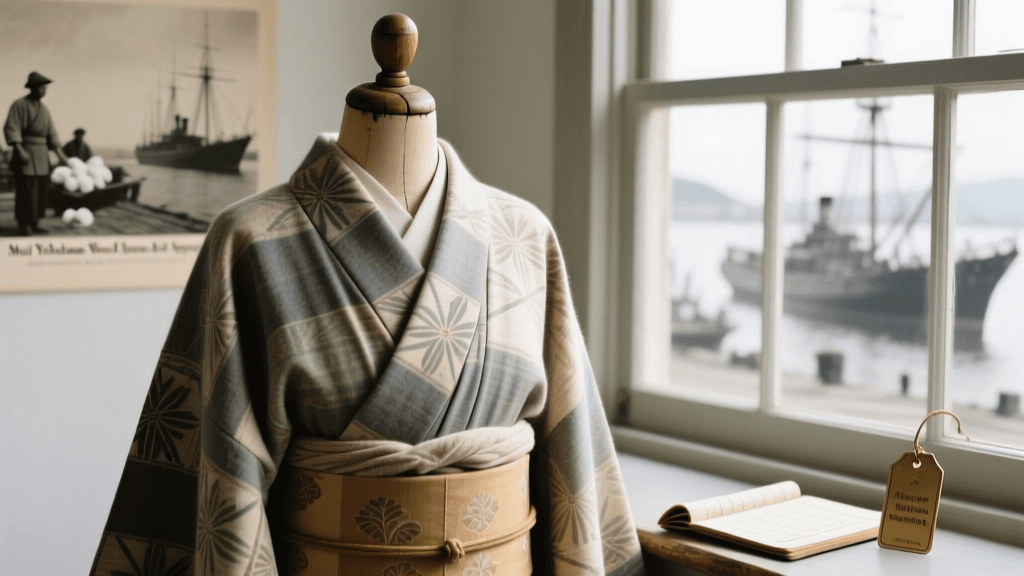
The opening of the port of Yokohama in 1859 fundamentally altered the Japanese wardrobe. The subsequent Meiji era (1868–1912) saw an unprecedented influx of Western textiles, most notably imported wool serge and synthetic aniline dyes from Europe. According to archival records preserved at the Victoria and Albert Museum's Asian collections, these imports were initially used for military uniforms and government official attire. However, by the late Meiji and early Taisho periods, imported wool and synthetic dyes had permeated civilian fashion.
Imported wool, known as serge or rasha, was highly valued for its durability and warmth, leading to the creation of hybrid garments and winter kimonos that blended Western silhouettes with traditional T-shaped seams. More transformative, however, was the import of aniline dyes. Unlike traditional plant-based dyes such as madder or indigo, European aniline dyes offered blindingly bright reds, purples, and greens that were colorfast and resistant to fading. This directly enabled the explosion of Meisen silk kimonos in the 1920s, which featured bold, graphic patterns made possible only by the chemical stability of imported synthetic colorants.
Table: Historical Textile Imports vs. 2026 Artisan Revivals
| Era / Trade Route | Imported Material | Historical Application | 2026 Artisan Revival Status |
|---|---|---|---|
| 14th C. / Southern Maritime | Indian Cotton & Patola Techniques | Ryukyu Kasuri summer garments | High: Okinawan cooperatives reviving heritage seed cotton. |
| 8th C. / Silk Road | Persian Brocade Motifs & Gold Thread | Nishijin-ori ceremonial obi | Moderate: Kyoto ateliers using modern metallic yarns. |
| 19th C. / Yokohama Port | European Wool Serge | Meiji-era winter kimonos & haori | Low: Sourced mostly by vintage upcyclers. |
| 19th C. / Yokohama Port | German Aniline Dyes | Vibrant Meisen and Omeshi silks | High: Artisans formulating eco-friendly aniline alternatives. |
Persian Motifs and the Silk Road Legacy in Nishijin Weaving
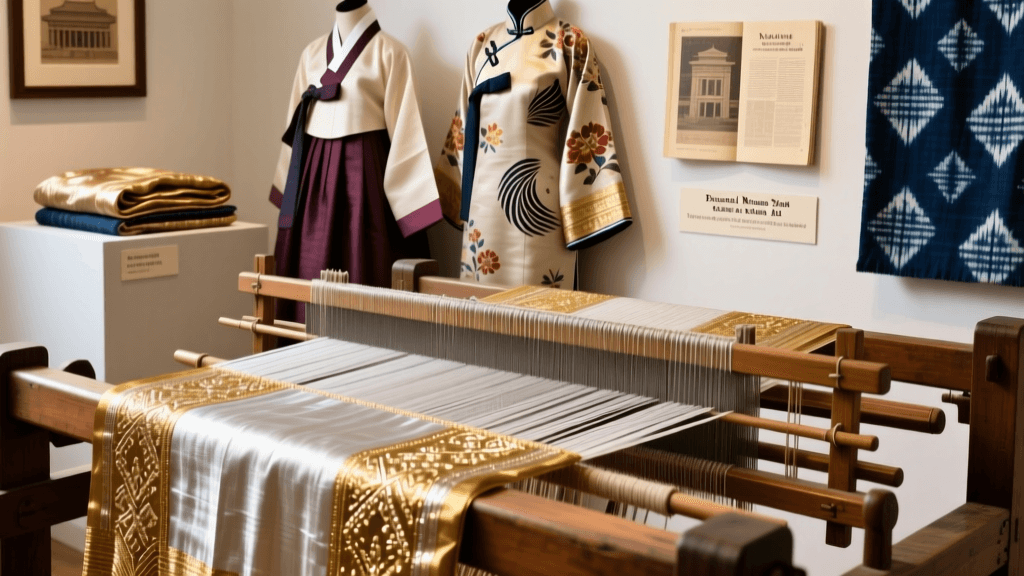
While the kimono is inherently Japanese, its most luxurious component—the obi (sash)—owes a significant debt to the ancient Silk Road. The Nishijin district in Kyoto, the epicenter of Japanese brocade weaving (Nishijin-ori), absorbed profound influences from Persian and Central Asian textiles. As documented by textile historians featured in the Metropolitan Museum of Art's Asian Art department, Sassanian Persian motifs such as the roundel, the confronting lions, and the stylized pomegranate tree were integrated into Japanese court fabrics as early as the Nara period (710–794).
The integration of these foreign elements was not mere imitation; Japanese weavers masterfully abstracted these motifs, blending them with indigenous flora and fauna to create a hybrid visual language that defined aristocratic dress for centuries. These imported motifs were adapted into the Maru obi and Fukuro obi, woven with imported gold and silver threads. The structural complexity of Nishijin brocade relies on draw-loom techniques that share direct lineage with Middle Eastern and Chinese weaving traditions. In 2026, high-end Nishijin weaving houses are collaborating with international textile conservators to analyze surviving 8th-century Shosoin Repository fragments, ensuring that modern ceremonial obi maintain the exact warp-and-weft ratios of their Silk Road ancestors.
Collecting and Authenticating Trade-Imported Kimonos in 2026
For vintage textile collectors and museum curators operating in 2026, distinguishing between domestically sourced materials and historical imports requires a keen eye and an understanding of material degradation. The market for Meiji-era imported wool and early Taisho aniline-dyed Meisen has surged, driven by a renewed interest in globalized fashion history.
When evaluating a garment for historical imports, consider the following authentication markers:
- The Burn Test and Fiber Analysis: While destructive testing is discouraged on intact garments, microscopic fiber analysis can identify early imported wool serge. Meiji wool often exhibits a coarser, uneven spin compared to refined 20th-century domestic wools.
- Aniline Dye Halos: Early German aniline reds and purples, while colorfast to light, were often sensitive to water. Look for slight 'haloing' or micro-bleeding along the edges of the resist-dyed patterns, a telltale sign of early synthetic dye application on Meisen silk.
- Lining Materials: A kimono featuring an imported wool or heavy silk exterior but lined with distinct, hand-loomed domestic ramie or early machine-spun cotton often indicates a transitional Meiji-era garment adapting to foreign imports.
- Motif Anomalies: The presence of Art Deco geometry mixed with traditional Persian roundels often points to the Taisho era (1912–1926), a period where Yokohama port imports heavily influenced domestic design sensibilities.
- Hardware and Fasteners: Imported brass or glass fasteners, occasionally used on early hybrid haori, can be cross-referenced with European manufacturing stamps from the late 19th century.
Furthermore, the provenance of the garment plays a critical role. Auction houses in Tokyo and Kyoto now routinely employ spectrophotometry to trace the chemical signature of early aniline dyes back to specific German manufacturing plants in the Rhine valley, providing certificates of authenticity that verify the garment's import lineage.
Preserving the Global Thread
The narrative of the kimono is incomplete without acknowledging the ships, caravans, and merchants that brought foreign fibers, dyes, and motifs to Japanese shores. As we advance through 2026, the preservation of these garments is not merely an act of safeguarding Japanese culture, but of protecting a tangible record of global economic and artistic exchange. Institutions like the British Museum's Department of Asia continue to highlight these cross-cultural intersections, reminding us that traditional garments are living archives of human connectivity. Whether you are a collector bidding at auction, a weaver studying historical drafts, or a historian mapping maritime routes, recognizing the imported soul of the kimono enriches our understanding of Asian traditions on a global scale.