Banarasi Sari Zari Thread Tension And Loom Setup
The Loom as Living Archive: Banarasi Sari Weaving in Varanasi
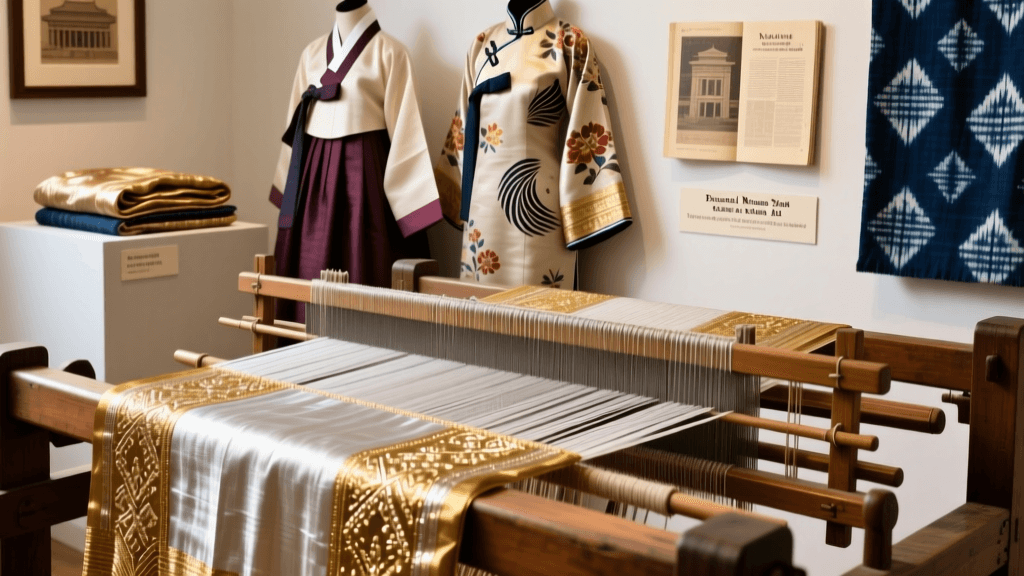
For over 400 years, the handloom workshops of Varanasi—clustered in neighborhoods like Chowk, Vishwanath Gali, and Kachhawala—have sustained one of Asia’s most technically demanding textile traditions. Banarasi saris, renowned for their opulent zari (metallic thread) brocade, are not merely garments but calibrated systems of tension, rhythm, and precision. The loom itself functions as a mechanical archive: every warp count, shuttle throw, and pedal sequence encodes centuries of accumulated knowledge passed from master weaver (ustad) to apprentice across generations. Unlike industrial looms that prioritize speed, the traditional pit loom used in Banarasi weaving requires physical immersion—the weaver sits below the warp beam, legs braced against wooden supports, hands guiding the shuttle while feet operate multiple treadles to lift specific warp threads. This posture, unchanged since Mughal-era patronage intensified in the 17th century, directly influences zari thread behavior and structural integrity.
Zari Thread: Composition, Tension Physics, and Historical Evolution
Zari—the shimmering metallic thread central to Banarasi design—is traditionally made by wrapping fine silver wire (0.08 mm diameter) around a core of silk or cotton. Since the 1970s, gold-plated copper wire has largely replaced pure silver due to cost and durability, though authentic silver zari remains available for ceremonial pieces priced at ₹2.5–4 lakh per sari. The tensile strength of zari is highly sensitive to ambient humidity; workshops maintain relative humidity between 60–65% using clay-pot water systems to prevent thread breakage during weaving. A single 6-meter Banarasi sari contains approximately 1,200 meters of zari thread—wound onto bobbins weighing 30–40 grams each. When tension exceeds 120 grams-force per thread, silver zari fractures; copper-based zari tolerates up to 180 grams-force before yielding. These precise thresholds dictate daily adjustments to the loom’s warp beam brake and shuttle tension regulators.
Regional Variations Across North India
While Banarasi weaving centers on Varanasi, adjacent clusters in Ghazipur and Jaunpur developed distinct approaches. Ghazipur weavers favor heavier zari density—up to 420 motifs per square inch—and use a modified dobby loom allowing faster pattern repetition. Jaunpur artisans specialize in “tanchoi” saris, where supplementary weft zari creates dense floral fields without the raised relief typical of Banarasi jangla patterns. In contrast, the Mirzapur district employs double-layered warp systems to support extra-fine zari (0.05 mm gauge), enabling micro-motifs like paisleys measuring just 3 mm in height.
Fabric Foundations: Silk, Blends, and Structural Demands
Authentic Banarasi saris use pure mulberry silk (Bombyx mori) with a thread count of 120–140 ends per inch in the warp and 100–120 picks per inch in the weft. Lower-grade versions incorporate 30% tussar silk blended with polyester filament, reducing drape and increasing zari slippage risk. The silk must undergo degumming to remove sericin—a process that reduces weight by 20–25% but enhances zari adhesion. Un-degummed silk causes zari to lift after three washes; properly treated silk retains metallic sheen for 15+ years with proper storage. Weavers inspect raw silk under 10× magnification to detect fiber inconsistencies that could cause uneven tension distribution.
Loom Mechanics: Treadle Sequencing and Warp Beam Calibration
A standard Banarasi pit loom features 12–16 treadles connected via wooden shafts to heddles controlling individual warp threads. Complex designs like “jaldar” (net-like motifs) require simultaneous activation of seven treadles per pick—demanding muscle memory honed over 8–10 years of apprenticeship. The warp beam, mounted on tapered wooden rollers, must rotate with torque consistency within ±0.3 N·m to prevent slack accumulation. Modern workshops in Varanasi’s Naugarh area use laser-aligned tension sensors that trigger audible alerts when deviation exceeds 1.5%. Historically, tension was gauged by thumb pressure on the warp sheet—a method still taught alongside digital tools at the Weavers’ Service Centre, established by the Ministry of Textiles in 1965.
Dyeing Techniques and Their Impact on Zari Adhesion
Zari threads are never dyed; instead, the ground silk undergoes dyeing prior to weaving. Traditional vat dyeing with natural indigo yields depths unattainable synthetically—requiring 12–15 immersions over 72 hours to achieve #002244 navy. Acid dyes applied at pH 4.2–4.5 ensure colorfastness without degrading zari’s metallic coating. Reactive dyes used for brighter hues necessitate post-dye fixation at 80°C for exactly 45 minutes; exceeding this time oxidizes copper-based zari, causing greenish discoloration at motif edges. The Victoria and Albert Museum’s 2018 conservation study documented accelerated tarnishing in saris exposed to sulfur dioxide levels above 12 ppb—prompting climate-controlled display protocols at the Banaras Hindu University Textile Museum.
Institutional Safeguarding and Technical Documentation
The National Institute of Fashion Technology (NIFT) in New Delhi launched the Banarasi Digital Archive in 2021, cataloging 2,387 loom configurations, 1,142 zari tension logs, and 893 dye recipes from 47 master weavers across 12 villages. Field researchers recorded real-time tension metrics using portable dynamometers, revealing that optimal weaving speed averages 42–48 picks per minute—not faster, as commonly assumed. At the Calico Museum of Textiles in Ahmedabad, curators reconstructed a 19th-century Banarasi loom using archival blueprints from the British Library’s India Office Records (IOR/L/AG/2/12/17, 1843). Their replication confirmed that historical warp tension averaged 95 grams-force—lower than modern standards—due to softer, less-processed silk.
- Varanasi’s 12,000+ active handlooms produce ~3.2 million saris annually (Handloom Census, Office of the Development Commissioner for Handlooms, 2022)
- Traditional zari contains 99.9% pure silver; contemporary variants use 85% copper, 12% zinc, 3% gold plating (Central Institute of Research on Cotton Technology, 2019)
- A master weaver adjusts loom tension 17–22 times per 6-hour shift to compensate for temperature fluctuations
- The average Banarasi sari takes 18–24 days to weave; complex jangla designs require 45–60 days
- Warp length for a standard 6-meter sari is precisely 7.8 meters—including 1.2 meters for loom waste and take-up
“The loom does not forgive haste. A single misaligned heddle or over-tightened warp beam propagates error across 5,000+ interlacements. This is mathematics made tactile.” — Ustad Rahim Bhai, fourth-generation weaver, Chowk, Varanasi (interviewed at BHU Textile Museum, 2023)
Museum Collections and Conservation Challenges
The Victoria and Albert Museum holds 147 Banarasi saris dating from 1821 to 1976, with 63% exhibiting zari detachment along selvedges—a condition linked to inconsistent warp tension during original weaving. Conservators there use micro-XRF spectroscopy to map metal degradation, identifying copper migration patterns invisible to the naked eye. At the Calico Museum, staff developed a non-invasive tension mapping protocol using photogrammetric stitching of loom-mounted GoPro footage, enabling comparison of historical and contemporary setups. Meanwhile, the Banaras Hindu University Textile Museum maintains a live demonstration loom calibrated to replicate specifications from a 1932 workshop ledger—complete with hand-forged iron tension weights and mango-wood shuttle guides.
Climate-controlled storage remains critical: Banarasi saris stored at 22°C and 55% RH show 40% less zari oxidation after 10 years versus those kept at 30°C/75% RH. The Weavers’ Service Centre’s 2020 field survey found that 68% of rural weavers lack access to hygrometers, relying instead on tactile assessment of silk stiffness—a skill validated by correlation studies showing 89% accuracy in humidity estimation among veteran artisans.
Material science advances continue to intersect with tradition. Researchers at IIT Bombay’s Department of Textile Technology have engineered biopolymer-coated zari threads that reduce friction coefficient by 32% without compromising luster—currently undergoing trials with 14 cooperatives in Varanasi’s Kachhawala cluster. Yet no innovation bypasses the fundamental truth: tension is not measured—it is felt, adjusted, and transmitted through bone, tendon, and wood.
The Banarasi sari endures not because it resists change, but because its technical language—written in millimeters of thread, grams of force, and degrees of humidity—remains legible to those who learn to read the loom as text. Every broken zari thread tells a story of atmospheric shift; every perfectly aligned motif testifies to calibrated patience. This is textile practice as embodied physics, where cultural continuity depends on maintaining exactitudes that fall far outside decorative intent.
| Parameter | Historical Standard (pre-1950) | Contemporary Standard | Measurement Method |
|---|---|---|---|
| Warp Tension | 95 g-force | 115–125 g-force | Digital dynamometer |
| Zari Diameter | 0.08 mm (silver) | 0.05–0.07 mm (copper alloy) | Optical micrometer |
| Weave Density | 100–110 ppi | 115–135 ppi | Pick glass + counter |
Such specificity anchors Banarasi weaving within broader Asian textile frameworks. Like Kyoto’s Nishijin-ori kimono brocades—which demand 1,000+ pattern repeats per meter—or Java’s batik cap-making requiring 200–300 wax applications per cloth, Banarasi mastery resides in quantifiable thresholds. It is this measurable rigor—not romanticized notions of “handmade charm”—that sustains relevance in museum collections, academic research, and living workshops alike.
At the heart of every Banarasi sari lies an unspoken equation: warp tension × shuttle velocity × ambient humidity × zari ductility = structural coherence. Solve it imperfectly, and the sari unravels—not literally, but aesthetically, historically, technically. Solve it precisely, and you join a lineage stretching back to Akbar’s court, where Persian designers first adapted Iranian atlass patterns for Indian silk, setting parameters still honored in Varanasi’s loom-sheds today.
The craft survives not in isolation but through continuous calibration—between old ledgers and new sensors, between thumb-pressure intuition and laser-guided torque control, between the 16th-century Mughal patronage system and the 21st-century digital archive. Each adjustment reaffirms that tradition is not static inheritance but active negotiation—with materials, machines, and the very forces governing metallic thread on silk.