Chinese Drawloom Weaving: Yunjin Brocade Revival 2026
The Intersection of Ancient Technology and Modern Fashion
The traditional Chinese drawloom represents one of the most sophisticated mechanical and computational achievements of the ancient world. Long before the invention of the Jacquard loom in Europe, Chinese weavers were utilizing complex binary logic to program intricate patterns into silk. Today, as the global fashion industry seeks deeper authenticity and sustainable heritage practices, these ancient weaving techniques are experiencing a massive renaissance. In 2026, the revival of the traditional drawloom is not merely an exercise in historical reenactment; it is the driving force behind the most luxurious tier of the Xin Zhongshi (New Chinese Style) movement, bridging millennia of Silk Road history with contemporary haute couture.
The Engineering Marvel of the Da Hua Lou
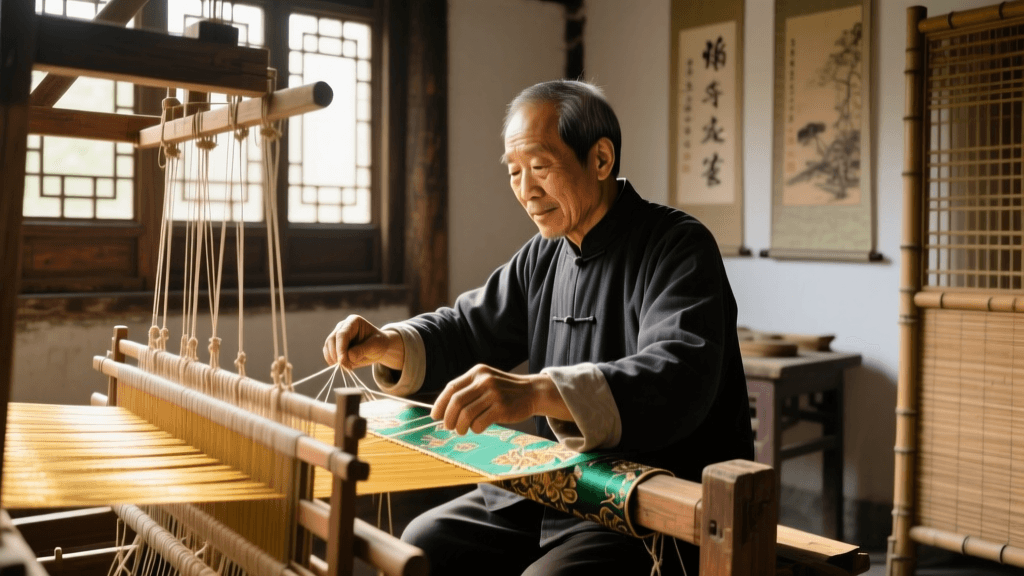
The traditional Chinese drawloom, known as the Da Hua Lou (大花楼), is a massive wooden structure that requires a highly synchronized two-person operation. The master weaver sits at the base of the loom, managing the shuttle, the beat-up of the weft, and the intricate color changes. Meanwhile, the 'drawboy' (or programmer) sits elevated on the 'flower tower' at the top of the loom. This upper section houses thousands of knotted bamboo cords that act as the loom's physical memory. By pulling specific cords in a precise sequence, the drawboy raises individual warp threads, allowing the weaver to pass the shuttle through and create complex, asymmetrical motifs. In 2026, academic researchers and textile engineers continue to study the Da Hua Lou not merely as a historical artifact, but as a foundational piece of early computing technology. The precision required to draft a Yunjin pattern translates to a physical programming language that remains entirely unmatched by modern digital jacquard machines when it comes to specific three-dimensional textile structures and discontinuous weft techniques.
Yunjin Brocade: The Pinnacle of Silk Road Textiles
Originating in Nanjing over 1,600 years ago, Yunjin (cloud brocade) is celebrated for its vibrant colors, intricate patterns, and the use of luxurious materials like gold foil and peacock feather yarn. According to UNESCO's Intangible Cultural Heritage registry, the technique involves a meticulous process that cannot be fully replicated by modern power looms. The inclusion of precious metals and avian fibers requires the sensitive, tactile tension control that only a human weaver operating a traditional wooden drawloom can provide. The weaver must adjust the tension dynamically based on the thickness of the gold-wrapped threads, ensuring the fabric remains supple despite its heavy metallic content. In the modern era, the survival of this craft hinges on its adaptation to contemporary luxury markets and high-end interior design.
Natural Dyeing and Material Preparation in 2026
Before the weaving even begins, the silk threads must undergo a rigorous dyeing process. In 2026, the most prestigious Yunjin ateliers have returned to the exclusive use of heritage natural dyes, rejecting synthetic alternatives to maintain the textile's historical integrity and archival longevity. Indigo, madder root, lotus shells, and pagoda tree buds are utilized to achieve the deep, resonant hues characteristic of imperial brocades. The dyeing of the silk warp and weft must be perfectly colorfast, as the tension on the Da Hua Lou is immense. Artisans in Nanjing are now employing controlled, solar-assisted thermal vats to ensure the natural pigments bond with the silk fibroin at a molecular level, resulting in vibrant colors that resist fading even when exposed to the ambient lighting of modern fashion runways and gallery exhibitions.
The 2026 Xin Zhongshi Movement and Ancient Looms
The Xin Zhongshi (New Chinese Style) movement has reached a fascinating inflection point in 2026. Moving beyond the superficial application of traditional motifs onto modern streetwear, today's avant-garde designers are returning to the source: the loom itself. Design houses in Shanghai, Hangzhou, and Paris are commissioning bespoke Yunjin panels woven on restored Da Hua Lou drawlooms, integrating them into structured blazers, modular outerwear, and high-fashion evening gowns. The 2026 aesthetic favors a juxtaposition of hyper-traditional textiles with minimalist, architectural silhouettes. For instance, a single, continuous woven band of gold-threaded Yunjin might be used as a structural spine down the back of a tailored wool coat, or woven into the cuffs of a modern silk blouse. This approach respects the integrity of the ancient weaving technique while placing it firmly within a modern, global wardrobe.
Comparative Analysis of Traditional Chinese Looms
To understand the uniqueness of the drawloom, it is helpful to compare it with other historical weaving apparatuses utilized across China's rich textile history. The following table outlines the primary distinctions between these traditional systems.
| Loom Type | Primary Era of Prominence | Complexity & Operation | Notable Textile Output |
|---|---|---|---|
| Da Hua Lou (Drawloom) | Ming & Qing Dynasties | Extremely High (Two-person, binary cord programming) | Yunjin (Cloud Brocade), Imperial Dragon Robes |
| Shu Brocade Loom | Han to Tang Dynasties | High (Multi-heddle, warp-faced compound weaves) | Shu Brocade (Sichuan), Geometric Polychromes |
| Song Brocade Loom | Song Dynasty | Moderate-High (Specialized for fine, flat weaves) | Song Brocade, Scroll Mountings, Scholar Robes |
| Standard Waist Loom | Neolithic to Present | Low-Moderate (Body-tensioned, single weaver) | Plain weaves, basic tapestries, rural textiles |
Sourcing, Pricing, and Authentication in 2026
For collectors, interior designers, and fashion houses looking to source authentic, hand-woven Yunjin brocade in 2026, navigating the market requires specialized knowledge. Authentic hand-woven Yunjin is exceptionally rare, with master weavers producing only five to six centimeters of fabric per day. Consequently, the pricing reflects this intense, specialized labor. As of early 2026, authentic Nanjing Yunjin featuring genuine gold leaf threads and peacock feather yarn ranges from $4,500 to $9,000 per meter, depending on the complexity of the pattern and the density of the metallic threads. When sourcing, buyers must look for the characteristic reverse side of the fabric. Because the Da Hua Lou weaves complex brocades with discontinuous wefts, the back of authentic Yunjin will show loose, floating threads where the colored wefts do not interlock across the entire width of the fabric. Machine-made imitations, conversely, will have a uniform, locked reverse side. Furthermore, the Nanjing Yunjin Research Institute provides digital blockchain-backed certification for authentic pieces, a crucial step for high-value acquisitions in the current market.
Digital Preservation and Academic Research
While the physical weaving remains a strictly analog, human endeavor, the preservation of the patterns has fully entered the digital age. In 2026, academic institutions are utilizing high-resolution 3D scanning and AI-assisted drafting to archive the fragile, centuries-old bamboo cord programs of surviving antique drawlooms. As noted by textile historians at institutions like the Metropolitan Museum of Art's Heilbrunn Timeline of Art History, the study of Chinese silk weaving provides critical insights into historical trade, chemistry, and mathematics. By digitizing the physical 'code' of the drawlooms, researchers ensure that even if a physical wooden loom degrades, the mathematical sequence required to weave a specific Ming Dynasty dragon motif is preserved for future generations of artisans to reconstruct and study.
Caring for Drawloom-Woven Garments
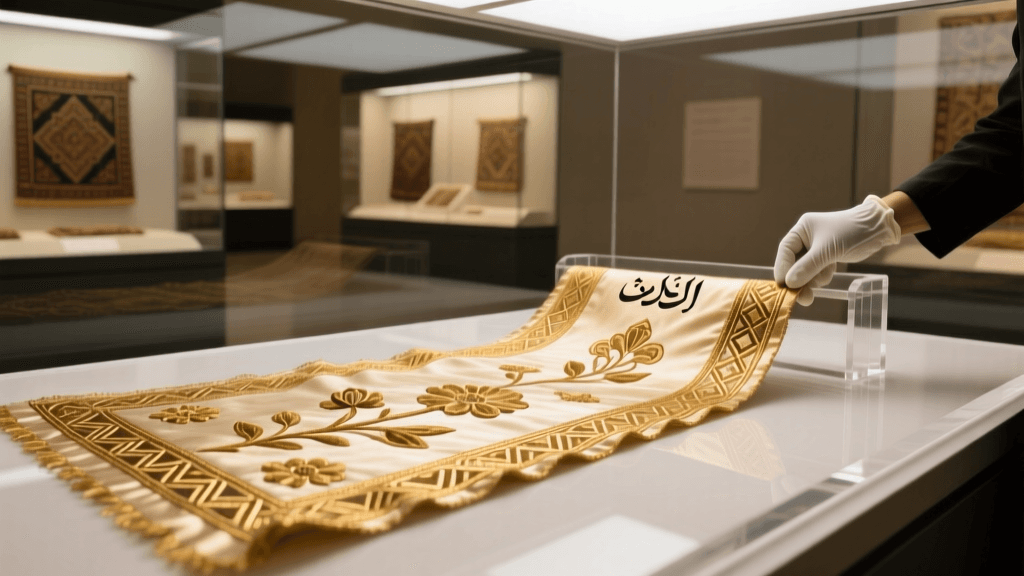
Garments featuring authentic drawloom-woven Yunjin require specialized storage and maintenance to preserve their structural and historical integrity. The metallic threads, particularly those utilizing real gold leaf wrapped around a silk core, are highly sensitive to high humidity, oxidation, and friction. In 2026, textile conservationists recommend storing these garments flat in acid-free, buffered tissue paper within climate-controlled environments set to exactly 20°C (68°F) and 50% relative humidity. Never hang a heavy Yunjin garment on a standard hanger, as the immense weight of the metallic wefts can cause structural distortion and stretching of the silk warp over time. When cleaning is necessary, only specialized textile conservators should be consulted; traditional dry cleaning solvents can strip the natural sericin from the silk core and permanently dull the iridescent luster of the peacock feather yarn. By adhering to these strict conservation protocols, collectors and designers can ensure these masterpieces of ancient engineering remain pristine for centuries to come.