How to Style Yukata and Haori for Everyday Casual Wear
The Renaissance of Casual Japanese Traditional Wear
For decades, the global perception of Japanese traditional clothing has been dominated by the highly formal, intricately layered silk kimono, often reserved for weddings, tea ceremonies, or coming-of-age celebrations. However, the rich tapestry of Japanese garment history includes a vibrant array of everyday, casual, and utilitarian wear that is remarkably adaptable to modern wardrobes. As contemporary fashion increasingly embraces slow fashion, heritage textiles, and cross-cultural layering, garments like the yukata, haori, and samue are experiencing a renaissance outside the borders of Japan.
According to the Metropolitan Museum of Art, the evolution of Japanese dress has always been deeply intertwined with social class, daily labor, and seasonal changes. While the aristocracy wore restrictive, multi-layered silks, commoners and artisans developed practical, breathable, and highly functional garments. Today, integrating these historical pieces into a casual, everyday wardrobe is not about playing dress-up; it is about appreciating masterful craftsmanship, sustainable textile practices, and effortless comfort. Whether you are lounging at home, heading to a casual dinner, or navigating a summer festival, Japanese casual wear offers a sophisticated alternative to standard Western loungewear and outerwear.
Yukata, Haori, and Samue: Choosing Your Everyday Piece
Before diving into styling, it is essential to understand the distinct roles of the three primary casual garments. Each serves a different purpose and requires a different approach to modern integration.
| Garment | Best For | Avg. Cost (USD) | Styling Difficulty | Seasonality |
|---|---|---|---|---|
| Haori (Jacket) | Year-round layering, outerwear | $35 - $150 | Low | All (depends on fabric) |
| Yukata (Robe) | Summer outings, loungewear, sleepwear | $40 - $120 | Medium | Summer / Warm weather |
| Samue (Workwear) | At-home crafting, relaxing, casual chores | $50 - $100 | Low | Spring / Autumn / Winter |
How to Style a Haori for Modern Everyday Wear
The haori is a hip- or thigh-length jacket worn over a kimono. Historically, it was worn by samurai to protect their garments from dust and cold, and later adopted by geisha and commoners. Because it is open at the front and lacks a wrap closure, the haori is arguably the easiest traditional Japanese garment to integrate into a Western wardrobe.
The Denim and Haori Combination
The most effortless way to wear a vintage or modern haori is as a substitute for a duster coat or a heavy cardigan. Pair a mid-thigh length, solid-colored tsumugi (slubbed silk) or cotton haori with a crisp white t-shirt, dark wash straight-leg denim, and leather loafers. The straight cut of the haori complements the structured lines of denim, while the subtle woven patterns of the silk add a layer of tactile luxury to an otherwise basic outfit. For men and women alike, this combination bridges the gap between smart-casual and artistic bohemian.
Belted Haori as a Tunic
For a more structured silhouette, particularly with longer, knee-length haori, you can repurpose the jacket as a wrap tunic. Cross the front panels over your chest and secure them with a thin leather belt or a braided cord. Worn over wide-leg linen trousers or a simple slip dress, the belted haori mimics the aesthetic of a modern wrap coat but with the distinct, wide sleeves (sode) that characterize Japanese design.
Securing the Haori: The Himo
If you prefer to wear the haori open but want to keep the front panels from slipping off your shoulders, use a haori himo. This is a decorative, braided cord that ties the two front lapels together at the chest. Modern artisans create these cords with intricate macrame or beaded tassels, allowing you to customize the jacket's look. Tying a haori himo takes less than thirty seconds and immediately elevates the garment's intentionality.
Wearing Yukata Outside the Summer Festival
The yukata is a lightweight, unlined cotton robe originally worn as a bathrobe by the nobility before becoming the ubiquitous summer festival wear of the Edo period. The Victoria and Albert Museum notes that while formal kimono require extensive undergarments and padding, the yukata was designed for breathability and ease, making it highly relevant for contemporary summer styling.
The Two-Piece Yukata Hack
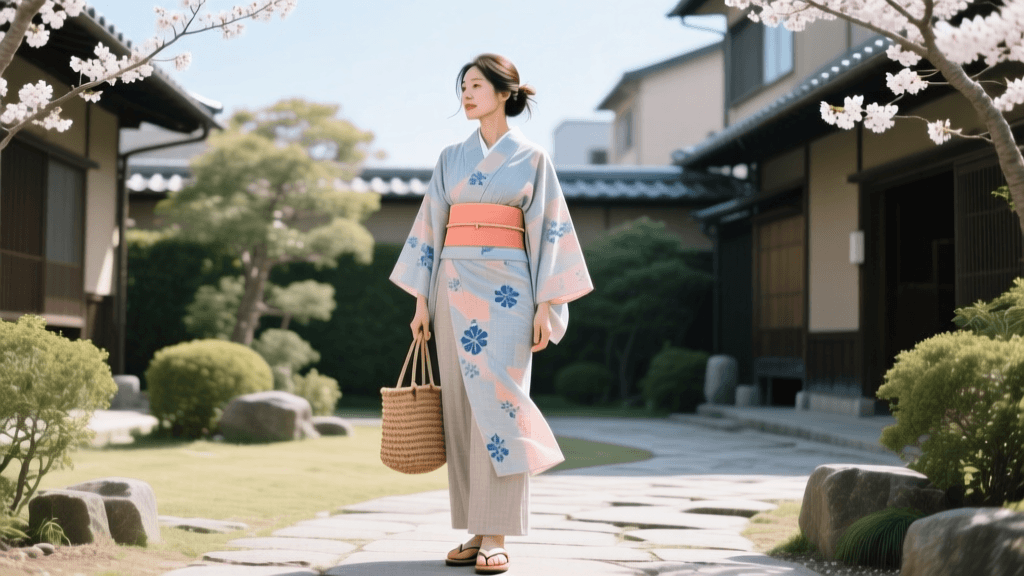
Wrapping and tying a full-length yukata with an obi (sash) can be intimidating and restrictive for everyday tasks like driving or sitting at a desk. A highly practical, modern styling hack is to separate the yukata into a two-piece set. Wear the bottom half wrapped and secured with a simple elasticized tsuke-obi (pre-tied belt) or even a woven leather belt, and wear the top half open like a lightweight duster over a camisole and shorts. Alternatively, many modern Japanese brands now sell 'separates' yukata sets, which feature a pull-on skirt or wide-leg pant paired with a matching wrap top, retaining the traditional textile patterns while offering the convenience of modern activewear.
Footwear: Moving Beyond the Geta
Traditionally, yukata are paired with geta (wooden clogs) and tabi (split-toe socks). While beautiful, wooden geta are noisy and impractical for paved city streets. For everyday wear, pair your yukata or two-piece set with minimalist leather sandals, espadrilles, or even clean white canvas sneakers. The juxtaposition of traditional indigo-dyed cotton with contemporary streetwear footwear creates a striking, fashion-forward aesthetic that respects the garment's casual origins.
Sizing and Measurements: Getting the Right Fit
Unlike Western clothing, which is tailored to fit the contours of the body, traditional Japanese garments are cut from straight bolts of fabric (tanmono) and are meant to drape. Understanding two key measurements will ensure you purchase pieces that fit comfortably.
Understanding Yuki and Mihaba
- Yuki (Arm Span): This is the most critical measurement. It is measured from the center back of the neck, across the shoulder, and down to the wrist. For a comfortable, modern casual fit, the yuki should ideally end at your wrist bone or slightly above. If you are 5'6' (167 cm) tall, look for a yuki measurement of approximately 63 cm to 65 cm.
- Mihaba (Body Width): This is the half-width of the garment from the center back seam to the front edge. A standard mihaba is around 60 cm to 64 cm. If you have a broader chest or prefer a more generous, oversized drape, seek out garments labeled as 'hiro-mihaba' (wide width), which typically measure 68 cm or more.
When shopping for vintage haori or yukata online, always ask the seller for these specific flat measurements rather than relying on generic 'Small, Medium, Large' tags, which do not apply to traditional garments.
Sourcing, Costs, and Care
Building a wardrobe of casual traditional wear is surprisingly accessible. The secondary market is flooded with high-quality vintage pieces due to the decline of everyday kimono wear in Japan during the late 20th century.
- Vintage Markets: Platforms like eBay, Etsy, and specialized Japanese export sites (such as Yamatoku or Japan Kimono) offer vintage cotton yukata for $30 to $60, and silk haori for $40 to $90. Look for pieces in 'excellent' or 'very good' condition, checking specifically for stains on the collar or fading on the shoulders.
- Modern Retailers: Brands like Uniqlo and Muji frequently release modern interpretations of the samue and jinbei (summer loungewear) during the spring and summer seasons, usually priced between $30 and $50. For authentic, newly crafted yukata, the Japan National Tourism Organization frequently highlights regional textile hubs like Chugoku and Tohoku, where you can source directly from artisans, though new, hand-dyed pieces will cost upwards of $150 to $300.
Maintenance and Washing
One of the greatest advantages of the casual yukata and cotton samue is their washability. Unlike silk kimono, which require expensive professional dry cleaning (arai-hari), modern cotton yukata can be hand-washed or machine-washed on a gentle cycle using a mesh laundry bag and mild detergent. Always hang them to dry in the shade to prevent the indigo and natural dyes from fading in direct sunlight. Silk haori should be spot-cleaned or professionally dry-cleaned, but airing them out in a shaded, breezy area after wearing is usually sufficient for everyday maintenance.
Conclusion
Integrating Japanese casual traditional wear into your daily life is a celebration of textile history, sustainable fashion, and personal comfort. By understanding the structural differences between the haori, yukata, and samue, and by adapting them with modern styling techniques and practical footwear, you can honor the cultural significance of these garments while making them entirely your own. Whether you are wrapping a cotton yukata on a humid July evening or throwing a silk haori over your favorite denim, you are participating in a living, breathing tradition that values both beauty and everyday utility.