Yoruba Aso Oke Weaving Loom Techniques And Yarn Prep
Origins and Cultural Significance of Aso Oke in Yoruba Society
Aso Oke—literally “top cloth” in Yoruba—is a handwoven textile originating from the Yoruba people of southwestern Nigeria, particularly concentrated in towns such as Iseyin, Oyo, and Ibadan. Historically reserved for royalty and titled elders, Aso Oke has functioned as both ceremonial regalia and a marker of social status since at least the 18th century. Its use in major life-cycle events—including chieftaincy installations, weddings, and funerals—reinforces its role as a vessel of ancestral continuity and communal identity. Unlike kente cloth of Ghana’s Asante and Ewe peoples—which employs horizontal strip-weaving on narrow looms—Aso Oke is produced on vertical, warp-weighted looms that allow for greater structural flexibility and longer continuous lengths.
The textile’s symbolic lexicon is embedded in color, pattern, and material composition. Indigo-dyed cotton (etù) signifies humility and spiritual depth; deep red silk (láfòrì) conveys courage and vitality; while silver or gold metallic threads (ewù) denote prosperity and divine blessing. Each motif carries narrative weight: the *Etu* pattern mimics the striped plumage of the guinea fowl, symbolizing vigilance; *Sanyan*, woven with wild silk from Anaphe moth cocoons, references resilience and natural abundance.
Loom Construction and Technical Specifications
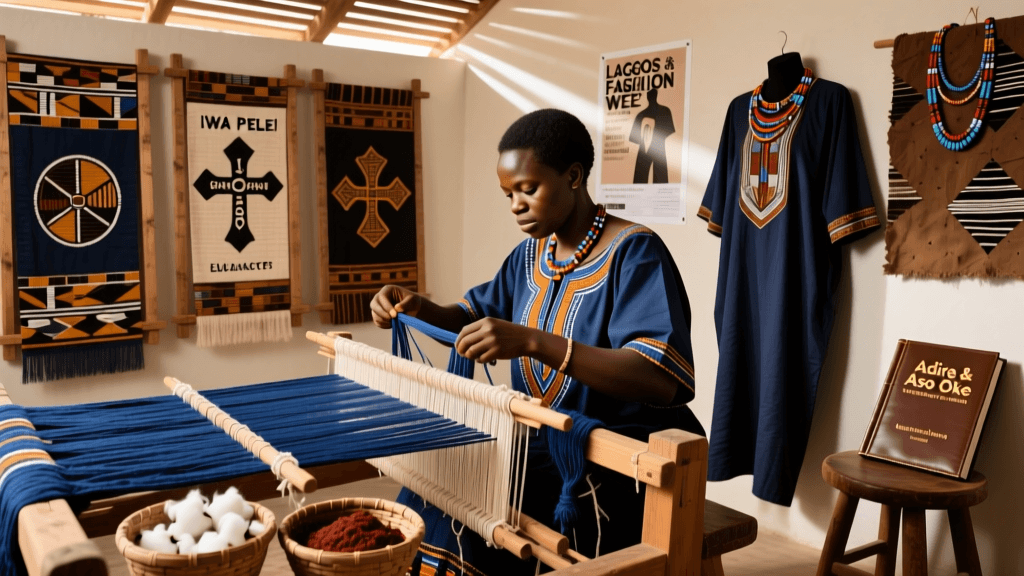
Traditional Aso Oke looms are constructed entirely from local hardwoods—primarily iroko and ope—and assembled without nails or metal fasteners. The frame stands approximately 2.4 meters tall and 1.2 meters wide, with a fixed warp beam at the top and a movable cloth beam at the base. Tension is maintained using clay weights (àdá) that hang from the warp threads—each weighing between 350–420 grams—and calibrated to prevent breakage during high-tension weaving.
Warp Setup and Alignment Precision
Before weaving begins, the warp is painstakingly measured and strung across the loom using a system called *ìkúnlé*, where threads are counted in groups of 24 to ensure even density. A standard ceremonial Aso Oke cloth requires 1,872 warp threads per meter of width, spaced precisely 0.8 millimeters apart. This exactitude allows for the intricate interlacing required in complex patterns like *Etu Aládé*, which incorporates over 32 distinct shuttle passes per centimeter of weft.
Weavers—predominantly men trained through multi-generational apprenticeships—operate the loom barefoot to maintain tactile sensitivity and rhythmic control. Foot pedals activate heddles made from palm frond ribs, lifting alternate warp layers to create the shed. The shuttle, carved from ebony and measuring 28 cm in length, carries bobbins wound with up to 120 meters of prepared yarn.
Yarn Preparation: From Cocoon to Cone
Authentic Aso Oke relies on three primary fiber sources: hand-spun cotton (*ògèdè*), wild silk (*sanyan*), and imported mercerized silk (*láfòrì*). Sanyan production remains one of West Africa’s most endangered textile practices. Cocoons are harvested from the Anaphe panda moth, native to forest zones near the Ogun River basin. Each cocoon yields only 60–75 meters of usable filament, and it takes roughly 1,200 cocoons to produce 1 kilogram of raw sanyan yarn.
Dyeing Protocols and Natural Pigment Sources
Natural dyes dominate traditional preparation. Indigo vats in Iseyin use fermented leaves of *Indigofera tinctoria*, aged for exactly 14 days before dyeing. Cotton yarn is dipped seven times, with air oxidation intervals of 22 minutes between immersions, to achieve the signature deep *etù* blue. Local alum (from clay deposits near Igbo-Ora) serves as mordant at a concentration of 8.5 grams per liter of dye bath. Red hues derive from *Loranthus* bark boiled for 9 hours at 92°C—temperature precision being critical to avoid pigment degradation.
- Standard Aso Oke cloth width: 38–42 cm (narrower than kente’s 10–20 cm strips)
- Minimum ceremonial length: 4.5 meters (equivalent to three full body wraps)
- Warp thread count for elite-grade fabric: 2,160 ends per meter
- Sanyan filament tensile strength: 1.8–2.1 g/denier (measured by the National Institute for Textile Research, Ibadan, 2019)
- Time to weave one 4.5-meter cloth: 14–21 days (depending on pattern complexity)
Institutional Preservation and Contemporary Practice
The Centre for Black Culture and International Understanding (CBCIU) in Osogbo has documented over 67 distinct Aso Oke motifs since 2015, archiving oral histories from master weavers including Alhaji Adeyemi Adelabu of Iseyin. Similarly, the Yoruba Heritage Museum in Oyo State maintains a working loom installation and hosts biannual workshops for youth apprenticeship—training 43 new weavers between 2021 and 2023. These initiatives respond directly to UNESCO’s 2020 Recommendation on the Safeguarding of Intangible Cultural Heritage, which cites Aso Oke as a priority textile under Nigeria’s National Inventory of Living Heritage.
At the University of Ibadan’s Department of Textile Technology, researchers have standardized yarn twist measurements for sanyan: optimal twist angle is 27° for warp and 33° for weft to balance strength and drape. Their 2022 study confirmed that improperly twisted sanyan loses 41% of tensile integrity after five wash cycles—a finding now integrated into CBCIU’s artisan certification curriculum.
Symbolism Embedded in Pattern and Structure
Every Aso Oke design encodes philosophical concepts rooted in Ifá cosmology. The *Olokun* pattern—featuring concentric diamond motifs—represents the deity of the deep sea and embodies abundance, mystery, and creative potential. Its geometric repetition follows a 12×12 grid system, referencing the 12 Odu (primordial verses) foundational to Yoruba divination. In contrast, *Ewu* (goat-skin) pattern uses staggered zigzags to evoke the animal’s sure-footed movement across rugged terrain—symbolizing perseverance amid adversity.
“An Aso Oke cloth is not worn—it is inhabited. When draped, it repositions the wearer within time: linking past lineage, present responsibility, and future legacy.” — Chief Folake Olowofoyeku, Director, Yoruba Heritage Museum, Oyo (2021)
Contemporary designers such as Deola Sagoe and Lisa Folawiyo integrate Aso Oke into modern silhouettes while preserving structural integrity—using traditional loom widths but adapting seam allowances to accommodate tailored jackets and asymmetrical skirts. Their collaborations with Iseyin weavers uphold strict adherence to pre-industrial dye ratios and warp counts, ensuring continuity rather than commodification.
Comparative analysis reveals key technical distinctions across African textile traditions:
| Textile | Ethnic Group / Country | Loom Type | Typical Warp Density (ends/cm) | Primary Fiber Source |
|---|---|---|---|---|
| Aso Oke | Yoruba / Nigeria | Vertical warp-weighted | 18–22 | Cotton, sanyan silk, mercerized silk |
| Kente | Asante & Ewe / Ghana | Horizontal strip loom | 30–36 | Cotton, rayon, silk |
| Mud Cloth (Bògòlanfini) | Bamana / Mali | Hand-stitched resist-dyed cotton | N/A (not woven) | Hand-spun cotton |
The National Museum of Unity in Abuja displays a 1947 Aso Oke wrapper commissioned for the coronation of Oba Adesoji Aderemi of Ile-Ife—its 4.82-meter length and 2,016 warp threads verified through digital thread-count imaging conducted by the Nigerian Conservation Council in 2018. Such artifacts underscore how material specificity anchors cultural memory: each millimeter of tension, each gram of dyestuff, each degree of twist constitutes an act of resistance against erasure.
Preservation efforts extend beyond museums. In Iseyin’s annual *Ìṣẹ̀ṣe* Festival, master weavers demonstrate live loom operation while elders recite proverbs tied to specific patterns—for example, *Àkókò* (rooster comb) warns against arrogance, its sharp peaks echoing the bird’s comb just before crowing. These intergenerational transmissions occur without written notation, relying instead on embodied rhythm and auditory mnemonics passed through call-and-response chants.
According to the African Fashion Foundation’s 2023 Market Impact Report, demand for certified Aso Oke textiles increased by 67% among diaspora communities in London and Atlanta between 2020 and 2023—driven largely by wedding commissions requiring minimum 4.5-meter lengths and authentic sanyan content. This growth underscores a broader shift: textile heritage is no longer relegated to ethnographic display but functions as active currency in identity negotiation.
Unlike dashiki fabrics—often screen-printed cotton produced industrially in Accra—or Maasai beadwork, which prioritizes symbolic color coding over fiber provenance, Aso Oke’s value resides in process fidelity. Even minor deviations—such as substituting synthetic indigo for fermented leaf dye—disrupt the cloth’s ritual efficacy and invalidate its ceremonial use within Yoruba cosmology.
The Oyo State Ministry of Culture and Tourism reports that 89 registered Aso Oke cooperatives operate across 17 local government areas, employing over 1,240 artisans. Of these, only 14 maintain full sanyan production capacity—a figure unchanged since 2010, highlighting both the fragility and tenacity of this practice.
When a young apprentice in Iseyin ties her first warp knot under the guidance of her grandfather, she does not merely learn mechanics—she inherits a grammar of geometry, chemistry, and cosmology encoded in fiber. That grammar remains legible only when every measurement, every interval, every weight adheres to ancestral calibration—not as rigid dogma, but as living syntax.