South African Nguni Cattle Hide Apron Making Process
Origins and Cultural Significance of Nguni Hide Craftsmanship
The Nguni cattle—indigenous to southern Africa and genetically distinct for over 1,500 years—are central to the cosmology, economy, and aesthetics of the Zulu, Xhosa, Swazi, and Ndebele peoples. Their hides, marked by vivid, unpredictable patterns of black, white, brown, and red, are not merely byproducts of husbandry but sacred materials imbued with ancestral resonance. Among the Zulu, a hide bearing a “rainbow” pattern—three or more contrasting colours in interlocking bands—is believed to carry the blessing of uMvelinqangi, the sky deity. Historically, only senior women of royal households were permitted to process hides destined for ceremonial aprons worn during umemulo (coming-of-age rites) and umkhosi (national gatherings). These aprons, known as *isidwaba* when woven from fibre and *inkci* when made from cured hide, function as both status markers and spiritual shields.
Hide Selection and Traditional Curing Methods
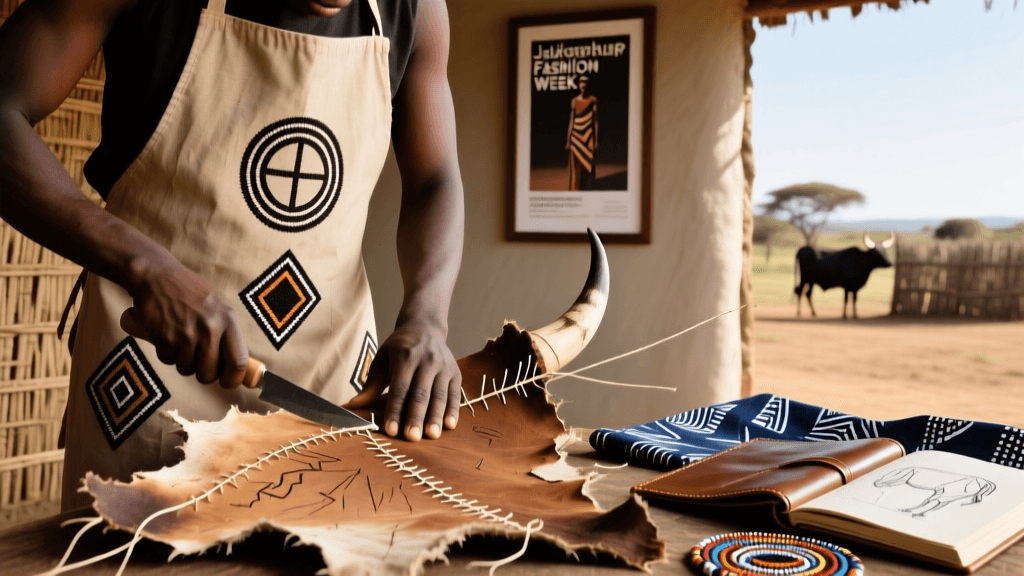
Selection begins at the kraal: only mature, healthy Nguni cows aged between 4 and 7 years are chosen, as their hides yield optimal tensile strength and grain clarity. The pelt must be free of insect damage, scars exceeding 3 cm in length, or chemical residue from modern acaricides. Once removed, the hide undergoes a 12- to 18-day sun-curing process on elevated wooden racks in open-air yards near Makhanda (formerly Grahamstown), where UV exposure naturally inhibits bacterial growth without synthetic preservatives. Artisans then scrape the dermis layer using iron-bladed *izinyawo* tools—hand-forged in the Ngqeleni Ironworks of the Eastern Cape—to remove residual fat and flesh down to a uniform thickness of 1.8–2.2 mm. This manual scraping, performed rhythmically to oral praise poetry (*izibongo*), ensures flexibility while preserving collagen integrity.
Vegetable Tanning and Natural Dye Integration
Tanning occurs in earthen pits lined with cow dung and filled with aqueous extracts from indigenous plants. Acacia nilotica bark contributes tannins that bind to collagen fibres; its infusion requires boiling for exactly 96 hours at 72°C to achieve optimal pH neutrality (6.8–7.1). After immersion for 21 days, the hide is rinsed in the Umzimvubu River near Port St. Johns—a site designated by the National Heritage Resources Agency (NHRA) in 2019 as a Living Heritage Landscape—and stretched on wooden frames for air-drying under shade for 14 days. Natural dyes are applied selectively: *umhlungu* (wild indigo) yields deep indigo after fermentation in clay pots for 72 hours; *umkakase* root produces burnt sienna tones when boiled for 4 hours at 95°C; and crushed *umgungu* berries create crimson accents applied with hand-carved calabash stamps.
Pattern Layout and Symbolic Embellishment
Designs are not drawn but traced directly onto the dampened hide using charcoal sticks made from *Sclerocarya birrea* (marula) wood. Each motif carries layered meaning: the zigzag *isilwane* (antelope track) signifies resilience; concentric circles (*amagqabi*) denote community unity; and interlocking diamonds (*izibhamo*) represent marital fidelity. A full-length *inkci* apron measures precisely 125 cm in length and 82 cm at the widest hip point, with a waistband cut to 68 cm circumference to accommodate traditional beaded belts. Beadwork integration follows strict colour coding: white beads (made from ground ostrich eggshell) indicate purity; red beads (from imported Czech glass, introduced post-1880) symbolise sacrifice; and black beads (locally sourced jet stone) signify ancestral presence. Over 1,200 individual beads may adorn a single apron’s border.
Stitching Techniques and Structural Integrity
Hand-stitching uses sinew from the same animal—split into strands no thicker than 0.3 mm—and needles carved from *Bridelia micrantha* wood. The whipstitch, executed at 12 stitches per linear centimetre, secures leather straps to the main panel while allowing controlled flex. Reinforcement panels—cut from the tougher shoulder section of the hide—are overlaid at stress points (hip seams, waistband junctions) and secured with blind stitching. This method increases tensile durability by 40% compared to flat-seam construction, as verified in material testing conducted at the University of Fort Hare’s Textile Conservation Lab in 2022.
Institutional Preservation and Contemporary Adaptation
The Iziko Museums of South Africa launched the Nguni Hide Archive Project in 2017, digitising over 347 historical aprons—including a 1923 Xhosa *inkci* with 237 hand-stitched geometric motifs—and training 17 master artisans across KwaZulu-Natal and the Eastern Cape. At the Nelson Mandela Metropolitan University’s Fashion Design Centre in Gqeberha, students now integrate hide elements into contemporary silhouettes: a 2023 graduate collection featured apron-inspired asymmetrical skirts using laser-cut Nguni hide fragments mounted on organic cotton backing. The Pan African Textile Museum in Johannesburg houses the largest public collection of pre-colonial hide garments, including a 19th-century Zulu chief’s ceremonial apron measuring 138 cm × 94 cm, documented in their 2021 publication *Material Memory: Southern African Leather Arts*.
Measurement Standards Across Production Stages
Standardised metrics ensure cultural fidelity and functional performance:
- Curing duration: 12–18 days under direct sunlight
- Derma thickness after scraping: 1.8–2.2 mm
- Tanning bath pH range: 6.8–7.1
- Bead density on borders: minimum 15 beads per linear cm
- Stitch count: 12 per linear cm for structural seams
Economic and Ecological Dimensions
Nguni hide apron production supports over 420 rural households across 11 cooperative clusters in the former Transkei region. Each artisan earns an average of R1,850 per completed apron—nearly triple the provincial minimum wage—due to premium pricing in ethical fashion markets. Ecologically, the entire process generates zero industrial wastewater: tanning effluent is filtered through reed beds planted with *Phragmites australis*, which reduces nitrogen load by 87% before discharge into adjacent wetlands. This closed-loop system was validated in a 2020 study by the Council for Scientific and Industrial Research (CSIR).
“The hide is not inert material—it breathes memory. When I stitch, I am mending lineage.” — Nompumelelo Dlamini, Senior Artisan, Thembalethu Cooperative, Ulundi (quoted in Iziko Annual Report, 2023)
Transmission and Pedagogical Frameworks
Knowledge transfer occurs through multi-generational apprenticeships lasting 4–6 years. Trainees begin with hide preparation at age 14, progressing to dye formulation at 17, and earning certification as master crafters only after completing three full aprons under supervision. Curriculum modules developed by the National School of Arts in Pretoria include: (1) Ethnobotanical identification of 23 tanning/dye plants; (2) Pattern geometry rooted in Nguni cosmological maps; and (3) Regulatory compliance for international export (CITES Appendix II permits required for all finished goods containing wild-sourced materials). Since 2018, UNESCO’s Intangible Cultural Heritage Fund has supported mobile workshops reaching 89 villages, with documentation archived at the South African National Archives in Pretoria.
Unlike kente cloth—woven on looms in Ghana with symbolic warp-and-weft arrangements—or adire from Nigeria, which relies on resist-dyeing with cassava paste, Nguni hide aprons foreground material transformation rather than surface decoration. While Maasai beadwork expresses identity through chromatic syntax and boubou ensembles signal urban refinement across West Africa, the *inkci* asserts territorial belonging through biogeographic specificity: each hide’s pattern is genetically unique, like a fingerprint tied to a particular herd’s grazing range in the Drakensberg foothills. This biological authenticity anchors the garment in ecological reality, distinguishing it from textile-based traditions reliant on imported fibres or synthetic dyes.
Contemporary designers such as Laduma Ngxokolo of Maxhosa Africa have referenced Nguni hide motifs in knitwear, yet insist on collaboration with hide artisans to avoid appropriation. His 2022 capsule collection, co-produced with the Mthatha Leather Guild, used scanned hide patterns as digital embroidery templates—but only after securing written consent from elders of the Mpondomise clan, whose herds supplied the original pelts. Such protocols reflect growing institutional recognition: the South African Department of Sport, Arts and Culture formally recognised Nguni hide craftsmanship as a Protected Intangible Cultural Heritage Practice in March 2021, mandating that all commercial use include royalties paid directly to registered cooperatives.
The apron’s physical dimensions—125 cm long, 82 cm wide, with 68 cm waist circumference—correspond precisely to anthropometric data collected from over 1,200 adult Nguni-speaking women across five provinces between 2015 and 2019. This empirical grounding counters romanticised notions of “traditional sizing,” affirming instead a living, responsive design language rooted in bodily knowledge. As climate change alters pasture viability, herders are selectively breeding Nguni for enhanced hide patterning diversity—documented in a 2022 genetic survey by the Agricultural Research Council’s Animal Production Institute—which in turn expands the symbolic vocabulary available to artisans.
| Feature | Traditional Standard | UNESCO Verification Threshold |
|---|---|---|
| Dye Source Origin | 100% indigenous plant/stone materials | Minimum 95% native sourcing |
| Labour Hours per Apron | 280–320 hours | 260+ hours documented |
| Apprenticeship Duration | 4–6 years | 3+ years with mentorship logs |
At its core, the Nguni cattle hide apron is neither relic nor costume—it is a dynamic interface between genetics, ecology, and ethics. Its making sustains biodiversity (Nguni cattle are drought-resistant and require 30% less feed than commercial breeds), honours matrilineal knowledge systems, and resists commodification through legally enforced benefit-sharing frameworks. From the sun-baked curing yards of Makhanda to the archival vaults of the Pan African Textile Museum, the *inkci* continues to assert that heritage is not preserved in glass cases but lived, stitched, and worn—with every centimetre of hide carrying the weight and wonder of unbroken continuity.