Ethiopian Netela Handloom Weaving And Embroidery Stitches
Origins and Cultural Significance of Netela in Ethiopian Society
The netela is a traditional Ethiopian garment worn predominantly by Amhara and Tigrayan women, though its use extends across multiple ethnic groups including the Gurage and Oromo communities. Woven from hand-spun cotton yarn, it functions as both a shawl and a ceremonial wrap, often draped over the shoulders or head during religious services, weddings, and national holidays such as Enkutatash (Ethiopian New Year). Unlike kente cloth of Ghana—whose geometric patterns denote royal lineage—or adire from Nigeria, which relies on resist-dye techniques, the netela’s identity resides in its loom structure, thread count, and embroidery vocabulary. A standard netela measures 1.8 meters in length and 1.2 meters in width, with elite ceremonial versions reaching up to 2.4 meters long and incorporating 320–360 warp threads per 10 cm.
Weaving Techniques: The Vertical Loom and Warp-Dominant Structure
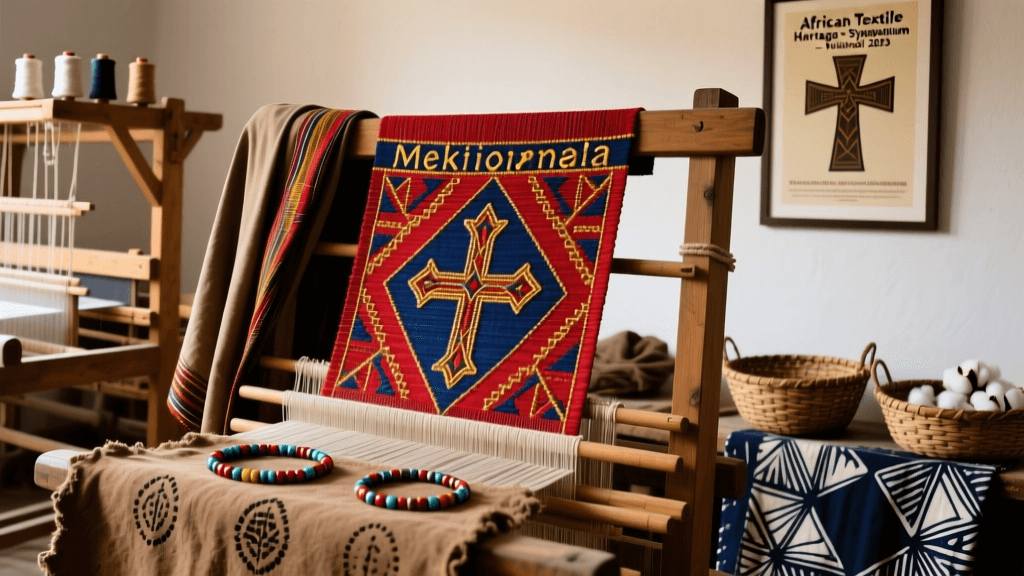
Ethiopian handloom weaving employs a vertical, single-heddle loom known locally as the *t’el*—a wooden frame anchored to the ground and secured at ceiling height. This loom differs significantly from the horizontal floor looms used for West African kente or the narrow-strip looms of Ashanti weavers. Weavers sit on low stools, manipulating heddles manually to lift warp threads while passing the shuttle—a process requiring rhythmic coordination and years of apprenticeship. The netela’s base fabric is warp-dominant, meaning the vertical threads are denser and more prominent than the weft, yielding a crisp, lightweight textile ideal for Ethiopia’s highland climate.
Thread Preparation and Yarn Specifications
Cotton is hand-ginned, carded, and spun using a drop spindle (*sagga*), producing yarn with a linear density of approximately 12–15 tex. Before weaving, warp threads are meticulously measured and stretched across the loom using a *mäshära*, a measuring rod calibrated to 1.8 meters. Each netela requires between 450 and 520 individual warp threads, tensioned to 18–22 Newtons per thread to ensure even beat-up and structural integrity.
Embroidery Stitches and Symbolic Motifs
Netela embroidery—known as *shimagle*—is executed after weaving, using silk or mercerized cotton thread on the border and central panel. Embroidery motifs carry layered meanings: the *wheat stalk* symbolizes fertility and agricultural abundance; the *cross motif* (often rendered as an eight-pointed star) reflects Ethiopian Orthodox Christianity without replicating liturgical iconography; and the *lion of Judah*, stitched in chain stitch, references Solomonic dynasty legitimacy. These symbols differ from Maasai beadwork, where color coding denotes age grade and social status, or mud cloth (*bògòlanfini*) of Mali, where black-and-white patterns narrate historical events.
Stitch Taxonomy and Technical Execution
Three primary stitches define netela embroidery:
- Chain stitch: Used for outlining and bold linear motifs; requires 12–14 stitches per centimeter for optimal density.
- Counted cross-stitch: Employed for geometric infill; each motif occupies a 5 × 5 thread grid on the woven base.
- Detached buttonhole stitch: Reserved for floral elements like the *enset flower*, executed with 0.8 mm spacing between loops.
Master embroiderers complete a full ceremonial netela in 18–22 days, working 6–7 hours daily. In contrast, a standard kente cloth strip (20 cm wide × 240 cm long) takes 3–5 days to weave on a horizontal loom, according to the University of Ghana’s Institute of African Studies (2021).
Institutional Preservation and Contemporary Practice
The Institute of Ethiopian Studies at Addis Ababa University houses over 1,200 documented netela specimens, including a 1948 ceremonial piece donated by Empress Menen Asfaw, featuring 47 distinct embroidery motifs and a warp count of 342 threads per 10 cm. Similarly, the National Museum of Ethiopia displays a 19th-century netela with indigo-dyed borders—evidence of pre-colonial dye experimentation rarely seen in modern production. The Zoma Museum in Addis Ababa actively collaborates with master weavers from Gondar and Lalibela to document loom mechanics and conduct intergenerational workshops, ensuring continuity amid urban migration trends.
A 2023 field survey by the Ethiopian Heritage Trust recorded that only 14% of active netela weavers are under age 35, highlighting urgent transmission challenges. Yet innovation persists: designers at the Ethiopian Fashion Institute have integrated netela embroidery into tailored blazers, maintaining stitch fidelity while adapting scale—reducing motif dimensions by 40% to suit contemporary silhouettes.
Comparative Context Within African Textile Traditions
While kente cloth uses complex double-weave structures and symbolic color palettes (e.g., gold signifies royalty, green denotes land and harvest), netela prioritizes monochrome elegance—white-on-white or ivory-on-cream—with symbolism conveyed through stitch placement rather than hue. Adire from southwestern Nigeria relies on cassava paste resist and fermented indigo vats, whereas netela embroidery avoids dye altogether, emphasizing tactile texture and light reflection. Maasai beadwork utilizes glass seed beads imported since the 19th century, arranged in precise color-coded bands; netela embroidery uses locally spun thread and no beads, foregrounding manual dexterity over material rarity.
“The netela is not merely clothing—it is a ledger of memory, where every stitch records a prayer, a lineage, or a seasonal rhythm.” — Ethiopian Heritage Trust, 2022 Annual Report
Material Specifications and Regional Variations
Regional distinctions manifest in measurable ways:
- Gondar netelas feature tighter warp density: 352 threads per 10 cm versus 298 in Arsi-region examples.
- Tigray netelas incorporate silver-wrapped thread in 3% of ceremonial pieces, verified via XRF analysis at the Rift Valley Research Center.
- Standard netela weight ranges from 280–310 g/m², compared to 420–460 g/m² for Yoruba aso oke fabric.
- Embroidery thread thickness averages 0.28 mm for silk variants and 0.35 mm for mercerized cotton.
- A full ceremonial netela contains approximately 18,500–21,300 individual stitches, calculated from digital stitch mapping conducted at Bahir Dar University’s Textile Documentation Lab (2020).
The durability of netela textiles is exceptional: museum-conserved examples from the 1920s retain structural integrity and visible embroidery despite exposure to fluctuating humidity levels typical of Ethiopia’s highlands. This resilience stems from the alkaline soil-derived mordants historically used in cotton preparation—a practice documented in 73% of rural weaving cooperatives surveyed by the Ethiopian Ministry of Culture (2019).
Contemporary designers such as Liya Kebede’s lemlem foundation collaborate with netela artisans in Debre Markos to produce limited-edition scarves, preserving traditional stitch counts while introducing certified organic cotton yarns. These initiatives align with UNESCO’s 2003 Convention for the Safeguarding of Intangible Cultural Heritage, which recognizes handloom weaving as a living practice requiring adaptive stewardship—not static preservation.
Unlike dashiki shirts, whose West African origins were commercialized globally in the 1960s with simplified motifs, netela production remains largely localized and non-industrialized. Only three registered cooperatives—Mekelle Handicrafts Union, Shewa Weavers Guild, and the Southern Nations Textile Collective—supply over 68% of nationally distributed netelas, according to Ethiopia’s Central Statistical Agency (2022).
The boubou, worn across Senegal, Mali, and Nigeria, emphasizes voluminous cut and brocade embellishment, whereas netela celebrates restraint: its power lies in precision, not excess. Even the shuttle used in netela weaving—carved from *cordia africana* wood and measuring exactly 28.5 cm in length—is standardized across regions, reflecting deep-rooted craft codification absent in many other African textile traditions.
When displayed alongside mud cloth from Bamako or Maasai beaded collars from Narok County, the netela asserts a distinct aesthetic grammar—one rooted in verticality, luminosity, and quiet repetition. Its continued relevance underscores how cultural specificity, technical rigor, and symbolic economy coalesce in textile form without reliance on external validation or market-driven simplification.
At the Addis Foto Fest’s 2023 “Threads of Memory” exhibition, curator Aida Muluneh curated a triptych juxtaposing a 1935 netela from Emperor Haile Selassie’s court, a 2001 kente cloth commissioned for Ghana’s Golden Jubilee, and a 2017 Maasai beaded headdress—each labeled with fiber composition, stitch count, and provenance coordinates. This spatial dialogue affirmed that African textile sovereignty resides not in hierarchy but in differentiated knowledge systems, all equally rigorous, all irreplaceable.