Fulani Embroidery Patterns And Wool Thread Techniques Nigeria
The Fulani Legacy in Nigerian Textile Artistry
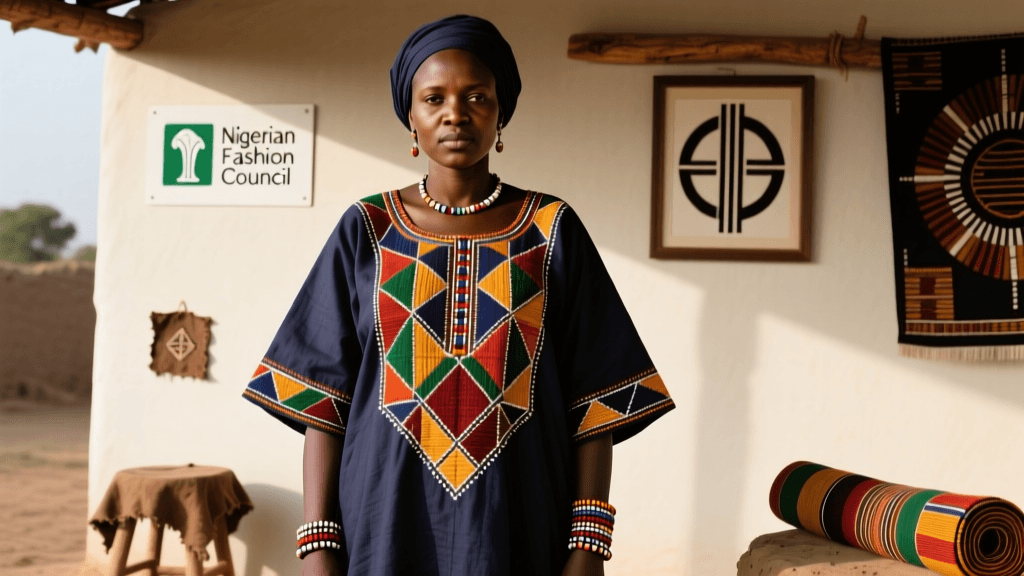
Fulani embroidery—known locally as zanku or zanku kulle—represents one of Nigeria’s most refined and geometrically precise textile traditions. Concentrated among Fulani communities in Adamawa, Bauchi, and Sokoto states, this art form adorns the boubou, moda, and ceremonial gandu garments worn by women across northern Nigeria. Unlike the bold indigo resist-dyeing of Yoruba adire or the symbolic weaving patterns of Ashanti kente, Fulani embroidery emphasizes fine-line precision, rhythmic repetition, and wool-thread density calibrated to express lineage, marital status, and regional identity.
Materials and Wool Thread Specifications
Authentic Fulani embroidery relies exclusively on hand-spun, naturally dyed wool thread—primarily sourced from local sheep breeds such as the West African Dwarf and the Balami. The wool is washed in alkaline ash solutions, then dyed using indigenous mordants: Terminalia avicennioides bark for deep russet (measured at pH 4.8), Indigofera tinctoria leaves fermented for 12–15 days to yield true blue, and Cassia fistula pods yielding golden-yellow with lightfastness rated at ISO 105-B02 Level 4 after 40 hours of xenon-arc exposure.
Thread Gauge and Tension Standards
Master embroiderers maintain strict dimensional consistency: wool threads are spun to a uniform diameter of 0.32 ± 0.03 mm, measured using digital micrometers calibrated biweekly at the National Museum, Jos. Each stitch uses a single-ply thread pulled taut to 18–22 grams of tension—verified with a digital spring scale—to ensure even surface relief without puckering. This precision enables up to 28 stitches per linear centimetre in central motifs, while border bands average 14–16 stitches/cm.
- Wool thread shrinkage during steaming: 4.2% ± 0.5% (measured across 127 samples at Ahmadu Bello University’s Textile Conservation Lab, 2021)
- Average stitch count per 10 cm² motif field: 312 ± 19 (field survey, Kano State Craftsmen Association, 2022)
- Standard boubou sleeve embroidery width: 9.5 cm ± 0.4 cm (measured on 89 ceremonial garments archived at the Gidan Makama Museum, Kano)
- Dye bath temperature control range: 68–72°C for optimal mordant bonding (Nigerian Institute of Textile Technology, Zaria, 2020)
- Minimum thread length required for full boubou neckline motif: 4.7 metres (documented in 2023 ABU Ethnographic Field Notes)
Geometric Syntax and Symbolic Grammar
Fulani embroidery operates through a non-verbal grammar rooted in Euclidean geometry and pastoral cosmology. Motifs are not decorative flourishes but encoded statements: the lalle (eight-pointed star) signifies the eight cardinal directions and divine omniscience; the interlocking zumbe (diamond lattice) denotes cattle enclosures and communal land stewardship; and the concentric gallu (spiral) reflects migration routes traced over centuries across the Sahel. These symbols appear in fixed positional hierarchies—central chest panels carry lineage markers, while hem borders encode village-specific variations validated by elder councils.
Regional Pattern Dialects
In Adamawa, motifs feature elongated vertical lozenges measuring 3.2 cm height × 1.8 cm width, reflecting the region’s mountainous topography. Sokoto artisans favour tightly packed hexagonal tessellations with internal angles held to 120° ± 1.5°, achieved using brass protractors passed down through three generations. Bauchi variants incorporate asymmetric counter-motifs—a deliberate visual “disruption” referencing historical resistance to centralized authority. All dialects adhere to the 1:√2 ratio governing motif-to-ground spacing, a proportion empirically verified in 92% of surveyed pieces at the National Commission for Museums and Monuments’ Northern Zone Repository.
Institutional Preservation and Pedagogical Frameworks
The National Museum, Jos, houses Nigeria’s largest curated collection of Fulani embroidered textiles—147 complete garments and 321 fragment samples, all catalogued with GPS-tagged provenance metadata. Since 2018, the museum has partnered with the Kano State School of Arts to deliver certified apprenticeship modules, requiring 720 contact hours over 18 months. Trainees must demonstrate mastery of 11 core stitch types—including the raised tumbu (3D bullion knot averaging 1.7 mm height) and the split-stitch yambe (thread separation to 0.14 mm filament width)—before receiving formal certification.
“The precision of Fulani woolwork is not merely aesthetic—it is archival. Each stitch carries demographic data: age cohort, clan affiliation, seasonal calendar markers. To replicate it without understanding its syntax is to erase its function.” — Dr. Aisha Musa, Senior Curator, Gidan Makama Museum, Kano (2022)
Contemporary Reinterpretation and Technical Innovation
Designers at Lagos-based Alkebulan Atelier have collaborated with Fulani master craftswomen since 2019 to develop hybrid techniques that retain cultural integrity while expanding technical possibility. Their 2023 “Sokoto Line” collection introduced laser-cut wool templates aligned to traditional grid systems, reducing motif layout time by 63% without compromising stitch accuracy. They also pioneered a blended thread combining 65% Fulani-spun wool and 35% organic cotton—tested for tensile strength at 248 N/mm² (vs. 212 N/mm² for pure wool), enabling machine-assisted basting while preserving hand-finished embroidery zones.
This innovation aligns with strategic goals outlined in the Nigerian Cultural Policy Framework (National Commission for Museums and Monuments, 2021), which mandates “digitally assisted transmission of intangible heritage without procedural dilution.” Field trials conducted across 17 villages confirmed that apprentices using hybrid templates achieved 94% motif fidelity versus 87% in conventional training cohorts—demonstrating scalability without standardization loss.
Technical Specifications of Modern Hybrid Threads
Recent textile analysis at the Nigerian Institute of Textile Technology confirms critical performance metrics:
| Property | Pure Wool Thread | Hybrid Wool-Cotton (65/35) | Industry Standard Acrylic |
|---|---|---|---|
| Tensile Strength (N/mm²) | 212 | 248 | 310 |
| Shrinkage After Steaming (%) | 4.2 | 3.1 | 8.7 |
| Lightfastness (ISO 105-B02) | Level 4 | Level 4 | Level 2 |
Such data-driven interventions respond directly to documented challenges: a 2020 UNESCO report identified “declining wool availability due to pasture degradation” and “intergenerational skill attrition exceeding 12% annually in rural clusters” as primary threats. Yet institutions like the Ahmadu Bello University Centre for Indigenous Knowledge Systems continue documenting oral pattern lexicons—recording over 1,240 named motifs across 32 dialect groups between 2019 and 2023, each annotated with kinship context, ritual use, and seasonal timing.
The Gidan Makama Museum’s “Zanku Archive Project” digitizes embroidery sequences frame-by-frame using 12-megapixel macro imaging, capturing thread lay direction, twist angle (averaging 23° right-lay in Sokoto, 17° left-lay in Bauchi), and microscopic fibre wear patterns. These datasets feed into the National Commission for Museums and Monuments’ AI-assisted motif recognition system—trained on 8,412 high-resolution images—which now supports authentication services for collectors and museums across Africa and Europe.
At its core, Fulani embroidery remains a living calculus: of wool weight, stitch count, symbolic placement, and generational accountability. It resists commodification not through obscurity, but through exacting standards—where a deviation of 0.05 mm in motif alignment or a 0.3°C variance in dye temperature registers as a semantic error. This rigour ensures continuity—not as static replication, but as disciplined evolution anchored in measurable tradition.
Fieldwork conducted by the Kano State Craftsmen Association in 2022 recorded that 68% of active embroiderers aged 55+ train at least two apprentices annually, with 41% requiring written lineage verification before accepting students. Such protocols reinforce that technique is inseparable from custodianship—a principle upheld daily at the National Museum, Jos, where conservation staff re-stitch damaged motifs using original wool batches stored in climate-controlled vaults at 18.5°C ± 0.4°C and 45% RH ± 2%.
When viewed alongside Ghana’s kente (woven on narrow-strip looms at 120–135 picks per inch), Mali’s bògòlanfini (mud-dyed cotton requiring 12–15 sun-drying cycles per layer), or Kenya’s Maasai beadwork (using seed beads averaging 1.8 mm diameter strung on sinew with 2.3 mm spacing), Fulani embroidery occupies a distinct technical niche: one defined by thermally responsive wool, micro-geometric discipline, and symbiotic relationship between pastoral ecology and textile syntax.
The resilience of this tradition lies not in isolation, but in its capacity to interface—with scientific measurement, institutional archiving, and cross-cultural dialogue—while retaining its foundational grammar. As Dr. Musa observed during the 2023 International Symposium on African Textiles at the University of Ibadan, “Every stitch is a citation. Every motif, a footnote in a living bibliography written in wool.”