Mauritanian Melhfa Draping Styles And Cotton Dyeing
The Melhfa: A Living Archive of Saharan Identity
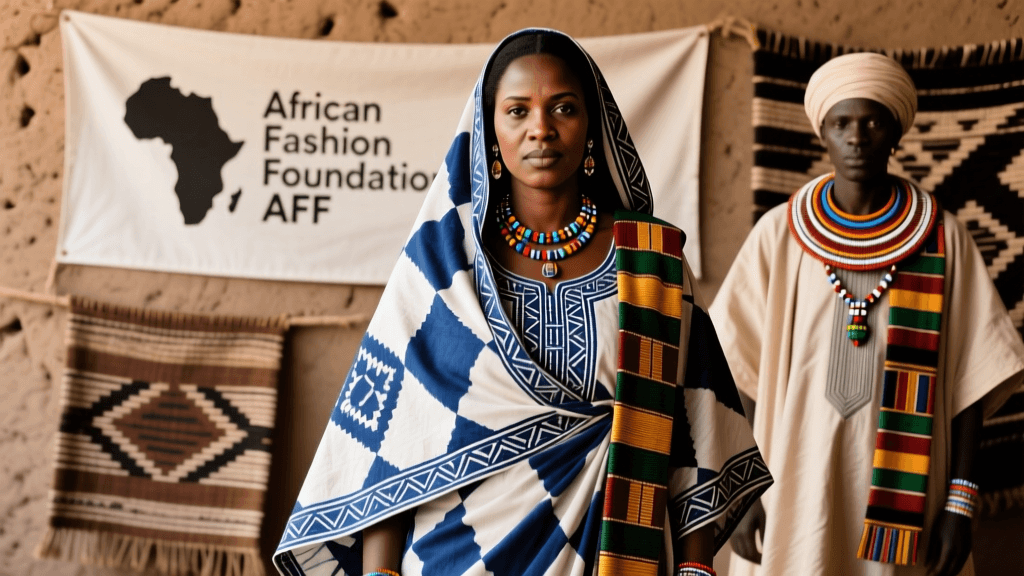
Worn across Mauritania’s vast desert expanse—from the coastal city of Nouakchott to the arid interior near the Senegal River basin—the melhfa is far more than a garment. It is a mobile archive of social status, regional affiliation, and spiritual intention. Unlike static ceremonial textiles such as Ghanaian kente or Malian bogolanfini, the melhfa functions daily: shielding wearers from sun and wind while encoding lineage through precise draping sequences. Its dimensions are standardized yet variable: traditional melhfas measure between 4.2 and 4.8 meters in length and 1.1 to 1.3 meters in width—enough fabric to wrap the body three times over with deliberate overlap. This scale enables both practicality and symbolic layering, where each fold corresponds to a stage of life or ethical commitment.
Cotton Cultivation and Regional Dyeing Traditions
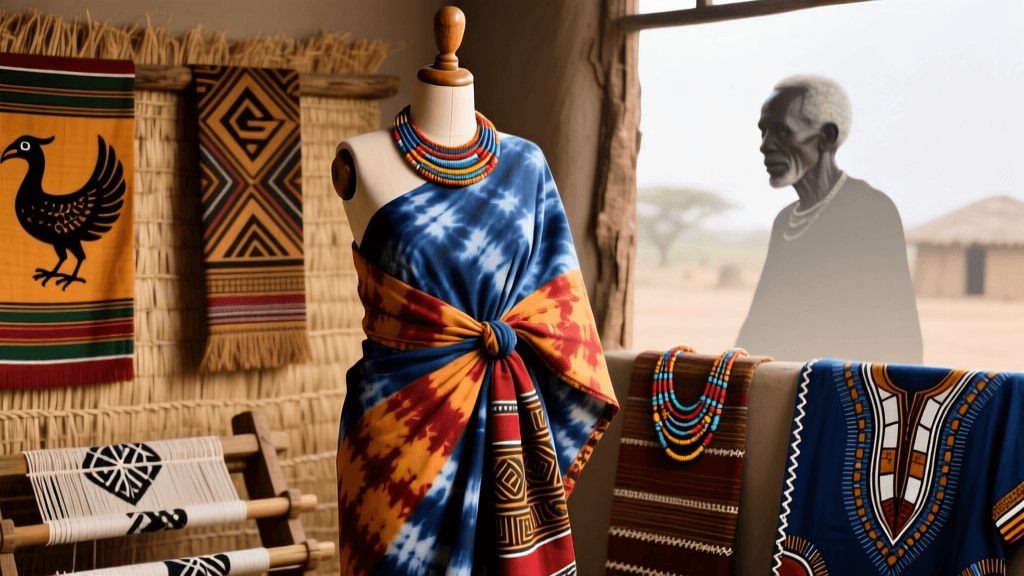
Mauritanian cotton originates primarily from the Gorgol and Trarza regions, where smallholder farms supply fibers to cooperatives like the Union Nationale des Producteurs de Coton (UNPC), established in 1998. These farms produce an average of 8,500 metric tons annually—less than 1% of West Africa’s total cotton output—but prioritize organic methods and heirloom varieties resistant to drought. Dyeing occurs in two primary contexts: urban ateliers in Nouakchott and rural workshops near Kiffa, where women use locally harvested plants and minerals. Indigo leaves (Indigofera tinctoria) yield deep blues after fermentation in vats maintained at 28–32°C for 7–10 days. Henna (Lawsonia inermis) provides warm ochres when mixed with iron-rich laterite clay, a technique documented by the Institut National de la Recherche Agronomique de Mauritanie (INRAM) in 2021.
Kiffa Beadwork Integration
In southern Mauritania, melhfas often incorporate Kiffa beads—tiny, hand-rolled glass beads formed from powdered glass and pigment, then fired in open charcoal pits. Each bead measures approximately 2–3 mm in diameter and takes 15–20 minutes to shape and fire. Women in Kiffa’s artisan quarters produce up to 120 beads per hour using copper wire mandrels no thicker than 0.8 mm. These beads are stitched onto melhfa hems in geometric motifs representing protection (triangles), fertility (concentric circles), and ancestral memory (zigzag lines mimicking the Tagant plateau’s escarpments). The Kiffa Artisanal Cooperative, founded in 2005, trains over 230 women annually in bead composition and motif grammar.
Draping Syntax: Four Regional Styles with Distinct Grammar
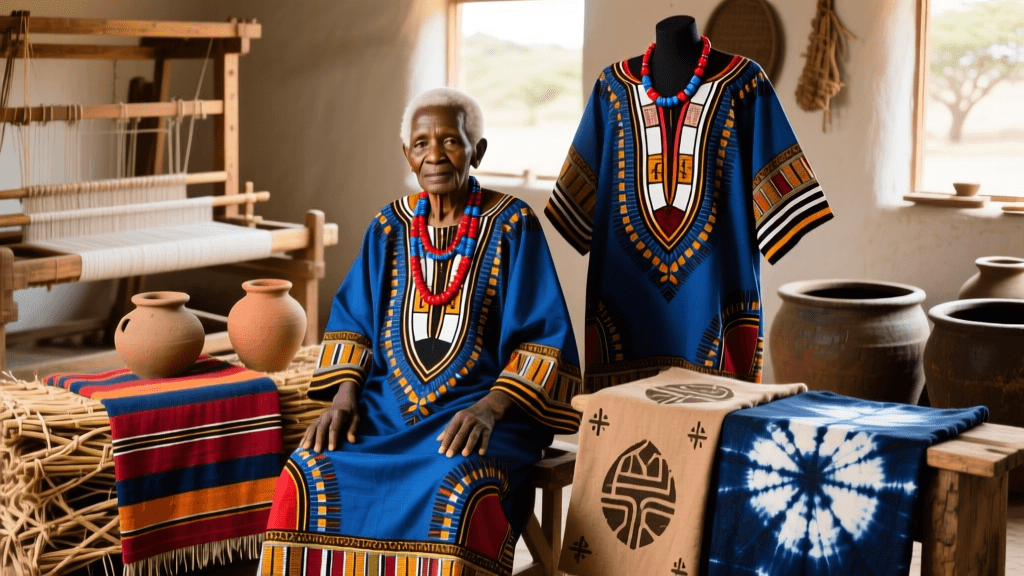
Draping is not improvisation but syntax—a set of rules governing how fabric interacts with posture, movement, and occasion. Each style reflects geography, climate adaptation, and sociopolitical history. In the Adrar region, women drape the melhfa so the front panel falls precisely 17 cm below the navel—a measurement calibrated to align with solar noon shadow length during Ramadan. In Nouakchott’s urban centers, younger women adopt the “double-fold” method, folding the melhfa into a 32-cm-wide sash before wrapping, allowing hands-free mobility during market work. Rural pastoralists in the Hodh El Chargui employ the “wind-lock” drape: fabric is twisted tightly around the torso and anchored under one arm, enabling unimpeded herding across dunes exceeding 60 meters in height.
Symbolic Color Systems
Color carries lexical weight. Deep indigo signals marital maturity and Quranic literacy; saffron-yellow (from Curcuma longa rhizomes) denotes pregnancy or recent childbirth; white cotton, undyed and starched, marks mourning periods lasting exactly 40 days. A 2019 ethnographic survey by the Musée National de Mauritanie recorded 27 distinct color combinations tied to tribal affiliations—including the Brakna’s cobalt-and-silver palette and the Lemtouna’s rust-and-cream sequence. These are not decorative choices but grammatical markers embedded in textile language.
Weaving Infrastructure and Institutional Support
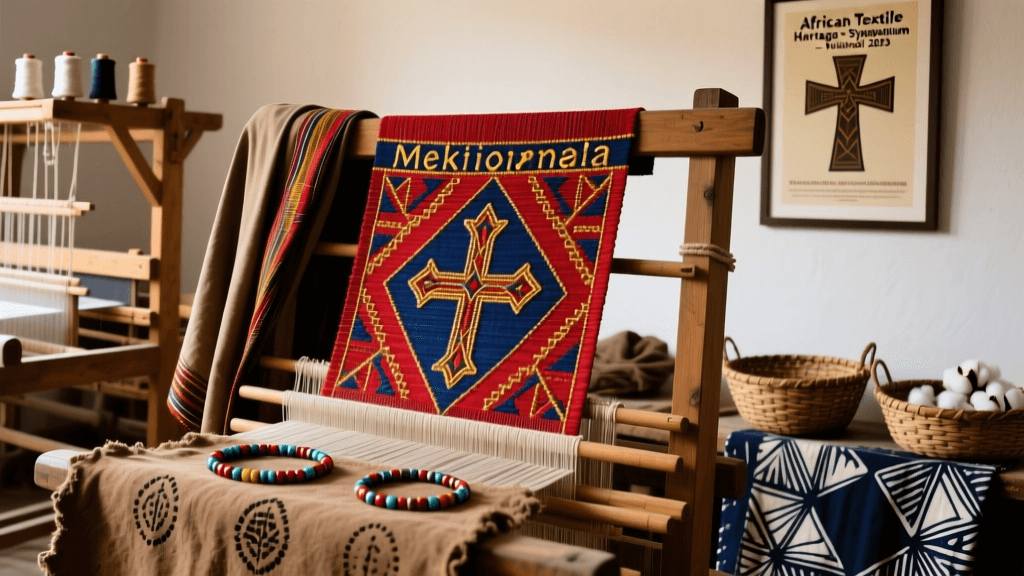
While most melhfas are machine-woven today on TC-2000 looms imported from Turkey, heritage weaving persists at the Centre Artisanal de Rosso, where 14 master weavers operate 120-year-old foot-treadle looms capable of producing 1.2 meters of cloth per day. These looms require 280 warp threads per 10 cm—twice the density of standard commercial cotton—and use hand-spun yarns measuring 32–36 Ne (Number English) count. The Centre partners with the African Fashion Foundation (Dakar, 2020) to digitize draping manuals and host biannual workshops on natural dye preservation. Similarly, the Institut Supérieur des Arts et de la Culture (ISAC) in Nouakchott offers a three-year diploma in textile anthropology, enrolling 47 students in 2023 who document melhfa practices across 19 municipalities.
Contemporary Reinterpretation and Ethical Challenges
Global fashion houses have referenced melhfa draping in runway collections since 2016, notably in designs by Oumou Sy’s Dakar-based label and collaborations with Paris-based Maison Margiela. Yet appropriation risks persist. In 2022, the Union des Créateurs Africains (UCA) filed a formal complaint against a European brand that patented a “desert wrap” silhouette derived directly from Adrar draping without crediting source communities or sharing royalties. The UCA’s 2023 policy brief emphasized that “melhfa knowledge systems constitute intangible cultural heritage under UNESCO’s 2003 Convention”—a stance echoed by the Musée National de Mauritanie’s 2024 exhibition Tissus de Mémoire, which displayed 14 original melhfas alongside soil samples from their cotton-growing regions.
- Standard melhfa length: 4.2–4.8 meters
- Kiffa bead diameter: 2–3 mm
- INRAM’s 2021 study confirmed optimal indigo vat temperature: 28–32°C
- Centre Artisanal de Rosso produces 1.2 meters of heritage cloth per day
- UCA’s 2023 policy brief cited UNESCO’s 2003 Convention on Intangible Cultural Heritage
The melhfa’s resilience lies in its refusal to be fixed. It breathes with the wearer, shifts with seasonal winds, and absorbs new meanings without shedding old ones. When draped correctly, the melhfa does not conceal—it reveals: revealing labor, revealing lineage, revealing a continuity that stretches from pre-colonial trade routes along the Senegal River to fiber-optic data centers in Nouakchott’s Technopole district. Its folds hold more than cloth—they hold time measured in sunrises, in dye vats, in the calloused fingers of women who count threads not in meters but in generations.
“The melhfa is not worn—it is negotiated. With heat, with authority, with memory. Every centimeter of fabric carries a clause in a covenant written in wind and wool.” — Fatou Dieng, textile anthropologist, ISAC Nouakchott, 2022
Preservation Through Practice, Not Display
Museums alone cannot safeguard the melhfa. Its survival depends on functional continuity: schoolgirls learning draping in Nouakchott’s Lycée de l’Océan, midwives teaching postpartum wraps in Timbédra health clinics, and elders correcting fold angles during Eid al-Fitr prayers in Atar’s Grand Mosque courtyard. The African Fashion Foundation’s 2021–2023 “Melhfa Literacy Initiative” trained 89 community educators across six regions, each tasked with documenting at least 12 draping variations and verifying their alignment with oral histories. One outcome was the creation of a tactile reference kit—containing swatches dyed to exact Pantone standards (PMS 19-4053 TCX for Adrar indigo; PMS 16-1349 TPX for Hodh ochre)—distributed to 37 schools and 4 regional archives.
This approach rejects static conservation. Instead, it treats textile knowledge as infrastructure—as vital as irrigation canals or solar grids. When a young woman in Akjoujt adjusts her melhfa’s hem to fall precisely at the ankle bone—a measurement verified by her grandmother against a brass caliper passed down since 1947—she performs archaeology in real time. She does not replicate the past; she recalibrates it for present pressures: rising temperatures, shifting trade routes, digital documentation. The melhfa endures because it is never finished—always being rewoven, re-dyed, re-draped.
Its cotton fibers retain traces of Saharan dust. Its dyes hold alkaline residues from ancient riverbeds. Its folds map migration paths older than national borders. To study the melhfa is to study sovereignty—not as political claim, but as embodied, everyday insistence on self-definition. That insistence is measured not in hectares or GDP, but in centimeters of cloth, degrees of temperature, days of fermentation, and the quiet, unwavering certainty of a woman adjusting her wrap before stepping into sunlight.
| Region | Primary Dye Source | Standard Draping Fold Count | Associated Symbolism |
|---|---|---|---|
| Adrar | Natural indigo + fermented date palm sap | 7 folds | Quranic scholarship & marital stability |
| Hodh El Chargui | Henna + iron-rich laterite clay | 5 folds | Pastoral endurance & territorial knowledge |
| Nouakchott | Synthetic indigo + local mordants | 3 folds | Urban mobility & generational negotiation |
At the Centre Artisanal de Rosso, looms hum at dawn. At the Kiffa Artisanal Cooperative, women roll beads beneath acacia shade. In classrooms at ISAC, students compare pH levels of historic dye vats with contemporary samples. These are not isolated acts—they are nodes in a living network, sustaining a textile logic that predates nation-states and will outlast them. The melhfa is not heritage frozen in glass. It is heritage walking, breathing, adapting—one precise fold at a time.