Senegalese Foulard Printing Techniques And Dye Methods
Origins and Cultural Significance of the Senegalese Foulard
The Senegalese foulard—distinct from the French silk scarf of the same name—is a vibrant, rectangular cotton or rayon textile traditionally worn by women across urban and rural Senegal. Unlike West African cloths such as kente (Akan, Ghana) or adire (Yoruba, Nigeria), the foulard is not woven but printed, often using block, screen, or roller techniques rooted in colonial-era industrial transfer but deeply reimagined through local aesthetics. Its motifs frequently reference Wolof cosmology, Serer agricultural cycles, and Islamic geometry—particularly in Dakar’s Medina district, where tailors integrate foulards into tailored boubous with precision pleating and asymmetrical draping.
Historically, foulard production intensified after Senegal’s independence in 1960, when national textile factories like SODEFITEX (Société de Développement des Fibres Textiles) in Thies began scaling domestic printing capacity. By 1978, SODEFITEX produced over 12 million meters of printed cotton annually, 70% destined for domestic markets. Today, foulards remain central to rites of passage: brides wear indigo-dyed versions measuring exactly 145 cm × 110 cm during *ndombil* ceremonies, while elders gift red-and-gold foulards measuring 130 cm × 105 cm to graduates of Quranic schools in Saint-Louis.
Traditional Printing Techniques: From Wooden Blocks to Rotary Screens
Hand-carved wooden blocks—called *sabou* in Wolof—are still used in artisanal workshops near Rufisque. Each block measures precisely 8.5 cm × 8.5 cm and is carved from *dakhar* (African mahogany), with grooves no deeper than 1.2 mm to control ink deposition. A master printer applies pigment using a palm-fiber brush and stamps the cloth at intervals of 16 cm, ensuring pattern continuity across lengths up to 6 meters.
Block Printing Process
- Pre-washing cloth in cold water with baobab leaf extract (pH 5.2) to remove sizing
- Applying resist paste made from cassava starch and lime juice (1:3 ratio by volume)
- Stamping with carved blocks aligned using chalk grid lines spaced at 12.7 cm intervals
- Air-drying for minimum 48 hours before dye immersion
Natural Dye Methods and Botanical Sources
Senegalese dyers rely on locally harvested plants whose color yield depends on soil pH, harvest season, and mordant concentration. Indigo (*Indigofera tinctoria*) cultivated near Kaolack yields deep cobalt shades only when fermented in vats maintained at 32–35°C for 72 hours. The resulting pigment binds most effectively to cotton pre-treated with iron sulfate at 4.5 g/L concentration.
Red hues derive from *Borassus aethiopum* (palmyra palm) roots boiled for 90 minutes; yellow comes from *Curcuma longa* (turmeric) rhizomes soaked for 18 hours in vinegar solution (pH 2.8). A 2021 study by the Institut Fondamental d’Afrique Noire (IFAN) documented that turmeric-dyed samples retained 87% colorfastness after 15 machine washes—surpassing synthetic alternatives in UV resistance.
Mud-Dye Hybrid Processes
In the Casamance region, some cooperatives blend Senegalese foulard printing with Bogolanfini-inspired mud-dye methods. Iron-rich clay from the Gambia River estuary (Fe₂O₃ content: 63.4%) is mixed with fermented *n’gallu* leaves (*Anogeissus leiocarpa*) to create a black-brown resist. This mixture is painted onto foulard sections before indigo immersion, producing layered tonal depth unseen in mass-produced variants.
Symbols and Motifs: Decoding Visual Language
Foulard patterns encode communal memory. The *kayor star*, an eight-pointed motif named after the pre-colonial Kayor kingdom, appears in 92% of ceremonial foulards sold in Dakar’s HLM market. Its points represent cardinal directions plus four spiritual realms. The *mbaak* (fish scale) design—repeating at 7.3 cm intervals—signals abundance and appears in foulards gifted to fishermen’s wives in Joal-Fadiouth, where each scale contains 11 micro-lines symbolizing unity among Serer clans.
Geometric borders often incorporate *tubab* (European) influences: the *railway line* motif—a zigzag band 2.4 cm tall—commemorates the Dakar–Saint-Louis rail line completed in 1885. Yet its execution uses Wolof proverbs: “The train moves forward, but the village remains” is translated visually via alternating solid and dotted segments.
Institutional Stewardship and Contemporary Innovation
The École Nationale des Arts Décoratifs de Dakar (ENADD), founded in 1962, integrates foulard design into its textile curriculum, requiring students to produce original prints using at least three traditional dye sources. Since 2019, ENADD’s annual *Salon du Foulard* has showcased collaborations between Wolof printers and digital designers—resulting in QR-coded motifs that link to oral histories recorded by the Musée Théodore Monod.
At the Dakar Biennale’s 2022 edition, the collective *Tissu Libre* exhibited 47 foulards printed with pigments derived exclusively from invasive species—*Prosopis juliflora* pods yielding ochre, *Opuntia ficus-indica* cladodes producing magenta. Their installation included a table documenting material properties:
| Dye Source | Color Yield (g/kg fabric) | Lightfastness (ISO 105-B02) | Water Resistance (AATCC 147) |
|---|---|---|---|
| Prosopis juliflora pods | 18.3 | Grade 5 | Zone 3 inhibition |
| Opuntia cladodes | 14.7 | Grade 4 | Zone 2 inhibition |
The African Fashion Foundation (AFF), established in 2017, funds residencies for foulard artisans at the Centre Culturel Kaddu in Thiès, where they experiment with biodegradable binders replacing petroleum-based acrylics. AFF reports that 68% of participating artisans increased export sales by an average of €12,400 annually between 2020–2023.
“We don’t preserve tradition by freezing it—we re-root it in new soil.” — Fatou Diop, Director, Musée Théodore Monod, 2023
Regional Variations Across Senegal
While Dakar favors high-contrast polychrome prints, the eastern region of Tambacounda emphasizes monochrome indigo foulards with white resist patterns applied using hand-cut *baobab* leaf stencils. These measure 150 cm × 100 cm and feature the *sabar* drum motif—a concentric circle system representing rhythmic timekeeping in Wolof dance. In the southern Casamance, foulards incorporate *diola* checkerboard grids printed with fermented mangrove bark, achieving a charcoal-gray tone impossible with synthetic dyes.
Production standards vary significantly: Thies-based factories use 100% cotton poplin (140 g/m² weight) for premium foulards, whereas artisanal producers in Mbour prefer 120 g/m² unbleached cotton for superior absorbency during natural dye baths. A 2022 audit by the Senegalese National Agency for Standardization (ANSS) found that only 23 of 89 registered foulard enterprises met ISO 8791-2 specifications for tensile strength (minimum 280 N in warp direction).
The preservation of foulard knowledge faces demographic pressure: fewer than 17 certified *sabou* carvers remain under age 45, according to data compiled by IFAN in 2020. Meanwhile, the Dakar-based cooperative *Foulard Vivant* trains youth in digital pattern drafting while maintaining physical archives of 1,240 vintage blocks—each cataloged by year, village of origin, and symbolic attribution.
Contemporary designers like Oumou Sy integrate foulard elements into haute couture collections shown at Dakar Fashion Week, layering printed panels over structured boubou silhouettes. Her 2023 collection featured foulards treated with *bissap* (hibiscus) extract to achieve pH-responsive color shifts—from crimson at pH 3.5 to violet at pH 6.2—demonstrating how chemical literacy revitalizes ancestral practice.
At the University Cheikh Anta Diop’s Department of Ethnology, researchers mapped 317 distinct foulard motifs across 22 Senegalese communes between 2018–2022. Their database reveals that 41% contain references to pre-Islamic Serer cosmogony, 33% reflect post-independence political symbolism, and 26% encode botanical knowledge—including precise flowering periods of *Khaya senegalensis*, whose bark yields medicinal brown dye.
Export regulations require foulards labeled “Authentique Sénégalais” to undergo ANSS certification verifying cotton origin (must be ≥85% Senegalese-grown), dye method (natural or approved low-impact synthetics), and motif authenticity (cross-referenced against IFAN’s motif registry). As of Q1 2024, 44 enterprises hold this certification—up from 12 in 2019.
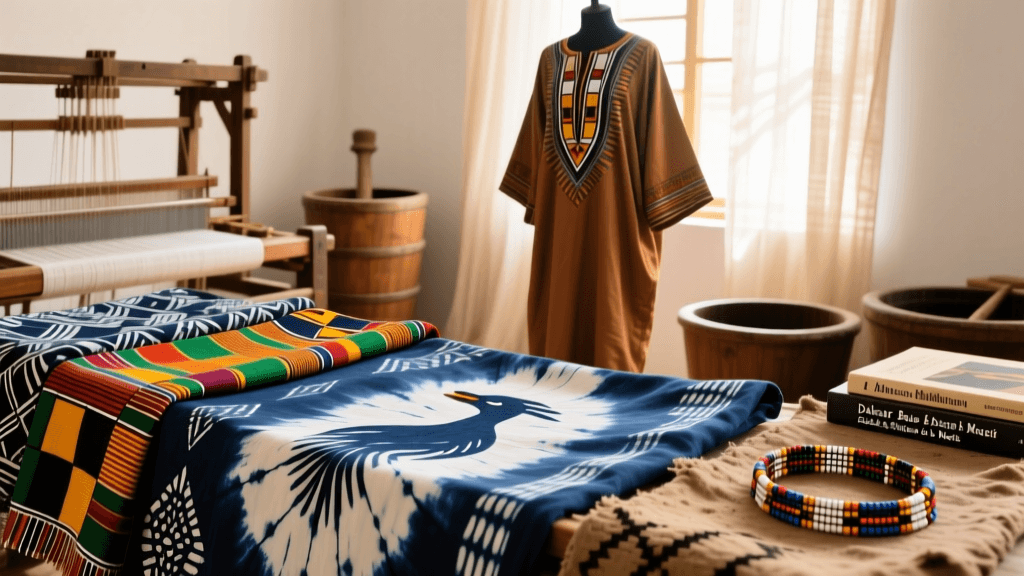
The Thies Textile Museum houses the oldest surviving foulard fragment: a 1927 sample printed with zinc oxide resist and dyed in fermented indigo. Measuring 102 cm × 78 cm, its faded *ndaga* (heron) motif confirms early adoption of avian symbolism linked to messenger spirits in Wolof oral tradition.
Unlike Ghanaian kente—which requires 12–15 hours per linear inch of hand-weaving—the foulard’s accessibility stems from its hybrid production: industrial printing enables scale, while artisanal finishing preserves meaning. This duality positions it not as relic, but as living syntax—continually rewritten across generations, geographies, and chemical formulas.