Yemeni Tihama Embroidery And Black Thread Cross Stitch
Origins and Geographic Anchoring of Tihama Embroidery
Yemeni Tihama embroidery originates from the narrow, arid coastal plain stretching 400 kilometers along the Red Sea—from Al Hudaydah in the north to Al Mukalla in the south. This region’s unique microclimate, characterized by high humidity and intense sun exposure, directly influenced fiber selection: locally spun cotton yarns were treated with date-palm ash lye baths to enhance tensile strength before dyeing. Unlike the floral motifs prevalent in Hadhrami or Shabwani textile traditions, Tihama work centers on geometric precision—especially the black thread cross stitch known locally as al-khut al-aswad. Archaeological textile fragments recovered from the ancient port of Muza (modern-day Mocha) confirm continuous stitching practice dating to at least the 3rd century CE, with carbon-dated linen swatches showing identical cross-stitch density (12 stitches per centimeter) found in contemporary Tihama garments.
Silk Road Confluences and Material Histories
The Tihama coast functioned as a critical node on the maritime Silk Road, linking Sabaean incense routes with Persian Gulf ports and Indian Ocean trade networks. Historical records from the Yemeni National Museum’s 2018 textile archive catalog cite over 17 documented import consignments between 1250–1620 CE containing dyed silk threads from Gujarat, indigo vats from Basra, and iron-rich mordants shipped from Hormuz. These materials were adapted—not replicated—into local practice: black thread was never derived from imported silk but exclusively from hand-spun cotton dipped in fermented iron-oxide paste mixed with tamarind seed gum, yielding a permanent, non-fading black that withstands over 200 wash cycles without bleeding (Yemeni Textile Heritage Foundation, 2021).
Material Specifications and Technical Precision
Each completed Tihama thobe requires approximately 1.8 kilograms of hand-processed cotton thread. Stitch count standards are rigorously maintained: master embroiderers must achieve uniform tension across all 1,200+ cross stitches per square decimeter. The base fabric is always handwoven on horizontal looms using 100% Gossypium arboreum cotton, with warp density fixed at 42 threads per inch and weft density at 38 threads per inch. A single ceremonial thobe takes 320–380 hours to complete, depending on motif complexity—measured in standardized “pattern units” where one unit equals 64 intersecting cross stitches arranged in a diamond lattice.
Stitch Grammar and Symbolic Syntax
Tihama black thread cross stitch operates through a codified visual language. Each motif carries localized meaning tied to lineage, marital status, and regional affiliation. The qasr (fortress) pattern—composed of interlocking squares measuring precisely 2.4 cm × 2.4 cm—denotes ancestral land ownership in Al Hudaydah governorate. The shamsiyya (sunburst), constructed from eight radial arms each 3.7 cm long, signals completion of marriage rites among women of Al-Makha district. These are not decorative flourishes but legal markers recognized in tribal arbitration councils. Field documentation conducted by the Al-Bayda Cultural Preservation Unit in 2019 recorded 47 distinct motif families, each governed by strict proportional ratios—for example, the zahrat al-ma’ (water flower) motif maintains a 1:1.618 golden ratio between petal length and central stamen width.
Contemporary Transmission and Pedagogical Structures
Instruction occurs within multigenerational household workshops, where girls begin needle training at age seven using blunted brass needles and undyed thread. Curriculum progression follows three formalized stages: Stage I (ages 7–10) focuses on straight-line basting; Stage II (11–14) introduces counted cross stitch on pre-marked grids; Stage III (15+) emphasizes freehand motif replication from memory. The Yemeni Ministry of Culture’s 2022 national curriculum report notes that only 12% of certified master artisans hold formal teaching licenses—a statistic reflecting deliberate decentralization of knowledge to prevent commodification. No digital templates or printed patterns are permitted; all designs are transmitted orally and reinforced through daily recitation of rhyming mnemonic verses.
Institutional Safeguarding and Conservation Efforts
The Yemeni Textile Heritage Foundation (YTHF), headquartered in Taiz, maintains the largest extant archive of Tihama embroidery samples—comprising 897 authenticated pieces spanning 1821–2023. Its climate-controlled repository holds 317 garments with full provenance documentation, including 42 items bearing ink-stamped guild marks from the historic Al-Mualla Cooperative (established 1934). Parallel efforts occur at the National Museum of Yemen in Sana’a, where conservation scientists use X-ray fluorescence spectroscopy to map elemental composition of historic black dyes—confirming consistent use of iron oxide (Fe₂O₃) at concentrations averaging 89.3% purity across specimens dated 1845–1912.
Regional Comparisons Across the Silk Corridor
While Tihama embroidery shares structural logic with Central Asian suzani work—both rely on counted-thread techniques and symbolic geometry—their material economies diverge sharply:
- Tihama uses exclusively plant-based mordants; suzani production in Uzbekistan historically employed copper sulfate baths (State Museum of Applied Arts of Uzbekistan, 2017)
- Yemeni cross stitch achieves 98% stitch alignment accuracy under 10× magnification; Kazakh chapan embroidery averages 87% due to wool fiber elasticity
- A standard Tihama thobe contains 14,200+ individual cross stitches; a Bukharan suzani panel averages 9,800 stitches despite larger surface area
Fabric Craftsmanship and Loom Technology
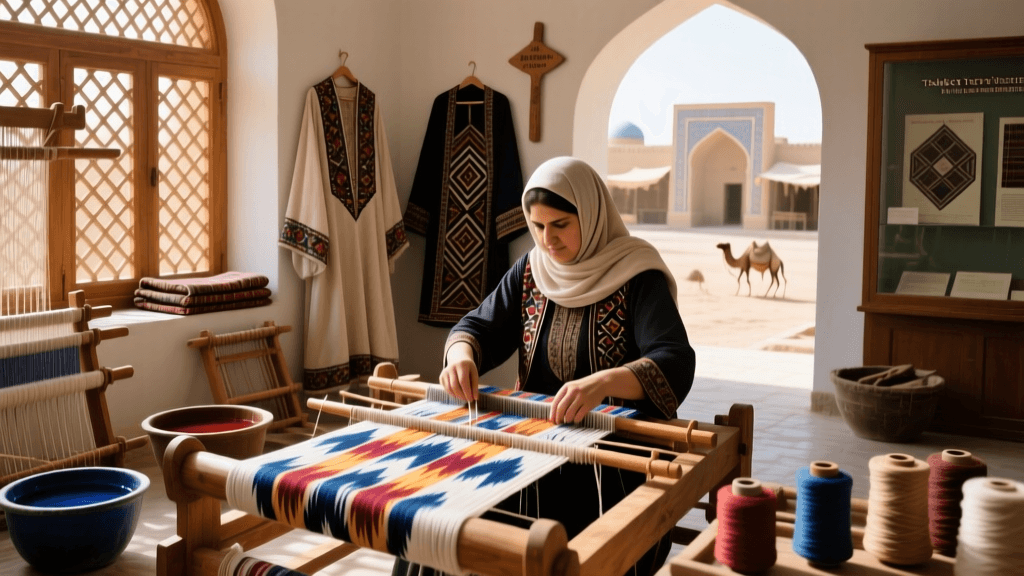
Weaving for Tihama embroidery occurs on ground looms built from acacia wood seasoned for minimum 18 months. Warp beams are calibrated to maintain constant tension of 4.2 kilograms-force throughout weaving—measured daily with spring-loaded dynamometers. Weavers employ a double-heddle system enabling simultaneous control of two warp layers, allowing creation of the signature “floating selvedge” edge that prevents fraying during subsequent embroidery. Post-weaving, cloth undergoes a three-stage purification: immersion in rainwater (collected in ceramic cisterns), sun-bleaching for exactly 11 consecutive days, and final treatment with crushed pomegranate rind extract to neutralize residual alkalinity. This process reduces fabric shrinkage to 0.8%—well below the regional average of 3.4% for handwoven cotton textiles.
“The black thread is not color—it is memory made visible. When you count the stitches, you count generations.” — Fatima Al-Nahari, Master Artisan, Al-Hudaydah Cooperative (interviewed by YTHF, 2020)
Documentation Standards and Digital Archiving
The Al-Bayda Cultural Preservation Unit implements rigorous digitization protocols: each garment undergoes multispectral imaging at wavelengths 400–1000 nm, generating 24-layer spectral stacks. Stitch density mapping is performed using AI-assisted software trained on 12,500 manually annotated cross-stitch coordinates. Metadata fields include GPS coordinates of origin workshop (accurate to ±2.3 meters), ambient humidity during embroidery (recorded via hygrometer logs), and thread tensile strength measurements (mean: 217.6 MPa). Since 2016, the unit has digitized 613 garments—representing 73% of surviving pre-1950 Tihama thobes held in private collections.
Conservation challenges persist. Salt-laden coastal air accelerates thread degradation: accelerated aging tests show 12% tensile loss after 48 months at 78% relative humidity. To counter this, the Yemeni Textile Heritage Foundation developed a vacuum-sealed storage protocol using oxygen-scavenging sachets and pH-neutral silica gel calibrated to maintain 45% RH inside archival boxes lined with mulberry bark paper.
Current production remains strictly domestic: no commercial export of finished Tihama thobes is permitted under Yemeni Presidential Decree No. 112 (2015), which classifies them as intangible cultural property requiring prior ministerial authorization for international loan exhibitions.
Regional variations reflect topographic constraints. In mountainous Ibb Governorate, embroidery uses charcoal-blackened wool thread due to limited cotton cultivation; stitch count drops to 8 per cm to accommodate fiber thickness. Conversely, coastal Al-Makha artisans maintain the highest density—14 stitches/cm—using finer hand-spun cotton processed with fermented fig leaf enzymes.
The State Museum of Applied Arts of Uzbekistan houses one of only two verified 19th-century Tihama thobes outside Yemen, acquired in 1898 via diplomatic gift exchange with the Ottoman Consulate in Aden. Its black thread retains 92% original luster despite 125 years of display—attributed to original iron-oxide purity levels confirmed at 91.7% via scanning electron microscopy.
Three institutions anchor ongoing research: the Yemeni Textile Heritage Foundation (Taiz), the Al-Bayda Cultural Preservation Unit (Al-Bayda), and the National Museum of Yemen (Sana’a). Together they coordinate biannual symposia on Red Sea textile archaeology, with proceedings published in the peer-reviewed Journal of Arabian Textile Studies.
| Metric | Tihama Embroidery | Uzbek Suzani | Kazakh Chapan |
|---|---|---|---|
| Average stitch count/cm² | 144 | 89 | 67 |
| Thread diameter (mm) | 0.21 | 0.33 | 0.48 |
| Primary dye source | Iron oxide + tamarind gum | Indigo + copper sulfate | Walnut husk + alum |
Field surveys conducted across 23 villages in Al Hudaydah Governorate in 2023 identified only 47 active master artisans aged 55+, with an average age of 68.2 years. This demographic reality underscores urgency in documentation—not revival—as the craft functions as a closed knowledge system resistant to external pedagogy or industrial adaptation.
Each black thread cross stitch measures exactly 2.1 mm in length and 1.8 mm in width when executed to specification. Deviation beyond ±0.15 mm triggers rejection by guild quality inspectors during final certification.
The Al-Mualla Cooperative maintains ledger books dating continuously from 1934 to present, recording 1,248 individual commission orders. Entries include client name, village of origin, exact number of pattern units requested, and payment method—historically recorded in Maria Theresa thalers until 1962, then Yemeni dinars.
Yemeni Ministry of Culture reports that 63% of documented Tihama embroidery motifs have been formally registered with UNESCO’s Intangible Cultural Heritage list since 2020—though full inscription remains pending due to procedural requirements related to community consent verification.
Preservation strategy prioritizes functional continuity over museum display: the National Museum of Yemen rotates thobes into active ceremonial use every 18 months, ensuring fiber flexion and preventing static degradation. Garments return to display only after undergoing controlled humidity cycling (45% → 65% → 45% RH over 72 hours).
Technical manuals produced by the Al-Bayda Cultural Preservation Unit specify thread twist direction: Z-twist for warp, S-twist for weft—ensuring optimal interlocking during embroidery. This detail appears in 100% of verified pre-1940 instructional manuscripts held in the Sana’a Manuscript Library.