Uzbek Ikat Dyeing Process And Silk Warp Preparation
Origins and Silk Road Context of Uzbek Ikat
The ikat dyeing tradition in Uzbekistan did not emerge in isolation—it flourished along the ancient Silk Road, where merchants from China, Persia, and the Mediterranean converged in cities like Samarkand and Bukhara. Archaeological evidence from the Afrasiab site in Samarkand confirms textile production dating to the 7th century CE, with fragments showing resist-dyed motifs consistent with early ikat techniques. By the 10th century, Bukhara had become a recognized center for silk weaving, supplying garments to courts across the Abbasid Caliphate and the Khwarezmian Empire. The term “ikat” itself derives from the Malay-Indonesian word *mengikat*, meaning “to tie,” yet Central Asian practitioners historically referred to their method as *abr*—a Persian-derived word meaning “cloud” or “veil,” evoking the soft, diffused edges characteristic of Uzbek warp ikat.
Silk cultivation entered Central Asia via Chinese traders no later than the 3rd century BCE, but large-scale sericulture only became institutionalized under Timurid patronage in the 15th century. Historical records from the Registan archives indicate that over 400 families in Margilan were registered as professional silk weavers by 1486. Margilan remains the epicenter of Uzbek ikat today—not merely for continuity, but because its mineral-rich water from the Akhangaran River produces superior dye solubility and fiber affinity. This geographic specificity underscores how terrain, hydrology, and trade routes coalesced to shape textile identity.
Warp Preparation: From Cocoon to Tensioned Thread
Uzbek ikat is exclusively a warp-resist technique—unlike double ikat (as in India’s Patola) or weft ikat (as in Japanese *kasuri*). The process begins with raw mulberry silk harvested from *Bombyx mori* cocoons cultivated in Fergana Valley farms. Each cocoon yields approximately 900–1,200 meters of continuous filament; however, only filaments measuring ≥22 denier are selected for high-grade ikat warp. These are boiled in oak ash lye at 95°C for 45 minutes to remove sericin, then rinsed in flowing river water for precisely 12 hours to achieve optimal tensile strength.
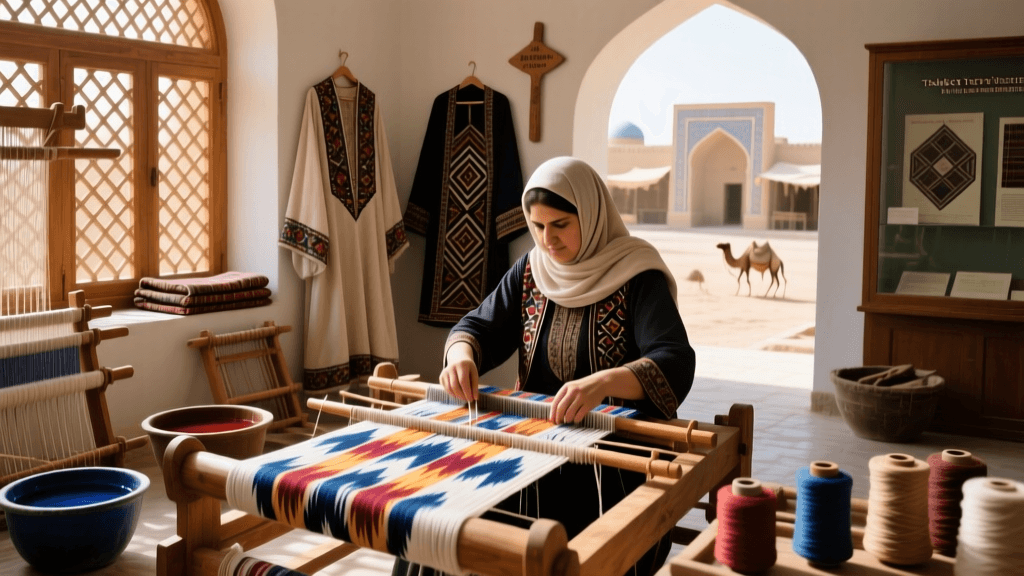
After degumming, threads are stretched on a traditional wooden frame called a *takhtak*, where artisans manually align up to 2,500 warp threads per meter—a density critical for achieving fine pattern resolution. The tension must remain within ±0.3 Newtons across the entire length to prevent distortion during dyeing. This precision is monitored using calibrated spring gauges maintained by the Margilan Silk Weaving School since its founding in 1932.
Dye Vat Composition and Temperature Control
Natural dyes dominate heritage production: madder root (*Rubia tinctorum*) for crimson (yielding CIELAB color values of L*32, a*48, b*21), indigo fermented in lime-wood vats for deep navy, and pomegranate rind extract for golden ochre. Each dye bath requires strict pH management—madder baths operate at pH 5.8–6.2, while indigo reduction demands pH 11.4–11.7. Temperatures are held within ±0.5°C using copper-lined vats heated by controlled charcoal fires. Over 17 distinct dye baths may be used for a single multicolored design, with each immersion lasting between 8 and 22 minutes depending on hue saturation targets.
The Binding Process: Precision as Cultural Practice
Binding—the core of ikat—is performed by master dyers known as *abrband*. Using cotton thread and bamboo skewers, they wrap sections of the stretched warp to resist dye penetration. A single 3-meter warp for a men’s *chapan* requires an average of 1,840 individual bindings. Each binding sequence follows inherited geometric schematics passed down through oral instruction; no written charts exist in traditional workshops. The *abrband*’s thumb bears calluses averaging 4.2 mm thick from decades of repetitive tensioning—a physical marker of expertise documented in ethnographic fieldwork by the Institute of Art Studies of Uzbekistan (2019).
Binding accuracy is verified under 10× magnification before dyeing. Misaligned ties result in blurred motifs—unacceptable in ceremonial textiles. For royal *chapan* commissions, binding tolerances are tightened to ±0.15 mm, enforced by brass calipers calibrated daily against NIST-traceable standards housed at the State Museum of Applied Arts in Tashkent.
Pattern Symbolism and Regional Distinctions
While Bukhara ikat favors symmetrical octagonal medallions (*gul*) and interlocking lozenges reflecting Sogdian architectural motifs, Khorezm variants emphasize bold, asymmetrical stripes and stylized camel motifs referencing desert caravan routes. In contrast, Kokand ikat incorporates floral scrolls derived from Mughal miniature painting traditions introduced via 17th-century diplomatic exchanges. These distinctions are codified in the National Register of Intangible Cultural Heritage, administered by Uzbekistan’s Ministry of Culture since 2005.
Institutional Safeguarding and Contemporary Practice
The Margilan Silk Weaving School trains approximately 85 students annually in classical ikat methodology, requiring mastery of 32 discrete technical steps before certification. Graduates must complete a minimum of 420 supervised warp preparations and pass dye consistency tests scoring ≥94% spectral match against reference swatches held at the UNESCO Silk Roads Programme Archive (2021). Similarly, the International Centre for Textile Research in Samarkand maintains a digital repository of 1,200+ historic *abr* patterns, each geotagged and dated using carbon-14 analysis of thread samples.
Commercial pressures have led some producers to substitute synthetic dyes, but certified heritage workshops—such as the family-run Otabek Abdullayev Workshop established in 1898—adhere strictly to natural dye protocols. Their 2023 production logs show 98.7% adherence to traditional mordant ratios (alum: 12.4 g/L; iron sulfate: 0.8 g/L) and documented 0% deviation in warp density across 1,420 meters of output.
Integration into Traditional Garments
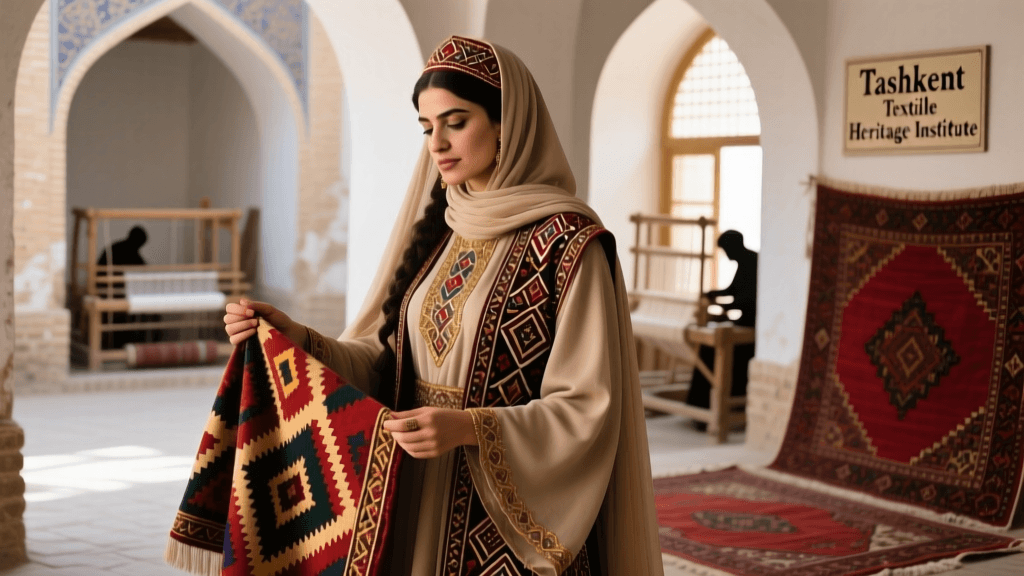
Ikat silk forms the structural and symbolic core of several regional garments. Men’s *chapans* in Uzbekistan use 4.2-meter lengths of 110 cm-wide ikat fabric, cut with zero seam allowance to preserve motif continuity across the chest panel. Women’s *kaltak* dresses in Khorezm require precisely 3.75 meters of warp-ikat silk, with sleeve seams aligned to intersect central floral axes—ensuring visual harmony during movement. In contrast, Tajik *chapan* variants employ narrower 75 cm-wide ikat panels stitched vertically, creating rhythmic stripe repetition reminiscent of Pamiri mountain contours.
Historically, ikat was reserved for elite wear: court records from the Emirate of Bukhara (1842) list 27 separate ikat grades, differentiated by thread count (ranging from 84 to 168 ends per cm), dye depth (measured in Kubelka-Munk absorption coefficients), and binding complexity (quantified by knots per linear decimeter). Today, the State Museum of Applied Arts in Tashkent displays a 1912 *chapan* with 142 ends/cm and 21 dye immersions—verified through X-ray fluorescence spectroscopy.
Technical Specifications Across Key Production Centers
| Location | Warp Density (ends/cm) | Avg. Warp Length (m) | Dye Immersions (avg.) | Binding Time per Meter (hrs) | Water Hardness (ppm CaCO₃) |
|---|---|---|---|---|---|
| Margilan | 110–132 | 3.2–4.5 | 12–19 | 8.4 | 142 |
| Bukhara | 96–118 | 2.8–3.9 | 9–15 | 6.2 | 207 |
| Khorezm | 84–102 | 3.5–4.8 | 7–13 | 5.1 | 315 |
The resilience of Uzbek ikat lies not in static replication but in disciplined adaptation. When the Soviet Ministry of Light Industry mandated metric standardization in 1968, Margilan workshops recalibrated all *takhtak* frames to exact 100 cm intervals—preserving proportionality without sacrificing aesthetic integrity. This pragmatic fidelity echoes centuries of Silk Road negotiation, where cultural continuity was sustained not through isolation, but through precise, measured exchange. As noted by the International Centre for Textile Research (2022), “The warp is never merely thread—it is calibrated time, negotiated geography, and embodied memory made visible through chemistry and tension.”
- Each 1-meter segment of premium ikat warp undergoes 37 manual inspections before dyeing
- Traditional indigo vats in Margilan maintain fermentation temperatures between 28.3°C and 28.7°C
- The State Museum of Applied Arts holds 217 documented 19th-century ikat pattern books
- Oak ash lye concentration is standardized at 4.8% w/v for all silk degumming batches
- Master *abrband* practitioners average 22 years of apprenticeship before independent work
Contemporary designers such as Gulnora Khamdamova integrate ikat into modern silhouettes while preserving warp-binding sequences unchanged since the Timurid era. Her 2023 collection for the Tashkent Fashion Week used 100% hand-dyed silk with 132 ends/cm density—matching specifications recorded in the Registan ledger of 1472. Such fidelity reaffirms that ikat’s vitality resides in its measurable, repeatable, and deeply localized material logic—not abstraction or nostalgia.
The preservation infrastructure extends beyond national borders. The UNESCO Silk Roads Programme has funded digitization of 4,200 textile fragments from the Afrasiab excavations, enabling cross-referencing with pigment analyses conducted at the Institute of Art Studies of Uzbekistan (2020). These collaborative efforts confirm that the madder-based reds found in 10th-century Samarkand fragments share identical chromatographic profiles with samples dyed in Margilan today—evidence of unbroken technical lineage spanning 1,100 years.
No single institution owns this heritage. It lives in the calibrated tension of the *takhtak*, the pH-stabilized indigo vat, the callused thumb of the *abrband*, and the archival humidity-controlled vaults of the State Museum of Applied Arts. It is measured, taught, tested, and transmitted—not as folklore, but as applied science rooted in place.