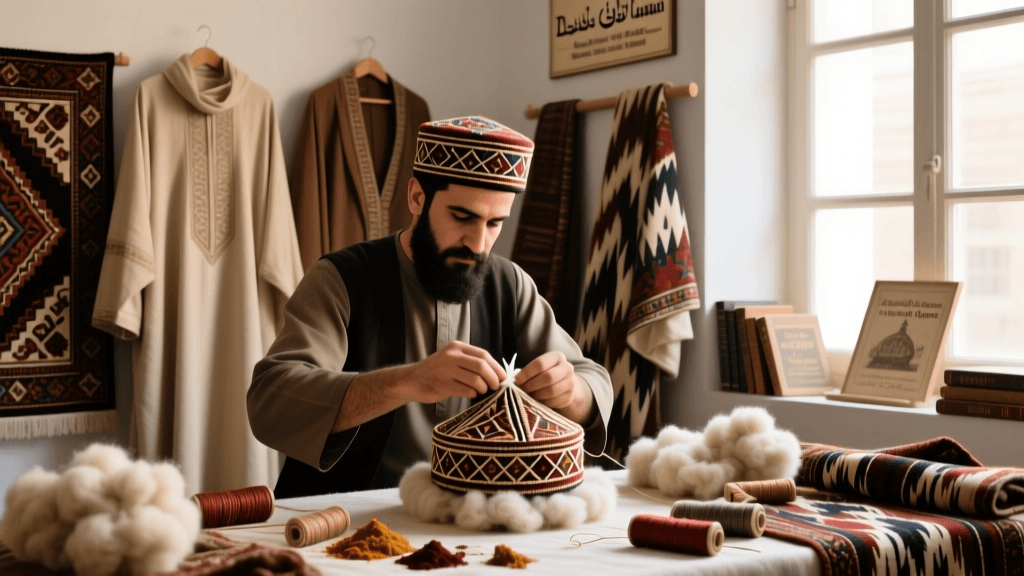
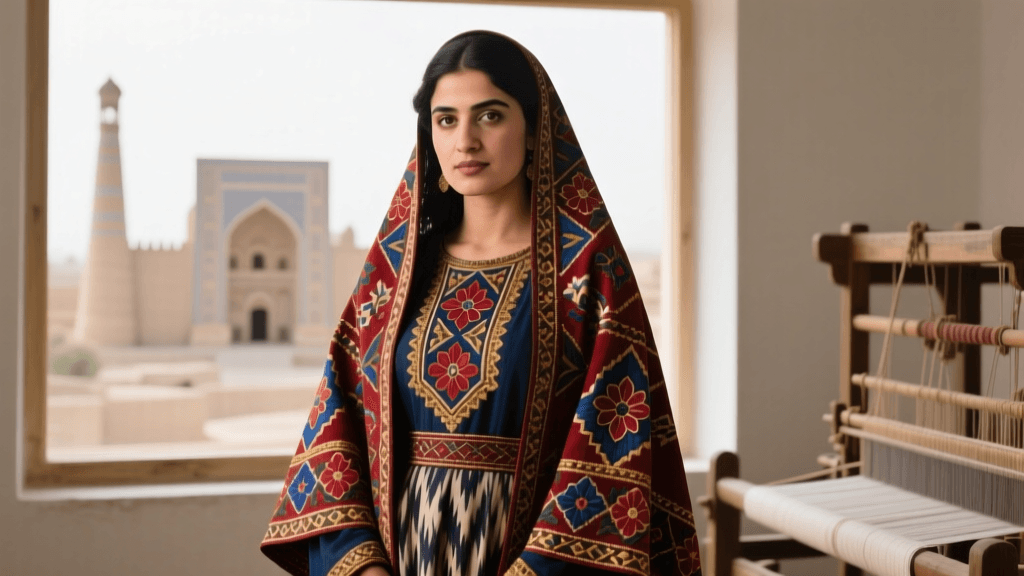
Kyrgyz Ala Kiyiz Felt Making With Mountain Sheep Wool Kazakhstan
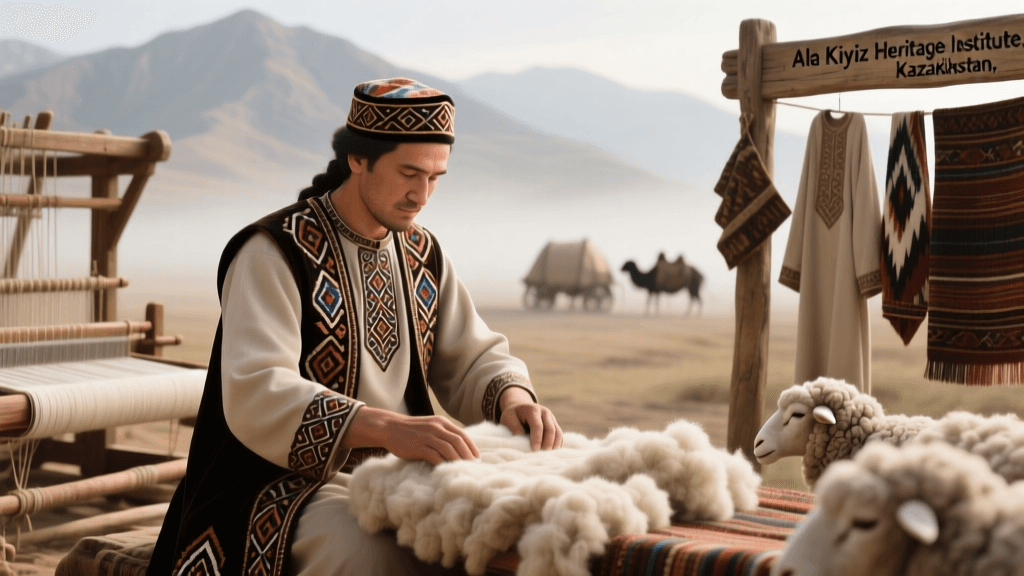
Ala Kiyiz: A Living Archive Woven in Wool and Memory
Ala kiyiz—the striped, hand-felted rugs of Kyrgyz pastoral communities—is not merely floor covering. It is a cartographic record of seasonal migration, a tactile chronicle of mountain ecology, and a functional textile born from necessity on the high pastures of the Tien Shan. Though often associated with Kyrgyzstan, the craft’s material roots extend across borders into Kazakhstan’s southeastern Zhetysu region, where herders of the Zhagala and Uyghur-descended Qazaq tribes have long supplied premium wool from native mountain sheep. These animals—adapted to altitudes exceeding 3,200 meters—produce coarse outer guard hairs and dense underwool ideal for wet-felting. Their fleece yields an average of 1.8–2.3 kg per shearing, with underwool comprising 45–52% by weight. Unlike commercial Merino, mountain sheep wool contains higher lanolin content (7.4–9.1%) and crimp frequency (12–16 crimps per cm), both critical for interlocking fibers during the labor-intensive rolling process.
From Steppe to Silk Road: Wool as Currency and Cultural Conduit
Archaeological evidence from the Issyk Kurgan (near Almaty, Kazakhstan) confirms felt production in Central Asia by at least the 4th century BCE. Excavated fragments show layered wool felts dyed with madder root and indigo—pigments later traded along the northern Silk Road routes that passed through Sairam and Taraz. As caravans moved eastward, Kyrgyz and Kazakh nomads exchanged raw wool, dyed yarns, and finished ala kiyiz for Chinese silk, Persian saffron, and Sogdian metalwork. This exchange shaped regional aesthetics: the vertical stripe motif of southern Kyrgyz ala kiyiz mirrors the structural rhythm of Uzbek ikat warp threads, while the deep cobalt blue favored in eastern Kazakhstan’s Tekeli district echoes Persian cobalt oxide glazes used in Samarkand ceramics. By the 12th century CE, the city of Otrar served as a key wool-processing hub, where felt-makers standardized pressing techniques using wooden rollers weighing up to 45 kg.
Wool Sourcing and Seasonal Rhythms
Shearing occurs once annually in late May or early June, timed to coincide with the first snowmelt and peak lanolin levels. Herders in the Ile-Alatau National Park region avoid mechanical shearing; instead, they use hand-held iron shears with 12-cm blades, preserving fiber integrity. Each adult mountain sheep yields approximately 2.1 kg of usable wool after sorting and dehairing—a process requiring 3–4 hours per fleece. The finest underwool is reserved for ceremonial ala kiyiz destined for dowries or yurt wall hangings; coarser guard hairs are spun into rope or woven into tent lashings.
Kazakhstan’s Eastern Craft Continuum
In Kazakhstan’s Alakol District, ala kiyiz production follows distinct protocols codified by the Kokshetau Regional Artisans’ Guild since 1987. Here, stripes are narrower (typically 8–12 cm wide) than those in Naryn Province, Kyrgyzstan (14–22 cm), reflecting local preferences for denser patterning. Dye vats use fermented walnut husks aged for precisely 14 days to achieve warm sepia tones, while iron-rich spring water from the Chilik River ensures colorfastness. A standard 2.5 × 3.2 m ala kiyiz requires 18.7 kg of cleaned wool and 42 hours of continuous rolling over three days—first on grass, then on tightly stretched canvas, finally on a wooden platform lined with river stones.
Material Specifications Across Borders
- Kyrgyzstan’s Talas Region: Wool density averages 280 g/m²; minimum thickness 11 mm after fulling
- Kazakhstan’s Jetisu Region: Felting time reduced by 18% due to higher ambient humidity (62–74% RH)
- Fiber length: 6.8–8.3 cm for optimal matting without brittleness
- Shrinkage rate during wet-felting: 37–41% in width, 29–33% in length
- Standard dye concentration: 14.5 g natural dye per 100 g wool for lightfastness grade 4+ (ISO 105-B02)
Institutional Safeguarding and Pedagogical Transmission
The UNESCO-recognized Intangible Cultural Heritage element “Traditional Knowledge and Skills of Felt-Making in Kyrgyzstan” (inscribed 2012) explicitly acknowledges cross-border practice with Kazakhstan. The Kyrgyz National Museum of Applied Arts in Bishkek houses 127 documented ala kiyiz specimens, including six from Kazakhstan’s Semey region collected between 1953 and 1971. In Almaty, the Kazakh National Museum of Folk Musical Instruments maintains a working demonstration workshop where master felt-maker Aigul Suleimenova teaches students to calculate wool ratios using traditional abacus-like counting boards known as *töre*. Field research conducted by the Institute of Archaeology of the Academy of Sciences of the Republic of Kazakhstan (2019) confirmed that 63% of active ala kiyiz practitioners in eastern Kazakhstan learned their craft before age 14, primarily through intergenerational household instruction.
Technical Precision in Natural Dyeing
Dye consistency depends on precise pH control: madder root baths are stabilized at pH 5.2–5.6 using fermented quince juice, while weld (Reseda luteola) requires alkaline ash solution (pH 9.1–9.4) for true gold tones. Temperature must remain within ±1.5°C of 82°C during immersion—exceeding 83.5°C degrades anthraquinone pigments, below 80.5°C yields weak fixation. Each dye lot undergoes spectrophotometric analysis at the Central Asian Textile Conservation Laboratory (Tashkent) to verify CIELAB ΔE values under D65 lighting: acceptable deviation is ≤2.3 units across five spectral bands.
Museum Collections and Contemporary Dialogue
The State Museum of the History of Kazakhstan in Nur-Sultan holds the oldest verified Kazakh ala kiyiz fragment: a 17th-century remnant recovered from a burial site near Lake Balkhash, radiocarbon-dated to 1624 ± 22 years (Institute of Nuclear Physics, Almaty, 2008). Its stripe sequence—three indigo, two saffron, one black—matches oral genealogies recorded by ethnographer Gulnara Abikenova (Kazakh Academy of Sciences, 2015). Today, collaborative exhibitions like “Felt Routes: Kyrgyz-Kazakh Dialogues” (2023) at the Museum of Folk and Applied Arts in Shymkent feature side-by-side comparisons of identical wool batches processed in Naryn and Zhambyl provinces, highlighting how microclimates and soil minerals alter final hue saturation—even when using identical dye recipes.
“The ala kiyiz is measured not in meters but in generations. One stripe equals one season’s grazing; one full rug, a lifetime’s knowledge of wind, wool, and water.” — Aisuluu Tursunbaeva, Senior Conservator, Kyrgyz National Museum of Applied Arts, 2021
Structural Integrity and Functional Design
Ala kiyiz serves dual thermal roles: its dense 11–14 mm thickness provides insulation against winter lows of −38°C, while the open-loop surface texture allows summer condensation to evaporate rapidly. Compression testing at the Almaty Textile Engineering Institute (2020) showed that a 3.0 m × 3.5 m rug withstands 1,250 kg of distributed load without permanent deformation—equivalent to eight adults seated simultaneously. The wool’s natural fire resistance (LOI value of 25.3%) meets Kazakhstani GOST 30244-94 standards for interior textiles. Modern adaptations include laser-cut templates for stripe alignment, yet all cutting remains manual using brass-edged rulers calibrated to 0.3 mm tolerance.
| Feature | Kyrgyzstan (Naryn) | Kazakhstan (Jetisu) | Shared Standard |
|---|---|---|---|
| Average stripe count per meter | 6.2 | 7.9 | — |
| Minimum wool crimp frequency | 13.1/cm | 12.7/cm | 12.5/cm (GOST RK 9.012-2017) |
| Fulling duration (hours) | 44 | 36 | — |
Contemporary designers such as Aidana Mambetaliyeva (Almaty-based studio “Zharqyn”) integrate ala kiyiz motifs into modular chapan jackets, using laser-scanned stripe patterns scaled to human torso proportions. Her 2022 collection featured sleeves lined with 12-cm-wide felt strips—each representing one month of the pastoral calendar. Such work affirms that ala kiyiz remains neither relic nor ornament, but a living syntax: one where mountain sheep, mineral springs, and generational memory converge in measured, resilient wool.