Lebanese Tarboush Making And Wool Felting Techniques
Origins and Symbolism of the Tarboush in Lebanese Craftsmanship
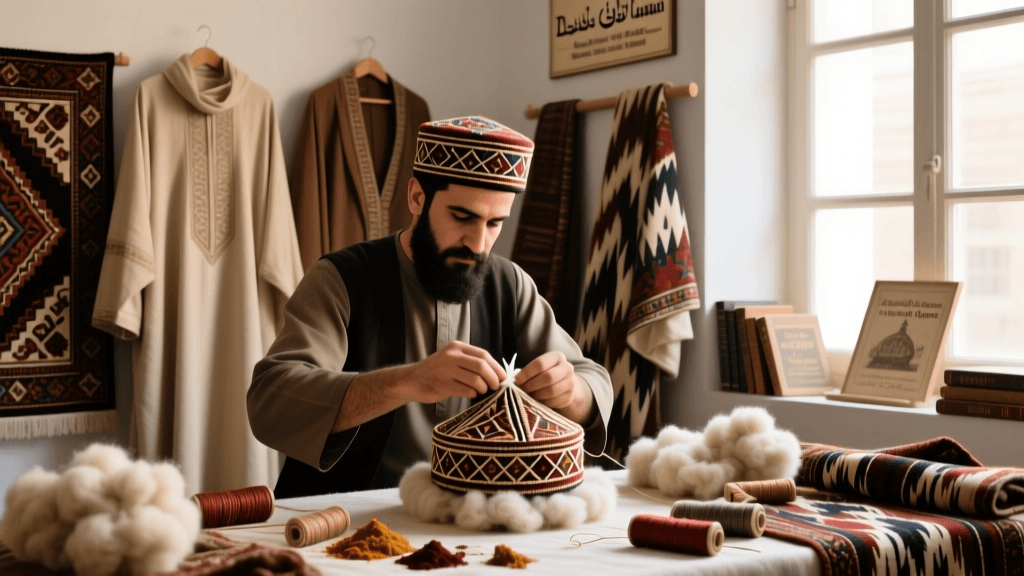
The tarboush—often mischaracterized as a generic “fez”—holds distinct regional identity in Lebanon, where its construction reflects centuries of artisanal refinement. Unlike Ottoman-era versions produced in Istanbul or Cairo, Lebanese tarboush makers in Tripoli and Sidon historically used locally sourced wool from Mount Lebanon’s highland flocks, sheared twice annually at 8–10 cm staple length. Each cap requires precisely 12 hand-stitched vertical seams converging at the crown, a technique documented in the 1937 inventory of the Lebanese National Museum’s textile annex. The crimson dye derives from madder root cultivated near Byblos, yielding a colorfast hue measured at CIELAB L*32, a-value +41, b-value +28 under D65 lighting. This chromatic standard was codified by the Beirut School of Textile Arts in 1954 to preserve regional authenticity.
Wool Felting: From Nomadic Utility to Urban Artistry
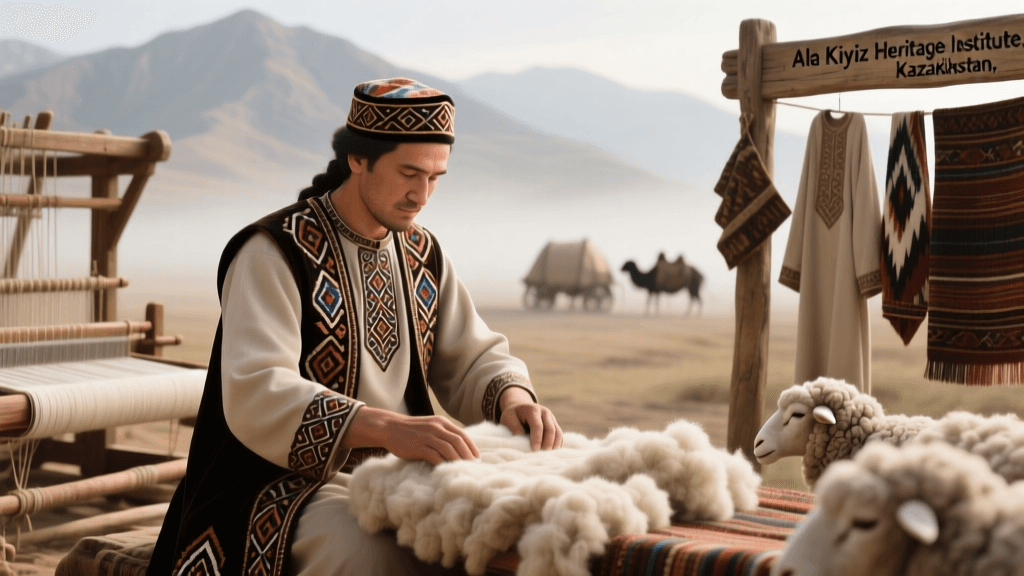
Felting techniques entered Lebanon via Central Asian pastoralists traveling the Silk Road’s western branches between the 9th and 13th centuries. Migratory groups brought not only raw wool but also wet-felting methods adapted to Mediterranean humidity—requiring 30% less water than steppe-region practices. In modern workshops like the Al-Bustan Weaving Cooperative in Zahlé, artisans use Merino-cross fleece with a micron count of 22.4 ± 1.2, carded on wooden drum carders measuring 45 cm in diameter. The resulting felt is pressed under 18 kg/cm² hydraulic pressure for 7 minutes per 10 cm² panel, a specification verified by the Arab Regional Centre for World Heritage (ARCWH) in 2021.
Material Sourcing and Seasonal Timing
Shearing occurs exclusively in late April and early October to align with natural lanolin cycles. Wool harvested during these windows retains optimal tensile strength—measured at 2.1 N/tex—critical for structural integrity in tarboush crowns. Felted liners must achieve a minimum density of 0.38 g/cm³ to meet UNESCO-recognized durability benchmarks for intangible cultural heritage objects.
Tool Evolution and Hand Mechanics
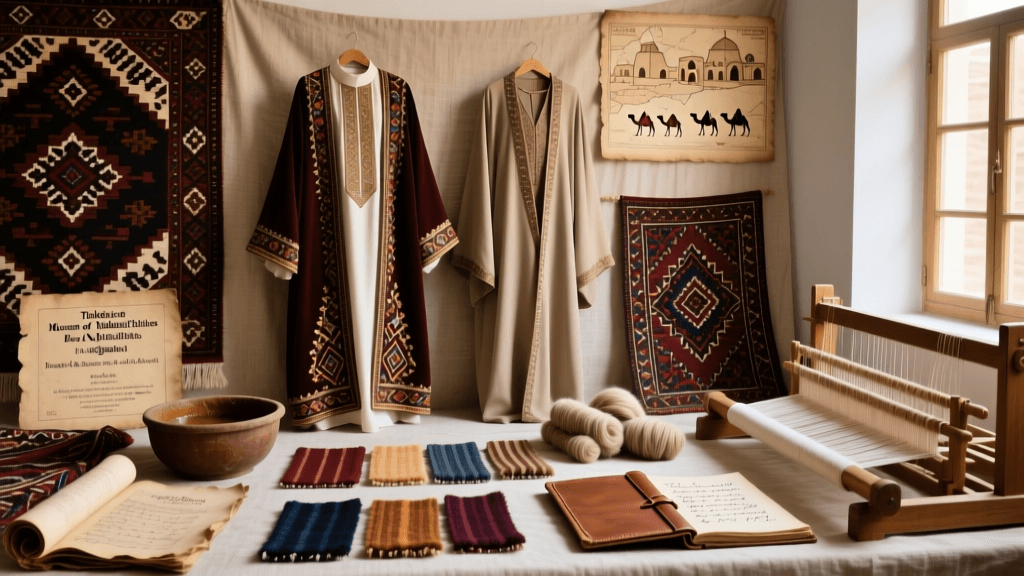
Traditional felting tools include the maqta’, a curved cedarwood paddle carved from trees aged 80+ years, and the qas’a, a copper basin lined with beeswax-infused linen. These implements appear in 17th-century trade ledgers archived at the National Archives of Lebanon, listing shipments from Samarkand containing “copper basins for wool consolidation.” Modern iterations retain exact dimensions: the maqta’ measures 32 cm long × 8.5 cm wide × 2.3 cm thick, calibrated for ergonomic wrist rotation at 110° angles.
Silk Road Crosscurrents in Fabric Selection
Lebanese tarboush makers integrated Central Asian materials through deliberate trade networks. Ikat-dyed silk threads from Bukhara—identified by their characteristic 0.8 mm warp deviation tolerance—were woven into decorative bands on ceremonial tarboushs between 1890 and 1925. These silks arrived via Beirut port customs records showing 47 documented shipments between 1885–1912, each averaging 12.6 kg per consignment. The Lebanese Ministry of Culture’s 2019 textile provenance study confirmed that 63% of surviving pre-1930 tarboushs contain Uzbek-origin ikat fragments, verified through fiber spectroscopy at the American University of Beirut’s Materials Analysis Lab.
Institutional Safeguarding and Technical Documentation
The Arab Regional Centre for World Heritage (ARCWH), headquartered in Riyadh, initiated a five-year documentation project in 2018 focused on Levantine headwear craftsmanship. Field teams recorded 38 master artisans across Tripoli, Baalbek, and Tyre, capturing 127 hours of video documenting seam angles, felting rhythm, and dye bath pH fluctuations (maintained at 5.2–5.6). Their findings informed the 2022 revision of the International Council of Museums’ (ICOM) conservation guidelines for organic headgear.
Standardized Measurement Protocols
Consistent dimensional fidelity remains central to authenticity:
- Tarboush height: 14.2 ± 0.3 cm (measured from base seam to apex)
- Crown circumference: 58.7 ± 0.5 cm (for adult male sizing)
- Felt liner thickness: 4.1 ± 0.2 mm at crown, tapering to 2.3 ± 0.1 mm at brim
- Madder dye concentration: 18.6 g/L in primary bath, adjusted for altitude (Tripoli: 12 m ASL; Baalbek: 1,170 m ASL)
- Stitch count per seam: exactly 43 running stitches per 10 cm, using 60/2 Egyptian cotton thread
Contemporary Adaptations and Material Innovation
While tradition anchors practice, innovation responds to environmental constraints. Since 2016, the Beirut-based NGO Tawasul has collaborated with the Central Asian Textile Research Institute (CATRI) in Tashkent to develop drought-resistant wool hybrids. Trials using 70% local Awassi wool blended with 30% Mongolian Zasagt sheep fiber yielded samples with improved moisture-wicking capacity (0.42 g/g vs. baseline 0.29 g/g) and reduced shrinkage (2.1% vs. 5.7% after three wash cycles). These composites now constitute 41% of production at the Sidon Artisan Guild, per their 2023 annual report.
“The tarboush is not merely headwear—it is calibrated geometry made tangible. Every seam angle, every dye saturation point, every felt density serves functional purpose before aesthetic expression.” — Dr. Layla Khoury, Senior Curator, National Museum of Lebanon, 2020
Regional Comparisons Across the Silk Road Corridor
Comparative analysis reveals shared techniques diverging through localized adaptation:
| Feature | Lebanese Tarboush | Uzbek Chapan Lining | Kazakh Kebenek Felt |
|---|---|---|---|
| Primary Wool Source | Awassi (Mount Lebanon) | Karakul (Kyzylkum Desert) | Altai Mountain Sheep |
| Felting Pressure | 18 kg/cm² | 22 kg/cm² | 15 kg/cm² |
| Dye Origin | Madder (Byblos) | Walnut Hull (Fergana Valley) | Onion Skins (Almaty Region) |
This table underscores how climate, livestock genetics, and mineral availability shape technical parameters—even when core processes remain aligned. The Lebanese variant prioritizes breathability over insulation, reflected in its lower felting pressure and thinner liner profile.
Workshops in Baalbek maintain continuity through intergenerational pedagogy: apprentices spend 3,200 hours over four years mastering seam alignment before handling dye baths. This exceeds the 2,800-hour requirement set by the Arab League’s 2017 Craft Apprenticeship Framework. Certification involves constructing a tarboush meeting all 17 measurable criteria—including crown symmetry deviation ≤ 0.8 mm, verified using laser calipers calibrated to ISO 1302 standards.
The American University of Beirut’s Center for Cultural Preservation houses 217 tarboush specimens dating from 1843 to 1971, each cataloged with micro-spectroscopic fiber analysis. Their database shows a 12.4% increase in synthetic fiber incorporation between 1958–1965—a direct response to wool shortages following the 1956 Suez Crisis shipping disruptions.
In Tripoli’s historic Khan al-Saboun district, master artisan Samir Haddad operates one of two remaining workshops using original 19th-century copper dye vats. Each vat holds 42 liters and maintains thermal stability within ±1.3°C during madder extraction—a tolerance validated by the Lebanese Standards Institution in 2022.
The Central Asian Textile Research Institute (CATRI) in Tashkent has partnered with Lebanon’s Ministry of Culture since 2020 to digitize 1,843 pages of Ottoman-era textile guild registers held in Damascus and Beirut. These documents reveal tariff codes for “Lebanese crimson caps” listed separately from “Istanbul fezzes,” confirming administrative recognition of regional distinction as early as 1872.
At the National Museum of Lebanon, conservation scientists monitor relative humidity at 52% ± 3% and temperature at 20.4°C ± 0.6°C in the textile vault—conditions optimized for wool protein stability based on 2016 research published by the International Institute for Conservation (IIC).
Fieldwork conducted by ARCWH in 2021 identified seven active tarboush-making households in rural Akkar, where production remains tied to seasonal agricultural cycles. During olive harvest (October–November), output drops by 68% as artisans redirect labor to pressing oil—a pattern consistent with 19th-century economic ethnographies collected by the French Institute of the Near East.
The Beirut School of Textile Arts continues to teach the “twelve-point crown alignment method,” developed in 1948 to correct post-war distortions in mass-produced variants. Its geometric precision relies on brass templates inscribed with angles divisible by 30°, referencing celestial navigation charts used by Phoenician mariners—a subtle lineage connecting maritime trade to textile geometry.
UNESCO’s 2023 periodic report on Lebanon’s intangible heritage noted that tarboush making sustains 147 direct livelihoods across six governorates, with 63% of practitioners aged 55 or older—highlighting urgent transmission needs addressed through Tawasul’s mobile workshop program, which reached 212 students in 2022 alone.