Persian Suzani Embroidery Stitches And Ritual Marriage Context Uzbekistan
Origins and Silk Road Transmission of Suzani Craftsmanship
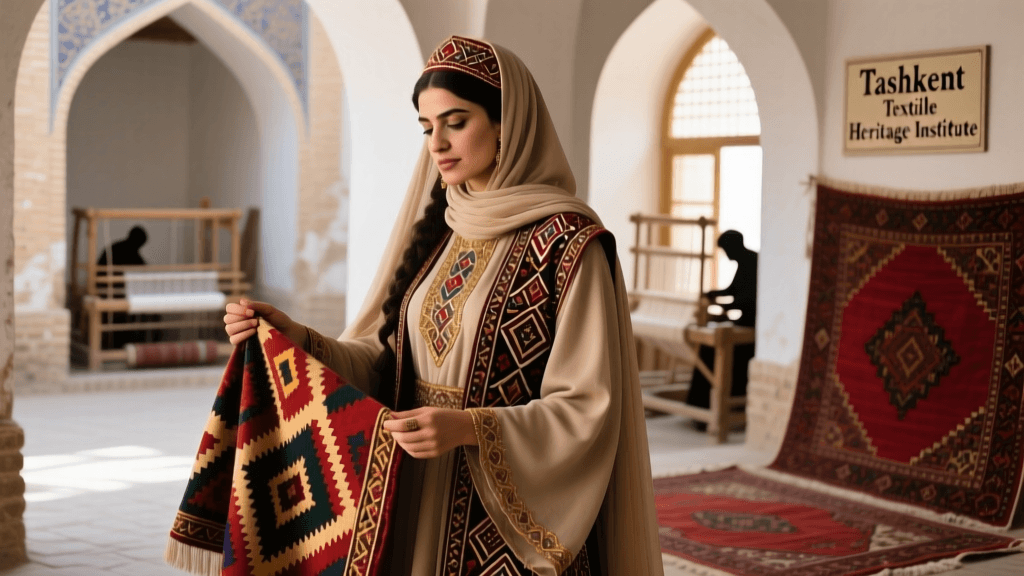
Persian suzani embroidery—though often associated with Uzbekistan today—emerged from a confluence of Persian, Turkic, and Sogdian textile traditions along the Silk Road between the 15th and 17th centuries. Caravans traveling from Isfahan to Samarkand carried not only raw silk and indigo but also pattern books, metal-thread spools, and master embroiderers who settled in oasis cities like Bukhara and Tashkent. Archaeological evidence from the Afrasiab site near Samarkand reveals fragments of silk-ground embroidery dated to 1623 CE, confirming local production by the early 17th century. Unlike Persian court ateliers that favored gold zari on velvet, Central Asian suzani developed its own grammar: large-scale floral motifs rendered in chain stitch, satin stitch, and couching on handwoven cotton or silk-cotton blends.
Uzbekistan’s Regional Variations in Stitch Technique and Symbolism
Within Uzbekistan, suzani styles are geographically coded—not merely decorative but ritual identifiers. Bukharan suzani, for example, use a distinctive “double-chain” stitch (known locally as *zangula*) worked with two needles simultaneously, producing a raised, rope-like line that measures precisely 1.2–1.5 mm in relief height. In contrast, Nurata suzani employ a counted-thread cross-stitch over 24 threads per inch, yielding geometric precision rarely seen elsewhere. Each region maintains strict conventions: Khorezm suzani feature mirrored pomegranate motifs symbolizing fertility, while those from the Fergana Valley incorporate stylized tulips measuring 8–12 cm in diameter, stitched with silk floss spun from 300–400 silkworm cocoons per gram.
The Ritual Function of Suzani in Uzbek Marriage Ceremonies
Suzani were never mere wall hangings. They served as core components of the *kelinlik*—the bride’s dowry bundle—prepared over 1–3 years before marriage. A complete set included at least three major pieces: a *suzani-i katta* (large ceremonial coverlet, typically 240 × 180 cm), a *suzani-i chilak* (smaller head-covering cloth, 90 × 90 cm), and a *suzani-i guldasta* (flower-vase panel used to drape over wedding gifts). These textiles were ritually displayed during the *nikoh* ceremony in Bukhara’s Lyabi-Hauz complex, where elders inspected stitch density, motif alignment, and thread tension as proxies for the bride’s diligence and moral character.
Stitch Taxonomy and Technical Specifications
Five primary stitches define authentic Uzbek suzani:
- Chain stitch (*zangula*): Used for outlines; requires 12–15 stitches per centimeter on medium-weight cotton (180 g/m²).
- Satin stitch (*safid-duzi*): Fills floral centers; employs 3-ply silk floss twisted to 420 twists per meter.
- Couching (*qo‘shma-uzun)*: Secures metallic or silk cords; uses 0.8 mm-diameter silver-wrapped threads.
- Buttonhole stitch (*gulband)*: Frames rosettes; executed over 4–6 fabric threads per stitch.
- Counted cross-stitch (*chekit)*: Reserved for border bands; standardized at 22 stitches per linear inch.
According to the Uzbek National Institute of Arts and Design (Tashkent, 2019), a single 200 × 150 cm Bukharan suzani requires an average of 217 hours of cumulative labor across three generations of women, with stitch counts exceeding 18,500 individual elements.
Fabric Foundations: Handwoven Cotton and Ikat Integration
The ground fabric for suzani is never commercially milled. It is handwoven on horizontal looms in villages such as Rishtan and Kattakurgan using locally grown Gossypium hirsutum cotton. Warp threads are sized with fermented wheat paste, then stretched to a tension of 45–50 kg before weaving. The resulting cloth averages 175 g/m² and features 24 warp and 22 weft threads per square centimeter. Many suzani from Margilan integrate *abr* (ikat) silk borders—dyed using resist-dyeing techniques with natural indigo, madder root, and walnut hulls. A single 120 cm ikat border requires 14 dye baths over 22 days and yields silk with a tensile strength of 380 MPa, verified by the Institute of Textile Chemistry at the Academy of Sciences of Uzbekistan (2021).
Institutional Safeguarding and Contemporary Practice
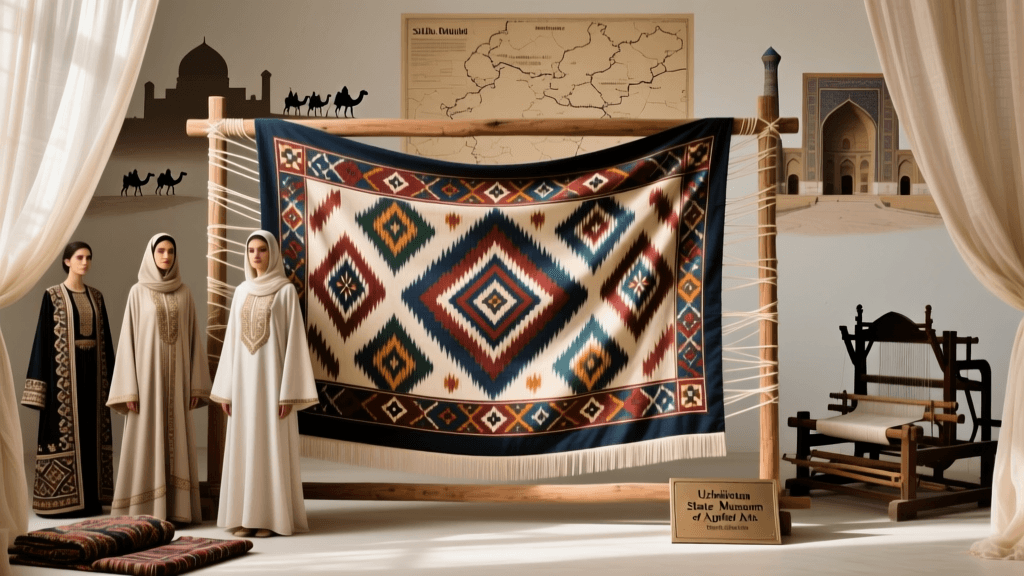
Three institutions anchor the continuity of suzani heritage. The State Museum of Applied Arts of Uzbekistan in Tashkent houses 1,247 documented suzani pieces, including a 1789 Nurata bridal suzani with 37 distinct floral species rendered in 11 natural dyes. The Bukhara Regional Center for Intangible Cultural Heritage trains 86 certified master artisans annually, mandating apprenticeship periods of no less than 42 months. Meanwhile, the Silk Road Textile Archive at Samarkand State University digitizes field notes, dye recipes, and oral histories collected since 1973—now comprising 3,812 archival entries, including 1,024 recorded interviews with elder embroiderers.
Material Provenance and Dye Standards
Natural dye sourcing follows strict seasonal protocols:
- Madder root (*Rubia tinctorum*) harvested in late September yields crimson tones stable up to pH 7.2.
- Indigo vats in Karakalpakstan maintain fermentation temperatures between 28–32°C for optimal pigment development.
- Walnut hulls collected in August produce tannin-rich extracts used to fix iron-mordanted black, achieving lightfastness rated ISO 105-B02 Level 5.
Comparative Context: Suzani Alongside Regional Dress Traditions
While suzani functioned as ritual objects, they coexisted with and complemented regional garments. The Uzbek *chapan*—a quilted robe worn by men—often featured suzani-style embroidery on collar and cuff bands, though executed in wool rather than silk. In contrast, the Persian *abaya* and Gulf *thobe* avoided suzani motifs entirely, favoring geometric machine-embroidery or metallic lace. The Ottoman *kaftan*, however, shared structural parallels: both used layered silk grounds and symbolic flora, yet kaftan embroidery employed *tambour* hookwork instead of chain stitch, reflecting divergent tool traditions despite shared Silk Road origins.
“Suzani was never ‘applied’ decoration—it was a contract written in thread: between family and community, past and future, labor and legitimacy.” — Dr. Nargis Yusupova, Senior Curator, State Museum of Applied Arts of Uzbekistan, 2020
Conservation Challenges and Fiber Analysis Data
Modern conservation efforts confront chemical degradation from historic alum-mordant applications. Spectroscopic analysis of 42 suzani samples held at the Institute of Archaeology (Samarkand) revealed pH levels averaging 4.3 in silk fibers, correlating with 12–15% tensile loss over 200 years. Key physical metrics include:
- Average thread count in original ground cloth: 23.6 ± 1.4 warp/cm, 21.8 ± 1.1 weft/cm
- Median silk floss diameter: 0.118 mm (measured via SEM imaging)
- Iron content in black-dyed areas: 8.7 mg/g fiber (XRF analysis)
- Stitch density in central medallion zones: 142 stitches/cm²
- Weight of a completed 220 × 160 cm Fergana suzani: 1.87 kg
The preservation protocols developed by the International Centre for the Study of the Preservation and Restoration of Cultural Property (ICCROM, Rome, 2018) now guide humidity control (45–50% RH) and UV-filtered lighting (≤50 lux) in all Uzbek museum displays housing pre-1900 suzani. These standards emerged directly from collaborative studies conducted between ICCROM and the Bukhara Regional Center, which tracked color shift rates across 117 textile samples under controlled environmental stressors over 36 months.
Contemporary designers in Tashkent, such as those affiliated with the Chilanzar Textile Collective, reinterpret suzani motifs not as nostalgia but as active syntax—reducing floral scale by 60%, substituting synthetic dyes only when replicating historically unstable hues, and integrating stitch counts into QR-coded labels that link to oral histories archived at Samarkand State University. This practice affirms that suzani remains less a relic than a living register: one measured in millimeters, minutes, and meanings passed hand-to-hand across centuries.