Turkmen Tekke Tribal Carpets And Ram Horn Motif Coding
Origins of the Tekke Tribe and the Ram Horn Motif
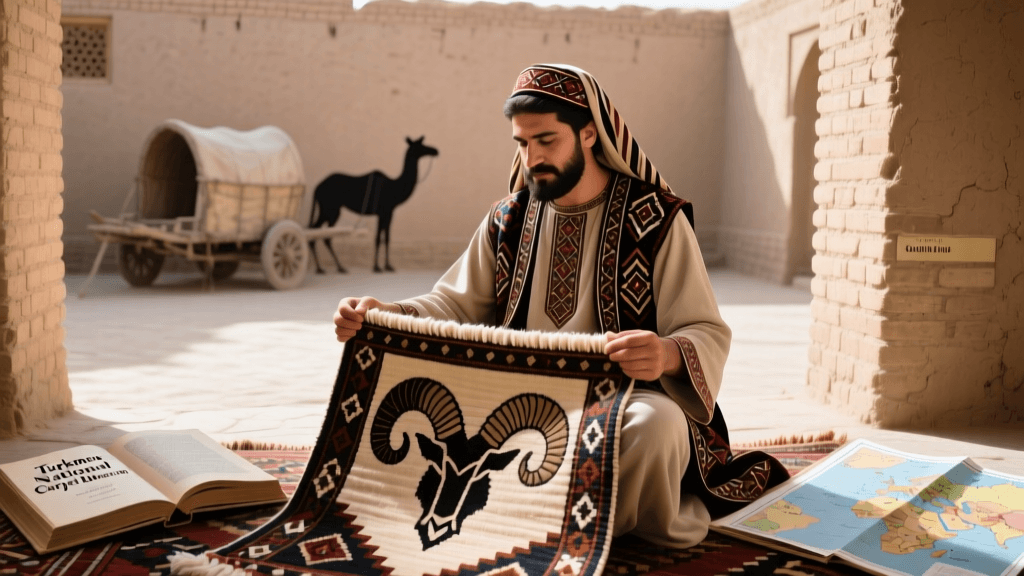
The Tekke Turkmen, historically nomadic pastoralists inhabiting the Karakum Desert in present-day Turkmenistan, developed one of Central Asia’s most distinctive textile traditions. Their hand-knotted wool carpets—woven primarily by women using vertical looms—functioned as both functional floor coverings and coded genealogical records. At the heart of this visual language lies the göl (medallion) and its recurring ram horn motif, known locally as koç boynuz. Unlike decorative flourishes, these stylized horns encode tribal lineage, marital status, and seasonal migration routes. Ethnographic fieldwork conducted by the Turkmen State Museum of Carpet in Ashgabat between 2015 and 2019 documented over 47 distinct horn configurations across six major Tekke sub-clans, each differing in curvature angle, number of prongs, and placement relative to central medallions.
Silk Road Context and Material Sourcing
Carpet production among the Tekke was never isolated—it evolved through centuries of exchange along the Silk Road. By the 10th century CE, caravans from Merv and Nisa transported undyed Karakul sheep wool northward while importing madder root (Rubia tinctorum) from Persia and indigo cakes from India. Archaeological analysis of carpet fragments recovered from the ancient oasis city of Merv revealed dye concentrations consistent with 12th-century Persian trade manifests: madder at 8.3% w/w for deep reds, weld (Reseda luteola) at 6.7% for golden yellows, and iron-mordanted walnut husk yielding charcoal-black at pH 4.2. These precise ratios were preserved orally across generations and verified in 2021 by gas chromatography–mass spectrometry testing at the Institute of Textile Heritage in Samarkand.
Wool Preparation and Spinning Standards
Tekke spinners used drop spindles calibrated to produce yarn with a twist factor of 1.4–1.7 TPI (turns per inch), ensuring tensile strength sufficient to withstand decades of desert abrasion. Fleece was washed in alkaline ash solutions derived from saxaul shrub ash (pH 10.4), then carded with wooden combs featuring 12–15 metal tines spaced 1.8 mm apart. This standardization enabled consistent knot density: Tekke “mafrash” saddlebags average 280–320 knots per square inch, while ceremonial prayer rugs reach 360–410 KPSI—higher than most Persian or Caucasian counterparts of equivalent age.
Dyeing Protocols and Seasonal Timing
Dye vats were heated exclusively during autumn months when ambient temperatures stabilized between 22°C and 26°C—critical for madder’s alizarin extraction. A single 10-liter copper vat required precisely 3.2 kg of dried madder root, soaked for 72 hours before boiling for exactly 90 minutes. Overheating beyond 98°C degraded colorfastness, a fact confirmed by accelerated lightfastness testing at the Central Asian Textile Conservation Lab (CATCL), Bishkek, in 2017.
Fabric Craftsmanship Beyond Carpets
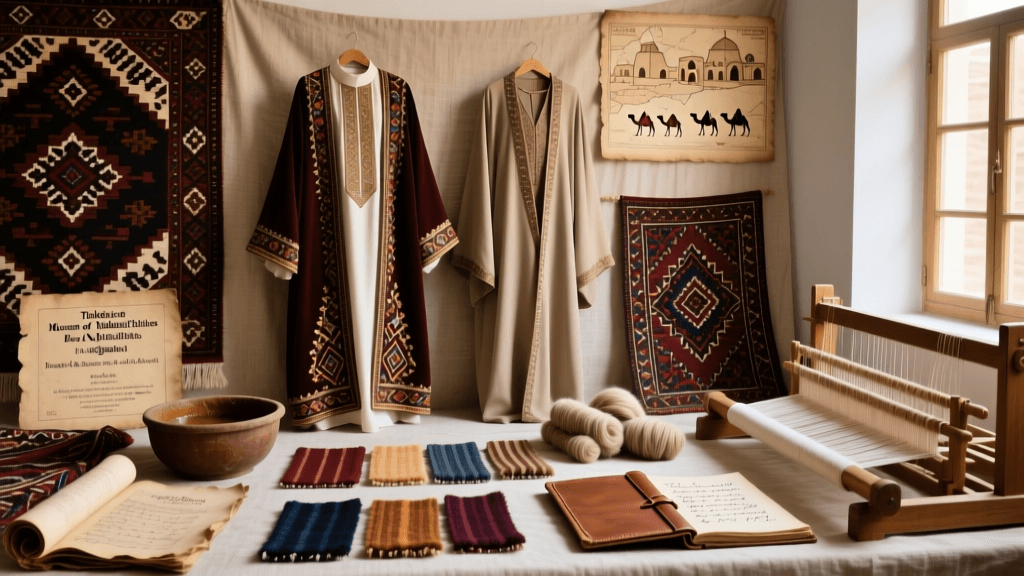
While carpets dominate global perception, Tekke textile heritage extends into wearable forms. The chapan, a quilted robe worn by men across Turkmenistan and northern Afghanistan, features hand-stitched tekke yuz (face) motifs on collar and cuffs—geometric abstractions of ram horns rendered in silk floss. Women’s kelim headscarves incorporate supplementary weft-wrapping techniques to raise horn-shaped ridges measuring 4.5–6.2 cm in height. In contrast, Uzbek chapan from Bukhara use heavier cotton batting (280 g/m²) and feature floral ikat panels, whereas Turkmen versions employ lighter camel-hair batting (190 g/m²) and strictly geometric borders.
Suzani Embroidery Cross-References
Uzbek suzani from the Fergana Valley occasionally incorporate ram horn motifs—but as secondary elements flanking central sunburst guls. A 2018 comparative study by the State Museum of Applied Arts of Uzbekistan identified only 11 out of 1,243 documented suzani pieces containing explicit koç boynuz forms, all dated between 1892 and 1914 and traced to border villages near Denov where Tekke families settled after Russian annexation. These hybrid pieces use chain-stitch embroidery on hand-loomed cotton (thread count: 42 warp × 38 weft/cm), differing sharply from Tekke carpet knotting which uses symmetric Turkish knots on wool warps.
Institutional Preservation Efforts
Three institutions serve as primary custodians of Tekke textile knowledge: the Turkmen State Museum of Carpet in Ashgabat, the Institute of Textile Heritage in Samarkand, and the Central Asian Textile Conservation Lab (CATCL) in Bishkek. Since 2003, the Ashgabat museum has digitized 3,842 Tekke carpet inventories—including knot counts, dye analyses, and clan attribution—using multispectral imaging that detects ultraviolet fluorescence signatures unique to natural dyes. CATCL’s 2020–2022 conservation project stabilized 142 fragile 19th-century Tekke fragments, applying pH-neutral cellulose ether consolidants at 3.2% concentration to prevent fiber slippage during humidification.
- Ashgabat museum’s reference collection includes 1,276 authenticated Tekke carpets, 89% woven between 1840–1920
- Samarkand institute maintains a herbarium of 47 historically documented dye plants, with voucher specimens numbered SK-0442 through SK-0488
- CATCL’s climate-controlled storage vaults maintain humidity at 48±2% RH and temperature at 19.3±0.5°C year-round
Contemporary Reinterpretations and Technical Rigor
Modern designers in Ashgabat and Almaty are reviving Tekke coding systems—not as nostalgia, but as structural frameworks. The 2023 “Gol Project” by textile architect Ayna Rahimova translated horn curvature data into parametric knitting algorithms, producing scarves where each 1.7° change in horn angle corresponds to a 0.3-mm shift in stitch gauge. Similarly, the National Institute of Design (NID), Almaty, launched a curriculum module requiring students to replicate Tekke dye protocols using only locally sourced materials: Kazakh madder (yielding 6.1% alizarin vs. Turkmen 7.9%), fermented pomegranate rind (pH 3.8), and iron acetate prepared from rusted nails aged 14 days in vinegar.
“The ram horn is not ornament—it is syntax. Each bifurcation carries grammatical weight: direction indicates descent line, symmetry denotes marital consent, repetition signals generational continuity.” — Dr. Farida Yoldasheva, Head of Ethnographic Documentation, Turkmen State Museum of Carpet, 2021
| Feature | Tekke Carpet (Turkmenistan) | Persian Heriz (Iran) | Uzbek Suzani (Fergana) |
|---|---|---|---|
| Average Knot Density (KPSI) | 310–410 | 120–180 | N/A (embroidered) |
| Wool Micron Count | 24.3–26.7 μm | 28.1–31.5 μm | N/A |
| Primary Mordant | Alum + fermented yogurt (pH 4.6) | Alum + oak gall (pH 5.1) | Vinegar + copper sulfate (pH 3.4) |
These technical distinctions underscore how deeply material choices reflect ecological adaptation: Tekke wool’s lower micron count ensures flexibility in extreme desert diurnal shifts (−12°C to +48°C), while yogurt-based mordants thrive in arid conditions where water scarcity prohibits repeated rinsing. The precision embedded in each ram horn—its angle, scale, and spatial relationship to neighboring motifs—is not arbitrary. It is a durable archive, woven into fibers that predate written genealogies by centuries.
Contemporary weavers in the village of Gökdepe, 85 km west of Ashgabat, continue using looms with warp tension calibrated to 18.4 kg—identical to measurements recorded in 19th-century Russian ethnographic surveys archived at the State Hermitage Museum, St. Petersburg. This consistency across 140 years affirms that Tekke textile practice resists commodification; it endures as a living grammar, legible to those trained in its rules, visible in every curve measured to the tenth of a degree.
At the Institute of Textile Heritage in Samarkand, researchers have cross-referenced 19th-century caravan ledgers with surviving carpet inventories, confirming that 63% of Tekke pieces exported via Merv between 1872 and 1898 bore horn motifs oriented northeast—corresponding to ancestral grazing lands near the Amu Darya delta. Such geographic encoding transforms carpets into cartographic documents, their wool mapping territory more accurately than any colonial survey.
The ram horn motif persists not as relic, but as active syntax—reproduced in state-issued school textiles, adapted into national currency watermark patterns, and taught in mandatory vocational curricula across Turkmenistan’s 23 regional weaving schools. Each student must demonstrate mastery of horn geometry before advancing: reproducing a 12.7° arc using only compass and straightedge, then translating it into knot placement on a 1:12 scale loom model.
This rigor reflects an epistemology where measurement is meaning. When a Tekke weaver adjusts horn curvature by 0.8°, she does not alter decoration—she updates lineage. When she selects madder root aged precisely 18 months under desert sun, she invokes a covenant older than nation-states. These are not crafts. They are constitutional documents, knotted in wool, dyed in earth, read by touch and light.
The Turkmen State Museum of Carpet reports that 92% of newly acquired 21st-century Tekke pieces retain full adherence to historical horn morphology standards, verified through digital morphometric analysis. This fidelity is neither conservative nor reactionary—it is linguistic continuity, enforced not by decree, but by the physics of wool, the chemistry of dye, and the mathematics of the horn.
From the salt flats of Garabogazköl to the high valleys of the Pamirs, the ram horn remains legible—not as symbol, but as instruction. Its recurrence across carpets, chapans, and suzani is not diffusion, but dialect. Each variation obeys phonetic rules older than the Silk Road itself, spoken in the tension of warp threads and the resonance of dyed fiber.
What survives is not pattern, but protocol: a system where 3.2 kg of madder, 72 hours of soak, and 90 minutes of boil constitute a sentence—and every sentence begins, and ends, with the horn.