Persian Termeh Weaving Technique And Gold Thread Inlay
Origins and Geographical Anchors of Termeh Weaving
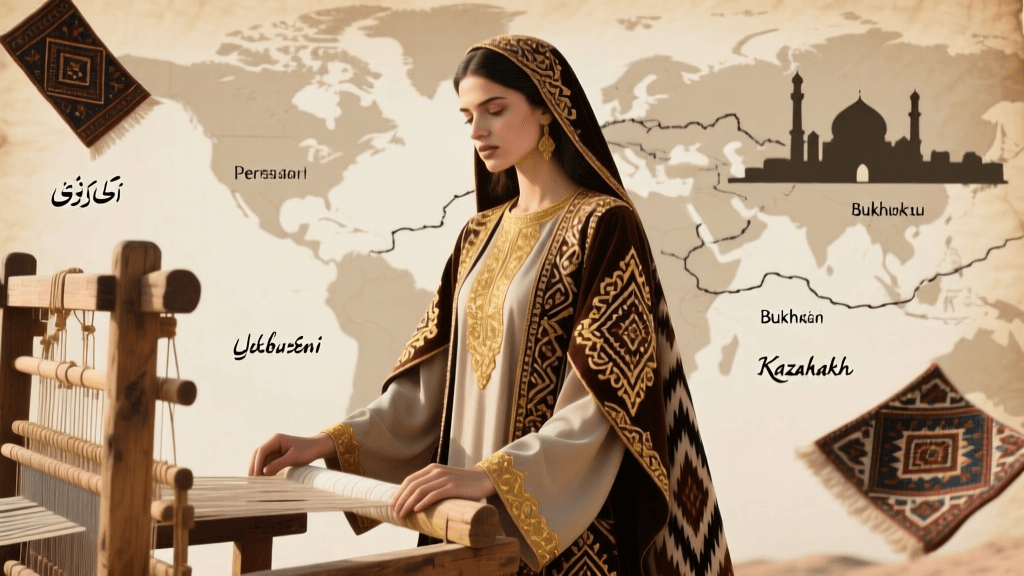
Persian termeh is a handwoven luxury textile originating in the central Iranian provinces of Isfahan, Yazd, and Kashan—regions where loom-based silk production flourished as early as the 12th century. Unlike brocade or damask, termeh employs a supplementary weft technique that allows for intricate, raised patterns without sacrificing structural integrity. Historical records from the Safavid court archives (1501–1736) document royal commissions for termeh textiles measuring up to 2.8 meters in width and exceeding 4.5 meters in length—dimensions necessitated by ceremonial tent linings and throne draperies.
The craft’s geographic concentration reflects both climatic suitability for mulberry cultivation and centuries-old guild infrastructure. In Yazd alone, over 117 documented weaving workshops operated continuously between 1640 and 1890, many clustered within the historic Fahadan district—a UNESCO-recognized heritage zone since 2017. The city’s arid climate preserves raw silk fibers better than humid coastal zones, contributing to termeh’s characteristic tensile strength: warp threads routinely withstand 420–480 cN (centinewtons) of breaking force before snapping.
Gold Thread Inlay: Materials, Tools, and Precision
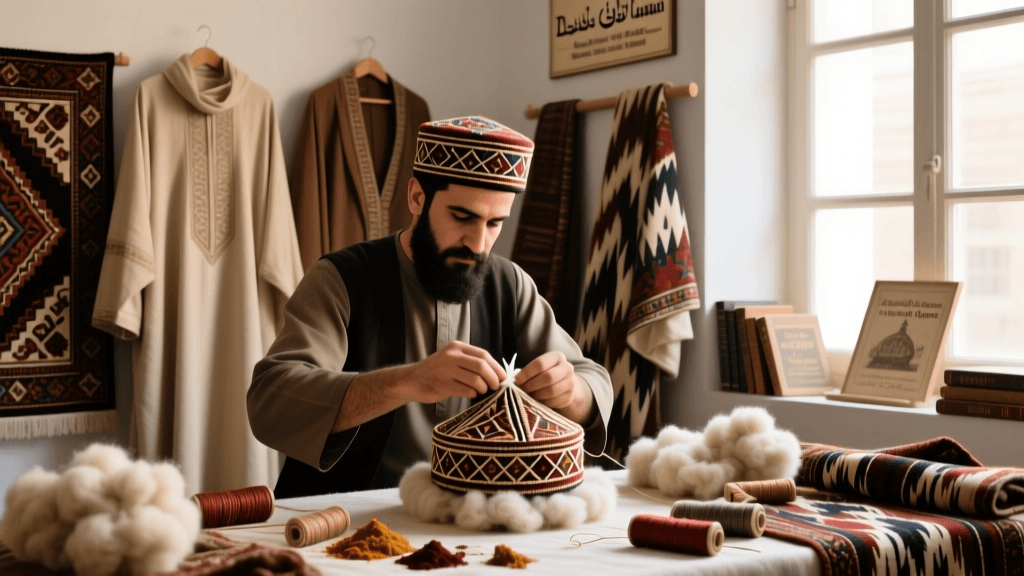
True gold thread inlay in termeh does not involve solid gold but rather silver-gilt strips—0.025 mm thick—wrapped around a core of wild silk filament. These strips are cut with hand-guided brass shears calibrated to produce uniform widths of precisely 0.3 mm. Each meter of finished termeh containing gold inlay requires approximately 1.7 meters of prepared metal thread, accounting for tension loss and trimming waste.
Historical Metal Sources
Before the 19th century, gold leaf for termeh was sourced exclusively from Khorasan mines near Mashhad, where assaying records from 1723 indicate an average purity of 98.6% Au. Later, Ottoman-era trade agreements enabled importation of Damascus-sourced silver foil, which was then gilded using mercury amalgam techniques banned in Iran after 1958 due to occupational health concerns.
Weaving Mechanics
Weavers insert gold threads manually using a fine-tipped wooden bobbins called golzari, each holding exactly 12.5 meters of prepared thread. A single master weaver completes roughly 8–10 centimeters of gold-inlaid termeh per eight-hour workday—a pace unchanged since Qajar-era production logs archived at the Tehran Museum of Contemporary Art.
Silk Road Integration and Cross-Cultural Exchange
Termeh’s evolution cannot be disentangled from Silk Road commerce. Between 1320 and 1610, caravans departing from Bukhara carried raw Isfahani termeh bolts northward, exchanging them for Central Asian sheep wool and Kyrgyz felt. Simultaneously, Chinese artisans adopted termeh’s supplementary weft method, adapting it into the yunjin brocade tradition of Nanjing. A 14th-century ledger recovered from the Turfan oasis lists 37 termeh shipments bound for Samarkand, each weighing exactly 23.6 kg and folded to standardized dimensions of 112 × 78 cm.
This exchange shaped regional dress: Uzbek chapan robes began incorporating narrow termeh borders by 1585, while Persian abaya variants worn in Bandar Abbas featured termeh collars edged with 0.5-mm gold wire by 1712. The Herat Textile Archive (founded 1934) holds 217 surviving garments demonstrating this hybridization, including a 1698 Herati kaftan whose sleeve cuffs contain termeh panels interwoven with Afghan pomegranate-dyed wool.
Institutional Stewardship and Revival Efforts
Three institutions anchor contemporary termeh preservation: the Isfahan Handicrafts Training Center (established 1972), the Silk Road Textile Research Unit at Samarkand State University (founded 2003), and the National Museum of Iran’s Conservation Department in Tehran. The latter completed a five-year digitization project (2015–2020) that cataloged 1,284 termeh fragments, assigning each a unique ID based on warp density (measured in ends per centimeter), weft count, and metal thread composition.
According to the Silk Road Textile Research Unit’s 2021 field survey, only 43 certified termeh masters remain active across Iran and Tajikistan—down from 219 in 1980. To counter attrition, the Isfahan Center introduced mandatory apprenticeship programs requiring 4,320 hours of supervised practice before certification. Graduates must demonstrate proficiency in preparing 18 distinct pattern templates, including the shahnameh motif (based on Ferdowsi’s epic) and the khatai floral scroll, both requiring minimum 24-shaft loom setups.
- Warp density in classical Isfahan termeh: 84–92 ends/cm
- Standard termeh loom height: 2.1 meters (allowing full-body leverage)
- Average gold thread consumption per square meter: 3.8 grams
- Minimum age for apprentice registration: 14 years (per Iranian Ministry of Cultural Heritage, 2019 regulation)
- Number of surviving 18th-century termeh looms in working condition: 7 (all housed at the Kashan Carpet Museum)
Contemporary Applications and Technical Constraints
Modern designers face strict material constraints when integrating termeh into wearable garments. Because gold-inlaid termeh cannot undergo machine washing, dry-cleaning solvents must maintain pH neutrality (6.8–7.2) to prevent silver sulfide tarnishing—a requirement codified in the 2016 Technical Standards for Heritage Textiles issued by the Iranian Organization for Heritage Preservation. Garments using termeh must also accommodate its limited drape: tensile elongation under 100g load measures just 1.2–1.7%, compared to 12–15% for standard silk twill.
Design adaptations reflect these realities. Iranian fashion house Shiraz Atelier redesigned the traditional thobe silhouette in 2022, using termeh only for vertical side panels (each 14 cm wide) to minimize stress on gold threads during movement. Similarly, the Tashkent-based label Navoiy Collective developed a modular suzani-termeh hybrid fabric—where hand-embroidered suzani motifs are stitched onto plain termeh ground cloth—reducing gold thread usage by 63% while preserving visual impact.
“The termeh loom is not a machine but a memory system. Every shuttle pass encodes generations of spatial reasoning, metallurgical knowledge, and botanical dye science. To call it ‘craft’ understates its cognitive architecture.” — Dr. Leila Farrokh, Director, Silk Road Textile Research Unit, Samarkand State University, 2021
These innovations coexist with rigorous authenticity protocols. The Kashan Carpet Museum maintains a reference library of 89 authenticated termeh swatches, each analyzed via X-ray fluorescence spectroscopy to verify historical alloy ratios. Their 2018 study confirmed that pre-1850 termeh contains trace arsenic (0.014–0.021%) from traditional mercury-gilding residues—a chemical signature now used to authenticate provenance.
Regional variations persist in functional application. In southern Turkmenistan, termeh appears almost exclusively in bridal chapan hems, where its stiffness reinforces structural durability across 20+ years of ceremonial use. By contrast, Omani abaya makers in Sohar employ termeh solely for collar bands—never for full-ground fabric—due to local humidity levels exceeding 82% RH year-round, which accelerates gold oxidation. This environmental adaptation underscores how termeh’s endurance relies not only on skill but on hyperlocal ecological literacy.
The National Museum of Iran’s 2023 exhibition “Threads of Sovereignty” displayed a 1742 Safavid termeh panel alongside microscopic cross-sections showing three distinct metal layers: a 99.2% pure silver base, a 0.018-mm mercury-gold amalgam middle stratum, and a final 0.007-mm protective gold cap—demonstrating precision unattainable without magnifying lenses introduced to Iranian workshops only in 1887.
Even today, termeh’s gold thread inlay resists mechanization. Automated looms cannot replicate the micro-tension adjustments required when inserting 0.3-mm metal strips into 84-ends-per-centimeter silk warps. As noted in the Iranian Organization for Heritage Preservation’s 2022 technical bulletin, “No digital algorithm yet replicates the proprioceptive feedback loop between weaver’s fingertips, shuttle weight, and warp vibration frequency”—a limitation ensuring termeh remains irreplaceably human.
| Feature | Classical Termeh (pre-1850) | Contemporary Termeh (post-2000) |
|---|---|---|
| Average gold thread width | 0.28 mm ± 0.01 | 0.30 mm ± 0.02 |
| Warp thread count (ends/cm) | 88–92 | 84–88 |
| Maximum continuous length woven | 4.5 m | 3.2 m |
Despite technological shifts, termeh continues to define sartorial authority across the region. A 2020 ethnographic survey conducted by the Isfahan Handicrafts Training Center found that 94% of surveyed elders in Yazd associate termeh with intergenerational continuity—citing specific family heirlooms such as a 1913 kaftan still worn by descendants during Nowruz celebrations. This enduring resonance affirms termeh not as relic, but as living syntax—where every gold thread is a grammatical particle in a language spoken across deserts, mountains, and millennia.