Xiu He Fu vs Qun Kwa: Chinese Wedding Attire Guide
The Resurgence of Chinese Ceremonial Wedding Attire
In recent years, the landscape of Chinese wedding fashion has experienced a profound cultural renaissance. While the Western white wedding gown remains a staple for the main ceremony, a growing number of brides are embracing their heritage by donning traditional Chinese garments for the morning tea ceremony, banquet, or pre-wedding photoshoots. This revival is deeply rooted in the diverse textile traditions of China's ethnic groups, blending Han, Manchu, and regional Lingnan influences into breathtaking ceremonial wear. For modern brides navigating this rich sartorial history, the choice usually comes down to two iconic garments: the Xiu He Fu and the Qun Kwa. Understanding the historical context, structural differences, and practical buying considerations of these garments is essential for any bride planning a traditional Chinese wedding.
Xiu He Fu: The Cinematic Revival of Han Elegance
Despite its appearance as an ancient garment, the Xiu He Fu is actually a modern cinematic creation that has become a beloved ceremonial staple. The name originates from the 2001 television drama Orange Turned Red (Ju Zi Hong Le), in which the protagonist, Xiu He, wears a distinctively styled traditional outfit for her wedding. The costume designers based the garment on the Ao Qun (jacket and skirt) style worn by Han Chinese women during the Ming and early Qing dynasties. According to The Metropolitan Museum of Art, the transition of Han Chinese clothing during the Qing dynasty maintained distinct Ming-era silhouettes, particularly the pleated skirts and cross-collared jackets, which the Xiu He Fu beautifully replicates.
Design and Silhouette
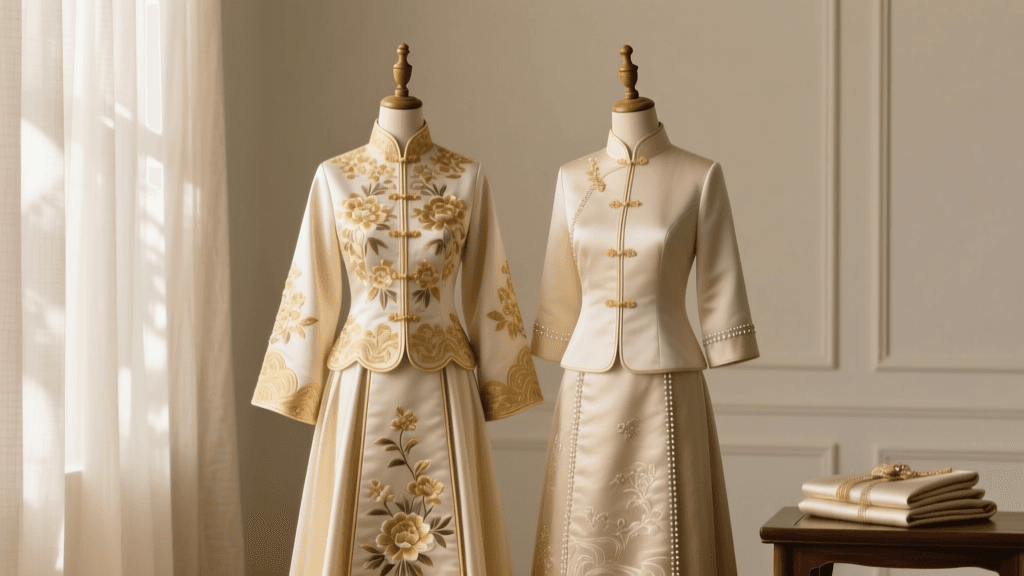
The Xiu He Fu consists of two main pieces: a tailored, usually cross-collared or Mandarin-collared jacket (Ao) and a flowing, A-line pleated skirt (Ma Mian Qun or horse-face skirt). The silhouette is exceptionally forgiving. The structured jacket highlights the shoulders and waist, while the voluminous, floor-sweeping pleated skirt gracefully conceals the lower body. This makes it a highly sought-after option for brides who want a regal, modest, and comfortable fit that allows for easy movement during the intricate tea ceremony rituals.
Embroidery and Motifs
Xiu He Fu embroidery is typically vibrant, utilizing silk threads in shades of red, gold, and sometimes pastel accents. Common motifs include the phoenix (representing the bride), peonies (wealth and honor), and bats (symbolizing good fortune). The embroidery density is generally moderate, allowing the rich red base fabric to remain visible, creating a striking contrast.
Qun Kwa: The Lingnan Masterpiece of Manchu-Han Fusion
The Qun Kwa (often simply called Kwa or Kwa outfit) boasts a much older, deeply regional lineage originating from the Guangdong (Lingnan) province. It represents a fascinating historical fusion of Manchu ceremonial robes and Han Chinese two-piece garments, a sartorial compromise that emerged during the Qing dynasty's 'Tifa Yifu' edicts. As documented by the Victoria and Albert Museum, Qing dynasty ceremonial textiles are renowned for their opulent, densely packed metallic thread work, a hallmark that defines the modern Qun Kwa.
Design and Silhouette
Unlike the flowing Xiu He Fu, the Qun Kwa features a much more structured, column-like silhouette. It consists of a straight, tailored skirt and a boxy, stand-collared jacket. The garments are heavily stiffened by the sheer volume of metallic embroidery, giving the bride a statuesque, formal, and highly structured appearance. Because it lacks the A-line flare of the Xiu He Fu, the Qun Kwa requires a more precise, tailored fit.
The Hierarchy of Kwa Embroidery Density
When shopping for a Qun Kwa, brides must understand the grading system based on embroidery density, which directly dictates the garment's cost, weight, and prestige:
- Xiao Wu Fu (Small Five Blessings): 30% to 50% embroidery density. The red base fabric is highly visible. Lightweight and more affordable.
- Zhong Wu Fu (Medium Five Blessings): 50% to 70% density. A balanced mix of red fabric and gold/silver thread.
- Da Wu Fu (Large Five Blessings): 70% to 90% density. The garment appears predominantly gold and silver, with only flashes of red. Heavy and highly formal.
- Gua Huang (Jacket Emperor): 95% to 100% density. The base fabric is completely obscured by intricate, three-dimensional gold and silver bullion embroidery. This is the pinnacle of Qun Kwa craftsmanship, often taking over a year to hand-stitch, and is usually reserved for royalty, celebrities, or bespoke heirloom commissions.
Comparison Chart: Xiu He Fu vs. Qun Kwa
| Feature | Xiu He Fu | Qun Kwa |
|---|---|---|
| Historical Origin | Modern revival (2001) based on Ming/Qing Ao Qun | Qing Dynasty Lingnan (Guangdong) Manchu-Han fusion |
| Skirt Silhouette | A-line, pleated (Ma Mian Qun), flowing | Straight, columnar, structured |
| Embroidery Material | Silk threads, occasional metallic accents | Dense gold and silver metallic bullion thread |
| Embroidery Density | Moderate (30% - 60%) | High to Extreme (50% - 100%) |
| Garment Weight | Light to Medium (2 - 4 kg) | Heavy to Very Heavy (4 - 10+ kg) |
| Best Body Type | Forgiving; excellent for pear shapes and hiding lower body | Requires proportional fit; best for petite to average frames |
| Regional Popularity | Nationwide, Northern and Central China | Southern China, Cantonese diaspora, Southeast Asia |
Practical Guide: Budgeting, Timelines, and Measurements
Planning for traditional Chinese wedding attire requires strategic foresight. According to wedding cultural guides like China Highlights, the tea ceremony and traditional dressing are central to the familial bonding of the wedding day, meaning the attire must be flawless. Here is the actionable advice you need for procurement.
Budgeting: Rent vs. Buy vs. Bespoke
- Rental ($200 - $800 USD): Ideal for brides on a budget or those who only need the garment for a 4-hour morning tea ceremony. Most bridal boutiques in major Asian cities and international Chinatowns offer rental packages that include accessories and dressing assistance.
- Off-the-Rack / Made-to-Measure ($800 - $3,000 USD): Best for Xiu He Fu and lower-to-medium density Qun Kwa (Xiao Wu Fu / Zhong Wu Fu). You select a pre-designed pattern, and the tailor adjusts it to your measurements. Delivery usually takes 2 to 3 months.
- Bespoke / Heirloom ($4,000 - $20,000+ USD): Necessary for Da Wu Fu and Gua Huang. Because the embroidery is done entirely by hand on flat fabric before the garment is cut and sewn, bespoke Qun Kwa requires a significant investment. These pieces are often kept as family heirlooms and passed down to future generations.
Timelines and Fittings
Do not leave traditional attire shopping to the last minute. For a standard made-to-measure Xiu He Fu, begin the process 4 to 6 months before the wedding. For a high-density Qun Kwa, you must commission the piece 8 to 12 months in advance. Schedule your first measurement session early, but insist on a final fitting no more than 3 weeks before the wedding to account for any fluctuations in your weight or posture changes due to wedding planning stress.
Crucial Measurements Needed
When ordering online or visiting a tailor, ensure you provide the following precise measurements (taken while wearing the undergarments you plan to use on the wedding day):
- Shoulder Width: Crucial for the structured collar of the Qun Kwa.
- Bust, Waist, and Hips: Taken at the fullest points to ensure the straight skirt of the Kwa does not pull.
- Sleeve Length: Measured from the shoulder seam to the wrist bone; traditional sleeves should just cover the wrist to allow heavy jade or gold bangles to be visible.
- Hollow-to-Hem: Measured from the base of the neck to the floor, factoring in the exact heel height of your ceremonial shoes.
Accessorizing the Ceremonial Look
The garments are only half of the ceremonial equation. The Xiu He Fu is traditionally paired with a Fengguan (Phoenix Crown), an elaborate headdress adorned with kingfisher feathers (or modern silk/velvet alternatives), pearls, and gold filigree. Because the Xiu He Fu has a more open neckline and flowing skirt, the heavy crown balances the silhouette perfectly. Conversely, the Qun Kwa's high, stiff collar and dense embroidery demand a more streamlined hair approach. Brides wearing a Qun Kwa typically opt for intricate, low-swept updos adorned with gold hairpins, jade combs, and fresh flowers, avoiding overly bulky crowns that clash with the jacket's heavy shoulders. Finally, both looks are grounded by traditional red silk Xiu He Xie (embroidered shoes), which must be purchased early to ensure the hem length of your skirts is altered to the exact millimeter.
Conclusion
Choosing between the Xiu He Fu and the Qun Kwa is a deeply personal decision that bridges the gap between historical reverence and modern aesthetics. The Xiu He Fu offers romantic, flowing elegance and cinematic grace, while the Qun Kwa provides unparalleled structural majesty and masterful metallic artistry. By understanding the historical roots, regional variations, and practical procurement timelines of these magnificent garments, brides can confidently honor their Asian traditions while looking absolutely breathtaking on their wedding day.