Xiangyunsha Silk: China's Intangible Heritage Fabric Guide
The Legacy of Gambiered Canton Gauze
Xiangyunsha (香云纱), often translated as Gambiered Canton Gauze or Fragrant Cloud Silk, represents one of the most extraordinary textile achievements in Chinese history. Originating from the Shunde district of Foshan in Guangdong Province, this luxurious fabric is not merely a textile; it is a living testament to the harmonious relationship between human craftsmanship and the natural environment. Recognized as a National Intangible Cultural Heritage of China, Xiangyunsha is celebrated for its unique rustling sound, its lustrous dark finish, and its remarkable breathability, making it a highly coveted material for traditional garments, high-end Qipaos, and modern Hanfu revivals.
The creation of Xiangyunsha is deeply tied to the subtropical climate of southern China. Unlike standard silk weaving, which relies primarily on the mechanical skills of the weaver, Xiangyunsha requires the active participation of the sun, the soil, and specific botanical extracts. As noted by cultural preservationists and documented in the UNESCO Intangible Cultural Heritage records regarding Chinese sericulture and silk craftsmanship, the traditional techniques of silk production in China encompass a vast array of regional specialties, with Xiangyunsha standing out as a masterclass in natural dyeing and chemical transformation.
The Botanical and Geological Ingredients
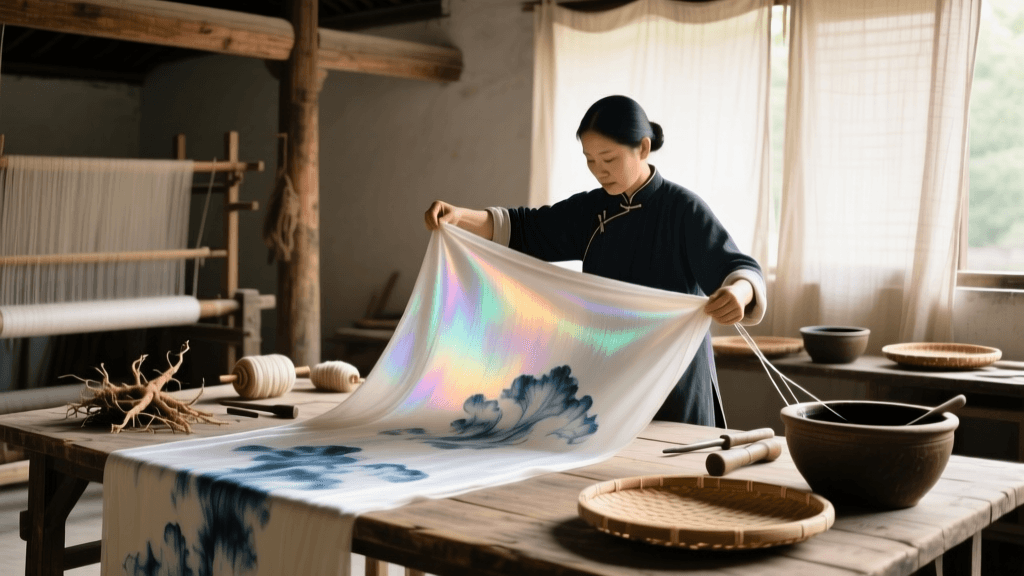
The magic of Xiangyunsha lies in its two primary non-silk ingredients: the juice of the Shouliang yam (Dioscorea cirrhosa) and the iron-rich mud from the Pearl River delta. The Shouliang yam is a wild tuber native to the region, packed with tannins. When the silk is repeatedly soaked in the extracted juice of this yam, the tannins bind to the silk fibers. However, the true transformation occurs when the tannin-soaked silk is coated with the specific river mud from Shunde. This mud is rich in iron ions. When the iron meets the tannins under the hot southern sun, a natural chemical reaction occurs, creating a dark, lustrous, and durable coating on one side of the fabric. This process is entirely organic, utilizing no synthetic chemicals, which aligns with the growing global demand for sustainable and eco-friendly luxury textiles.
The 13-Step Intangible Heritage Process
Producing genuine Xiangyunsha is a grueling, time-intensive endeavor that can only be executed during a specific window of the year—typically from April to October—when the sunlight is sufficiently intense and the humidity is optimal. The artisan process involves up to 13 distinct steps, repeated multiple times over several weeks:
- Preparation and Soaking: Raw white silk gauze is cut and immersed in the concentrated yam juice.
- Initial Sun-Drying: The silk is laid out on grassy fields to dry under the direct sun, allowing the tannins to penetrate the fibers.
- Repeated Dyeing: The soaking and drying process is repeated up to 30 times, gradually shifting the silk's color from pale yellow to a deep reddish-brown.
- Boiling: The silk is boiled in water to remove impurities and soften the fibers, ensuring the fabric remains supple despite the heavy tannin coating.
- Mud Coating (Guo Ni): In the late afternoon, artisans evenly spread the iron-rich Pearl River mud over one side of the silk. This step requires immense skill; the mud layer must be perfectly uniform to prevent blotching.
- Washing and Final Drying: After the chemical reaction turns the mud-coated side black, the fabric is washed in the river to remove excess soil, then dried one final time.
This meticulous process is a closely guarded tradition passed down through generations of Shunde artisans. The reliance on specific weather conditions means that production cannot be rushed or artificially scaled, preserving the exclusivity and artisanal integrity of the fabric. Institutions like the Victoria and Albert Museum, which houses extensive historical Chinese textile collections, frequently highlight the importance of such regional, terroir-driven textile practices in understanding the broader scope of Asian material culture.
Sourcing and Pricing: A Buyer’s Guide
For collectors, designers, and enthusiasts of traditional Asian garments, sourcing authentic Xiangyunsha requires an understanding of market dynamics, timing, and pricing. Because the production is strictly seasonal and heavily dependent on manual labor, genuine Xiangyunsha commands a premium price.
Comparison Chart: Xiangyunsha vs. Standard Mulberry Silk
| Feature | Authentic Xiangyunsha | Standard Mulberry Silk |
|---|---|---|
| Production Time | 15 to 30 days (seasonal) | Continuous, factory-based |
| Weight & Drape | Heavier, structured, crisp drape | Lightweight, fluid, soft drape |
| Surface Finish | Two-tone: Black/brown with subtle crackle | Uniform color, high sheen |
| Breathability | Exceptional; naturally cooling | High, but can cling in humidity |
| Average Cost (per meter) | 800 to 2,500 RMB ($110 - $350 USD) | 150 to 400 RMB ($20 - $55 USD) |
Note: Prices fluctuate based on the base silk quality (e.g., heavy crepe vs. lightweight gauze) and the intricacy of any jacquard weaving incorporated before the dyeing process.
Actionable Advice: The best time to purchase Xiangyunsha is in late autumn (October to November), immediately after the production season concludes. During this time, artisan workshops in Shunde release their fresh batches, offering the widest selection of patterns and weights. If you are buying online, always request a video of the fabric being crumpled; genuine Xiangyunsha produces a distinct, crisp rustling sound, often described as 'the sound of wind through clouds.'
Tailoring and Garment Measurements
When commissioning a garment from Xiangyunsha, it is crucial to account for the fabric's unique structural properties. Unlike soft silks that cling to the body, Xiangyunsha has a sculptural quality. It holds pleats exceptionally well, making it the premier choice for traditional Hanfu Mamianqun (horse-face skirts) and structured Qipaos.
- For a Mamianqun (Hanfu Skirt): You will need between 4.5 to 6 meters of fabric, depending on the desired volume and the wearer's height. The crispness of Xiangyunsha ensures the knife pleats remain sharp without the need for heavy synthetic interlinings.
- For a Traditional Qipao: A standard knee-length Qipao requires approximately 2.5 to 3 meters of fabric (assuming a standard width of 114cm or 45 inches). Because the fabric is less forgiving than stretch silks, ensure your tailor takes precise measurements and leaves a 1-inch seam allowance for future adjustments.
- For a Song Dynasty Beizi (Jacket): A lightweight Xiangyunsha gauze is ideal for summer Beizi. Allocate 2 meters for a standard hip-length garment.
Authenticating Artisan Craftsmanship
As the popularity of traditional Chinese clothing surges, the market has seen an influx of synthetic imitations marketed as Xiangyunsha. To ensure you are investing in genuine intangible heritage, rely on the following authentication markers:
The Sensory Test: Genuine Xiangyunsha is a feast for the senses. Visually, it should exhibit a subtle 'crackle' pattern (龟裂纹) on the dark side, resembling ancient tortoise shells or dried earth. Tactilely, it should feel cool to the touch and slightly textured, never slick or plasticky. Auditoryly, the friction of the fabric against itself must produce a clear, crisp rustle.
Furthermore, examine the reverse side of the fabric. Authentic Xiangyunsha is dyed unevenly by design; the side exposed to the yam juice and mud will be dark brown or black, while the reverse side, which rests against the grass during sun-drying, will remain a lighter, earthy rust or tan color. Imitations are often uniformly dyed black using synthetic chemical vats.
Caring for Heritage Mud-Dyed Silk
Owning a piece of Xiangyunsha is an investment in wearable art, and its care requires specific protocols to maintain the integrity of the natural dyes and the silk fibers.
- Washing: Never machine wash or dry clean Xiangyunsha. The harsh chemicals in dry cleaning solvents can strip the natural tannin-iron coating. Hand wash the garment in cold water (strictly below 30°C or 86°F) using a neutral pH detergent or a specialized silk wash.
- Drying: Do not wring the fabric. Gently press out excess water and hang the garment to dry in a well-ventilated, shaded area. Direct sunlight during the drying process can cause the natural dyes to fade unevenly or become brittle.
- Storage: Store Xiangyunsha garments on padded hangers to maintain their structural shape. Avoid folding them for long periods, as the heavy dye coating can cause permanent creases or cracking along the fold lines. Keep them in a breathable cotton garment bag, away from direct moisture and strong odors.
Conclusion
Xiangyunsha is far more than a luxury textile; it is a profound expression of Chinese intangible cultural heritage. The artisans of Shunde who continue to brave the intense subtropical sun, turning raw silk, wild yams, and river mud into 'Fragrant Cloud Silk,' are the custodians of a centuries-old dialogue between humanity and nature. By understanding the intricate 13-step process, knowing how to source and authenticate the fabric, and committing to its proper care, enthusiasts and collectors can help ensure that this remarkable craft continues to thrive in the modern era. Whether fashioned into a flowing Hanfu skirt or an elegant Qipao, a garment made of Xiangyunsha carries the weight of history, the warmth of the sun, and the enduring spirit of Asian artisanal traditions.