Silk Road Threads: How Trade Shaped Tang Dynasty Hanfu
The Crossroads of Couture: Tang Dynasty and the Silk Road
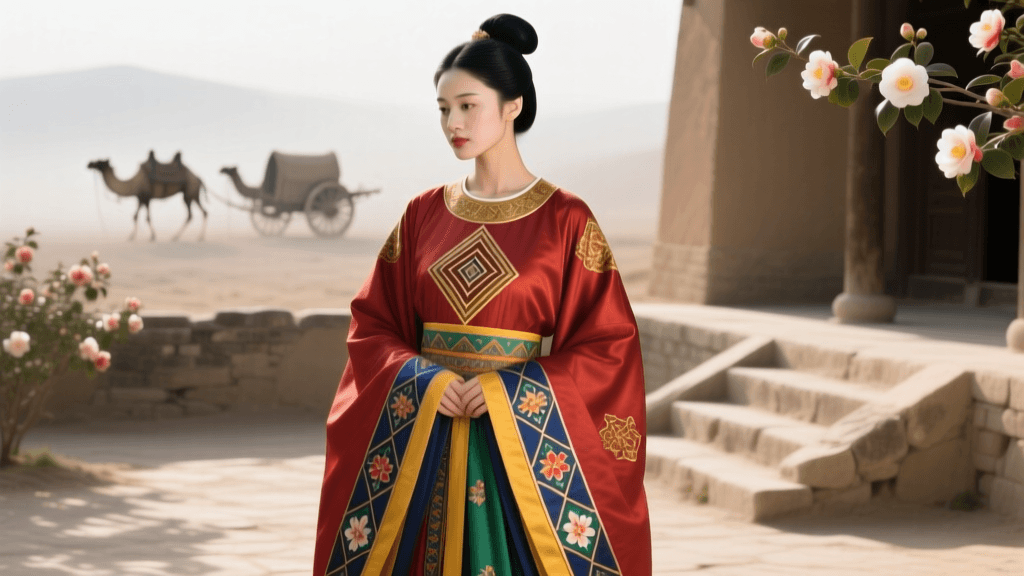
The Tang Dynasty (618–907 CE) is universally celebrated as a cosmopolitan golden age in Chinese history. At its heart was Chang'an (modern-day Xi'an), a sprawling metropolis of over one million residents and the eastern terminus of the Silk Road. This vast network of trade routes did not merely facilitate the exchange of spices, jade, and precious metals; it acted as a superhighway for cultural and sartorial exchange. As merchants, diplomats, and monks traversed the dunes of the Taklamakan Desert and the mountain passes of the Pamirs, they brought with them the fashions of Central Asia, Persia, and the Byzantine Empire. According to the UNESCO Silk Roads Programme, this cross-cultural dialogue fundamentally altered the material culture of China, leading to a radical departure from the conservative, indigenous clothing styles of the preceding Han and Wei dynasties.
For modern enthusiasts and historians alike, understanding Tang Dynasty clothing requires looking beyond the borders of China. The iconic silhouettes and vibrant textiles of the era are a direct result of this historical globalization, representing a fascinating synthesis of indigenous Han tailoring and foreign 'Hufu' (barbarian/foreign clothing) aesthetics.
Sogdian Influence: The Round-Collar Robe (Yuanlingpao)
Prior to the Tang Dynasty, traditional Han clothing was dominated by the 'Ruqun' (a blouse and skirt ensemble) and the 'Shenyi' (a deep, wrapped robe) characterized by crossed collars and wide, flowing sleeves. However, the influx of Sogdian merchants from Central Asia introduced a highly practical, equestrian-friendly garment to the Chinese court: the round-collar robe, or 'Yuanlingpao'.
The Sogdians were the master middlemen of the Silk Road. Their native clothing featured narrow sleeves, fitted bodices, and lapels that folded over, designed for horseback riding and the harsh climates of the steppes. The Tang elite, particularly during the early and high Tang periods, became enamored with this exotic, masculine-leaning style. Women of the court famously adopted the Yuanlingpao, pairing it with leather riding boots and striped trousers, a radical subversion of traditional gendered dress codes. This cross-dressing trend was not merely a fashion statement but a reflection of the relatively high social mobility and liberal attitudes afforded to women in Tang society.
Furthermore, the 'Banbi', a half-sleeved waistcoat or jacket, was directly adapted from Central Asian layering techniques. Worn over a long-sleeved under-robe, the Banbi allowed for vibrant color blocking and was highly practical for the changing temperatures of the continental climate. The integration of these garments into everyday Tang life illustrates how trade routes function as conduits for lifestyle adaptation, not just economic gain.
Textile Innovations: Samite and Pearl Roundels
The visual language of Tang textiles was profoundly altered by Persian and Central Asian aesthetics. Before the Silk Road's peak, Chinese silk weaving was largely based on warp-faced weaves, which produced light, flowing fabrics with subtle, geometric, or cloud-like patterns. However, contact with Sasanian Persia introduced China to 'Samite', a heavy, weft-faced compound twill.
As detailed by The Metropolitan Museum of Art's Heilbrunn Timeline of Art History, Samite allowed for the creation of large, complex, and highly colorful motifs that were visible on both sides of the fabric. This structural innovation perfectly accommodated the most iconic Silk Road motif: the pearl roundel. Originating in Sasanian Persia, the pearl roundel consisted of a border of overlapping pearls enclosing a central, often symmetrical, design. Tang weavers eagerly adopted this framing device but filled the roundels with indigenous or hybridized motifs, such as paired ducks, dragons, boar heads, and winged horses (the 'Tianma').
The 'Lion and Grape' motif is another prime example of cross-cultural synthesis. While grapes were introduced to China from the Hellenistic world via the Fergana Valley centuries earlier, the combination of the grapevine with the lion—a symbol of Persian royalty and Buddhist protection—became a staple of Tang brocade. These textiles were so highly prized that they were frequently used as diplomatic gifts, further spreading Tang-Silk Road hybrid aesthetics to Japan and the Korean peninsula.
Comparing Traditional Han vs. Silk Road Influenced Garments
| Feature | Pre-Tang Traditional Han Style | Tang Silk Road Influenced Style |
|---|---|---|
| Collar Type | Crossed collar (Jiaoling), always right over left | Round collar (Yuanling) or folded lapels (Fanling) |
| Sleeve Silhouette | Extremely wide, floor-draping 'Da Xiu' | Narrow, fitted cuffs for riding and archery |
| Primary Motifs | Clouds, dragons, geometric lattice, phoenixes | Pearl roundels, paired beasts, lions, grapevines |
| Weaving Technique | Warp-faced weaves (lightweight, flowing) | Weft-faced compound twill / Samite (heavy, structured) |
| Footwear | Woven straw sandals or soft silk slippers | Knee-high leather riding boots with turned-up toes |
Actionable Guide: Sourcing and Wearing Silk Road-Inspired Hanfu Today
For modern Hanfu enthusiasts, historical reenactors, and textile collectors, acquiring authentic Tang-style garments influenced by the Silk Road requires specific knowledge of tailoring, fabrics, and market timing. Here is a practical guide to commissioning and wearing these cross-cultural masterpieces today.
1. Sourcing Authentic Replicas and Fabrics
When shopping on platforms like Taobao or through independent historical restoration studios, search for specific terminology. Use keywords like 'Tang-style Yuanlingpao' (唐制圆领袍) and 'Samite weave brocade' (织锦缎). For the half-sleeve jacket, search for 'Tang Banbi' (唐制半臂). To achieve the correct historical drape, avoid modern polyester satins. Instead, look for heavy silk brocades or jacquard weaves with a minimum weight of 19 momme, though 22 to 30 momme is ideal for the structured, regal silhouette of a Tang round-collar robe.
2. Crucial Tailoring Measurements
Tang garments rely heavily on the drape of the fabric rather than complex darting. When providing measurements to a custom tailor, ensure you include the following specific metrics:
- Chest/Bust Ease: Measure your chest and add 4 to 6 inches (10-15 cm) for historical ease. Tang robes were meant to be roomy and layered.
- Sleeve Length: Unlike Western tailoring which measures from the shoulder seam, Hanfu sleeves are measured from the C7 vertebra (the prominent bone at the base of the neck) down the extended arm to the wrist. For women, this is typically 28-32 inches; for men, 30-34 inches.
- Robe Length: Measure from the base of the neck to the ankle bone, then subtract 2 inches to prevent the hem from dragging and ruining the silk when walking outdoors.
- Collar Circumference: The Yuanlingpao collar must sit snugly at the base of the neck without choking. Measure the neck circumference and add exactly 1 inch for comfort.
3. Cost and Investment Guide
The market for Tang-style Hanfu varies wildly based on material authenticity and historical accuracy:
- Mass-Produced / Cosplay Grade ($40 - $80 USD): Made from synthetic jacquard or polyester. The pearl roundel motifs are often printed rather than woven. Suitable for casual conventions or photography, but lacks historical breathability and drape.
- Artisan Silk Brocade ($250 - $600 USD): Custom-tailored garments using genuine mulberry silk blends and woven motifs. This tier includes proper historical tailoring, such as the hidden inner ties and structured lapels of the Yuanlingpao.
- Museum-Grade Restoration ($1,000 - $3,000+ USD): Commissioned from specialized historical textile workshops. These pieces utilize traditional wooden drawlooms to recreate exact Sasanian-Tang Samite weaves, utilizing natural plant dyes and real gold-leaf threads. Lead times for these pieces can exceed six months.
4. Timing Your Purchase
If you are ordering custom silk garments from historical restoration studios, be aware of the traditional silk harvesting and weaving cycles. Most high-end studios open their pre-order windows in March (for Spring/Summer weight silks) and September (for heavy Autumn/Winter brocades). Placing an order outside these windows often results in a 45 to 60-day delay as the studio waits for the next batch of raw silk to be milled and dyed.
Preserving the Legacy: Museums and Archives
To truly appreciate the cross-cultural brilliance of Tang Dynasty textiles, one must study the surviving fragments recovered from the arid climates of the Silk Road. The Silk Road Seattle project by the University of Washington provides extensive digital archives of textiles recovered from the Tarim Basin, showcasing the exact weave structures and dye recipes used by ancient artisans. Furthermore, institutions like the China National Silk Museum in Hangzhou house meticulously preserved Tang brocades, offering modern weavers the blueprints needed to keep this ancient, globalized art form alive. By understanding and investing in these historically accurate garments, modern wearers do more than dress up; they actively participate in the preservation of humanity's earliest global trade network.