Xiangyunsha Silk Craft: China's Intangible Heritage
The Legacy of Xiangyunsha: China's Gambiered Canton Gauze
In the rich tapestry of Asian traditional garments, few textiles possess the mystique, complexity, and profound environmental connection of Xiangyunsha (香云纱), often translated as Gambiered Canton Gauze or 'Singing Silk.' Originating from the Shunde district of Foshan in Guangdong province, this extraordinary fabric is a masterpiece of Chinese traditional crafts. Recognized as a National Intangible Cultural Heritage of China in 2008, Xiangyunsha represents a harmonious blend of human ingenuity and natural elements. Unlike standard silk weaving, which focuses primarily on the loom, the creation of Xiangyunsha is an alchemical process of dyeing, mud-coating, and sun-baking that transforms raw mulberry silk into a luxurious, water-resistant, and uniquely textured textile.
As noted by UNESCO's Intangible Cultural Heritage registry, the broader traditions of Chinese sericulture and silk craftsmanship rely on generations of passed-down knowledge, but Xiangyunsha stands apart due to its strict geographical and climatic dependencies. It can only be produced in specific regions where the river mud possesses the exact mineral composition required for the dyeing process, making it a true terroir-driven textile.
The Artisan Process: Mud, Sun, and Sweet Potato
The creation of authentic Xiangyunsha is a grueling, 14-step manual process that takes several weeks to complete and can only be performed between April and October when the sunlight is intense and the humidity is optimal. The artisans, known as 'sha workers,' rely on three primary natural elements: raw silk, the juice of the Shoulang yam (Dioscorea cirrhosa), and iron-rich river mud.
1. The Yam Juice Dyeing Cycles
The process begins with raw, white mulberry silk gauze. Artisans crush the Shoulang yam to extract a thick, reddish-brown juice that is incredibly rich in tannins. The silk is submerged in this juice, massaged by hand to ensure even penetration, and then spread out on the grass to dry under the blazing sun. This dipping and drying cycle is repeated up to 30 times. With each cycle, the silk absorbs more tannins, gradually shifting from a pale cream to a deep, rich terracotta brown. The sun's UV rays are essential, as they help fix the tannins into the silk fibers.
2. The River Mud Coating
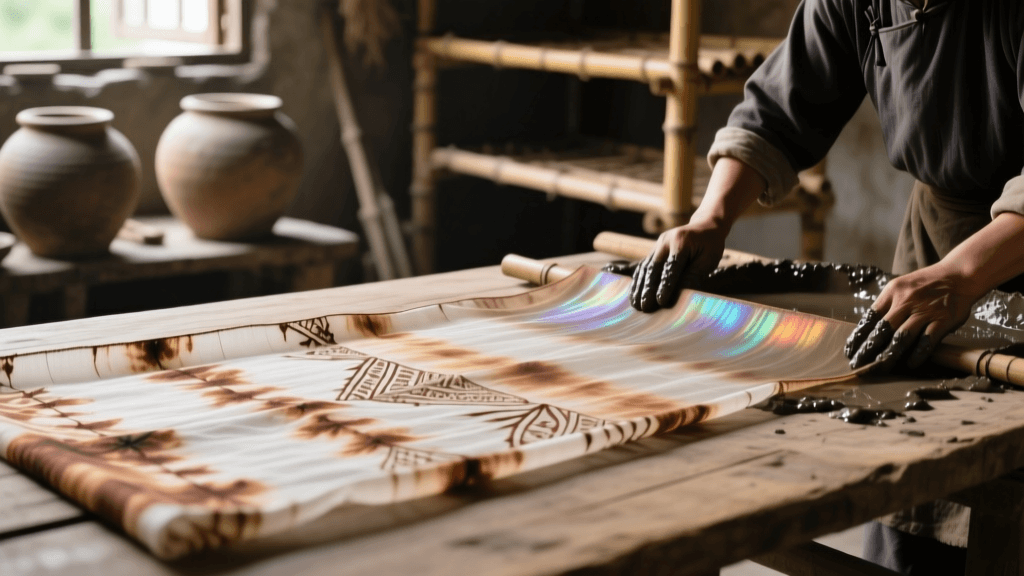
The defining step of Xiangyunsha is the application of river mud. Artisans harvest dark, silty mud from the unpolluted ponds of Shunde. This mud is rich in iron ions. In the early morning hours, the mud is smeared evenly across one side of the tannin-soaked silk. A rapid chemical reaction occurs: the iron in the mud reacts with the tannins in the yam juice to form a black, glossy complex known as ferric tannate. This reaction only takes a few minutes, after which the silk is immediately washed in the river to remove the excess mud, leaving behind a permanent, jet-black, metallic-looking coating on one side of the fabric.
3. Final Drying and Resting
After washing, the fabric is spread out on the grass one final time to dry. It is then rolled and stored in a dark, dry warehouse for several months to 'rest.' This resting period allows the colors to stabilize and the fabric to soften, developing the characteristic crackling sound that gives it the nickname 'Singing Silk.'
Sourcing Authentic Xiangyunsha: A Buyer’s Guide
For Hanfu enthusiasts, Qipao collectors, and textile connoisseurs, sourcing authentic Xiangyunsha requires a keen eye and an understanding of market metrics. Because the artisan process is labor-intensive and weather-dependent, genuine Xiangyunsha is a premium investment.
Measurements and Fabric Yields
- Traditional Width: Authentic, hand-woven Xiangyunsha typically comes in a narrow width of 90 cm (approx. 35 inches). This is a hallmark of traditional looms.
- Modern Width: Some modernized workshops offer a 140 cm (approx. 55 inches) width using mechanized base weaving, though the mud-dyeing remains manual.
- Yardage for Hanfu: To craft a standard Mamianqun (horse-face skirt), you will need 3.5 to 4.5 meters of fabric. For a Ruqun (jacket and skirt set), expect to purchase 5 to 6 meters.
- Yardage for Qipao: A standard knee-length Qipao requires approximately 2.5 to 3 meters of the 140 cm width, or 4 meters of the traditional 90 cm width due to pattern matching and narrow constraints.
Cost Breakdown and Pricing Metrics
When budgeting for a heritage garment, it is crucial to understand the cost structure. Mass-produced, chemically dyed imitations flood the e-commerce market, often selling for $10 to $20 USD per meter. However, authentic Shunde Xiangyunsha commands a much higher price.
- Authentic Fabric Cost: $80 to $150 USD per meter, depending on the complexity of the base weave (e.g., plain gauze vs. jacquard damask).
- Artisan Tailoring: Custom tailoring for heritage garments ranges from $150 to $400 USD. Pleating a Mamianqun or executing traditional hand-rolled hems on a Qipao requires specialized skills.
- Total Garment Investment: A fully custom, authentic Xiangyunsha Mamianqun will typically cost between $500 and $900 USD, while a bespoke Qipao can range from $600 to $1,200 USD.
How to Authenticate Genuine Xiangyunsha
To ensure you are purchasing an intangible heritage craft rather than a synthetic imitation, look for these specific markers:
- The Two-Tone Effect: Genuine Xiangyunsha is distinctly two-toned. One side is a glossy, metallic black, while the reverse side is a matte, earthy brown or terracotta.
- The 'Singing' Sound: When rubbed between the fingers, the fabric produces a distinct, crisp crackling sound due to the hardened tannin-iron coating.
- Natural Irregularities: Because it is dyed and dried outdoors on grass, authentic pieces often feature tiny, natural imperfections, such as faint grass marks or slight variations in the black coating.
- Water Resistance: The black side of the fabric is naturally water-repellent. Water droplets should bead up and roll off the surface rather than absorbing immediately.
Comparison Chart: Xiangyunsha vs. Standard Silk vs. Imitations
Understanding the material differences is vital for collectors and traditional garment makers. The following table outlines the key distinctions between authentic heritage Xiangyunsha, standard mulberry silk, and modern chemical imitations.
| Feature | Authentic Xiangyunsha | Standard Mulberry Silk | Mass-Produced Imitation |
|---|---|---|---|
| Dye Material | Shoulang Yam & River Mud | Natural or Chemical Dyes | Synthetic Chemical Dyes |
| Production Time | 3-4 Weeks + Resting | Hours to Days | Hours |
| Price per Meter | $80 - $150 USD | $15 - $40 USD | $10 - $20 USD |
| Texture & Sound | Crisp, 'Singing' Crackle | Soft, Fluid, Silent | Stiff, Plastic-like feel |
| Breathability | Highly Breathable, Cool | Breathable | Poor (traps heat) |
| UV & Water Resistance | Naturally UV & Water Repellent | Susceptible to UV & Water | Varies, generally poor |
Incorporating Heritage Textiles into Modern Wardrobes
While historically used for the garments of the elite and wealthy merchants during the Ming and Qing dynasties, Xiangyunsha has experienced a massive revival in contemporary Asian fashion. The historical context of Chinese silk weaving, as documented by The Metropolitan Museum of Art's Heilbrunn Timeline of Art History, highlights how silk was not merely a fabric but a currency and a marker of social status. Today, wearing Xiangyunsha is a way to reclaim that cultural prestige.
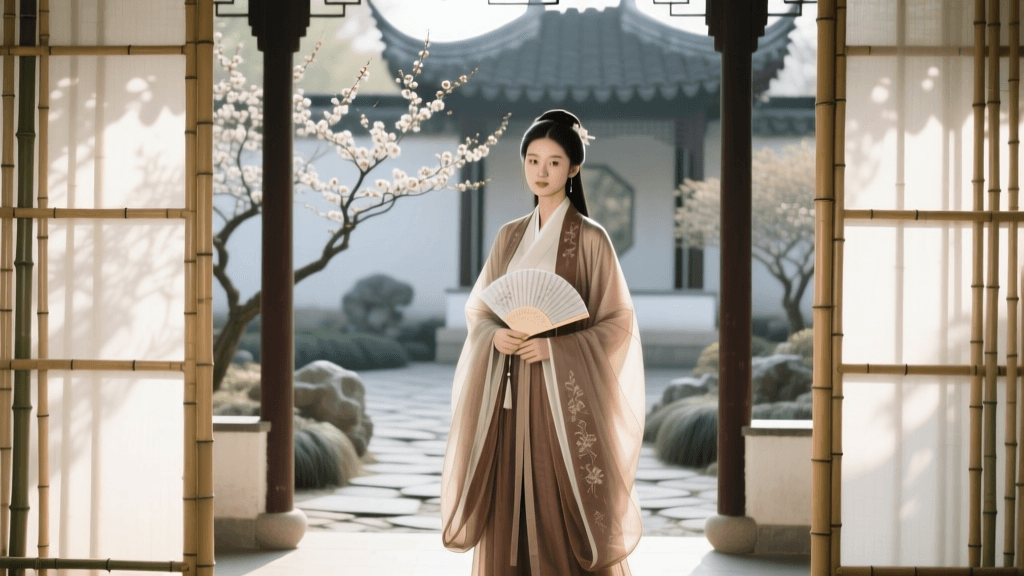
Modern designers are blending traditional Xiangyunsha with contemporary silhouettes. Beyond the classic Qipao and Hanfu, the textile is increasingly used for wide-leg trousers, structured blazers, and even luxury accessories like clutches and fan covers. The fabric's natural stiffness makes it ideal for structured garments that require architectural volume, such as the pleats of a Mamianqun or the stand collar of a traditional Ao (jacket).
Caring for Your Heritage Garment
Owning a piece of intangible cultural heritage comes with the responsibility of proper preservation. The tannin-iron complex that gives Xiangyunsha its unique properties requires specific care to maintain its structural integrity and color.
- Washing: Hand wash only in cold water (strictly under 30°C / 86°F). Never use alkaline detergents or standard laundry soaps, as they will strip the tannin coating. Use a neutral pH silk-specific detergent or even plain water if the garment is only lightly soiled.
- Drying: Never wring or twist the fabric, as this can cause the stiff coating to crack permanently. Instead, roll the garment in a clean, dry cotton towel to absorb excess moisture. Always dry in the shade; prolonged exposure to direct sunlight will degrade the tannin bonds over time and cause the black side to fade.
- Storage: Store the garment flat or loosely rolled. Hanging heavy, structured Xiangyunsha garments for long periods can distort the weave. Keep it in a breathable cotton garment bag, away from direct moisture and mothballs, which can chemically react with the iron ions.
Preserving the Intangible Craft
The survival of Xiangyunsha relies heavily on the continued patronage of conscious consumers and the dedication of the aging artisan workforce in Shunde. As urbanization encroaches on the traditional mud ponds and the younger generation seeks less grueling professions, the number of master 'sha workers' is dwindling. By choosing to invest in authentic, ethically sourced Xiangyunsha, collectors and traditional garment enthusiasts do more than acquire a beautiful textile; they actively fund the preservation of a centuries-old ecological and cultural practice. Supporting certified heritage workshops ensures that the 'Singing Silk' will continue to resonate for generations to come.