Packing Silk Kimonos for Long-Haul Flights: 2026 Wrinkle-Free Guide
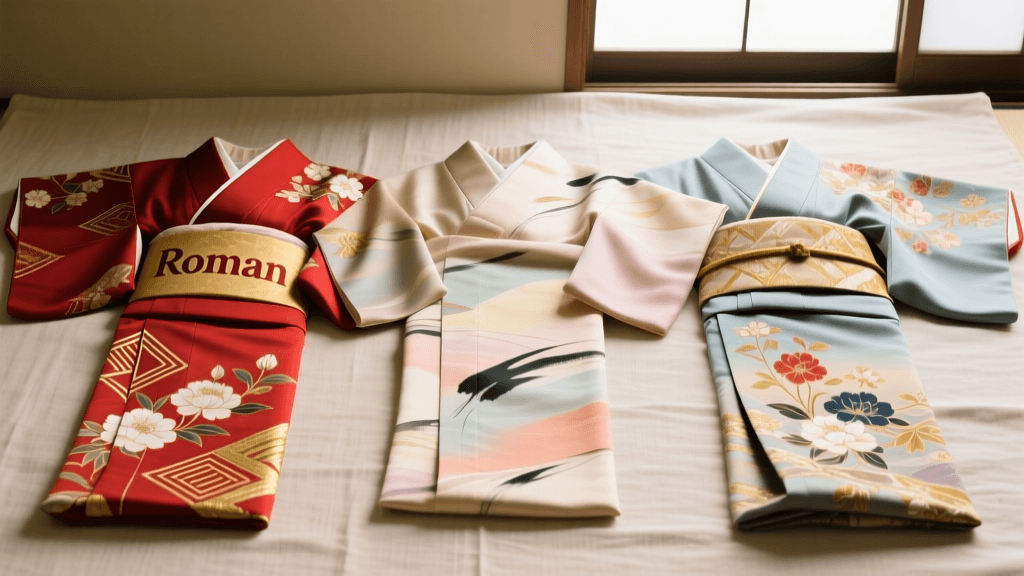
As cultural immersion travel reaches unprecedented heights in 2026, an increasing number of textile enthusiasts, practitioners of traditional Japanese arts, and diaspora families are traveling internationally with authentic silk kimonos. Whether you are attending a global tea ceremony convention in London, participating in a summer matsuri in Kyoto, or simply transporting a family heirloom across the Pacific, the logistics of moving delicate garments require meticulous planning. Silk, particularly the textured chirimen and glossy rinzu weaves used in high-end kimonos, is highly susceptible to permanent creasing, moisture damage, and friction wear.
The Science of Silk in 2026 Aircraft Cabins
Modern long-haul aviation has evolved significantly. The latest generation of wide-body aircraft, such as the Airbus A350-1000 and the Boeing 777X, feature composite fuselages that allow for higher cabin humidity levels—typically hovering around 15% to 20%, compared to the arid 10% of older models. While this is better for human skin, it still poses a severe dehydration risk to natural protein fibers like silk. Furthermore, the pressurization cycles and temperature fluctuations in the cargo hold make checking a silk kimono an absolute taboo. According to the International Air Transport Association (IATA) baggage guidelines, fragile and high-value cultural garments should always be treated as critical carry-on items to prevent exposure to extreme sub-zero cargo temperatures and rough automated sorting systems.
Essential Packing Gear for Kimono Transport
In 2026, the intersection of traditional Japanese preservation techniques and modern archival science offers travelers superior options for protecting their garments. The traditional method involves wrapping the folded kimono in a tatoushi (a specialized paper wrapper). While authentic tatoushi is excellent for climate-controlled storage at home, it lacks the water-resistance and structural rigidity needed for modern transit.
Traditional vs. Modern Archival Packing Materials
| Material | Pros | Cons for Air Travel | 2026 Recommendation |
|---|---|---|---|
| Traditional Washi Tatoushi | Breathable, culturally authentic, prevents acid transfer. | Tears easily in transit, offers no water or crush protection. | Use only as an inner layer. |
| Acid-Free Unbuffered Tissue | Archival safe, smooth, prevents dye transfer. | Requires multiple sheets, lacks structural support. | Ideal for stuffing sleeves and collar folds. |
| Eagle Creek Pack-It Isolate Garment Folder | Water-resistant, lightweight, includes folding board. | Sized for Western suits; requires adaptation for kimono length. | Best for standard komon and casual silk. |
| Custom EVA Hard-Shell Kimono Tube | Crush-proof, waterproof, eliminates folding creases. | Bulky, heavy, takes up significant cabin space. | Mandatory for heavily embroidered furisode and bridal uchikake. |
The Hon-Datami Folding Method for Travel
To pack a kimono properly, one must master the hon-datami (standard folding) technique. As detailed by textile historians at the Metropolitan Museum of Art, the kimono is constructed from straight bolts of fabric (tanmono), meaning its seams and folds are designed to align perfectly along specific geometric lines. Improper folding will force the silk against its natural grain, causing micro-fractures in the fibers and permanent white stress marks along the crests.
Step-by-Step Travel Folding Protocol
- Preparation: Lay the kimono face down on a clean, lint-free cotton sheet. Ensure your hands are washed and completely dry, or wear white cotton archival gloves.
- The Sleeve Fold: Fold the left sleeve back over the body of the kimono, aligning the edge precisely with the center back seam. Repeat with the right sleeve, folding it underneath.
- The Collar Alignment: Fold the left front panel over the right, ensuring the eri (collar) forms a perfect, smooth curve without buckling. Insert a roll of acid-free tissue paper inside the collar curve to maintain its shape and prevent a hard crease.
- The Length Fold: Fold the bottom hem up to meet the collar. Crucial 2026 Travel Hack: Do not press the fold flat. Instead, place a thick, unbuffered acid-free tissue roll exactly at the folding point. This creates a soft fold with a two-inch radius, drastically reducing the risk of a hard, permanent crease forming during a 14-hour flight.
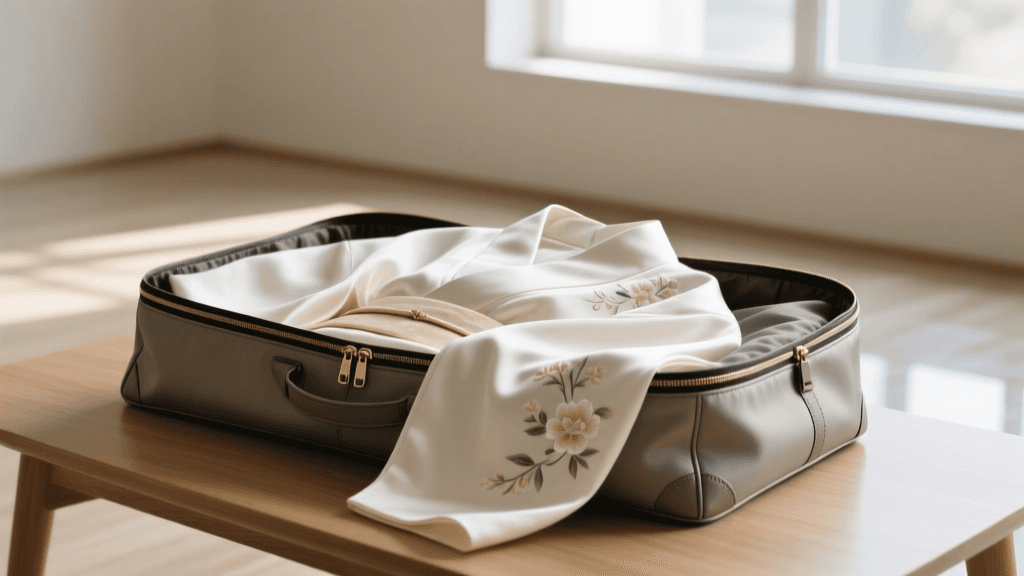
- Wrapping: Wrap the folded garment in a clean, unbleached cotton cloth (furoshiki) or a modern water-resistant silk blend wrapper before placing it in your carry-on.
Accessory Separation: Do not pack the silk obi in the same folder as the kimono. The metallic threads and stiff brocade weaves of a fukuro obi can snag the smooth surface of the kimono silk during transit. Pack the obi separately in its own cotton wrapper, rolled loosely rather than folded, to preserve the integrity of the metallic threads and prevent permanent creasing across the intricate patterns.
Navigating Airport Security and Cabin Storage
Airport security protocols in 2026 heavily utilize advanced CT (Computed Tomography) scanners at checkpoints. These machines allow security personnel to view the contents of your bag in 3D without requiring you to unpack your electronics or neatly folded garments. However, if your bag is flagged for a manual search, remain calm. Politely inform the TSA or international security agent that the bag contains fragile, high-value cultural silk garments. Request that they handle the fabric with clean hands or allow you to unwrap and re-wrap the kimono yourself.
When crossing international borders, particularly into countries with strict biosecurity laws like Australia or New Zealand, you may be asked about the materials in your luggage. Declare your silk garments accurately. Because silk is an animal product (produced by the Bombyx mori silkworm), some agricultural checkpoints require a brief visual inspection to ensure the fabric is fully processed and free from organic contaminants like raw seeds or untreated plant fibers used in traditional dyes.
Once aboard, never place your kimono in the overhead bin if the flight is full and bin space is contested. Overhead bins are subject to shifting luggage, and a heavy hard-shell suitcase dropped onto your garment bag will crush the silk. The safest place for a folded kimono is in the closet of the First or Business class cabin (if available), or laid completely flat on top of your other soft luggage in the overhead bin, ensuring nothing is placed on top of it.
On-the-Go Steaming and Emergency Wrinkle Removal
Even with meticulous packing, minor settling creases may occur. Ironing a silk kimono with a traditional hot plate is highly discouraged, as direct heat can scorch the protein fibers and flatten the delicate texture of chirimen silk. According to conservation guidelines from the American Institute for Conservation (AIC), steam is the preferred method for relaxing natural fibers.
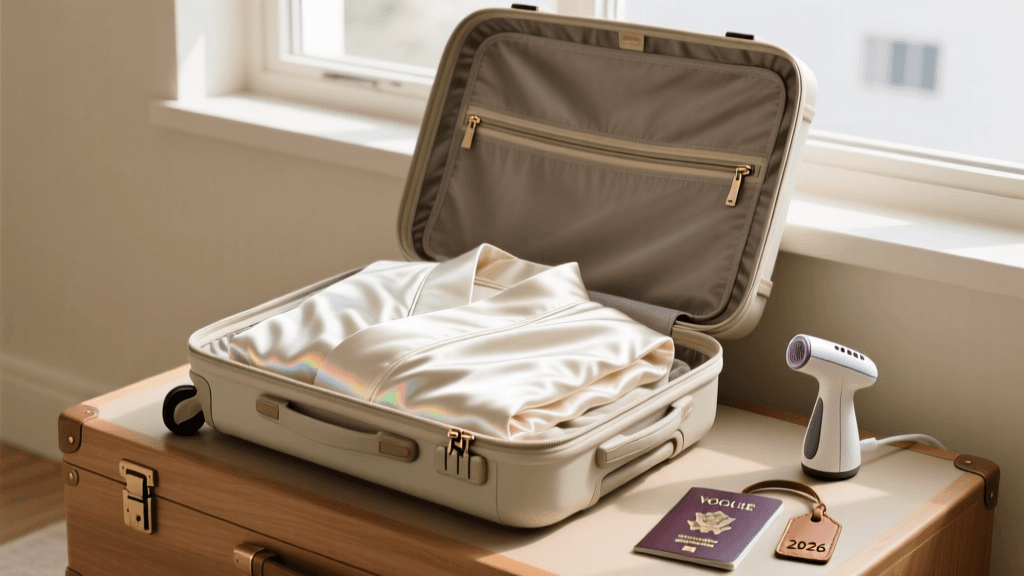
For travel in 2026, invest in a high-quality, dual-voltage portable steamer, such as the Panasonic NI-GSD090. These compact devices heat up in under 30 seconds and provide a continuous, gentle mist.
- The Hanging Method: Hang the kimono on a wide, padded wooden hanger (never wire or thin plastic). Hold the steamer at least six inches away from the fabric, moving continuously in downward strokes. Never let the steamer head touch the silk, as condensation droplets can leave water spots.
- The Bathroom Steam Technique: If you do not have a travel steamer, hang the kimono in the bathroom while taking a hot shower. Ensure the garment is far enough from the shower stall to avoid direct water splashes. The ambient steam will gently relax the fibers over 20 minutes.
- Crest Care: If your kimono features kamon (family crests) made of gold leaf or foil, avoid steaming directly over the crests. The moisture and heat can cause the adhesive backing to fail, leading to peeling or tarnishing.
Conclusion
Traveling with a silk kimono in 2026 is a rewarding endeavor that bridges the gap between ancestral heritage and modern global mobility. By understanding the environmental challenges of aircraft cabins, utilizing archival-grade packing materials, adhering to the geometric precision of the hon-datami fold, and employing safe, modern steaming techniques, you can ensure your garment arrives at its destination in pristine, museum-quality condition. Whether you are dressing for a formal tea gathering or simply safeguarding a generational heirloom, these specialized transport methods guarantee that the elegance of the kimono remains uncompromised, no matter where your travels take you.