What Is Traditional Indian Clothing? A Complete Cultural Guide
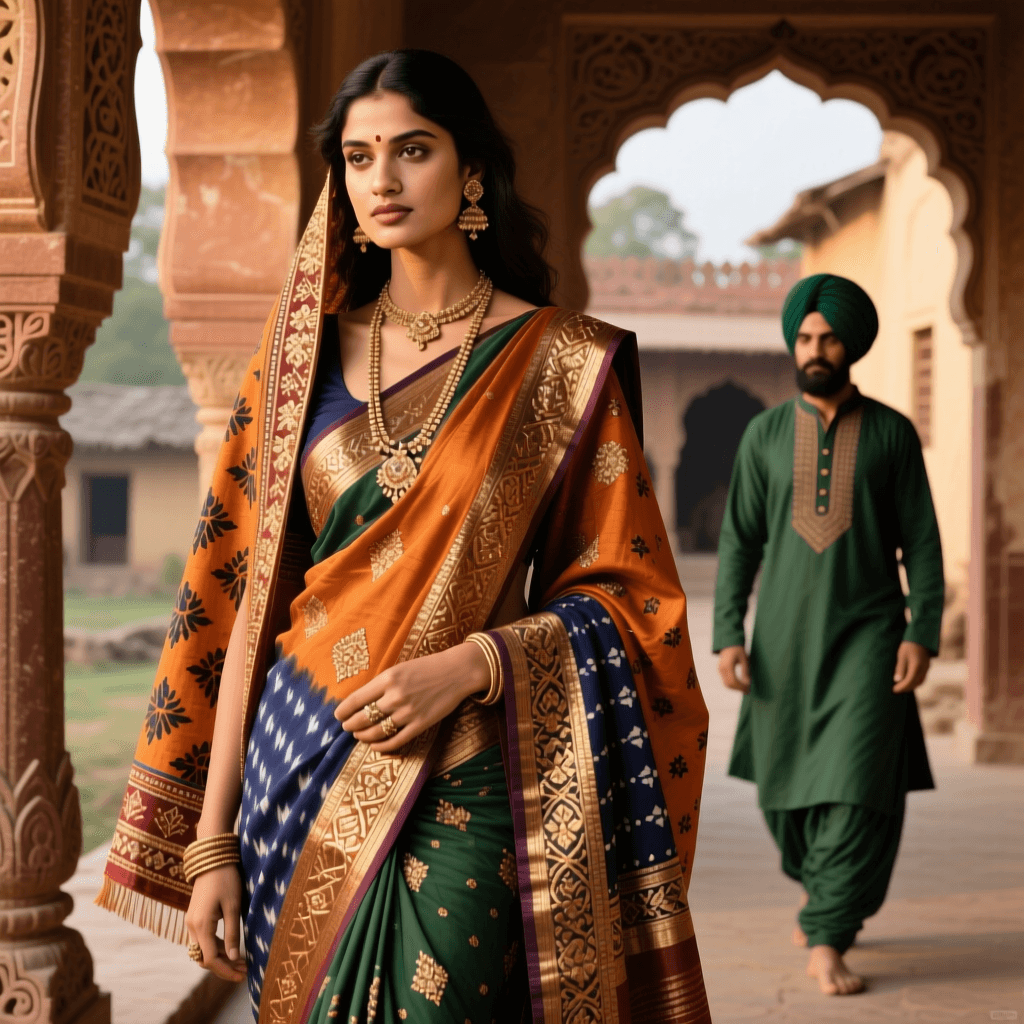
Traditional Indian clothing is among the oldest, most diverse and most symbolically rich sartorial systems in the world. From the flowing drape of a handloom sari to the structured elegance of a sherwani, garments across the Indian subcontinent have long functioned as far more than protection from the elements. They are markers of region, religion, caste, marital status, season and ceremony, woven from fibres that have travelled trade routes for millennia and stitched with techniques passed quietly from hand to hand across generations.
What we call “traditional Indian clothing” today is not a single costume but a living archive. It encompasses draped garments that predate the needle, tailored ensembles shaped by Central Asian and Persian courts, and hybrid forms born in colonial port cities. Cotton was first domesticated and woven here, silk was reeled along river valleys, and dyes such as indigo, madder and turmeric became global commodities. To understand Indian dress is to understand trade, empire, devotion, climate and craft all at once.
This guide walks through the origins, defining characteristics, major garments, regional variations and ceremonial roles of traditional Indian clothing, before closing with the cultural symbolism that continues to shape how millions dress every day. For a broader look at related traditions, our South Asian textile heritage overview is a useful companion.
Origins and Historical Evolution of Indian Dress
The earliest evidence of clothing on the Indian subcontinent comes from the Indus Valley civilisation, where terracotta figurines and seals show figures wrapped in draped garments rather than tailored ones. Cotton cultivation and weaving were already sophisticated, and spindle whorls recovered from archaeological sites confirm that spinning was a domestic craft thousands of years before recorded history. The draped tradition — a single length of cloth arranged around the body without cutting — would remain the dominant form of dress for most of the subcontinent for millennia.
The Vedic and post-Vedic periods refined this draped vocabulary. Texts describe the antariya (a lower-body wrap), the uttariya (an upper-body scarf or shawl) and the kayabandh (a sash). These three-piece ensembles appear in sculpture at sites such as Sanchi and Bharhut, where men and women are shown in pleated lower wraps and floating upper garments, often accessorised with elaborate jewellery. The needle and stitched garments existed but were associated with leatherwork and foreign peoples, and were therefore considered less pure in ritual contexts.
A decisive shift arrived with the movement of Central Asian, Persian and Turkic courts into northern India from the early medieval period onward. Tailored clothing — trousers, tunics, fitted jackets and coats — entered elite wardrobes and gradually filtered into everyday dress, especially in the north and west. The Mughal courts in particular codified a layered aesthetic of fine muslins, brocades, sashes and jewelled accessories that still echoes in garments such as the angarkha, the sherwani and the churidar. In the south and east, by contrast, the draped tradition remained dominant, evolving into the many regional sari styles seen today.
Colonial contact introduced yet another layer. Mill-made cotton, European tailoring, the blouse worn beneath the sari, and the adoption of the shirt-and-trouser combination by urban men all reshaped the wardrobe. Rather than replacing older forms, these influences were absorbed: the sari was re-draped in new ways, the kurta met the waistcoat, and traditional textiles found new markets. The result is a layered, syncretic dress culture in which a single family might wear a handloom sari for a temple visit, a tailored salwar kameez for work and a western suit for a business meeting — all within the same week.
Defining Characteristics of Traditional Indian Clothing
Despite enormous variety, several recurring principles unify traditional Indian dress across regions and communities.
- Draping as a primary technique. Many iconic garments — the sari, dhoti, lungi, turban, dupatta — are unstitched lengths of cloth arranged on the body. Draping allows a single textile to fit any body, adapt to climate and carry ritual significance, since unstitched cloth is often considered purer for worship.
- Rectangular construction. Even tailored garments tend to be cut from rectangular panels to minimise waste and preserve the integrity of handwoven cloth. This economy is visible in the straight-cut kurta and the gusseted dhoti.
- Layering. Indian dress is typically built in layers: an inner garment, a main garment, and an outer wrap or shawl. Layering accommodates climate shifts, modesty norms and ceremonial display.
- Textile as the primary ornament. Rather than relying on silhouette alone, Indian garments derive much of their beauty from the cloth itself — its weave, dye, print, embroidery or embellishment. A plain-cut kurta in a Banarasi brocade reads as formal; the same cut in plain cotton reads as everyday.
- Regional identity through technique. Specific weaves, dyes and embroidery styles are tightly linked to place: ikat to Odisha and Telangana, bandhani to Gujarat and Rajasthan, kantha to Bengal, phulkari to Punjab, chikankari to Lucknow. Wearing a textile is often a way of wearing a map.
Climate is another silent designer. The hot, humid plains favour loose, breathable cottons and open weaves; the cooler Himalayan foothills call for wool, pashmina and layered shawls; the desert regions of the west use vivid dyes and mirrorwork that stand out against arid landscapes. These environmental pressures, combined with local fibre availability, produce the striking diversity visitors notice when travelling even short distances within the country.
The Major Garments of Traditional Indian Dress
While hundreds of local garments exist, a core group forms the backbone of what most people recognise as traditional Indian clothing.
The Sari
The sari is a single, unstitched length of cloth, typically between five and nine metres long, draped around the body and over the shoulder. It is worn with a fitted blouse (choli) and a petticoat that anchors the pleats. The sari’s drape varies dramatically by region: the nivi drape of Andhra Pradesh (now the most widely seen style), the seedha pallu of Gujarat, the bengali drape without pleats, the madisar of Tamil Brahmin women, and the nauvari of Maharashtra, which is worn trouser-style. Our guide to sari history and draping styles explores these in detail.
The Salwar Kameez
A three-piece ensemble of tunic (kameez), tapered or wide trousers (salwar or palazzo) and a long scarf (dupatta). Originating in the north and west, the salwar kameez is now everyday wear for women across much of the subcontinent and in diaspora communities. Variations include the straight-cut Punjabi suit, the flowing Anarkali, and the shorter kurti worn with jeans.
The Lehenga Choli
A flared, often heavily embroidered skirt (lehenga) paired with a fitted blouse (choli) and a dupatta. The lehenga choli is strongly associated with weddings, festivals and classical dance, particularly in Rajasthan, Gujarat and among North Indian brides.
The Kurta and Dhoti
The kurta is a collarless, side-slit tunic worn by men and women. Paired with a dhoti (a long, draped lower garment) it forms one of the oldest Indian ensembles, still worn by priests, politicians, classical musicians and grooms in many regions. In the south the dhoti is known as veshti, mundu or pancha and is often worn without a stitched upper garment in hot weather.
The Sherwani and Achkan
Long, fitted coats buttoned to the neck, descended from Mughal court dress. The sherwani is now the standard formal and bridal garment for men across South Asia, usually worn over a kurta and churidar (tightly fitted trousers). The achkan is a closely related, slightly shorter variant.
Regional Everyday Garments
Beyond these, everyday traditional dress includes the lungi (a wrapped lower garment worn by men in the south and east), the ghagra (a long skirt worn in rural Rajasthan and Gujarat), the phiran (a long woollen tunic of Kashmir), the mekhela chador (the two-piece draped garment of Assam) and the pavadai (a skirt worn by young girls in the south).
Regional Variations Across the Subcontinent
India’s size and ecological diversity mean that “traditional Indian clothing” changes noticeably from one state to the next. A few regional signatures are especially distinctive.
North India — Punjab, Haryana, Uttar Pradesh, Rajasthan — favours tailored ensembles: the salwar kameez, the lehenga, the sherwani and the kurta-pyjama. Embroidery traditions such as phulkari, chikankari and zardozi are concentrated here, as are block-printed cottons from Rajasthan and the rich brocades of Banaras.
East India — West Bengal, Odisha, Assam, Bihar — retains a strong draped tradition. Bengali women often wear the sari in the distinctive aat-poure style, while Assamese women wear the mekhela chador in lustrous muga and eri silks. Odisha is famous for its sambalpuri and bomkai ikat weaves, and Bengal for its fine muslins and kantha-embroidered quilts and saris.
South India — Tamil Nadu, Kerala, Karnataka, Andhra Pradesh, Telangana — is the heartland of the draped sari and the dhoti. Kanjeevaram, Mysore, Pochampally and Kasavu silks are woven here, and the silk traditions of the south remain central to temple worship, weddings and classical dance costumes. Kerala’s white-and-gold mundum neriyathum and Tamil Nadu’s nine-yard madisar are among the most recognisable regional drapes.
West India — Gujarat, Maharashtra, Goa — blends draped and tailored forms. Gujarat is known for the heavily embroidered ghagra choli, bandhani tie-dye and patola double ikat. Maharashtra’s nauvari sari and the men’s pheta turban are iconic, while Goa’s Portuguese colonial history introduced elements such as the kunbi sari drape and tailored dresses worn by Christian communities.
The Himalayan and Northeast regions — Kashmir, Himachal, Sikkim, the Seven Sister states — have dress traditions that sit outside the mainstream Indian canon. The Kashmiri phiran and pashmina shawl, the Tibetan-influenced bakhu of Sikkim, and the handwoven wraparound skirts and shawls of Nagaland, Manipur and Meghalaya each reflect distinct cultural, climatic and ethnic histories.
Occasions and Ceremonial Wear
Traditional Indian clothing is deeply occasion-specific. What is appropriate for a temple visit may be unsuitable for a wedding, and what is worn at a funeral is carefully distinguished from what is worn at a festival.
Weddings are the most elaborate sartorial events. Brides in North India typically wear a red or maroon lehenga or Banarasi sari, heavily embroidered with zardozi, gota or thread work and accessorised with gold jewellery and a veil. South Indian brides usually wear a Kanjeevaram silk sari in auspicious colours such as red, green or mustard, with temple jewellery in gold. Grooms may wear a sherwani, an achkan, a silk dhoti-kurta or a regional equivalent such as the panche in Karnataka.
Festivals — Diwali, Eid, Durga Puja, Onam, Pongal, Baisakhi — are occasions for new clothing. Families traditionally buy or weave fresh garments for these days, and specific colours and textiles are associated with specific festivals: white and gold for Onam in Kerala, red for Durga Puja in Bengal, new cottons for Pongal in Tamil Nadu.
Religious and ritual contexts often favour unstitched cloth. Priests, pilgrims and devotees performing puja frequently wear a plain cotton dhoti or sari without a stitched blouse, reflecting the idea that unstitched fabric is ritually pure. Temple towns such as Varanasi, Tirupati and Madurai maintain living traditions of ritual dress that have changed little over centuries.
Classical dance and performance preserve some of the most elaborate traditional costumes in the world. Bharatanatyam dancers wear specially pleated silk saris that open into a fan during movement; Kathak dancers wear flowing Anarkali-style kurtas or ghagra-cholis; Odissi dancers wear sambalpuri or Bomkai saris draped in a distinctive style; Mohiniyattam performers wear the white-and-gold Kasavu of Kerala.
Everyday wear has shifted toward western and hybrid garments in urban settings, but traditional clothing remains common in rural areas, among older generations, and in professions tied to craft, religion and agriculture. A cotton sari or kurta-pyjama is still standard daily dress for millions.
Cultural Significance and Symbolism
Clothing in India carries meanings that extend far beyond fashion. Colour, textile, drape and ornament all communicate information about the wearer.
Colour is among the most potent signals. Red is the colour of marriage, fertility and the goddess in much of the subcontinent; white is associated with mourning in many Hindu communities (though it is celebratory in Kerala and among Christian communities); saffron and ochre signal renunciation and spiritual life; green is auspicious in many Islamic contexts and among several South Indian communities; black is often avoided in ritual settings but is protective in others, as in the black bead of a mangalsutra.
Marital status is frequently marked through dress. The sari itself, in many communities, is a garment of married women, while young girls wear skirts, salwar kameez or half-saris (langa voni, pavadai davani). Sindoor, bangles, toe rings and the mangalsutra work alongside clothing to signal marriage.
Caste, community and occupation have historically been readable in dress. Specific weaving communities produced specific textiles; specific embroidery styles belonged to specific groups; specific turban-tying styles belonged to specific regions and castes. While these markers have softened in urban settings, they remain potent in rural and ceremonial contexts.
Craft and livelihood are inseparable from clothing. Millions of artisans — weavers, dyers, printers, embroiderers, tailors — depend on the continued demand for traditional textiles. Choosing a handloom sari, a block-printed kurta or a hand-embroidered dupatta is therefore not only an aesthetic decision but an economic one, sustaining knowledge systems that are often centuries old.
Identity in the diaspora has given traditional Indian clothing a second life. For South Asian communities abroad, the sari, salwar kameez, kurta and sherwani have become powerful markers of cultural continuity, worn at weddings, religious festivals, national-day celebrations and coming-of-age ceremonies. They are often the first garment a child learns to associate with “home,” and the garment elders insist upon for important occasions.
Sustainability, though a modern term, describes a practice long embedded in Indian dress. Handloom textiles are low-energy, biodegradable and made to last. Garments are handed down, repurposed into quilts, children’s clothes or household textiles, and only discarded when truly worn out. The draped garment, which fits any body and any age, is inherently size-inclusive and waste-minimal.
Frequently Asked Questions
What is the most common traditional Indian garment?
The sari is the most widely recognised traditional Indian garment, worn in some form across most of the subcontinent. However, in everyday use the salwar kameez and the kurta-pyjama are equally common, particularly in North India and in urban settings. In the south and east, the sari and the dhoti remain dominant.
Is traditional Indian clothing the same across all regions?
No. Traditional dress varies dramatically between regions, shaped by climate, fibre availability, religious practice and historical influence. A Kanjeevaram sari from Tamil Nadu, a phulkari dupatta from Punjab, a mekhela chador from Assam and a phiran from Kashmir are all “traditional Indian clothing,” but they share almost nothing in silhouette, textile or technique.
What fabrics are traditionally used in Indian clothing?
Cotton, silk, wool and linen are the historic fibres. India was one of the first regions to cultivate and weave cotton, and it remains central. Silks include mulberry silk, tussar, eri and muga. Wool is important in the Himalayas (especially pashmina and shahtoosh alternatives), while jute, hemp and banana fibre appear in specific regional traditions.
When is traditional Indian clothing worn today?
Traditional clothing is worn daily by many people, especially in rural areas and among older generations. It is the default for weddings, religious festivals, temple visits, classical performances and most formal family occasions. In urban professional settings it is often reserved for cultural events, national holidays and celebrations.
How can someone outside India wear traditional Indian clothing respectfully?
Traditional Indian garments are widely shared and generally welcomed when worn with care. Choose well-made pieces from reputable makers, learn the basic way to drape or wear the garment, observe context (a sari at an Indian wedding is appropriate; treating it as a costume is not), and avoid mixing sacred symbols or ritual garments into casual styling. Supporting handloom and artisan-made pieces is one of the most respectful ways to participate in the tradition.
For more deep dives into specific garments and techniques, explore our guides on the sari, the lehenga choli and the wider world of South Asian textile heritage.