Top Wasai Kimono Sewing Workshops 2026: Kyoto & Tokyo Guide
The Renaissance of Wasai in 2026
In the global shift toward sustainable, slow fashion, the ancient Japanese art of Wasai (traditional garment sewing) has experienced a massive resurgence. Unlike Western tailoring, which relies on complex curved patterns and generates significant textile waste, Wasai is rooted in geometric precision, zero-waste cutting, and modular construction. For textile enthusiasts, fashion students, and cultural preservationists, 2026 offers an unprecedented array of immersive workshops and seminars across Japan. Whether you are looking to construct your first yukata (summer cotton kimono) or master the intricate blind-stitching of a formal silk homongi, the current landscape of Japanese sewing seminars provides unparalleled access to master artisans.
According to cultural initiatives tracked by the Japan Foundation, international enrollment in traditional craft seminars has reached record highs this year, driven by a desire to learn techniques that prioritize garment longevity and modularity. This guide explores the most prestigious Wasai workshops in Kyoto and Tokyo for 2026, detailing what you will learn, the tools required, and how to choose the right seminar for your skill level.
The Philosophy of Traditional Japanese Sewing
Before enrolling in a seminar, it is crucial to understand the foundational philosophy of Wasai. Traditional kimonos are constructed from a single bolt of fabric known as a tanmono, which measures approximately 36 centimeters in width and 12 meters in length. The garment is cut into straight, rectangular panels—two body panels, two sleeves, an overlapping front panel, and a collar.
Because the pieces are rectangular, there is virtually no fabric waste. Furthermore, the seam allowances are not trimmed; they are folded inside the garment. This allows the kimono to be completely disassembled, washed, re-stretched, and resewn—a traditional maintenance process called arai-hari. In our 2026 workshops, instructors emphasize this circular lifecycle, teaching students how to sew with the future un-making of the garment in mind.
Top In-Person Wasai Workshops: Kyoto & Tokyo
1. Kyoto Artisan Immersion Seminar (5-Day Intensive)
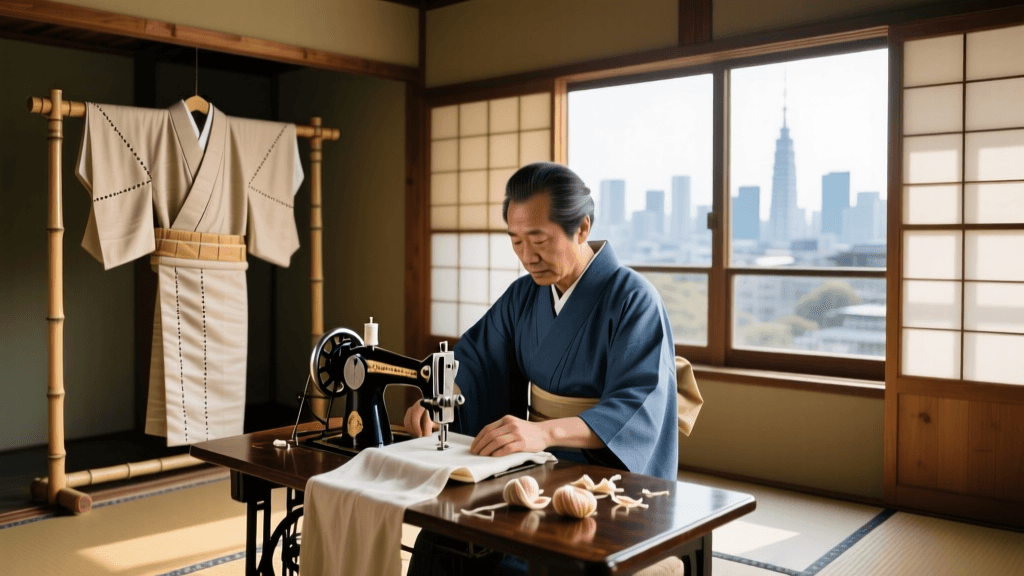
Kyoto remains the undisputed heart of Japanese textile arts. The Kyoto Artisan Immersion Seminar is a rigorous, five-day program designed for intermediate sewers who already understand basic machine sewing but want to transition to traditional hand-sewing techniques. Held in a historic machiya (traditional wooden townhouse) in the Nishijin weaving district, this seminar focuses on the construction of a nagajuban (under-kimono) and a cotton yukata.
Typical 5-Day Itinerary:
- Day 1: Shirushi-tsuke (Marking). Learning to use the mekiki (bamboo ruler) and ink to mark the tanmono. Students learn the mathematics of body proportions without relying on paper patterns.
- Day 2: Cutting and the Back Center Seam. Executing the sewari (back center seam) using the hon-gusshi (main running stitch), ensuring perfect tension and stitch length consistency.
- Day 3: Side Seams and Sleeve Setting. Attaching the okumi (front overlap panels) and setting the sleeves (sode-tsuke), focusing on the structural reinforcement stitch known as chikara-nui.
- Day 4: Collar Attachment (Eri-tsuke). The most challenging aspect of Wasai. Students learn to attach the hiro-eri (wide collar) with flawless geometric alignment at the center back neck.
- Day 5: Kuke (Blind Stitching) and Pressing. Mastering the kuke blind stitch to secure hems invisibly, followed by traditional pressing techniques using a kote (traditional iron).
2026 Tuition: ¥185,000 (approx. $1,250 USD), which includes all cotton fabrics, silk threads, and daily bento lunches.
2. Bunka Fashion College Weekend Intensive (Tokyo)
For those unable to commit to a week-long retreat, institutions like Bunka Fashion College in Tokyo offer specialized weekend intensives. Bunka is globally renowned for its fashion programs, and its 2026 Wasai seminars bridge the gap between historical techniques and modern wearable adaptations. The weekend seminar focuses on the haori (traditional jacket), teaching students how to adapt straight-line cutting for contemporary outerwear while maintaining traditional hand-finished hems and linings.
2026 Tuition: ¥48,000 (approx. $325 USD). Materials are not included, allowing students to bring their own vintage or modern textiles.
2026 Workshop Format Comparison
Choosing the right learning environment is critical for mastering the tactile nuances of Wasai. Below is a comparison of the primary seminar formats available this year.
| Format | Duration | 2026 Est. Cost (USD) | Best For | Skill Level |
|---|---|---|---|---|
| Kyoto Machiya Immersion | 5 Days | $1,250 | Purists wanting full hand-sewn yukata/nagajuban experience | Intermediate |
| Tokyo Weekend Intensive | 2 Days | $325 | Modern fashion students adapting Wasai for outerwear (Haori) | Beginner/Intermediate |
| Hybrid AR-Assisted Online | 8 Weeks | $450 | International students requiring digital pattern drafting support | All Levels |
Essential Wasai Toolkit: What to Buy Before Your Seminar
While many Kyoto seminars provide a starter kit, serious students of Wasai often prefer to curate their own tools. The Japanese sewing industry has seen several innovations in 2026 that make traditional tools more accessible and ergonomic for international students.
- Mekiki (Bamboo Ruler): Unlike Western measuring tapes, the mekiki is a rigid, 1-meter bamboo ruler marked with traditional Japanese units (shaku, sun, bu). Modern 2026 versions often feature dual metric/traditional markings. Cost: ¥4,500.
- Kote (Traditional Iron): The kote is a heavy, handled iron used to press seams open without flattening the fabric's natural texture. The latest smart-kote models feature digital temperature controls specifically calibrated for silk crepe (chirimen) and raw silk (tsumugi). Cost: ¥28,000.
- Kuke-dai (Blind Stitch Board): A specialized, angled wooden board with a fabric tension strap. It holds the hem at the perfect angle for executing the microscopic kuke blind stitch. Cost: ¥12,000.
- Harite (Tension Board): A long wooden board with metal clips used to stretch and hold fabric taut while sewing long seams like the back center. Essential for preventing puckering on slippery silks. Cost: ¥8,500.
Fabric Selection for Beginners
When attending your first seminar, fabric choice dictates your learning curve. Instructors universally recommend starting with Oka (high-quality Japanese cotton) or Tsumugi (a textured, matte pongee silk). These fabrics have a slight "tooth" or grip, preventing the layers from shifting while you execute the running stitch. Avoid Chirimen (silk crepe) for your first garment; its high shrinkage rate and slippery nature require an advanced understanding of tension control and pre-washing (yu-noshi) that is typically covered in intermediate seminars.
Preparing for Your First Kimono Sewing Seminar
To maximize your time in a 2026 Wasai seminar, preparation is key. First, familiarize yourself with the anatomy of the kimono. Understanding terms like migoro (body panels), okumi (front overlap), and furi (the unsewn sleeve pouch) will save you hours of translation and confusion during fast-paced demonstrations.
Secondly, condition your hands. Wasai requires immense finger strength to pull silk threads through multiple layers of fabric evenly. Many master artisans recommend practicing the hon-gusshi running stitch on cotton scraps at home, aiming for exactly three to four stitches per centimeter, before arriving in Japan. The preservation of these techniques is a vital part of cultural heritage, as noted by initiatives documented by the Japan National Tourism Organization, which actively promotes artisanal tourism and craft preservation.
Ultimately, learning Wasai is not just about making a garment; it is about adopting a mindset of patience, precision, and deep respect for the textile. Whether you are sitting on the tatami mats of a Kyoto machiya or at a modern drafting table in Tokyo, the skills you acquire in a 2026 Wasai seminar will fundamentally change how you view, wear, and create clothing for the rest of your life.