Sourcing Authentic Vyshyvanka & Romanian IE Shirts 2026
Introduction to Slavic and Balkan Embroidered Shirts in 2026
As we navigate the fashion landscape of 2026, the global appreciation for Eastern European and Balkan folk dress has evolved from niche historical interest into a cornerstone of the sustainable, slow-fashion movement. Discerning collectors and cultural enthusiasts are increasingly turning away from mass-produced, synthetic imitations, seeking instead the authentic, hand-loomed, and hand-embroidered garments that carry centuries of ancestral memory. At the heart of this revival are the iconic Ukrainian Vyshyvanka and the Romanian IE (pronounced 'ee-eh'), alongside the rich geometric traditions of the broader Balkan peninsula.
According to cultural preservation frameworks outlined by the UNESCO Intangible Cultural Heritage initiatives, traditional embroidery is not merely decorative; it is a complex language of regional identity, spiritual protection, and social status. In 2026, sourcing these garments requires a nuanced understanding of regional variations, natural fibers, and traditional stitching techniques. This comprehensive guide will equip you with the knowledge to identify, source, and care for authentic Slavic and Balkan folk textiles in today's market.
The Ukrainian Vyshyvanka: Regional Motifs and Sourcing
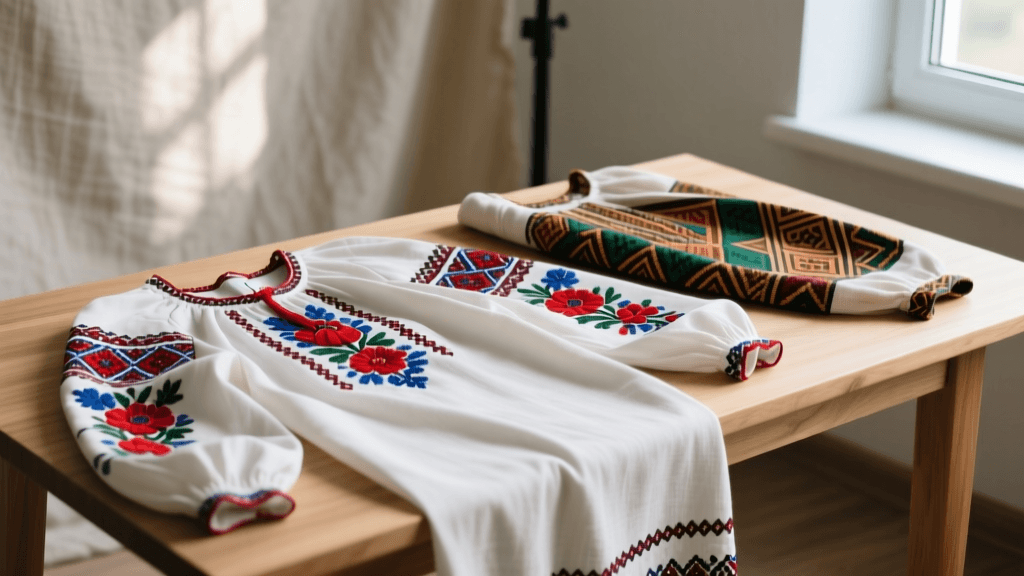
The Vyshyvanka is far more than a national symbol; it is a deeply regional garment. The word itself derives from the Ukrainian verb 'vyshyvaty,' meaning to embroider. In 2026, the market is flooded with machine-embroidered shirts made from polyester blends. To source an authentic piece, you must look for hand-spun linen or hemp, natural dyes, and specific regional stitch counts that dictate the garment's origin.
Authentic Vyshyvankas are defined by their local color palettes and motifs. For instance, the Carpathian mountain regions favor dense, vibrant geometric patterns, while the central steppes lean toward delicate, monochromatic floral and cutwork designs. When evaluating a piece, examine the reverse side of the embroidery. A true artisan's work will be nearly as neat on the back as on the front, with no long, loose threads or synthetic stabilizers.
Comparative Guide to Regional Vyshyvanka Styles
| Region | Primary Colors | Signature Stitch & Motif | 2026 Artisan Price Range (USD) |
|---|---|---|---|
| Hutsul (Carpathians) | Black, Red, Gold, Green | Cross-stitch, Nyzynka; Geometric stars | $250 - $480 |
| Poltava (Central) | White-on-White, Pale Blue | Cutwork (Lishva), Satin Stitch; Floral | $320 - $650 |
| Bukovina (Southwest) | Red, Black, Heavy Gold | Chain Stitch, Seed Stitch; Horns, Vines | $220 - $400 |
| Podillia (West-Central) | Red, Black, Grey | Low Stitch; Dense geometric bands | $180 - $350 |
The Romanian and Moldovan IE: Symbolism and Textile Care
The Romanian and Moldovan IE is a masterpiece of structural embroidery. Unlike the all-over patterns of some Slavic shirts, the IE is governed by strict architectural rules. The embroidery is concentrated on the shoulders (the 'altiță'), the gathered neckline (the 'încreț'), and the vertical bands flowing down the sleeves and body (the 'râuri'). This structure is designed to draw the eye upward and emphasize the wearer's posture.
In 2026, museum curators and textile experts, such as those contributing to the Victoria and Albert Museum's textile collections, emphasize the importance of fiber identification when sourcing vintage or newly woven IE blouses. Authentic pieces from the early-to-mid 20th century, as well as high-end contemporary reproductions, are woven from 'cânepă' (hemp) or 'in' (flax/linen). Hemp was traditionally used for everyday work shirts due to its durability, while finely spun linen was reserved for feast days and weddings.
Key Motifs in Romanian and Moldavian Embroidery
- The Sun Wheel (Roata Soarelui): A circular, radiating motif representing life, energy, and the cyclical nature of the seasons. Often found on the altiță.
- The Tree of Life (Arborele Vieții): A vertical, symmetrical motif connecting the underworld, the earthly realm, and the heavens. Frequently seen in the râuri.
- The Ram's Horns (Coarnele Berbecului): A stylized spiral representing strength, masculinity, and pastoral wealth, common in Transylvanian and Moldavian pieces.
- The Snake (Șarpele): Often misunderstood, the stylized snake is a protective household spirit in Balkan folklore, guarding the wearer from evil eyes and illness.
Balkan Influences: Serbian and Bulgarian Geometric Traditions
Expanding our view to the broader Balkan peninsula, the folk dress of Serbia, Bulgaria, and Bosnia offers a striking contrast to the floral and curvilinear motifs of Eastern Europe. Balkan embroidery is heavily geometric, deeply influenced by centuries of cross-cultural exchange, including Byzantine and Ottoman aesthetics. As noted in broader ethnographic studies on traditional folk art, the Balkan approach to textile decoration often serves as a strict identifier of village, marital status, and religious affiliation.
In Bulgaria, the 'Elbetitsa' (an eight-pointed star) and the 'Kanitsa' (a stylized floral-geometric hybrid) are ubiquitous. Bulgarian folk shirts ('riza') are often paired with heavily embroidered woolen aprons ('prestilka') and woven sashes ('poyas'). When sourcing Bulgarian textiles in 2026, look for the distinctive use of metallic threads (sirma) interwoven with wool, a technique that requires specialized artisanal knowledge that is currently experiencing a protected revival in regions like Koprivshtitsa.
Similarly, Bosnian 'Zmijanje' embroidery is characterized by its strict use of dark blue or black thread on white linen, featuring highly stylized, rigid geometric forms. This monochromatic discipline is a hallmark of authentic Dinaric Alpine folk dress and remains highly sought after by collectors of minimalist, high-contrast heritage textiles.
Where to Source Authentic Pieces in 2026
The digital marketplace of 2026 offers unprecedented access to Eastern European artisans, but it also requires rigorous vetting. To ensure you are supporting authentic heritage crafts rather than fast-fashion appropriations, follow these sourcing guidelines:
- Direct Artisan Cooperatives: Seek out verified weaving and embroidery cooperatives based in Lviv, Chernivtsi, Sibiu, and Sofia. These organizations often provide certificates of authenticity detailing the weaver's name, the village of origin, and the fiber composition.
- Museum Replica Programs: Institutions like the National Museum of Romanian History and the Ivan Honchar Museum in Kyiv occasionally partner with master artisans to produce limited-run, historically accurate replicas. These are premium investments but guarantee structural and material accuracy.
- The Burn Test (For Vintage Sourcing): If purchasing vintage pieces from estate sales or antique dealers, request a small thread sample for a burn test. Authentic linen and hemp will burn quickly, leaving a fine, grey ash and smelling of burning paper. Synthetic blends will melt, bead, and emit a chemical odor.
- Stitch Irregularity: True hand-embroidery will feature microscopic variations in tension and stitch length. If the pattern is mathematically perfect under a magnifying glass, it is likely machine-made.
Caring for Heritage Eastern European Textiles
Once you have sourced an authentic Vyshyvanka, IE, or Balkan blouse, proper conservation is paramount. The natural dyes used in traditional pieces—such as madder root for reds, walnut husks for browns, and woad for blues—are sensitive to modern alkaline detergents and high heat.
Always hand-wash heritage textiles in cool water using a pH-neutral, conservation-grade detergent. Never wring or twist the fabric, as this can distort the hand-woven weave and cause the dense embroidery threads to pucker the base fabric. Instead, gently press the water out and roll the garment in a clean, dry cotton towel to absorb excess moisture. Dry the piece flat, away from direct sunlight, which will rapidly fade natural botanical dyes.
For long-term storage, never use wire hangers, which will distort the delicate shoulder seams and cause the heavy embroidery to pull the fabric downward. Fold the garment using acid-free archival tissue paper to buffer the folds, preventing permanent creases and protecting the fibers from environmental acidity. Store the wrapped textile in a breathable cotton pillowcase or an archival cardboard box in a climate-controlled environment, ensuring the preservation of these vital cultural artifacts for decades to come.