Crafting the 15th-Century Burgundian Houppelande: 2026 Guide
The Resurgence of High Medieval Couture in 2026
As the historical reenactment and living history communities continue to evolve in 2026, the demand for meticulous, museum-quality garments has reached an all-time high. Among the most coveted and visually striking garments of the late medieval period is the Burgundian houppelande. Originating in the opulent courts of the Dukes of Burgundy in the late 14th century and dominating noble fashion through the mid-15th century, this sweeping, voluminous gown represents the pinnacle of medieval European tailoring. For modern makers, historical costumers, and high-tier reenactors, recreating the houppelande in 2026 requires more than just a basic sewing pattern; it demands an understanding of historical geometry, heritage textile sourcing, and period-accurate construction techniques.
Whether you are preparing for the 2026 Kaltenberg Knights Tournament in Germany or aiming for the highest authenticity tier at North American Renaissance festivals, this comprehensive guide will walk you through the anatomy, fabric selection, and tailoring secrets of the 15th-century Burgundian houppelande.
Anatomy of the Burgundian Houppelande
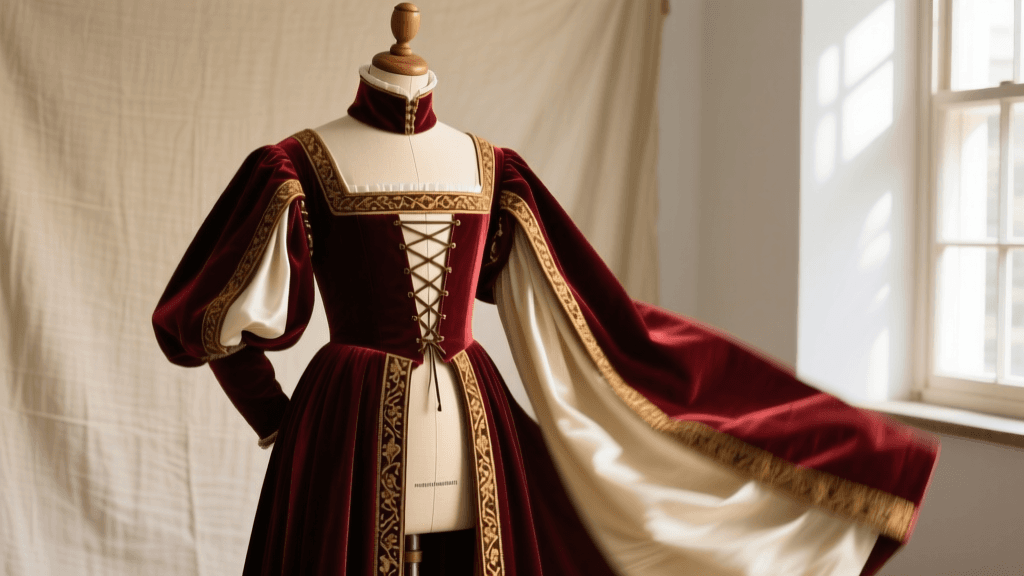
The houppelande is characterized by its immense volume, floor-length hem, and distinctive structural elements that defy modern tailoring norms. Unlike the fitted kirtles and cotehardies of the preceding century, the houppelande was designed to drape heavily from the shoulders, creating a majestic, bell-like silhouette. According to the Victoria and Albert Museum's Medieval and Renaissance collections, the garment was a symbol of immense wealth, as the sheer yardage of fabric required to construct one was prohibitively expensive for anyone outside the nobility.
The High Collar and Neckline
The defining feature of the early-to-mid 15th-century houppelande is the high, standing band collar. Often lined with contrasting silk or even fur, this collar frames the face and adds a regal posture to the wearer. The front of the garment typically features a deep V-neckline or a rounded opening that extends down to the natural waist, where it is secured by a wide, ornate belt. This belt is crucial; it gathers the massive folds of the bodice, creating the signature organ-pipe pleats that cascade down the skirt.
Bombard and Angel Sleeves
No houppelande is complete without its extravagant sleeves. The two most common styles are the bombard sleeve—which is exceptionally wide and long, often trailing on the ground—and the angel sleeve, which is cut in a semi-circle and features a dagged (scalloped) hem. In 2026, historical costumers are increasingly using wool felt appliqué or silk bias binding to finish these intricate dagged edges, preventing fraying while maintaining a period-correct aesthetic.
Sourcing Heritage Textiles for 2026 Projects
The success of your houppelande hinges entirely on your fabric choices. The modern 2026 textile market has seen a welcome resurgence in heritage weaving mills across the UK, Italy, and the Baltic states, making it easier than ever to source historically accurate materials. When consulting the Britannica archives on Renaissance and late Medieval dress, it becomes clear that the interplay of heavy outer wools and lightweight linen linings was essential for both the drape and the comfort of the garment.
Below is a comprehensive comparison of the best textiles for your 2026 houppelande project:
| Fabric Type | Best Use | 2026 Avg. Cost/Yard | Drape & Weight |
|---|---|---|---|
| Wool Broadcloth (Heavy) | Outer shell, main gown body | $45 - $70 | Stiff, heavy, holds pleats perfectly |
| Wool Challis (Medium) | Outer shell for warmer climates | $30 - $45 | Fluid, softer drape, lighter weight |
| Silk Damask / Brocade | Collar lining, sleeve cuffs, belts | $60 - $120 | Crisp, luxurious, high-sheen |
| Medium-Weight Linen | Full garment lining | $20 - $35 | Breathable, provides structural support |
| Faux Fur / Recycled Shearling | Winter collars, hem trim | $40 - $80 | Plush, adds necessary weight to hems |
Note: Prices reflect early 2026 averages from premium heritage textile suppliers. Always order swatches before committing to the 8-12 yards typically required for a full-length houppelande.
Pattern Drafting and Construction Techniques
Modern commercial patterns often fail to capture the true geometry of the medieval houppelande. Instead of relying on modern darts and princess seams, 15th-century tailors utilized geometric shapes—circles, rectangles, and triangles—to minimize fabric waste while maximizing volume. The Metropolitan Museum of Art's Medieval Art department frequently highlights how extant garments and tapestries reveal these brilliant, zero-waste cutting techniques.
The Circle-Cut Skirt
To achieve the massive, sweeping hemline, the skirt of the houppelande is typically cut as a full or three-quarter circle. For a wearer who is 5'6", a full-circle skirt with a 42-inch waist radius will yield a hem circumference of over 260 inches. This immense width is what allows the fabric to pool elegantly on the floor and creates the deep, organ-pipe folds when belted.
Bag-Lining the Sleeves
One of the most vital techniques for a professional finish is bag-lining. Because the bombard sleeves are so large, raw seams inside the sleeve will look messy and catch on the wearer's undergarments. To bag-line, you cut the outer wool and the inner linen to the exact same pattern piece. Sew them right-sides together along the curved outer edge and the dagged hem, turn the sleeve right-side out, and press. The armhole seam is then finished by binding it with a strip of linen or silk bias tape once the sleeve is set into the bodice.
Crowning the Silhouette: The Hennin and Chaperon
A houppelande is never worn in isolation; it requires the appropriate headwear to complete the 15th-century silhouette. For women, the steeple hennin or the heart-shaped bourrelet are the standard accompaniments. In 2026, milliners specializing in historical headwear are utilizing lightweight buckram and 3D-printed flexible armatures to create towering hennins that remain comfortable during long festival days. The veil attached to the hennin should be made of sheer silk organza or fine linen lawn, allowing it to catch the wind dramatically.
For men, the chaperon—a complex, turban-like headpiece evolved from the humble hood—is the essential accessory. Tying a chaperon correctly requires practice, but when paired with the high collar of the houppelande, it creates an unmistakably aristocratic profile.
Navigating 2026 Reenactment Authenticity Standards
As living history events become more rigorous in their educational mandates, understanding the specific authenticity guidelines for 2026 is crucial. Major events now employ garment inspectors who check for modern anachronisms. To ensure your houppelande passes inspection, adhere to the following checklist:
The 2026 Authenticity Checklist
- Thread Composition: Use 100% silk or linen thread for all visible stitching. Poly-blend threads will melt under the heat of a period iron and are easily spotted by inspectors.
- Seam Finishes: All interior seams must be flat-felled or bound. Serger stitching is an immediate disqualification in high-tier authenticity camps.
- Fasteners: Avoid modern metal eyelets. Use hand-sewn buttonholes with silk thread, or forge your own brass hooks and eyes.
- Hem Weights: If your wool is too light, sew lead-free drapery weights or a band of heavier wool inside the hem to ensure the garment swings correctly when walking.
- Undergarments: The houppelande must be worn over a proper linen chemise and a fitted wool kirtle. Wearing it over modern clothing ruins the posture and drape.
Conclusion: Embracing the Medieval Tailor's Art
Constructing a 15th-century Burgundian houppelande is a journey into the heart of medieval luxury and geometric ingenuity. By investing in heritage wools, mastering the art of the circle-cut skirt, and adhering to the rigorous authenticity standards of 2026, you do more than just sew a costume—you resurrect a masterpiece of European folk and courtly dress. Whether you are walking the grounds of a European castle or educating the public at a living history museum, your houppelande will stand as a testament to the enduring power of historical tailoring.