2026 Vyshyvanka Styling: Pairing Embroidery With Modern Tailoring
The 2026 Revival of Eastern European Folk Dress
The landscape of global fashion in 2026 has seen a profound shift toward heritage craftsmanship, with European folk dress transitioning from ceremonial archives into the forefront of contemporary urban wardrobes. Among the most prominent garments leading this revival is the Vyshyvanka, the traditional Eastern European embroidered shirt. Once reserved exclusively for cultural festivals, national holidays, and rural ceremonies, this iconic garment has been reimagined by modern stylists and artisans to fit the demands of 2026 capsule wardrobes. The fusion of ancestral textile techniques with modern minimalist tailoring represents a broader movement in the fashion industry: a rejection of transient micro-trends in favor of garments that carry historical weight, structural integrity, and artisanal value.
At the heart of this movement is a deep appreciation for the regional nuances of Eastern European embroidery. From the stark, elegant white-on-white cutwork of the Poltava region to the dense, vibrant geometric cross-stitch of the Carpathian Mountains, the Vyshyvanka offers a masterclass in textile storytelling. For the contemporary dresser, integrating these pieces requires a nuanced understanding of proportion, fabric weight, and color theory. In 2026, the goal is not to wear a costume, but to allow the folk garment to serve as the focal point of a sophisticated, modern silhouette.
Decoding the Vyshyvanka: Authenticity in a Modern Market
As the demand for heritage garments has surged, so too has the market saturation of mass-produced, machine-embroidered imitations. Navigating the 2026 market requires a discerning eye for authenticity. True artisan Vyshyvankas are constructed from natural fibers—primarily hand-loomed linen, organic cotton, or lightweight hemp—and feature embroidery executed with natural or high-grade mercerized cotton threads. The hallmark of an authentic piece lies in the reverse side of the fabric; in traditional hand-embroidery, the back of the garment is nearly as neat and structured as the front, with minimal loose threads or chaotic jumps.
Investing in an authentic piece is a commitment to slow fashion. In 2026, a genuine, hand-embroidered linen Vyshyvanka sourced directly from artisan cooperatives or specialized heritage boutiques typically ranges from $220 to $650, depending on the complexity of the stitch work and the rarity of the regional technique. While the initial cost is higher than fast-fashion alternatives, the structural longevity of hand-loomed linen ensures these garments can last for decades, often becoming more supple and comfortable with age.
Regional Embroidery Techniques & 2026 Sourcing Costs
Understanding the regional origins of your garment is essential for styling it appropriately. The weight of the fabric, the density of the thread, and the color palette all dictate how the piece will drape and interact with modern tailoring. Below is a comparative guide to the most sought-after regional styles available in the 2026 market.
| Region | Primary Technique | Thread Material | 2026 Avg. Market Price | Best Styling Application |
|---|---|---|---|---|
| Poltava | White-on-white cutwork & satin stitch | Fine Cotton / Silk | $350 - $550 | Ethereal Evening Wear |
| Hutsulshchyna | Dense geometric cross-stitch | Wool / Heavy Cotton | $250 - $400 | Bold Streetwear & Outerwear |
| Reshetylivka | Floral cutwork & drawn thread | Organic Linen Thread | $400 - $650 | Delicate Office & Smart Casual |
| Bukovyna | Polychrome geometric & floral | Silk / Metallic accents | $300 - $480 | Festive & Event Styling |
Contemporary Styling: Integrating Folk Textiles into Urban Wardrobes
The key to styling the Vyshyvanka in 2026 lies in contrast. The intricate, often voluminous nature of traditional folk dress must be balanced against the sharp, structured lines of contemporary tailoring. Here are three primary scenarios for integrating these heritage pieces into your daily rotation.
The Structured Office Look
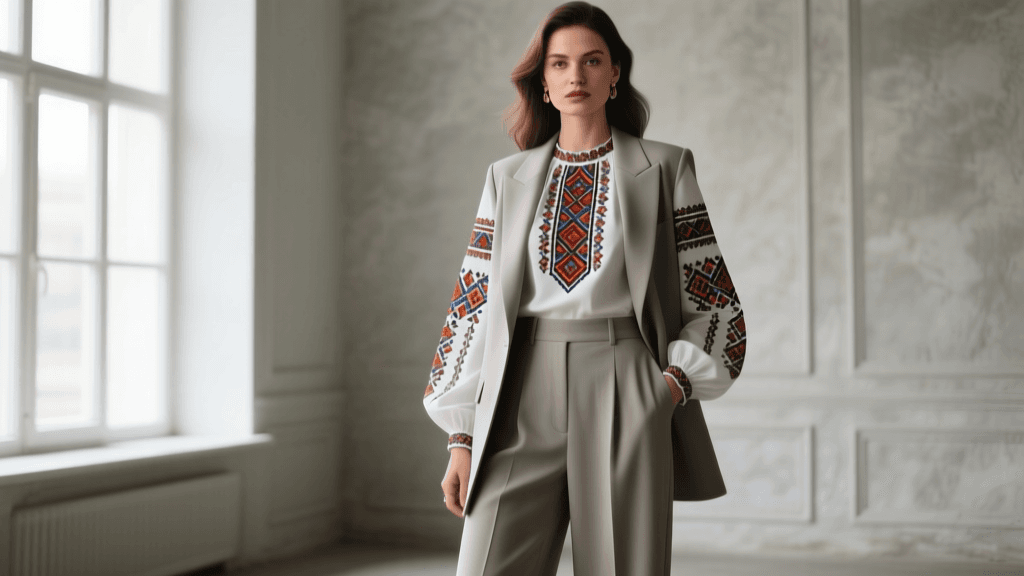
For the modern workplace, the Reshetylivka style blouse is unparalleled. Its delicate drawn-thread work and subtle tonal embroidery offer a refined texture that reads as sophisticated rather than theatrical. Pair a mid-weight, ivory linen Vyshyvanka with a structured, oversized charcoal wool-blend blazer. The 2026 silhouette for office blazers favors a dropped shoulder (approximately 22 inches across for a standard medium) and a relaxed but tailored waist. Tuck the blouse into high-waisted, wide-leg crepe trousers that graze the top of a pointed-toe leather boot. The contrast between the ancestral, handcrafted neckline and the severe, architectural lines of the wool blazer creates a powerful, intellectual aesthetic.
Evening Minimalism
Evening wear in 2026 has moved away from heavy embellishments in favor of textural depth. A Poltava white-on-white embroidered shirt is a masterclass in subtle luxury. To style this for an evening event, lean into monochromatic minimalism. Pair the blouse with a bias-cut, heavyweight silk midi skirt in a deep obsidian or midnight navy. Allow the voluminous, gathered sleeves of the Vyshyvanka to billow slightly, but keep the rest of the silhouette sleek. Accessorize with sculptural, unpolished silver jewelry that echoes the geometric motifs found in the embroidery. As noted in Britannica's comprehensive guide to textile arts, the use of drawn-thread work and cutwork creates a shadow-and-light effect that is particularly striking under low, ambient evening lighting.
Urban Streetwear & Layering
The dense, colorful cross-stitch of the Hutsul region is perfectly suited for contemporary streetwear and transitional layering. Because these garments are often cut from heavier linen or cotton blends, they function beautifully as mid-layers. Wear a Hutsul Vyshyvanka over a fine-gauge merino turtleneck, layered beneath a cropped, water-resistant technical jacket or a distressed leather moto jacket. Pair with raw-hem, wide-leg denim and chunky, lug-sole footwear. This approach grounds the historical garment in gritty, modern utility, proving that folk dress can thrive in dynamic, everyday environments.
Sizing, Fit, and Tailoring Adjustments for 2026 Silhouettes
Traditional Vyshyvankas were historically cut using a rectangular, zero-waste pattern, resulting in a boxy, voluminous fit with wide, gathered sleeves and a straight hem. While this silhouette is beautiful, it often requires adjustment to sit correctly beneath modern outerwear or to tuck cleanly into contemporary high-waisted bottoms.
When sourcing a piece in 2026, look for artisans who offer 'modernized heritage' cuts. These retain the traditional underarm gussets (which provide crucial mobility) but feature a slightly tapered side seam and a curved shirttail hem. If you are purchasing a vintage or strictly traditional rectangular cut, consider taking the garment to a specialist tailor. A skilled tailor can add subtle French darts to the back panel—removing no more than 1.5 inches of fabric on either side—to provide shape without disrupting the front embroidery panel or the structural integrity of the linen weave. Always ensure that the sleeve cuffs (the manzheta) sit precisely at the wrist bone, as the embroidery here is meant to be visible and protective.
Garment Care for Natural Linens and Dyes
Preserving the integrity of hand-loomed linen and naturally dyed threads requires a departure from standard laundry practices. The push to protect these techniques aligns with global efforts documented by UNESCO's Intangible Cultural Heritage initiatives, which emphasize the importance of maintaining the physical artifacts of cultural expression.
According to the Victoria and Albert Museum's textile conservation guidelines, natural fibers require gentle, pH-balanced care to prevent degradation. Never machine-wash an authentic, hand-embroidered Vyshyvanka. Instead, submerge the garment in cool water (no higher than 30°C or 86°F) with a specialized, pH-neutral detergent designed for delicate textiles. Avoid wringing or twisting the fabric, as this can distort the tension of the embroidery threads and cause the linen base to pucker. Press the garment gently between two clean, dry towels to absorb excess moisture, and lay it flat to dry away from direct sunlight. When ironing, always press the garment inside out on a medium-heat setting, using a pressing cloth to protect the raised texture of the embroidery from being flattened.
Conclusion
The integration of the Vyshyvanka into 2026 contemporary styling is more than a fleeting fashion trend; it is a deliberate embrace of cultural continuity and artisanal excellence. By understanding the regional histories, respecting the material properties of natural linens, and thoughtfully contrasting these heritage pieces with modern tailoring, we ensure that European folk dress remains a living, breathing component of the global wardrobe. Whether styled for the boardroom, the evening gala, or the city streets, the embroidered shirt stands as a testament to the enduring power of craftsmanship in an increasingly automated world.