Vintage Silk Kimono Preservation: 2026 Care & Storage Guide
The Evolution of Vintage Silk Preservation in 2026
Preserving vintage silk kimonos from the Meiji, Taisho, and early Showa eras requires a delicate balance between honoring traditional Japanese textile practices and utilizing modern conservation science. As we navigate 2026, the textile conservation community has largely moved away from harsh chemical treatments and synthetic storage methods, embracing a holistic approach that prioritizes fiber longevity, environmental sustainability, and structural integrity. For collectors, curators, and families holding onto precious heirlooms, understanding the current standards for Asian garment care is essential to prevent the irreversible degradation of silk, metallic threads, and natural dyes.
Silk is a protein fiber that is highly sensitive to light, humidity fluctuations, and acidic environments. The improper storage of a vintage kimono can lead to shattering (where the silk breaks along fold lines), dye migration, and permanent creasing. In 2026, museum-grade preservation techniques are more accessible to private collectors than ever before, allowing you to protect your garments with the same rigor used by top cultural institutions.
The Art of Tatoushi: 2026 Archival Folding Standards
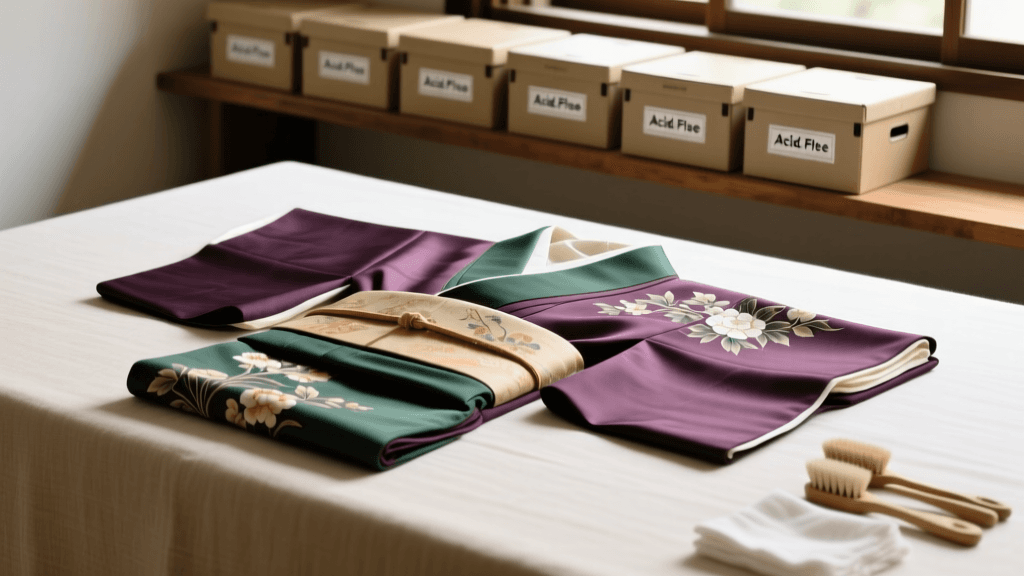
The traditional Japanese method of folding a kimono, known as tatoushi, is specifically designed to align the seams and distribute the stress of folding evenly across the garment. However, simply folding the garment is no longer sufficient for long-term archival storage. In 2026, the gold standard for home and museum preservation involves interleaving the folds with unbuffered, acid-free tissue paper.
Why unbuffered? While buffered tissue (which contains an alkaline reserve like calcium carbonate) is excellent for cotton and linen, it can react negatively with the protein structure of silk and the metallic elements in vintage zari (gold and silver thread embroidery). According to guidelines maintained by the American Institute for Conservation, unbuffered, pH-neutral tissue is the only safe choice for silk and mixed-media textiles. When executing the tatoushi fold, collectors should gently roll small 'sausages' of acid-free tissue and place them inside every fold line. This prevents hard creases from forming, which over time can cause the silk fibers to snap and shatter.
Climate Control: Smart Monitoring for Delicate Textiles
The environment in which a kimono is stored is just as critical as the physical materials touching it. Silk requires a stable environment to prevent the growth of mold (which thrives in high humidity) and the desiccation of fibers (which occurs in overly dry conditions). In 2026, the integration of smart home technology has revolutionized how we monitor textile storage environments.
Modern collectors utilize advanced, Wi-Fi-enabled environmental sensors that track temperature and relative humidity (RH) in real-time, sending push notifications to your smartphone if the climate drifts outside the safe zone. The ideal parameters for vintage silk in 2026 remain a temperature between 65°F and 68°F (18°C - 20°C) and a relative humidity strictly maintained between 50% and 55%. Fluctuations are more damaging than the absolute numbers; a sudden spike in humidity can cause natural dyes to bleed, while a rapid drop can make the silk brittle. Placing a 2026-model smart hygrometer inside your storage chest or archival box ensures you are never caught off guard by seasonal climate shifts.
Storage Solutions: Comparing 2026 Archival Materials
Choosing the right vessel for your folded kimono is a decision that impacts its lifespan by decades. Below is a comparison of the most common storage methods evaluated under current 2026 conservation standards.
| Storage Method | Pros | Cons | 2026 Verdict |
|---|---|---|---|
| Paulownia Wood (Tansu) | Breathable, traditional, naturally buffers humidity, repels some insects | Expensive, heavy, requires significant space, wood must be properly cured | Best for high-value heirlooms and dedicated collectors |
| Archival Corrugated Boxes | Cost-effective, pH neutral, lightweight, easily stackable | Less aesthetically pleasing, offers no active humidity buffering | Best for most modern collectors and off-site storage |
| Vacuum Sealing Bags | Extreme space-saving, blocks oxygen and pests | Crushes silk fibers, traps residual moisture, causes permanent creasing | Never Use on Silk or Vintage Textiles |
| Cotton Storage Bags | Breathable, washable, traditional aesthetic | Does not block dust or light, offers no structural support for folds | Good for short-term transport, poor for long-term archival |
For those opting for archival boxes, ensure you purchase boxes made from blue/grey corrugated board that meets the ISO 9706 standard for permanence. The Victoria and Albert Museum strongly recommends against storing textiles in standard cardboard or plastic bins, as standard cardboard off-gasses acidic compounds that will yellow and weaken silk, while plastic bins trap moisture and off-gas plasticizers that degrade metallic threads.
The 2026 Cleaning Renaissance: Liquid CO2 and Arai-Hari
Cleaning vintage silk is fraught with peril. Traditional dry cleaning using perchloroethylene (perc) has been widely phased out in high-end textile conservation due to its harshness on fragile fibers and its environmental toxicity. In 2026, the industry standard for cleaning delicate Asian garments has shifted toward Liquid Carbon Dioxide (CO2) cleaning and advanced silicone-based solvent systems. These methods operate at lower temperatures and gentler mechanical actions, safely lifting oils and particulate matter without stripping the silk of its natural sericin or causing dyes to run.
For the most precious, heavily soiled, or structurally compromised vintage kimonos, 2026 has seen a massive revival of arai-hari. This centuries-old Japanese technique involves meticulously unsewing the kimono into its original flat rectangular panels. The panels are then gently washed, stretched on wooden boards using small pins (shinshi), and allowed to dry. This process removes all creases, restores the fabric's natural luster, and allows for precise spot-treatment of stains. Once dry, the panels are re-sewn by a master artisan. Today, artisan collectives in Kyoto are utilizing digital ledgers to authenticate the arai-hari process, providing collectors with a verifiable history of the garment's restoration.
Non-Toxic Pest Deterrence for Protein Fibers
Silk, like wool, is a protein fiber and is highly susceptible to damage from clothes moths and carpet beetles. Historically, collectors relied on chemical mothballs containing naphthalene or paradichlorobenzene. In 2026, these chemicals are strictly forbidden in museum conservation. Not only are they toxic to humans, but their off-gassing can actually melt synthetic threads used in modern restorations and cause irreversible chemical burns to vintage silk and metallic zari.
Modern pest management relies on prevention and non-toxic deterrents. The Metropolitan Museum of Art Textile Conservation department advocates for rigorous environmental controls and the use of pheromone traps to monitor insect activity. For active deterrence inside the storage chest, collectors use untreated hinoki (Japanese cypress) wood blocks or aged cedar. These woods must be sanded lightly every six months to release their natural, pest-repelling oils. Crucially, the wood should never touch the silk directly; always wrap the wood blocks in acid-free tissue or washed, unbleached muslin to prevent oil transfer to the garment.
Handling and Display Best Practices
When it is time to admire or display your vintage kimono, proper handling is paramount. Always wash and thoroughly dry your hands before handling silk, or better yet, wear clean, lint-free cotton or nitrile gloves. The natural oils, salts, and acids present on human skin will transfer to the silk, causing brown oxidation spots that may not appear for years but are nearly impossible to remove once they do.
If you choose to display the garment, avoid hanging it on standard wire or wooden hangers, as the weight of the vintage silk will stress the shoulder seams, leading to tearing. Instead, use a padded, archival hanger wrapped in washed cotton muslin, and limit the display time to a maximum of three to six months. Keep the display away from direct sunlight and even indirect UV exposure, as ultraviolet light causes the most rapid and irreversible fading of natural dyes. In 2026, utilizing UV-filtering window films and LED lighting with zero UV emission is the standard for any room housing a textile collection.
Conclusion
Preserving a vintage silk kimono is an act of cultural stewardship. By adopting the 2026 standards for tatoushi folding, utilizing smart climate monitoring, choosing pH-neutral archival storage, and embracing eco-friendly cleaning methods like arai-hari, you ensure that these magnificent garments survive for future generations. The intersection of traditional Japanese craftsmanship and modern conservation science offers the best possible defense against the ravages of time, allowing the vibrant history woven into every silk thread to endure.